Fashion Photoshoot Cost: 2026 Prices and AI Options
A fashion photoshoot costs between $1,500 and $25,000+ per day depending on the scale of production. Budget-friendly shoots with minimal crew start at $1,500–$4,000. Mid-range productions with professional models, stylists, and studio rental typically run $5,000–$15,000. High-end editorial or campaign shoots for major brands regularly exceed $25,000–$50,000 per day. On a per-image basis, traditional fashion photography costs $150–$1,500 per final retouched photo, while AI photoshoot alternatives now produce comparable results for $0.50–$3.00 per image.
Create studio-quality product photos with AI for about $1 per image →
This guide breaks down the budget by crew, production scale and finished images. The market ranges and savings below are practical planning estimates in USD; location, usage rights, scope and the number of accepted images change the final quote.
Table of Contents
- The Complete Fashion Photoshoot Cost Breakdown
- Cost by Brand Size and Budget Tier
- Hidden Costs Most Brands Forget
- Per-Image Cost Analysis
- AI Photoshoot Alternatives: Cost Comparison
- AI vs Traditional: Cost Per Image
- How to Reduce Photoshoot Costs (7 Strategies)
- Cost per usable image
- Frequently Asked Questions
The Complete Fashion Photoshoot Cost Breakdown
Every fashion photoshoot consists of the same core cost categories, regardless of budget. Here is what each line item typically costs in 2026:
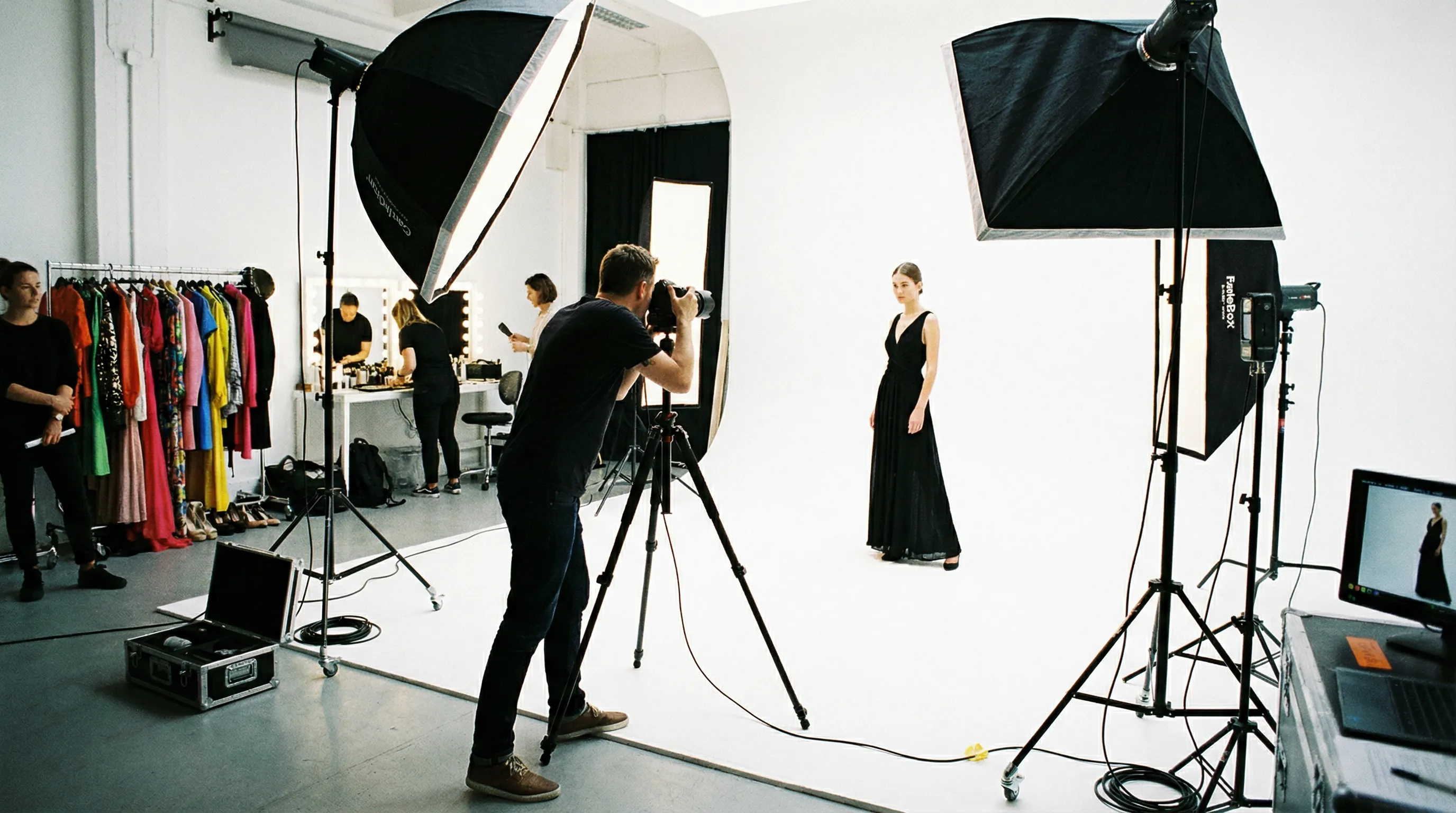 Behind the scenes of a professional fashion photoshoot with photographer, model, studio lights, and styling rack
| Cost Category | Budget Range | Notes |
|---|---|---|
| Photographer | $500–$5,000+/day | Includes equipment; assistants extra ($200–$500/day) |
| Models | $500–$3,000+/day | Agency models: $1,500–$3,000+. Freelance: $500–$1,200. Per model. |
| Studio rental | $300–$2,000/day | Basic white cyclorama: $300–$800. Specialty spaces: $1,000–$2,000+ |
| Stylist | $500–$2,000/day | Includes prep time; wardrobe rental extra |
| Hair & Makeup (HMUA) | $400–$1,500/day | Per artist. Complex looks or multiple models increase cost |
| Photo retouching | $25–$150/image | Basic retouching: $25–$50. High-end: $75–$150. Batch rates available |
| Props and set design | $200–$2,000+ | Location permits: $500–$3,000 additional |
| Catering | $150–$500/day | Required for full-day shoots with 5+ crew |
| Insurance | $200–$500/day | Liability coverage for studio or location shoots |
Typical total for a standard shoot day: $3,500–$15,000+
Product images do a lot of the selling: they show fit, material, detail and the overall brand experience. A consistent catalog helps buyers understand the product and makes each new launch easier to produce.
Cost by Brand Size and Budget Tier
What you spend depends on where you are as a brand. Here are realistic benchmarks:
Tier 1: Startup / Indie Brand ($1,500–$4,000/day)
- Freelance photographer ($500–$1,500)
- 1 freelance model ($500–$1,000)
- Natural light or rented studio ($300–$500)
- Basic styling (designer does it)
- Minimal retouching ($25/image × 20 images = $500)
- Output: 15–25 final images
- Per-image cost: $60–$270
Tier 2: Growing D2C Brand ($5,000–$15,000/day)
- Professional photographer ($2,000–$4,000)
- 1–2 agency models ($1,500–$3,000 each)
- Professional studio ($500–$1,500)
- Stylist ($750–$1,500)
- HMUA ($500–$1,000)
- Professional retouching ($50/image × 30 images = $1,500)
- Output: 25–40 final images
- Per-image cost: $125–$600
Tier 3: Established Brand / Editorial ($15,000–$50,000+/day)
- Top-tier photographer ($5,000–$15,000)
- Multiple agency models ($2,000–$5,000 each)
- Premium location or elaborate set ($2,000–$5,000)
- Creative director + stylist team ($3,000–$5,000)
- Full HMUA team ($2,000–$3,000)
- High-end retouching ($100–$150/image × 40 images = $4,000–$6,000)
- Output: 30–50 final images
- Per-image cost: $300–$1,500+
As a planning exercise, allocating 5–8% of a $500,000 revenue target to visual content gives $25,000–$40,000 annually. That is a budget scenario, not an industry average or a recommendation to spend the full amount on photography alone.
Hidden Costs Most Brands Forget
The line items above tell only part of the story. These hidden costs regularly add 30–50% to the total:
1. Pre-production planning (10–20 hours) Shot lists, model casting, location scouting, wardrobe pulling, and logistics coordination. At $50/hour for your time, that's $500–$1,000 in labor before the camera even clicks.
2. Sample shipping ($50–$300 per shoot) If your samples are manufactured overseas, international shipping and customs can add $100–$300 per shoot, plus 1–2 weeks of lead time.
3. Post-production management (5–10 hours) Reviewing proofs, providing retouching notes, quality-checking finals, organizing and renaming files for your e-commerce platform. This unseen labor adds $250–$500 per shoot.
4. Reshoots ($2,000–$10,000) Industry estimates suggest 15–20% of product photo shoots require partial reshoots due to fit issues, color accuracy problems, or creative direction changes. Budget an additional 15–20% contingency.
5. Opportunity cost Every week spent planning, shooting, and post-producing is a week your products aren't listed for sale. For a brand averaging $2,000/week in revenue per product, a 3-week photography delay costs $6,000 in lost sales per product line.
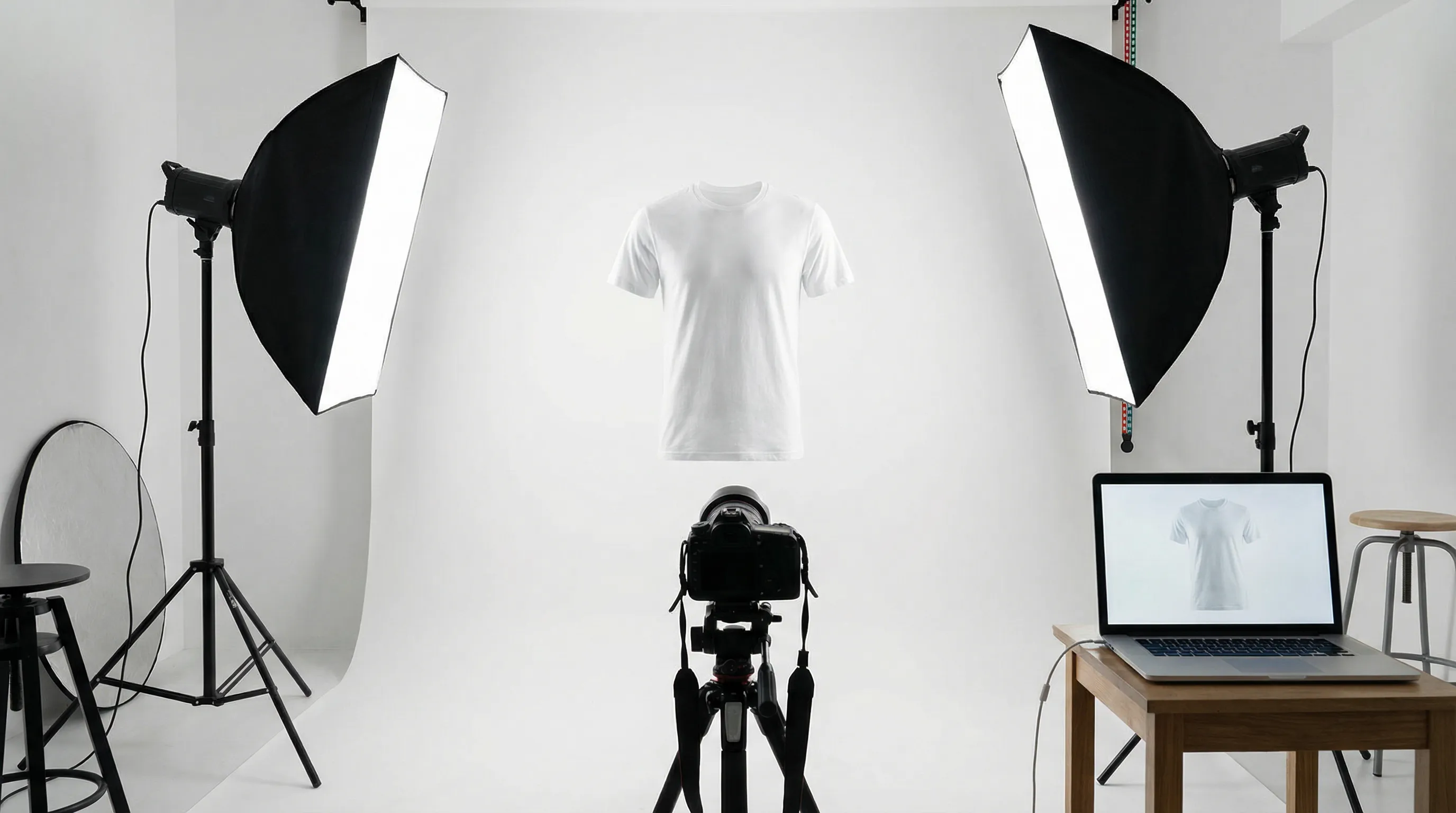 E-commerce product photography setup with garment on mannequin, studio lights, and camera equipment
Per-Image Cost Analysis
The most useful way to compare photography options is cost per final, retouched, e-commerce-ready image:
| Method | Cost Per Image | Turnaround | Quality Level |
|---|---|---|---|
| DIY (smartphone + lightbox) | $5–$20 | Same day | Basic — acceptable for marketplace listings |
| Freelance photographer | $60–$300 | 1–2 weeks | Good — suitable for D2C websites |
| Professional studio shoot | $150–$600 | 2–4 weeks | Excellent — suitable for all channels |
| High-end editorial | $300–$1,500+ | 3–6 weeks | Premium — campaign and print quality |
| AI photoshoot tools | $0.50–$3.00 | Minutes | Good to excellent — suitable for D2C and social |
The cost advantage is strongest when you need many consistent catalog variations. Adstronaut gives fashion brands model, background and pose choices without coordinating a full shoot for each image. Keep the source product clear and inspect the chosen results so lower production cost translates into usable assets.
Generate your first AI photoshoot images free →
AI Photoshoot Alternatives: Cost Comparison {#ai-photoshoot-alternatives}
These are indicative budget allocations for different workflows, not vendor checkout quotes. Verify current plans and compare the cost of images you actually keep:
| Tool | Cost Per Image | Input Required | Key Strength |
|---|---|---|---|
| Adstronaut AI | ~$1 | Flat-lay, mannequin, or on-model photo | Fashion-specific; model + background selection; editorial quality |
| Photoroom | $0.50–$2.00 | Product photo | Background removal and replacement; batch processing |
| Blend AI | $1–$3 | Product photo | Lifestyle scene generation; multi-product compositions |
| VModel | $1–$2 | Garment photo | Virtual try-on with AI models |
| Traditional reshoot | $150–$600 | Physical sample + crew | Full creative control; highest quality ceiling |
When AI photoshoots make sense:
- E-commerce product listings (hero images, gallery shots)
- Social media content at scale
- A/B testing different models, backgrounds, and styling
- Pre-launch marketing before physical samples arrive
- Seasonal catalog refreshes across large SKU counts
When traditional photography still wins:
- Flagship brand campaigns requiring specific artistic direction
- Print magazine editorials (ultra-high resolution requirements)
- Complex multi-model group shots with specific poses
- Lifestyle content requiring real environments and spontaneous moments
AI vs Traditional: Cost Per Image {#ai-vs-traditional-cost-per-image}
The clearest way to weigh AI against traditional photography is the fully-loaded cost of one final, retouched, e-commerce-ready image. Traditional methods carry fixed crew and studio costs that AI removes entirely. All figures below are USD, the standard reference for US, UK, and AU brands sourcing globally.
| Image type | Cost per final image (USD) | Turnaround | Best for |
|---|---|---|---|
| Studio editorial (on-model, full crew) | $300–$1,500 | 3–6 weeks | Campaigns, hero shots, print |
| Ghost-mannequin (invisible form + edit) | $75–$150 | 1–2 weeks | Clean catalog product pages |
| Flat-lay (styled tabletop) | $20–$75 | 3–7 days | Marketplace and social listings |
| AI per-image (Adstronaut on-model) | $0.50–$3.00 | Minutes | Catalog, colorways, A/B testing at scale |
A practical Adstronaut example: Pro costs $69/month and includes 375 credits, enough for up to 75 photoshoot images if all credits go to that tool. If you keep 40 catalog images from the month, allocating the full subscription to that batch gives about $1.73 per accepted image. The remaining credits can produce more work. This is a clearer budget than assuming a 40-image batch can always be purchased for $40.
On-model AI generation lets you create fashion imagery from a product reference without arranging a separate model booking for each variation. That makes broader colorway, background and campaign coverage affordable. Judge garment fidelity in the selected outputs; visualizing a garment on a model is not a physical fit measurement.
Count the images you can actually use
A generation is not automatically a finished catalog image. Check the garment silhouette, closures, logos/artwork, visible fabric detail and color before approving a result.
| Budget input | Example |
|---|---|
| Monthly Pro subscription allocated to the batch | $69 |
| Included credits | 375 |
| Credits per photoshoot image | 5 |
| Maximum images if all credits are used here | 75 |
| Accepted images in this illustrative batch | 40 |
| Allocated cost per accepted image | $1.73 |
Use your actual acceptance count and include any separate editing work. This keeps the AI value proposition strong while giving you a number you can budget against. See current plans for allowances, billing options and output limits.
Create your first photoshoot preview →
How to Reduce Photoshoot Costs (7 Strategies) {#how-to-reduce-photoshoot-costs}
Whether you use traditional photography, AI tools, or a hybrid approach, these strategies can significantly reduce your visual content budget:
1. Batch your shoots. Photograph 20–30 styles in one day instead of 5–10 across multiple days. Fixed costs (studio, HMUA, stylist) are amortized across more images, reducing per-image cost by 40–60%.
2. Use a hybrid AI + traditional approach. Shoot your hero campaign images traditionally (5–10 key looks) and use AI tools (Adstronaut, Photoroom, Blend AI, etc.) for the remaining catalog imagery (50–100+ SKU images). This captures the best of both worlds at 70–80% lower total cost. The same photo you shoot can also feed an AI tech pack generator to produce factory specs, so one image does double duty.
3. Negotiate half-day rates. Many photographers and studios offer half-day rates (4 hours) at 60–70% of the full-day price. If you can work efficiently, a half-day can yield 15–20 final images.
4. Build a model roster. Working with the same 2–3 freelance models repeatedly eliminates casting costs and reduces direction time. Many freelance models offer reduced rates for repeat bookings.
5. Invest in a permanent photo setup. A basic in-house photo setup (continuous lighting kit, white backdrop, camera) costs $1,500–$3,000 upfront but pays for itself after 2–3 shoots compared to studio rental fees.
6. Use ghost mannequin photography. Photograph garments on invisible mannequin forms, then remove the mannequin in post-production. This eliminates model costs entirely and works well for product pages. Cost: $10–$30 per image with outsourced editing.
7. Time your shoots strategically. Studios and photographers offer lower rates during off-peak seasons (January–February, July–August). Booking midweek instead of weekends can save 10–20%.
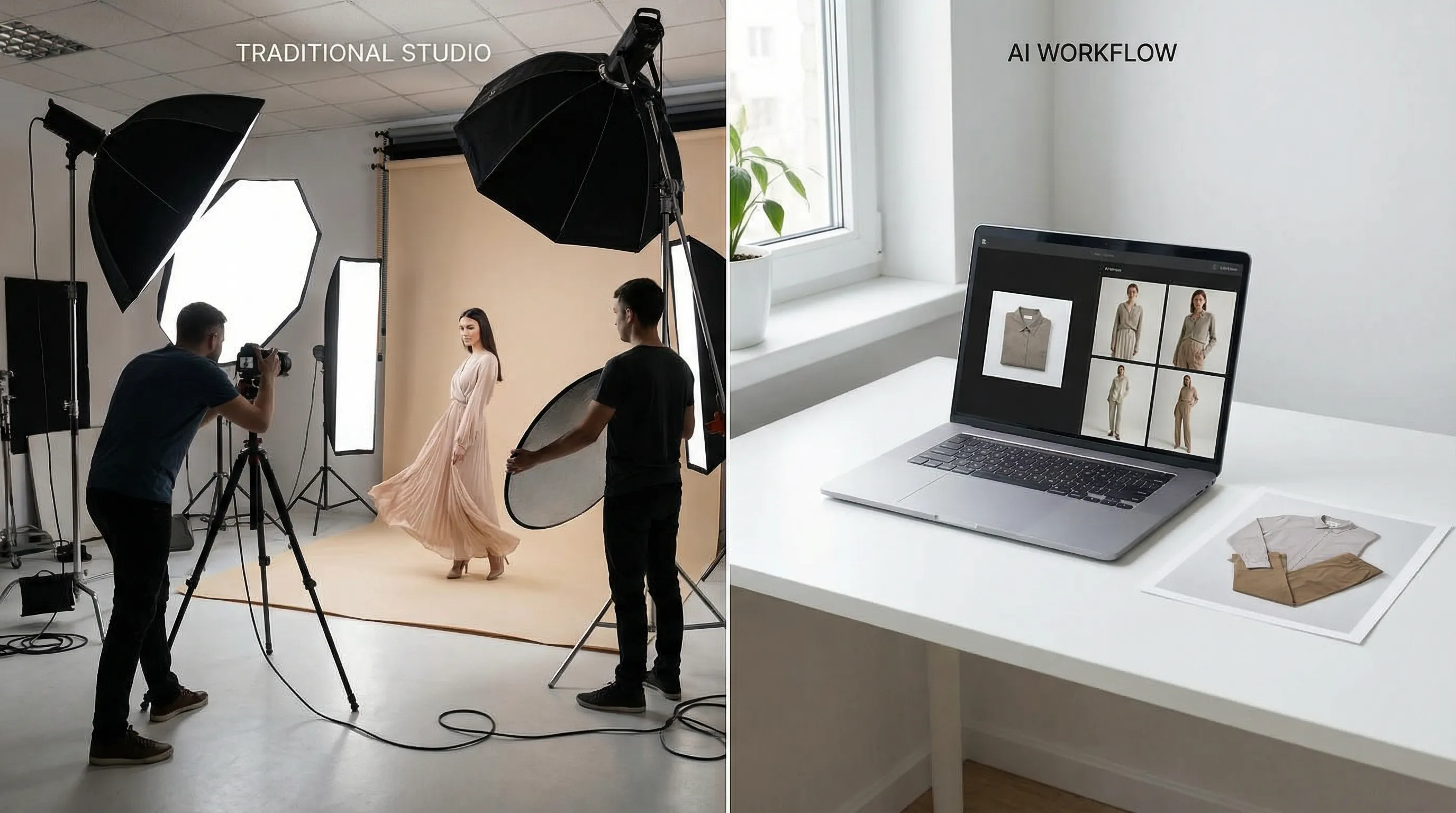 Split comparison showing a traditional fashion photography studio on the left and AI-generated product photos on a laptop screen on the right
Try AI photoshoots free — studio-quality images in minutes →
Frequently Asked Questions
How much should a small clothing brand budget for photography?
A small clothing brand launching 20–30 styles per season should budget $3,000–$8,000 for traditional photography, or $200–$500 if using AI tools for the majority of images. A hybrid approach (traditional hero shots + AI catalog images) typically costs $1,500–$3,000 per season. Most fashion advisors recommend allocating 5–8% of projected revenue to visual content.
How many images do I need per product for e-commerce?
The minimum for effective e-commerce listings is 4–5 images per product: one hero/front view, one back view, one detail/close-up, one lifestyle/on-model shot, and one size reference. The right mix helps a shopper answer different questions about the product; simply adding more near-identical images is less useful. For high-ticket items ($100+), 6–8 images is recommended.
Can I use smartphone photos for my fashion brand?
For marketplace listings (Etsy, Depop, Poshmark), smartphone photos with good lighting can work. For a branded D2C website, professional or AI-generated imagery is strongly recommended — consumer surveys consistently show that image quality is the #1 factor in perceived brand quality. Good presentation can make an affordable garment feel more desirable than a poorly presented premium one.
How often should I update my product photography?
At minimum, update photography seasonally (2–4 times per year) to keep content fresh. Refresh when the collection, campaign or creative performance calls for it; frequent variations make testing easier. AI tools make frequent refreshes financially viable — you can regenerate seasonal backgrounds or model diversity without reshooting.
Are AI-generated product photos good enough for Amazon and Shopify?
Yes, AI imagery can work well for commerce when it represents the actual product accurately and meets the destination’s current image rules. Check detail fidelity, resolution, background and any disclosure requirements for the specific listing rather than assuming one export fits every platform.
What is the cost per image for fashion photography in different cities?
Photography costs vary significantly by market. New York and Los Angeles are the most expensive (photographer day rates: $3,000–$8,000+). London and Paris: $2,500–$6,000. Miami and Dallas: $1,500–$4,000. Smaller markets: $800–$2,500. Remote shoots with shipped samples can access lower-cost markets regardless of your brand's location.
Sources and further reading:
- Adstronaut plans — credit allowances and subscription arithmetic used in the worked example.
- Shopify: ecommerce photography — practical production and image-mix guidance.
- AI photoshoots — current product workflow.
- Product photography cost per image — related budgeting guide.
Market budgets and savings in this article are planning estimates. The worked subscription example is arithmetic based on the stated allocation and accepted-image count.