How Much It Costs to Start a Clothing Brand: Real 2026 Numbers + Free Calculator
Starting a clothing brand costs $2,000–$50,000+ depending on your business model, production method, and initial collection size. A lean print-on-demand or blank-based brand can launch for $2,000–$5,000. A direct-to-consumer brand with custom Cut & Sew manufacturing typically requires $10,000–$30,000. A wholesale-focused brand targeting retail distribution needs $25,000–$50,000+ due to higher minimum order quantities, showroom costs, and extended cash flow cycles. These figures cover product development through first sales — ongoing operating costs are additional.
Cut your pre-production budget by 85% — view Adstronaut plans →
This guide breaks down every cost category with real numbers so you can build a realistic budget for your clothing brand launch. Prefer to model your own numbers? Use the free clothing line startup cost calculator to build a line-item budget in minutes. For the whole process, from the first product to the first order, follow how to start a clothing brand in 10 steps.
Table of Contents
- Total Startup Cost Summary by Business Model
- Product Development Costs
- Manufacturing and Production Costs
- MOQ Economics: Print-on-Demand vs Manufactured
- Branding and Design Costs
- E-Commerce and Technology Costs
- Marketing and Launch Costs
- Legal and Business Formation Costs
- Operating Costs: First 6 Months
- How AI Tools Are Reducing Startup Costs
- 3 Budget Scenarios: Lean, Mid-Range, and Premium
- Frequently Asked Questions
Total Startup Cost Summary by Business Model {#total-startup-cost-summary}
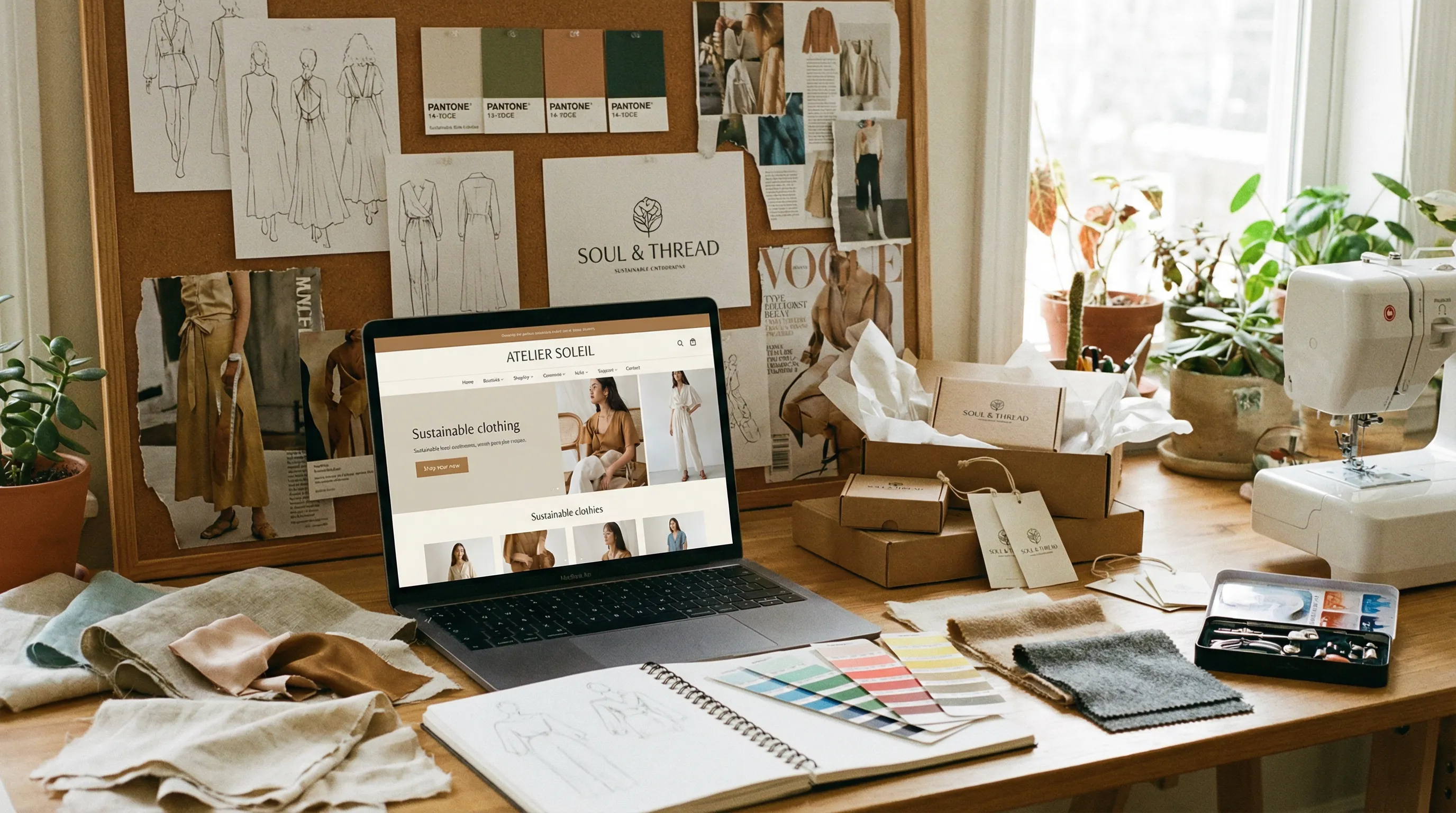 Fashion entrepreneur workspace with laptop showing online store, fabric samples, mood board with sketches, and brand packaging
| Business Model | Startup Cost Range | Time to Launch | Risk Level |
|---|---|---|---|
| Print-on-demand (Printful, Printify) | $500–$3,000 | 2–4 weeks | Low (no inventory) |
| Blank + print (Gildan, Bella+Canvas) | $2,000–$8,000 | 4–8 weeks | Low–Medium |
| Cut & Sew (custom manufacturing) | $10,000–$30,000 | 3–6 months | Medium–High |
| Wholesale-focused | $25,000–$50,000+ | 4–8 months | High |
| Luxury / designer | $50,000–$150,000+ | 6–12 months | Very High |
According to the U.S. Small Business Administration, approximately 20% of small businesses fail within the first year. In fashion specifically, undercapitalization — launching without sufficient budget for inventory, marketing, and operating expenses — is cited as the #1 reason for early failure by the Fashion Institute of Technology's industry research.
Product Development Costs
Product development is where your concept becomes a physical garment. This is where most first-time founders underestimate costs.
| Item | Cost Range | Notes |
|---|---|---|
| Design (sketching concepts) | $0–$2,000 | Free if you design yourself; freelance fashion designers charge $50–$100/hr |
| Tech packs (per style) | $100–$2,000 | Freelancer: $150–$800/style. AI tools: $3–$25/style. Full tech pack cost breakdown |
| Pattern making (per style) | $200–$800 | Often included by manufacturer; standalone: $300–$600 |
| Fabric sourcing (swatches and samples) | $200–$1,000 | S/H fees add up; platforms like Swatchon and Mood Fabrics charge per yard |
| First samples (per style) | $100–$500 | Most factories charge $100–$300 per sample |
| Sample revisions (1–3 rounds) | $200–$1,500 | Budget for 2–3 rounds minimum |
| Total per 8-style collection | $2,400–$15,600 |
Industry tip: The number one way to reduce product development costs is to minimize sample revision rounds. According to Common Objective, brands with complete, accurate tech packs average 1.5 sample rounds versus 3.5 rounds for brands with incomplete documentation — a difference of $1,000–$4,000+ per style. An AI tech pack maker like Adstronaut can help ensure completeness for $3–$5 per style, and every garment has a free tech pack template to start from.
Manufacturing and Production Costs
Production costs depend on your method, location, minimum order quantities (MOQs), and garment complexity.
By Production Method
| Method | Cost Per Unit | MOQ | Best For |
|---|---|---|---|
| Print-on-demand | $15–$35 (t-shirts) | 1 | Testing designs; zero inventory risk |
| Blank + screen print | $8–$20 (t-shirts) | 24–50 per design | Small batches; quick turnaround |
| Domestic Cut & Sew (U.S.) | $25–$100+ | 50–200 | Premium positioning; faster shipping |
| Overseas Cut & Sew (Asia) | $8–$40+ | 200–500+ | Scale; lower unit costs |
First Production Run Budget
For a typical 8-style collection with domestic Cut & Sew manufacturing:
| Item | Calculation | Cost |
|---|---|---|
| Fabric (average $10/yard × 2 yards × 100 units × 8 styles) | 1,600 yards | $16,000 |
| Manufacturing labor (average $15/unit × 100 units × 8 styles) | 800 units | $12,000 |
| Trims and hardware | Buttons, zippers, labels | $1,500–$3,000 |
| Shipping (domestic) | Factory to warehouse | $500–$1,500 |
| Total first production run | $30,000–$32,500 |
To reduce this dramatically, many indie brands start with 3–5 styles instead of 8, with MOQs of 50 instead of 100, bringing the first production run closer to $8,000–$15,000.
MOQ Economics: Print-on-Demand vs Manufactured {#moq-economics}
The single biggest lever on your startup budget is minimum order quantity (MOQ). Lower per-unit costs from a factory only materialize if you can afford — and sell through — the volume the MOQ forces you to buy. The tradeoff is always the same: cheaper units mean more capital locked up before your first sale. All figures below are USD.
| Model | Per-unit cost (USD) | Typical MOQ | Upfront capital at risk |
|---|---|---|---|
| Print-on-demand | $15–$35 (t-shirt) | 1 | ~$0 — units print only after a sale |
| Small-batch (blank + print / low-MOQ Cut & Sew) | $8–$25 | 24–100 per style | $2,000–$8,000 |
| Full production (overseas Cut & Sew) | $6–$20 | 200–500+ per style | $12,000–$40,000+ |
A print-on-demand hoodie might cost $30 a unit (≈ £24 / €28 / A$46) with zero inventory risk; the same hoodie from an overseas factory drops to $12 a unit but demands a $6,000+ commitment for a single 500-piece style. Full production wins on margin only once you reliably sell through — most first-time founders should validate demand at POD or small-batch first, then scale to manufactured runs.
The hidden costs that erode the "cheaper unit" math: sampling rounds ($100–$500 per style, often 2–3 rounds), inbound freight, import duties (12–32% for US apparel depending on fiber and origin), and returns (24.4% for online apparel, per the National Retail Federation). Factor all four before assuming a low per-unit quote is actually the cheaper path.
Branding and Design Costs
Your brand identity is a one-time investment that pays dividends across every customer touchpoint.
| Item | Cost Range | Notes |
|---|---|---|
| Logo design | $200–$2,000 | Fiverr: $50–$300. Professional studio: $500–$2,000 |
| Brand guidelines (colors, typography, voice) | $500–$3,000 | Often bundled with logo |
| Hang tags and labels (design + production) | $200–$800 | Woven labels: $0.10–$0.50 each at MOQ 1,000 |
| Packaging (poly mailers, tissue, stickers) | $300–$1,000 | Noissue, Packlane, or local print shops |
| Total branding | $1,200–$6,800 |
E-Commerce and Technology Costs
Your online store is your most important sales channel. Here is what the tech stack costs:
| Item | Cost | Billing |
|---|---|---|
| Shopify Basic plan | $39/month | Monthly |
| Domain name | $12–$20/year | Annual |
| Theme (premium) | $0–$350 | One-time |
| Product photography | $500–$5,000 | Per shoot. AI alternatives: $50–$200 per collection. Full cost comparison |
| Email marketing (Klaviyo free tier) | $0–$45/month | Monthly |
| First-year total | $800–$6,500 |
Shopify dominates the independent fashion brand market with approximately 30% market share among D2C fashion brands, according to Shopify's own reporting. Alternatives include WooCommerce (free + hosting at $10–$30/month), Squarespace ($27–$49/month), and BigCommerce ($39–$399/month).
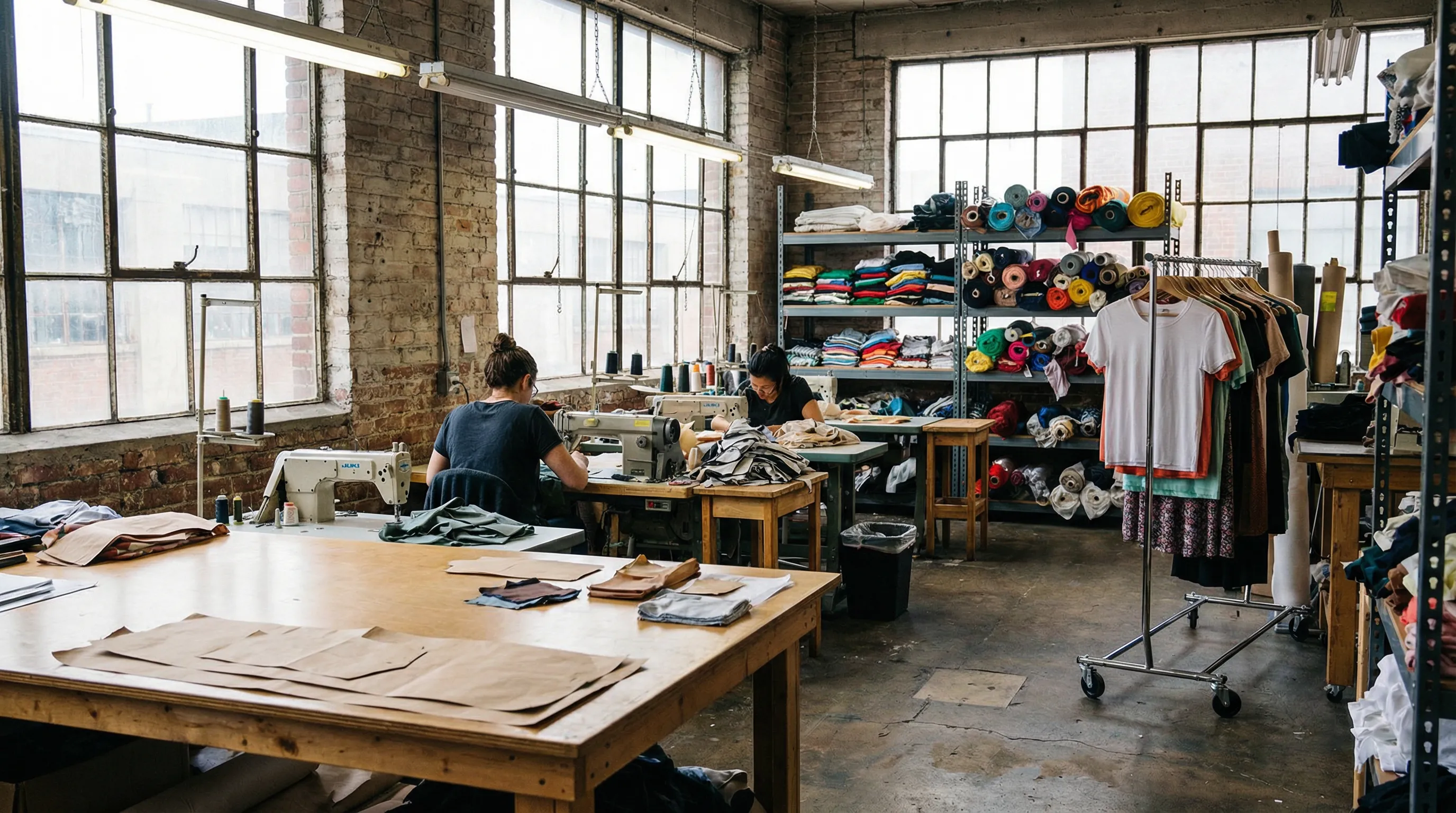 Small batch clothing manufacturing workshop with sewing machines, fabric rolls, and finished garments on a rack
Marketing and Launch Costs
Marketing is where first-time founders consistently underbudget. The general rule: plan to spend at least as much on marketing as you did on product development in your first year.
| Channel | Monthly Budget | Expected Role |
|---|---|---|
| Social media ads (Meta/TikTok) | $500–$3,000/month | Primary customer acquisition |
| Influencer seeding (gifting product) | $500–$2,000 (COGS) | Brand awareness; social proof |
| Email marketing | $0–$100/month | Retention; highest ROI channel long-term |
| Content creation (photos, video) | $200–$1,000/month | Feed organic growth |
| PR / press outreach | $0–$2,000 | Optional; higher impact for premium brands |
| First 3 months | $2,000–$15,000 |
According to a study by Shopify analyzing 100,000+ online stores, the average customer acquisition cost (CAC) for fashion e-commerce brands is $25–$50 per customer. To acquire your first 100 customers, budget $2,500–$5,000 in marketing spend — on top of organic and word-of-mouth efforts.
Legal and Business Formation Costs
| Item | Cost | Notes |
|---|---|---|
| LLC formation | $50–$500 | Varies by state; $50 in most states, $500+ in CA |
| EIN (Tax ID) | Free | IRS.gov |
| Trademark (federal) | $250–$350 per class | USPTO filing; recommended but not required at launch |
| Business insurance | $500–$1,500/year | General liability; product liability recommended |
| Accounting setup | $300–$1,000 | Bookkeeper or accountant for tax setup |
| Total | $1,100–$3,350 |
Operating Costs: First 6 Months
After launch, monthly operating costs for a lean online fashion brand typically include:
| Item | Monthly Cost |
|---|---|
| Shopify + apps | $50–$150 |
| Shipping supplies | $100–$300 |
| Marketing/ads | $500–$3,000 |
| Shipping (orders) | Variable (COGS) |
| Accounting | $100–$300 |
| Inventory restocking | Variable |
| Monthly operating | $850–$3,750 |
| 6-month operating | $5,100–$22,500 |
How AI Tools Are Reducing Startup Costs
The emergence of AI fashion tools has dramatically reduced several major startup cost categories since 2024:
| Cost Category | Traditional Cost | With AI Tools | Savings |
|---|---|---|---|
| Tech packs (8 styles) | $1,200–$6,400 | $24–$200 | 85–99% |
| Product photography (8 styles) | $3,000–$10,000 | $50–$200 | 95–98% |
| E-commerce copy/tagging | $500–$2,000 | $10–$50 | 95–98% |
| Design exploration/variations | $1,000–$5,000 | $50–$200 | 90–96% |
| Total savings | $5,600–$23,000 |
Platforms like Adstronaut AI bundle tech pack generation, AI photoshoots, product tagging, and design variation tools into a single platform. This consolidation alone can reduce a first collection's pre-production budget by $5,000–$15,000 compared to traditional methods.
See how much you can save — view plans and pricing →
3 Budget Scenarios: Lean, Mid-Range, and Premium {#three-budget-scenarios}
Scenario 1: Lean Launch ($3,000–$7,000)
- Print-on-demand or blank + print model
- 3–5 initial styles
- AI-generated product photography and tech packs
- DIY branding (Canva, free Shopify theme)
- Organic-only marketing (Instagram, TikTok)
- Timeline: 4–6 weeks to first sale
Scenario 2: Mid-Range Launch ($12,000–$25,000)
- Cut & Sew manufacturing (domestic, low MOQ)
- 5–8 initial styles
- Mix of AI and professional photography
- Professional branding package
- $500–$1,000/month ad budget
- Timeline: 3–4 months to first sale
Scenario 3: Premium Launch ($30,000–$50,000+)
- Cut & Sew manufacturing (quality-focused factory)
- 8–12 initial styles
- Professional photoshoot + AI supplemental imagery
- Full brand identity package
- $2,000–$3,000/month marketing budget
- PR/influencer launch strategy
- Timeline: 4–6 months to first sale
Cut your pre-production budget by 85% or more →
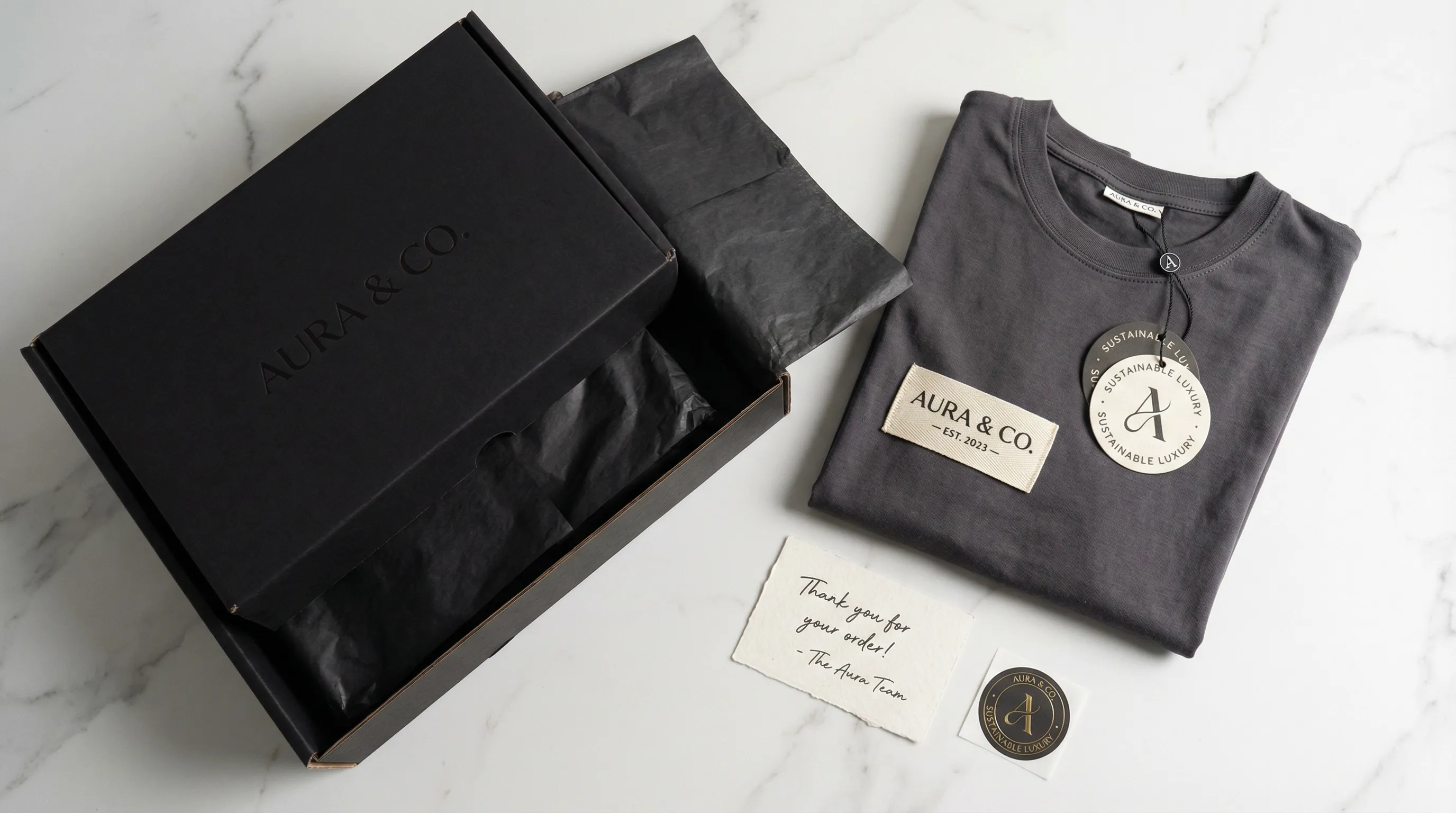 Fashion brand packaging and shipping flat lay with branded boxes, tissue paper, tags, and thank you cards on marble background
Embed the Free Pricing Calculator on Your Site {#embed-the-free-pricing-calculator}
Budgeting is half the math — the other half is what you charge. Once you have a cost per unit from the scenarios above, the free clothing pricing calculator turns it into wholesale and retail prices with margin checks, no signup needed. It pairs with the startup cost calculator you used for the budget.
If you run a blog or resource page for founders, you can embed the live calculator directly. Paste this snippet and keep the credit line underneath:
<!-- Free clothing pricing calculator by Adstronaut -->
<div style="max-width:720px;margin:1rem 0">
  <iframe src="https://www.adstronaut.net/embed/clothing-pricing-calculator"
    title="Clothing pricing calculator" width="100%" height="560" loading="lazy"
    style="border:1px solid #e5e7eb;border-radius:12px"></iframe>
  <p style="font-size:12px;color:#6b7280;margin:6px 0 0">
    Powered by <a href="https://www.adstronaut.net/free-tools/clothing-pricing-calculator?utm_source=embed&utm_medium=referral&utm_campaign=pricing-calculator" target="_blank" style="color:#111827">Adstronaut — free clothing pricing calculator</a>
  </p>
</div>
If your platform strips iframes (most email newsletters do), use a plain link instead:
<p>Try the free <a href="https://www.adstronaut.net/free-tools/clothing-pricing-calculator?utm_source=embed&utm_medium=referral&utm_campaign=pricing-calculator">clothing pricing calculator by Adstronaut</a> — no signup, no email.</p>
Frequently Asked Questions
Can I start a clothing brand with $1,000?
Yes, but only with a print-on-demand model (Printful, Printify, Gooten) where you carry zero inventory. Your $1,000 covers domain ($15), Shopify ($39/month), logo design ($50–$200), and initial ad spend ($500–$700). Profit margins are lower (15–30% vs 50–70% for Cut & Sew), but financial risk is near zero. Many successful brands started with print-on-demand and upgraded to custom manufacturing after validating demand.
What is the minimum order quantity (MOQ) for custom clothing?
MOQs vary by factory and location. Domestic U.S. manufacturers often accept 25–100 units per style. Overseas factories (China, Bangladesh, Vietnam) typically require 200–500+ units per style for Cut & Sew. Some manufacturers specialize in low-MOQ production for startups — platforms like Maker's Row, Sewport, and Alibaba can help you find them.
How much inventory should I order for a first collection?
Start conservative: 50–100 units per style across 3–5 core sizes. This limits your financial risk to $3,000–$8,000 in inventory while providing enough stock to test demand and gather customer feedback. Many successful indie brands deliberately sell out their first run quickly to create urgency and fund the second production order from revenue.
How long does it take to launch a clothing brand?
Print-on-demand: 2–4 weeks. Blank + print: 4–8 weeks. Cut & Sew (domestic): 3–4 months. Cut & Sew (overseas): 4–6 months. The longest lead times are typically manufacturing (4–8 weeks for domestic, 8–16 weeks for overseas) and product photography (1–3 weeks traditional, same-day with AI). AI tools can compress the product development phase from 8–12 weeks to 2–4 weeks.
What are the ongoing monthly costs of running a clothing brand?
For a lean online-only brand, expect $850–$3,750/month in fixed costs (Shopify, marketing, shipping supplies, accounting). Inventory restocking is additional and variable based on sales volume. Most fashion advisors recommend having 6 months of operating capital ($5,000–$22,000) in reserve before launching.
Should I manufacture domestically or overseas?
Start domestically if possible. U.S. manufacturers accept lower MOQs (50–100 vs 200–500+), have faster turnaround (4–6 weeks vs 8–16 weeks), eliminate international shipping costs and customs complexity, and allow easier factory visits and quality control. Overseas manufacturing makes sense when you need to scale past 500+ units per style and unit cost savings of 40–60% justify the added complexity. Many brands start domestic and transition overseas at the 1,000+ units/style threshold.
See how Adstronaut consolidates tech packs, photoshoots, and product tagging into one budget — compare plans and pricing.
Sources and further reading:
- U.S. Small Business Administration — Starting a Business: Costs and Planning (small business failure rates and capitalization data)
- Shopify — Starting an Online Store: True Costs (e-commerce startup cost benchmarks)
- Fashion Institute of Technology — Fashion Business Fundamentals (industry research on fashion brand failure factors)
- Maker's Row — Manufacturing Cost Guide (domestic manufacturing pricing and MOQ data)
- Common Objective — Fashion Supply Chain Costs (product development cost benchmarks)
- McKinsey & Company — The State of Fashion (industry-wide trends and brand economics)