How to Communicate with Your Manufacturer Using a Tech Pack — The Complete Guide
A tech pack is the single most effective way to communicate with a garment manufacturer. It replaces vague emails, WhatsApp voice notes, and Pinterest screenshots with a structured technical document that specifies exactly how your garment should be constructed — from fabric weight and Pantone colors to seam allowances and graded measurements across every size.
This guide covers what manufacturers actually need from you, how to structure your communication around a tech pack, email templates for sending specs to factories, and how to handle revision rounds without losing control of your timeline.
Table of Contents
- Why Clear Factory Communication Matters
- The Tech Pack as a Universal Language
- What Manufacturers Need From You
- Section-by-Section: What Factories Look at First
- Email Templates for Sending Tech Packs
- Handling Revision Rounds With the Fit Log
- Red Flags in Factory Communication
- How Adstronaut AI Tech Packs Are Factory-Ready
- FAQ
Why Clear Factory Communication Matters
Miscommunication between designers and manufacturers is the leading cause of sample rejections, production delays, and cost overruns in fashion. According to a study cited by Maker's Row, 30-50% of first samples require revisions, and the majority of those revisions trace back to unclear or incomplete specifications — not factory error.
Every revision cycle costs money. A single sample revision typically adds $150-$500 per style and 2-4 weeks to your timeline. For a 20-style collection, that translates to $3,000-$10,000 in wasted sampling costs and potentially missing your delivery window entirely.
| Communication Method | Avg. Revisions Per Style | Cost Per Revision | Timeline Impact |
|---|---|---|---|
| Verbal / WhatsApp only | 3-5 rounds | $150-$500 | 6-20 weeks delay |
| Incomplete tech pack + emails | 2-3 rounds | $150-$500 | 4-12 weeks delay |
| Complete tech pack (PDF) | 0-1 rounds | $0-$500 | 0-4 weeks delay |
| Tech pack + fit log + BOM | 0-1 rounds | $0-$250 | 0-2 weeks delay |
The pattern is clear: the more structured your documentation, the fewer revisions you face. Sewport reports that brands using complete tech packs experience 60-70% fewer revision rounds compared to those relying on informal communication.
The Tech Pack as a Universal Language
A tech pack bridges the gap between your creative vision and the factory floor. It does not matter whether your manufacturer is in Los Angeles, Istanbul, Dhaka, or Guangzhou — a well-structured tech pack communicates the same information regardless of language barriers or time zones.
According to the Fashion Institute of Technology (FIT), a tech pack serves three critical functions in the designer-manufacturer relationship:
- Specification document — It tells the factory exactly what to make.
- Legal reference — It serves as the agreed-upon standard for quality acceptance.
- Cost basis — Factories price your garment based on the complexity documented in the tech pack.
Without a tech pack, you are asking your manufacturer to interpret your intent. Interpretation introduces error. A factory that receives a photo and a text message reading "make this hoodie in black, medium weight fleece" has to guess at dozens of critical details: hood construction (2-piece or 3-piece?), pocket style (kangaroo or side-seam?), drawcord type (flat or round?), fabric weight (280 GSM or 360 GSM?), and measurement tolerances.
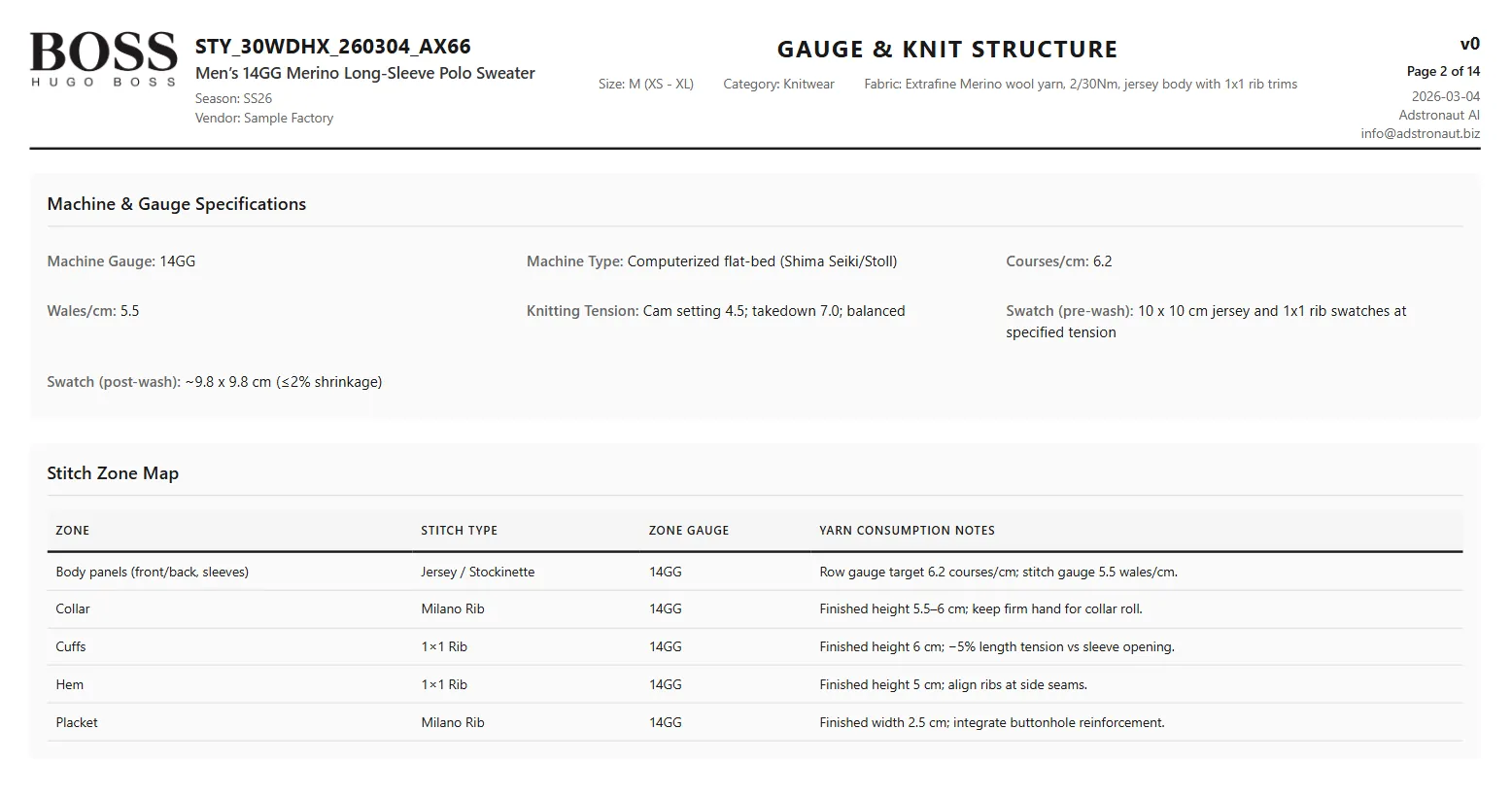 A proper tech pack header eliminates ambiguity from the first page — style number, season, category, and fabric specs are all defined upfront.
What Manufacturers Need From You
Factories evaluate your tech pack to determine three things: Can we make this? How much will it cost? How long will it take? Every piece of information you provide (or fail to provide) affects those answers.
Here is what manufacturers require, ranked by priority:
1. Style Identification
- Style number (unique identifier, e.g., ADS-HDE-001)
- Season and delivery date
- Size range (e.g., XS-3XL)
- Colorways with Pantone TCX references
2. Measurements With Tolerances
This is where most miscommunication occurs. A measurement table without tolerances is incomplete. Factories need to know not just that the chest width is 22 inches, but that the acceptable range is 22 inches +/- 0.5 inches.
| Measurement Point | Base Size (M) | Tolerance | Grade Rule |
|---|---|---|---|
| Chest Width (1" below armhole) | 22" | +/- 0.5" | +1.5" per size |
| Body Length (HPS to hem) | 28" | +/- 0.5" | +1.0" per size |
| Sleeve Length (shoulder to cuff) | 25.5" | +/- 0.375" | +0.75" per size |
| Across Shoulder | 19" | +/- 0.375" | +0.75" per size |
Common Objective notes that measurement ambiguity causes 40% of all first-sample failures — more than fabric issues, construction errors, or color mismatches combined.
3. Approved Materials (Bill of Materials)
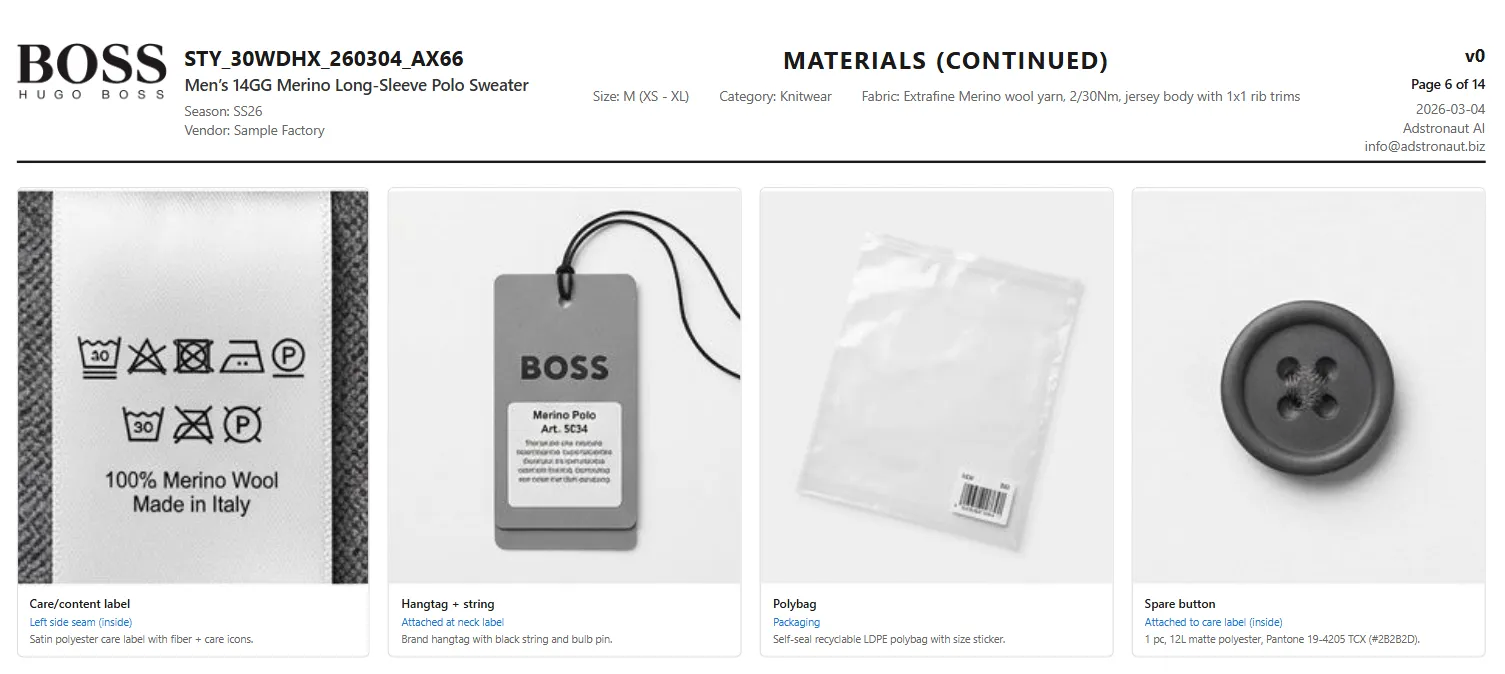
Every component that goes into the garment must be listed: shell fabric, lining, interlining, thread, zippers, buttons, labels, hang tags, and packaging.
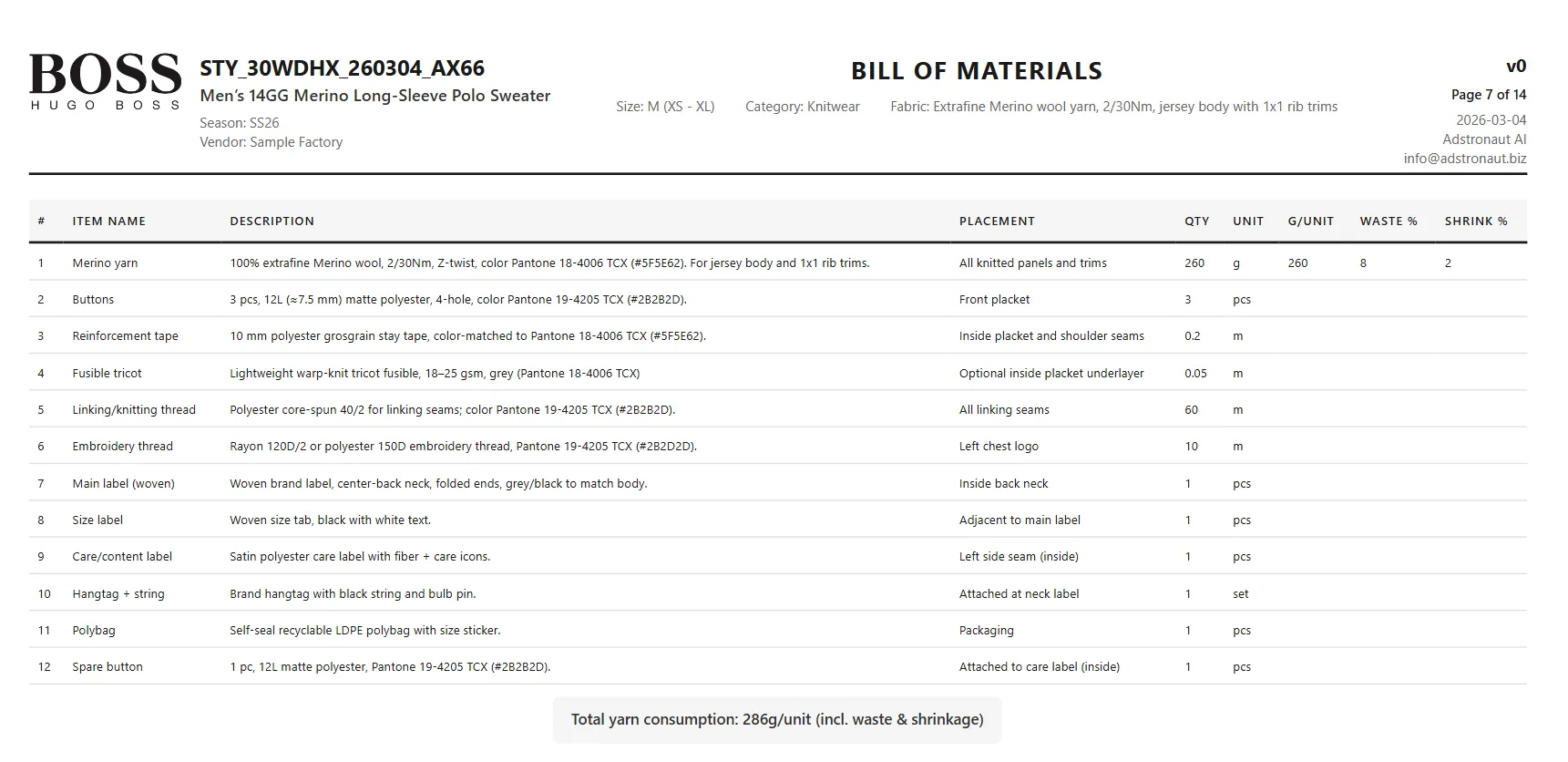 A complete BOM lists every component with supplier references, eliminating back-and-forth questions about materials.
4. Construction Details
Stitch types (e.g., 301 lockstitch, 504 overlock), seam allowances, topstitch distances, and assembly sequence. These details determine the garment's quality and durability.
Ready to build a factory-ready tech pack? Start with Adstronaut AI's Tech Pack Generator.
Section-by-Section: What Factories Look at First
Not every page of your tech pack carries equal weight on the factory floor. Understanding what manufacturers prioritize helps you focus your attention where it matters most.
What Gets Read First (The "Pricing Pages")
- Product Info Header — Style number, fabric type, target cost. This is page one, and it determines whether the factory even continues reading.
- Bill of Materials — Factories calculate cost based on material complexity. A garment with 8 BOM line items prices differently than one with 25.
- Size Chart / Graded Measurements — This tells the pattern maker how much work is involved and whether they have the technical capability.
What Gets Read During Production (The "Build Pages")
- Construction Guide — Step-by-step assembly instructions. Factories with experienced sewers may skim this; factories working on a new product category will study it closely.
- Flat Sketch with Callouts — The visual reference that every station on the production line uses to verify their work.
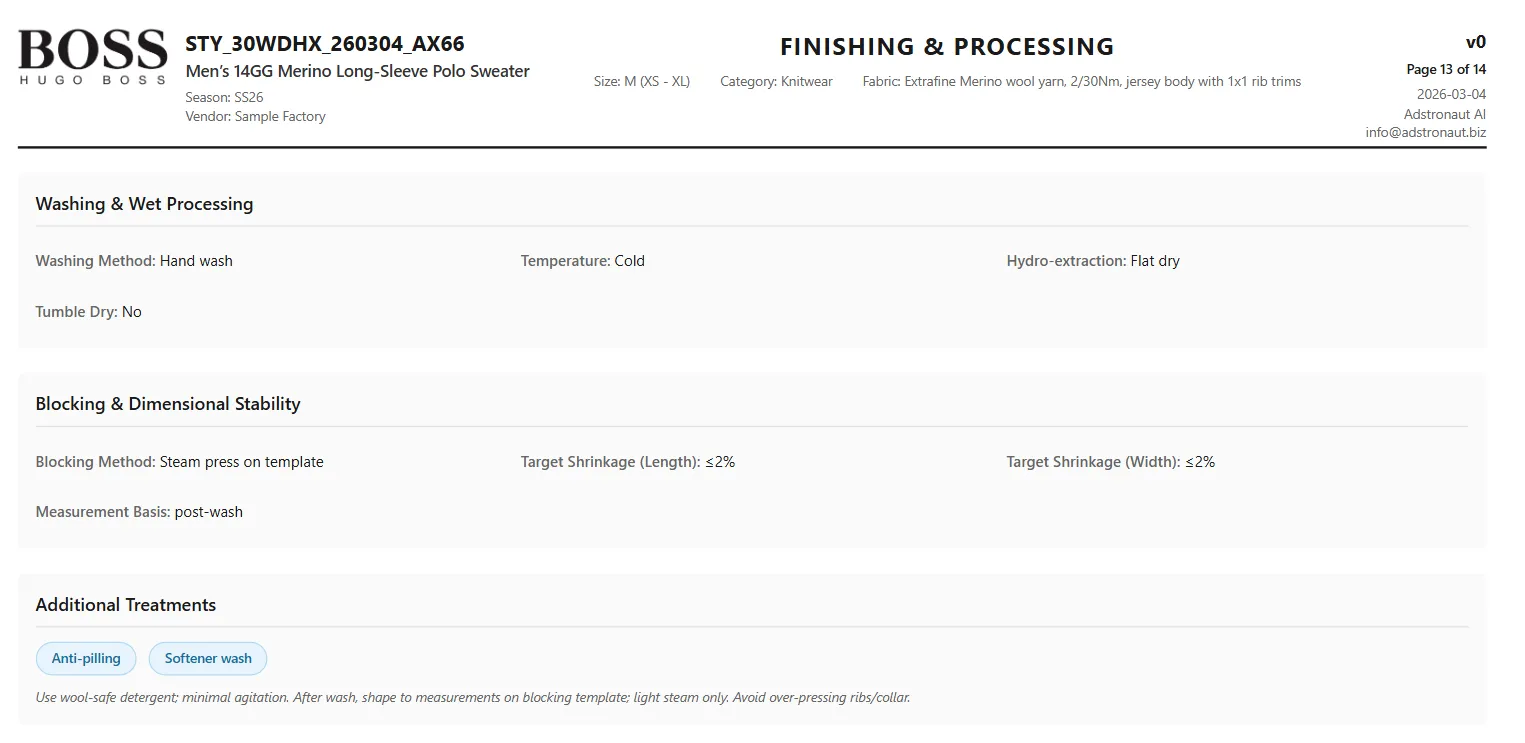 Construction details tell the factory exactly how to assemble each component — stitch types, seam allowances, and finishing methods.
What Causes the Most Questions
Based on data from Sewport's manufacturer network, these are the top 5 sections that generate clarification requests from factories:
| Rank | Section | % of Factory Questions | Common Issue |
|---|---|---|---|
| 1 | Measurements | 35% | Missing tolerances or grade rules |
| 2 | Materials / BOM | 25% | Unspecified supplier or generic descriptions |
| 3 | Color | 18% | No Pantone reference, only "navy blue" |
| 4 | Construction | 14% | Missing stitch type or seam allowance |
| 5 | Labeling / Packaging | 8% | No care label content or placement |
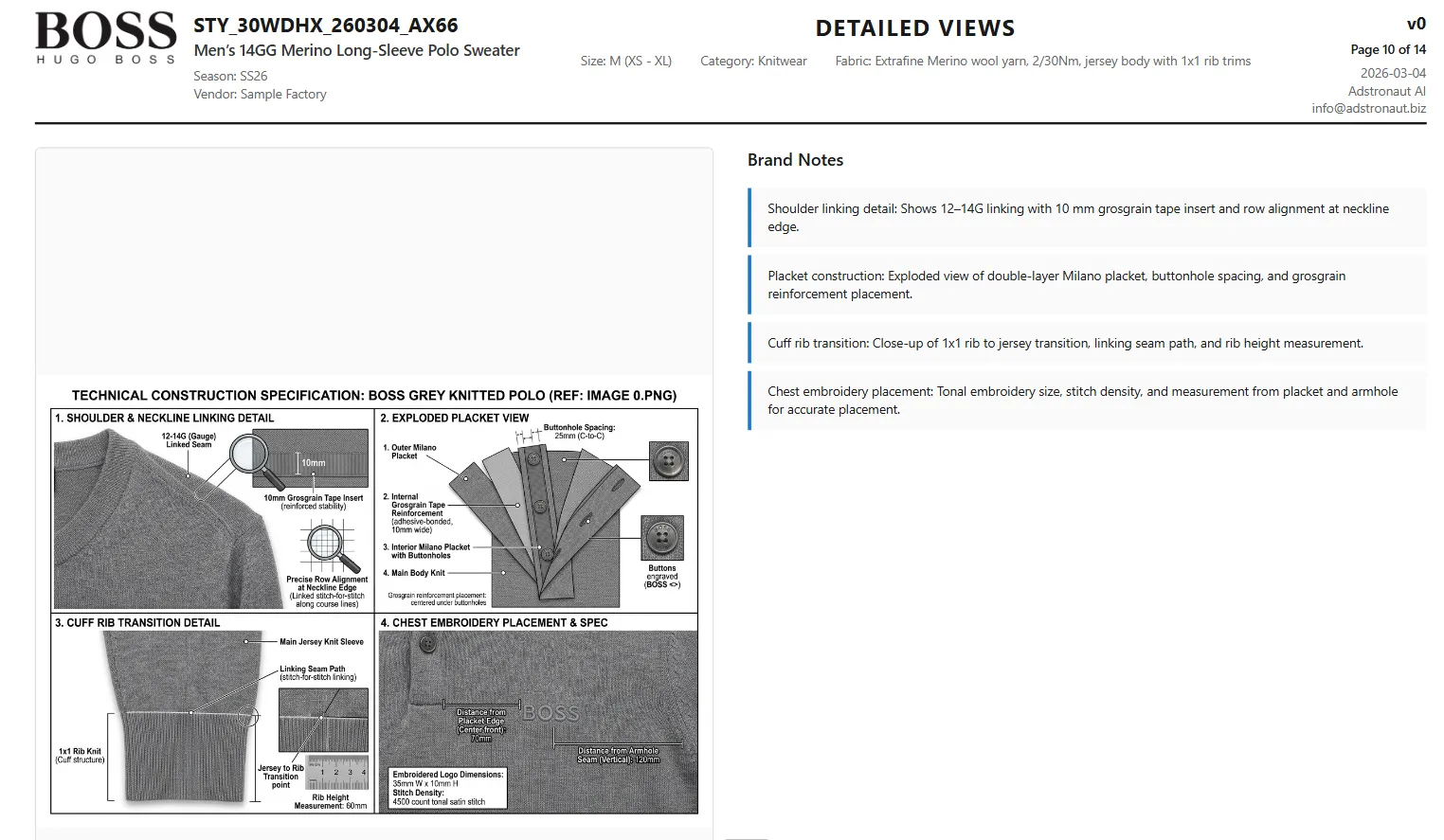 Colored mockups with Pantone TCX callouts eliminate the "what shade of blue?" conversation entirely.
Email Templates for Sending Tech Packs
How you send a tech pack matters almost as much as what is in it. A well-structured introduction email sets the tone for the entire relationship.
Template 1: Initial Inquiry (New Factory)
Subject: Tech Pack Attached — [Brand Name] — Style [ADS-HDE-001] — Quote Request
Dear [Factory Contact],
My name is [Your Name] and I am the [Title] at [Brand Name]. We are a [brief description — e.g., "direct-to-consumer streetwear brand based in New York"].
I have attached the complete tech pack for Style ADS-HDE-001, a heavyweight fleece hoodie. We are looking for:
- Quantity: 300-500 units (initial order)
- Size range: S, M, L, XL
- Target delivery: [Date]
- Target FOB price: $[XX]
The tech pack includes all measurements, BOM, construction details, and colorway specifications. Please review and let me know:
- Can you produce this style?
- What is your quoted FOB price at 300 and 500 units?
- What is your lead time from approval to delivery?
- What is your MOQ per colorway?
I look forward to your response.
Best regards, [Your Name]
Template 2: Revision Round (Existing Factory)
Subject: RE: Style [ADS-HDE-001] — Revision 2 — Updated Measurements
Hi [Factory Contact],
Thank you for the second sample. I have reviewed it against the tech pack and noted the following adjustments needed:
- Chest Width: Currently measures 23". Please adjust to 22" per spec (page 4).
- Hood depth: Increase by 0.5" — updated measurement on page 4, highlighted in yellow.
- Drawcord: Correct. Approved as-is.
Updated tech pack (Rev 2) is attached. All changes are highlighted in yellow. Please confirm receipt and revised sample timeline.
Best regards, [Your Name]
A study by Maker's Row found that designers who use structured email templates with specific page references reduce their email thread length by 45% and reach sample approval 2 weeks faster on average.
Handling Revision Rounds With the Fit Log
Revision rounds are inevitable — even with a perfect tech pack. The key is managing them systematically rather than letting them spiral into an endless chain of WhatsApp messages.
The Fit Log System
A fit log tracks every sample you receive against the approved measurements in your tech pack. For each revision round, you document:
- Date received
- Measurement comparison (spec vs. actual)
- Pass / fail / adjust for each point of measure
- Photos of issues with annotations
- Overall status: Approved / Approved with comments / Rejected
Best Practices for Revision Rounds
| Practice | Why It Matters |
|---|---|
| Always reference page numbers | Factories juggle 50+ styles; specificity prevents confusion |
| Highlight changes in yellow | Visual cues speed up factory review |
| Send updated PDF, not just email notes | The tech pack remains the single source of truth |
| Set a revision cap (3 rounds max) | Prevents scope creep and protects your timeline |
| Approve in writing, not verbally | Creates a paper trail for disputes |
According to Common Objective, brands that maintain formal fit logs achieve first-sample approval rates 2.5x higher than those relying on informal communication.
Generate your tech pack with built-in revision tracking. Try Adstronaut AI free.
Red Flags in Factory Communication
Not every factory is the right partner. Watch for these warning signs during your communication:
Pricing Red Flags
- Quoting without reading the tech pack — If a factory gives you a price within hours of receiving a 12-page tech pack, they did not read it. Expect surprises later.
- No questions about materials — Good factories ask clarifying questions. Silence is not a sign of competence; it is often a sign of assumptions being made.
- Price significantly below market — If three factories quote $12-$15 FOB and one quotes $7, the $7 factory is cutting corners somewhere.
Communication Red Flags
- Refusing to communicate via email — Factories that insist on WeChat or WhatsApp only are harder to hold accountable. Always have a written record.
- Ignoring your measurement tolerances — If a factory ships samples that are consistently outside tolerance and does not acknowledge the deviation, they lack quality control systems.
- No counter-questions on construction — A factory that builds from a tech pack without asking a single question about construction is either extremely experienced with your exact product type or is winging it.
Timeline Red Flags
- Vague delivery dates — "About 4-6 weeks" is not acceptable. You need a specific date.
- Missed sample deadlines without notice — One missed deadline is forgivable. A pattern of missed deadlines without proactive communication indicates systemic issues.
How Adstronaut AI Tech Packs Are Factory-Ready
Most manufacturer communication problems stem from incomplete tech packs. Adstronaut AI eliminates this by generating a 12-section tech pack from a single product photo that includes every section factories need to quote and produce your garment.
What You Get Out of the Box
| Tech Pack Section | Factory Use | Included? |
|---|---|---|
| Product Info Header | Identification & classification | Yes |
| Flat Sketch (front + back) | Visual reference for production line | Yes |
| Colored Mockups with Pantone | Color approval & dye matching | Yes |
| Bill of Materials | Cost calculation & sourcing | Yes |
| Graded Size Chart | Pattern making & cutting | Yes |
| Construction Details | Assembly instructions | Yes |
| Sample Measurements | Quality control checkpoints | Yes |
| Care & Label Instructions | Compliance & packaging | Yes |
| Finishing & Packaging | Final inspection standards | Yes |
Every tech pack exports as a single-file PDF that you can attach directly to your factory inquiry email — no reformatting, no missing pages, no broken links.
 Adstronaut AI tech packs export as clean, single-file PDFs ready to send to any manufacturer.
The Speed Advantage
Traditional tech pack creation takes 8-20 hours per style using Adobe Illustrator and Excel. Adstronaut AI generates a complete, editable tech pack in under 15 minutes. That means you can respond to factory questions with an updated PDF the same day — instead of waiting for your freelance technical designer to make changes next week.
Create your first factory-ready tech pack in 15 minutes. Start free.
FAQ
How do I find a manufacturer to send my tech pack to?
Platforms like Maker's Row (US-based factories), Sewport (global network), and Alibaba (Asia-based factories) allow you to search for manufacturers by product category, MOQ, and location. Always request references and samples before committing to a production run.
What file format should I send my tech pack in?
PDF is the universal standard. Factories can open it on any device without special software. Avoid sending editable files (Illustrator, Excel) unless the factory specifically requests them — editable files risk accidental modification. Adstronaut AI exports directly to PDF.
How detailed should my tech pack be for a first sample?
As detailed as possible. The tech pack for your first sample should include every section: product info, flat sketch, BOM, measurements with tolerances, construction details, and color callouts. Missing information does not save time — it creates questions that delay your sample by days or weeks.
What if my manufacturer says they don't need a tech pack?
This is a red flag. Professional manufacturers expect tech packs. A factory that says "just send us a photo and we will figure it out" is telling you they will make assumptions about every detail you did not specify. According to FIT, tech packs are considered a baseline requirement by 95%+ of professional garment manufacturers globally.
How many revision rounds should I expect?
With a complete tech pack, expect 1-2 revision rounds for a standard garment (t-shirt, hoodie, jogger) and 2-3 rounds for complex garments (tailored blazer, outerwear, technical sportswear). If you are consistently hitting 4+ rounds, the issue is likely an incomplete tech pack or a factory capability mismatch.
Should I include target pricing in my tech pack?
Yes. Including a target FOB (Free on Board) price gives the factory a benchmark. If your target is unrealistic given the materials specified, a good factory will tell you what needs to change (fabric weight, hardware quality, construction method) to hit your price point. Omitting pricing wastes time on both sides.
Can I use the same tech pack for multiple manufacturers?
Absolutely. A tech pack is manufacturer-agnostic by design. You can send the same PDF to five different factories for competitive quotes. In fact, this is standard industry practice. The only adjustment you may need is converting measurements between metric and imperial units depending on the factory's region.
How do I communicate changes after the tech pack is sent?
Never communicate changes verbally or through chat alone. Update the tech pack PDF, increment the revision number (Rev 1 to Rev 2), highlight the changed sections in yellow, and send the updated file via email with a summary of what changed. The tech pack must always remain the single source of truth.
What is the difference between a tech pack and a spec sheet?
A spec sheet is one component of a tech pack — specifically the measurement/grading table. A tech pack is the complete document that includes the spec sheet plus flat sketches, BOM, construction details, color callouts, labeling, and packaging instructions. Sending only a spec sheet is insufficient for production.
Do I need a separate tech pack for each colorway?
No. A single tech pack covers all colorways for one style. Use a dedicated colorway page that lists each color option with its Pantone TCX reference. The rest of the tech pack (measurements, construction, BOM) remains the same unless materials differ between colorways (e.g., different fabric for a special edition).
Start Communicating Like a Professional
The difference between brands that get clean first samples and brands that burn through five revision rounds is not luck — it is documentation. A complete tech pack transforms your manufacturer relationship from guesswork to precision.
Generate your factory-ready tech pack in 15 minutes with Adstronaut AI.
Sources: Maker's Row, Sewport, Common Objective, Fashion Institute of Technology (FIT)