Pantone Color Matching for Fashion: TCX Codes, Lab Dips & Free Tool
Pantone TCX (Textile Cotton eXtended) is the global color standard for fashion and textiles, covering 2,800+ colors calibrated to match dyed fabric under controlled lighting conditions. The Pantone Fashion, Home + Interiors (FHI) system is used by over 10 million designers and producers worldwide (Pantone LLC), and specifying a Pantone TCX code in your tech pack reduces color-related production rejections by an estimated 60-80% compared to sending hex codes or fabric swatches alone.
Match any garment photo to a Pantone TCX code with AI →
This guide covers everything fashion designers need to know about Pantone color matching: which system to use (TCX vs TPG vs C/U), how the lab-dip approval process works, acceptable Delta E tolerances, digital tools ranging from $100/year subscriptions to AI-powered auto-matching, and how to correctly specify Pantone colors in your tech packs.
Table of Contents
- What Is Pantone TCX and Why Fashion Uses It
- Pantone TCX vs TPX vs TPG vs C/U — Which to Use When
- How Pantone Matching Works in Production
- The Pantone Color of the Year and Trend Cycles
- Common Color Communication Mistakes
- Digital Pantone Tools: Fan Decks, Apps, and AI
- How AI Automates Pantone Matching
- Using Pantone in Tech Packs and Colorway Presentations
- Frequently Asked Questions
What Is Pantone TCX and Why Fashion Uses It
Pantone is a proprietary color standardization system created in 1963 by Lawrence Herbert, who developed a system of numbered color swatches to solve the problem of inconsistent color communication in the printing industry. In 1987, Pantone expanded into textiles with the Textile Color System, and today the Pantone Fashion, Home + Interiors (FHI) system is the backbone of global fashion production.
A Pantone TCX code — such as PANTONE 19-4052 TCX (Classic Blue) — is a unique identifier that maps to a physical fabric swatch dyed to an exact spectral specification. When a designer in New York specifies "19-4052 TCX" and a factory in Guangzhou reads that same code, both parties reference the identical color standard. No ambiguity. No guesswork.
According to X-Rite, the manufacturer of the spectrophotometers used to verify Pantone colors, the human eye can distinguish approximately 10 million colors, but can only reliably remember and communicate about 30-50 without a standardized reference system. This is precisely why Pantone codes exist: they replace subjective descriptions like "navy blue" or "dark teal" with measurable, reproducible values.
The TCX suffix stands for Textile Cotton eXtended and indicates the color is printed on cotton fabric, making it the most accurate reference for apparel production. Every TCX swatch is produced under ISO-certified conditions with D65 daylight illuminant, ensuring consistency across the entire global supply chain.
Why not just use hex codes or RGB values? Because digital color and physical dyed fabric behave fundamentally differently. A hex code like #0F4C81 describes how a pixel on your screen emits light — but fabric absorbs and reflects light, and the same dye formula produces different results on cotton vs polyester vs silk. Pantone TCX codes account for this by providing a physical textile reference, not just a digital approximation.
Pantone TCX vs TPX vs TPG vs C/U — Which to Use When
Pantone maintains several color guide systems, and using the wrong one is a common and costly mistake. Here is a breakdown of each system and when to use it:
| System | Full Name | Printed On | Color Count | Best For | Price Range |
|---|---|---|---|---|---|
| TCX | Textile Cotton eXtended | Cotton fabric | 2,800+ | Apparel, textile production | $800-$1,200 (swatch books) |
| TPG | Textile Paper Green | Coated paper (eco) | 2,800+ | Design reference, presentations | $300-$500 (fan deck) |
| TPX | Textile Paper (legacy) | Lacquer-coated paper | 2,100 | Discontinued — replaced by TPG | N/A (discontinued) |
| C | Coated | Coated paper stock | 2,390+ | Print: packaging, hangtags, labels | $200-$350 (formula guide) |
| U | Uncoated | Uncoated paper stock | 2,390+ | Print: tissue paper, uncoated boxes | $200-$350 (formula guide) |
Key rules for fashion designers:
- Always specify TCX for fabric production. TCX swatches are printed on actual cotton, making them the closest reference to how your garment will look when dyed.
- Use TPG for internal design work and client presentations. TPG guides cost 40-60% less than TCX swatch books and share the same numbering system, making them a practical desktop reference.
- Use C or U for packaging and printed materials only. The Pantone Graphics system uses entirely different pigments than the FHI textile system. PANTONE 19-4052 TCX and PANTONE 19-4052 C will look noticeably different — they share a number but are not the same color.
- Never mix systems in a tech pack. According to AATCC (American Association of Textile Chemists and Colorists), mixing Pantone systems is one of the top 5 causes of color approval failure in textile production.
Industry note: Pantone officially discontinued TPX guides in 2014, replacing them with TPG (which uses an environmentally friendlier paper coating process). If your fan deck still shows TPX codes, it is at least 12 years old and should be replaced — Pantone recommends replacing guides every 12-18 months due to fading.
How Pantone Matching Works in Production
Understanding the color approval workflow is critical for any designer working with factories. Here is the standard process from Pantone specification to production approval:
Step 1: Color Specification (Designer)
The designer specifies a Pantone TCX code for each component in the tech pack. A single garment may have 3-8 different Pantone codes — one for the shell fabric, one for contrast trim, one for hardware, one for lining, etc.
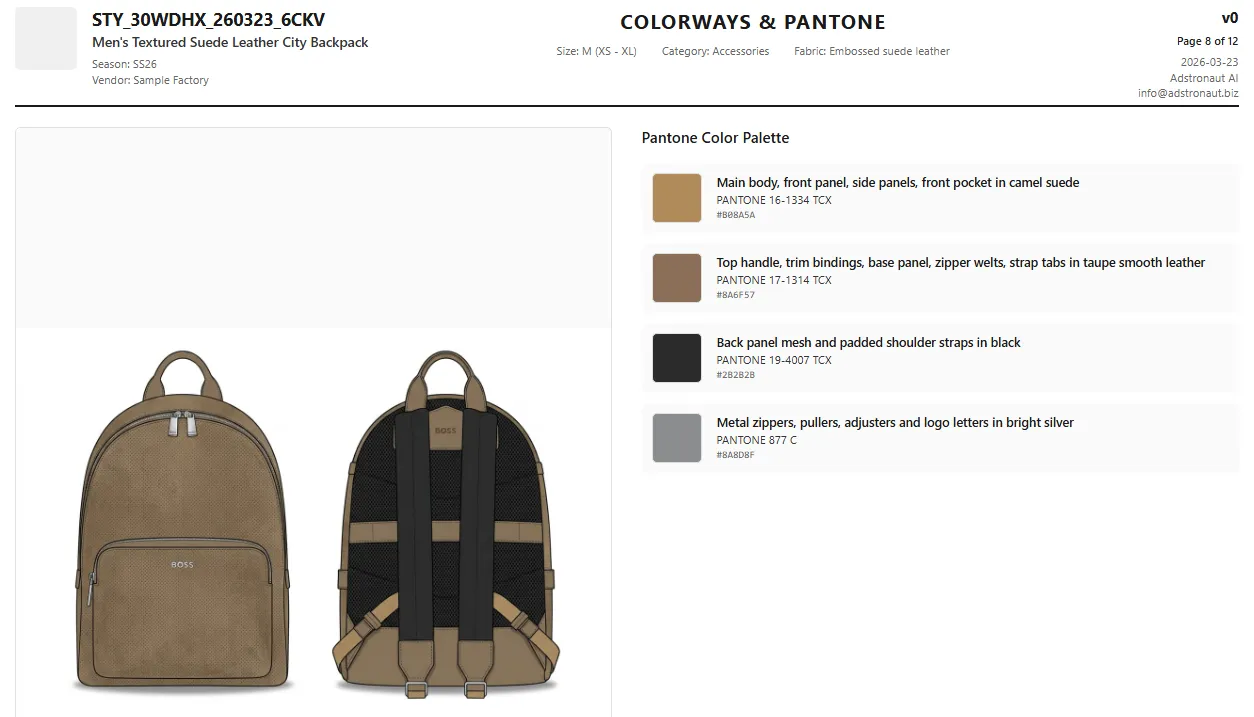 A tech pack colorway page specifying Pantone TCX codes for each component of a leather backpack.
Step 2: Lab Dip (Factory/Mill)
The fabric mill creates a lab dip — a small fabric swatch dyed to match the specified Pantone code. Mills typically submit 3-5 color variations per lab dip, each slightly different, and the designer selects the best match. Lab dips cost $15-$50 per color per fabric type and take 5-10 business days.
Step 3: Color Measurement (Quality Control)
The mill uses a spectrophotometer (devices from X-Rite or Datacolor, costing $3,000-$25,000) to measure the lab dip against the Pantone standard. The key metric is Delta E (dE), which quantifies the perceptible difference between two colors:
| Delta E Value | Perception | Industry Acceptance |
|---|---|---|
| 0-0.5 | Imperceptible difference | Perfect match |
| 0.5-1.0 | Slight difference, trained eye only | Excellent — accepted by luxury brands |
| 1.0-2.0 | Noticeable to trained observer | Standard acceptance for most apparel |
| 2.0-3.5 | Noticeable to untrained eye | Acceptable for some casual/fast fashion |
| 3.5+ | Obviously different | Rejected — requires re-dip |
According to Datacolor, the average fashion brand targets a Delta E of 1.0 or below for critical colorways (hero colors, brand signature colors) and allows up to Delta E 2.0 for secondary components like lining or internal trim. Luxury brands like Hermes and Louis Vuitton reportedly require Delta E below 0.5.
Step 4: Approval and Bulk Production
Once the designer approves a lab dip, the approved swatch becomes the production standard. The factory stores this physical swatch and measures every production batch against it. Brands typically allow 2-3 lab-dip rounds before approval, though complex colors (bright reds, neon greens, deep navies) may require 4-5 rounds.
Cost of getting color wrong at scale: A single rejected bulk dye lot of 5,000 yards of fabric represents $15,000-$40,000 in waste — not including the 4-6 week production delay. According to AATCC, color-related defects account for approximately 25% of all textile quality rejections globally.
The Pantone Color of the Year and Trend Cycles
Since 2000, Pantone has announced an annual "Color of the Year" that significantly influences fashion, interiors, and industrial design. The announcement, typically made in December for the following year, is based on trend analysis across fashion runways, entertainment, art, travel destinations, and socio-economic conditions.
Recent Pantone Colors of the Year:
| Year | Color | TCX Code | Industry Impact |
|---|---|---|---|
| 2026 | Mocha Mousse | 17-1230 TCX | Warm neutrals dominate ready-to-wear |
| 2025 | Mocha Mousse | 17-1230 TCX | Earth tones across accessories and outerwear |
| 2024 | Peach Fuzz | 13-1023 TCX | Soft pastels surged in spring collections |
| 2023 | Viva Magenta | 18-1750 TCX | Bold accent colors in athleisure and streetwear |
| 2022 | Very Peri | 17-3938 TCX | Periwinkle appeared in 34% more SS23 collections |
According to Pantone LLC, brands that align seasonal collections with the Color of the Year see an average 15-20% increase in press coverage for those specific SKUs. However, the Color of the Year should be treated as a trend signal, not a production mandate — consumer preference varies significantly by market.
How to use Color of the Year strategically:
- Incorporate it as an accent colorway (trim, lining, limited-edition capsule)
- Use it for marketing collateral and social media campaigns
- Reference it in tech packs alongside your core brand palette to show trend awareness to buyers
Common Color Communication Mistakes
After reviewing thousands of tech packs, these are the most frequent color specification errors that cause production delays:
Mistake 1: Using Hex Codes Instead of Pantone
Sending a factory "#FF6B35" without a corresponding Pantone TCX code forces the mill to interpret a screen color as a dye formula. Screen rendering varies by device — the same hex code looks different on a MacBook Pro vs a Windows laptop vs a phone. X-Rite research shows that a single hex code can produce Delta E variations of 5.0 or more when converted to physical dye across different substrates.
Mistake 2: Using an Outdated or Faded Fan Deck
Pantone recommends replacing physical guides every 12-18 months because pigments fade with light exposure and handling. A 3-year-old fan deck may have shifted by Delta E 2.0-4.0, meaning the "reference" you are sending to the factory is no longer accurate.
Mistake 3: Not Specifying Fabric Type with the Color
The same Pantone TCX code dyed onto cotton jersey, polyester interlock, and silk charmeuse will appear as three visibly different colors. The tech pack must specify both the Pantone code AND the target fabric — for example, "PANTONE 18-3838 TCX on 100% cotton 180gsm jersey."
Mistake 4: Evaluating Color Under Wrong Lighting
Metamerism — the phenomenon where two colors match under one light source but differ under another — is the most underestimated cause of color disputes. Colors should always be evaluated under D65 (6500K daylight) using a light booth. According to AATCC Test Method 173, visual color assessment performed under non-standard lighting accounts for 30-40% of disputed lab dip rejections.
Mistake 5: Mixing Pantone Systems
Specifying "PANTONE 19-4052" for fabric but referencing the Coated (C) guide instead of TCX results in a different color entirely. The Pantone Graphics and FHI systems use different pigment formulations and substrates.
Digital Pantone Tools: Fan Decks, Apps, and AI
The cost of accessing Pantone color standards has historically been a barrier for independent designers. Here is a breakdown of available tools:
Physical Guides ($300-$1,200)
| Product | Colors | Price | Lifespan |
|---|---|---|---|
| FHI Cotton Passport (TCX) | 2,800+ | $800-$1,200 | 12-18 months |
| FHI Color Guide (TPG) | 2,800+ | $300-$500 | 12-18 months |
| FHI Cotton Chip Set (TCX) | 2,800+ | $3,500+ | 12-18 months |
Digital Subscriptions ($60-$100/year)
Pantone Connect (web + mobile app) provides digital access to all Pantone libraries with cross-referencing between systems, color extraction from images, and integration with Adobe Creative Suite. At $89.99/year, it is significantly cheaper than physical guides — but digital swatches on a screen are not a substitute for physical textile references in production.
AI-Powered Color Tools (included in design platforms)
The newest category of Pantone tools uses computer vision to automatically identify and match colors. Rather than manually browsing fan decks, these tools analyze an uploaded image and return the nearest Pantone TCX matches algorithmically.
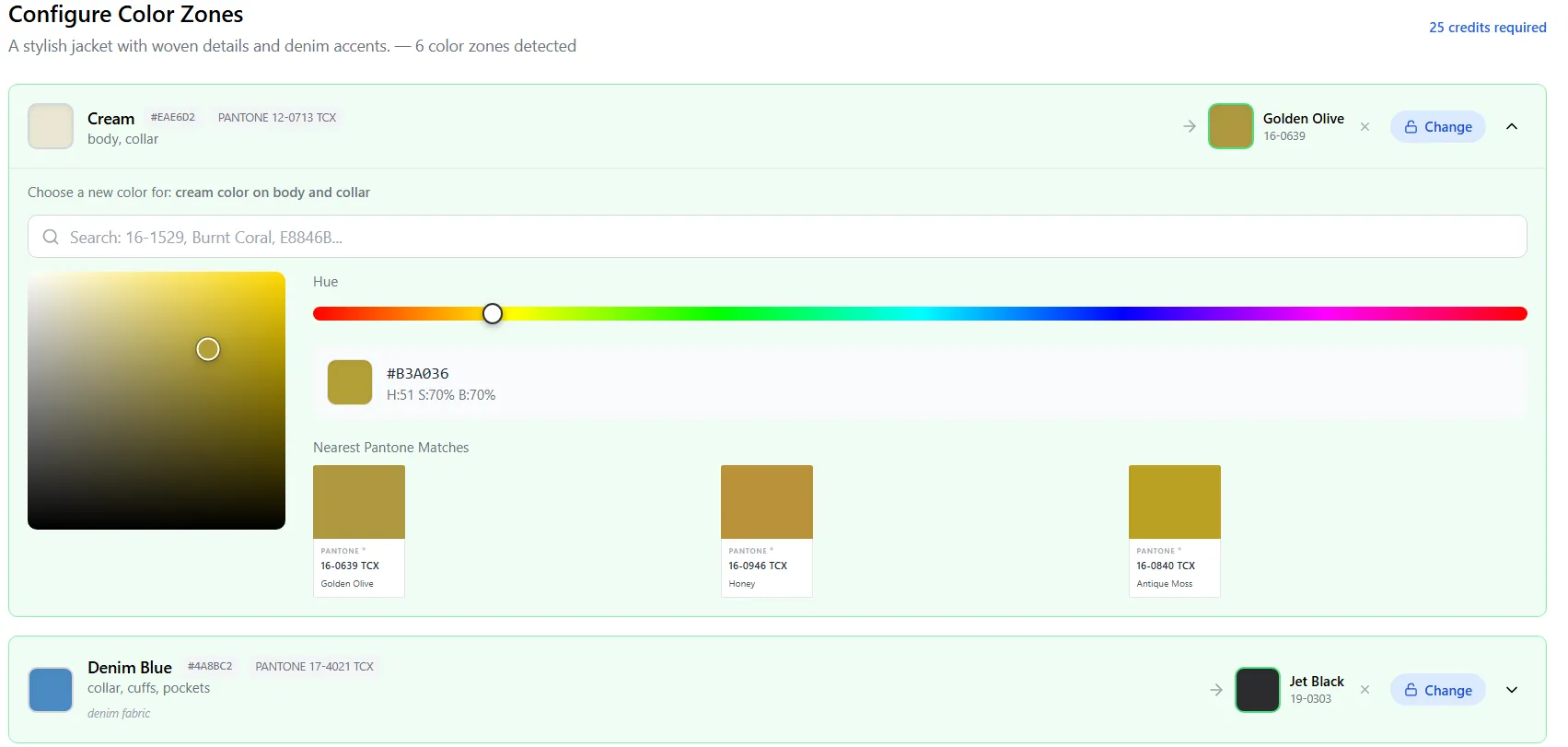 An AI color picker showing the 3 nearest Pantone TCX matches for a selected color — eliminating manual fan deck browsing.
Adstronaut AI's Color Changer includes a library of 2,300+ Pantone TCX codes (2,310 shades as of July 2026) and displays the 3 nearest Pantone matches for any color you select or pick from a garment photo. This means you can go from "I like that olive tone on this jacket" to a production-ready Pantone code in seconds, not hours.
How AI Automates Pantone Matching
Traditional Pantone matching requires a designer to hold a physical fan deck against fabric, squinting under a D65 light booth. AI changes this workflow fundamentally in three ways:
1. Auto-Detection from Product Photos
Upload a garment photo, and computer vision algorithms segment the image into distinct color zones — identifying the shell fabric, contrast panels, trim, hardware, and lining separately. Each zone is analyzed for its dominant color and mapped to the nearest Pantone TCX code.
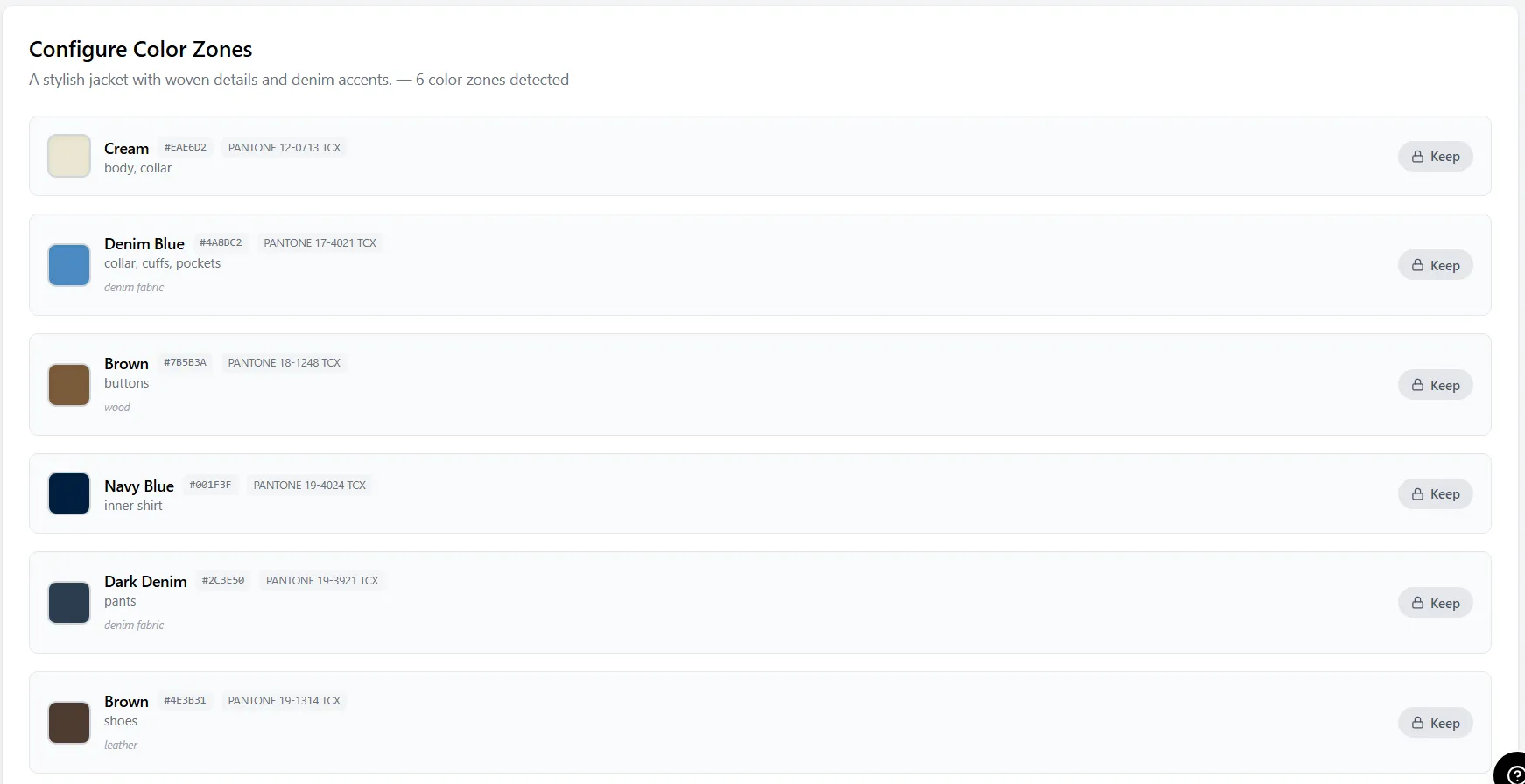 AI-powered zone detection identifying 6 distinct color regions on a jacket, each with an auto-assigned Pantone TCX code and material type.
2. Nearest-Match Algorithms
The color-matching algorithm converts the detected RGB values into the CIELAB color space (the same perceptual model used by spectrophotometers) and calculates Delta E against every Pantone TCX value in the database. The 3 closest matches are returned, ranked by Delta E distance, so the designer can choose the most appropriate production reference.
This approach is mathematically equivalent to what a spectrophotometer does — but applied to a photograph rather than a physical swatch. While it does not replace a physical lab dip, it gets the specification 90-95% accurate from day one, reducing lab-dip rounds from the typical 2-3 down to 1-2.
3. Batch Processing Across Collections
Instead of matching colors for one garment at a time, AI tools process an entire collection — 20, 50, or 100 styles — and auto-assign Pantone codes across all of them. This ensures color consistency across a collection (e.g., verifying that "the navy" in your bomber jacket matches "the navy" in your joggers) without manual cross-referencing.
Upload any garment photo and get instant Pantone TCX code assignments for every color zone.
Try the AI Color Changer with built-in Pantone matching →
Using Pantone in Tech Packs and Colorway Presentations
The color page is one of the most scrutinized sections of a tech pack. Factories need Pantone specifications to source dyes, approve lab dips, and conduct quality control. Here is what a production-ready color specification should include:
Required Information Per Colorway
| Field | Example | Why It Matters |
|---|---|---|
| Pantone TCX Code | 19-4052 TCX | Universal color reference |
| Color Name | Classic Blue | Human-readable identifier |
| Hex Value | #0F4C81 | Digital design reference |
| Target Fabric | 100% cotton 180gsm jersey | Same dye = different result on different fabrics |
| Component | Shell body | Where this color is applied |
| Delta E Tolerance | Max 1.5 | Acceptable production variation |
| Special Finish | None / Enzyme wash / Garment dye | Finishes alter final color appearance |
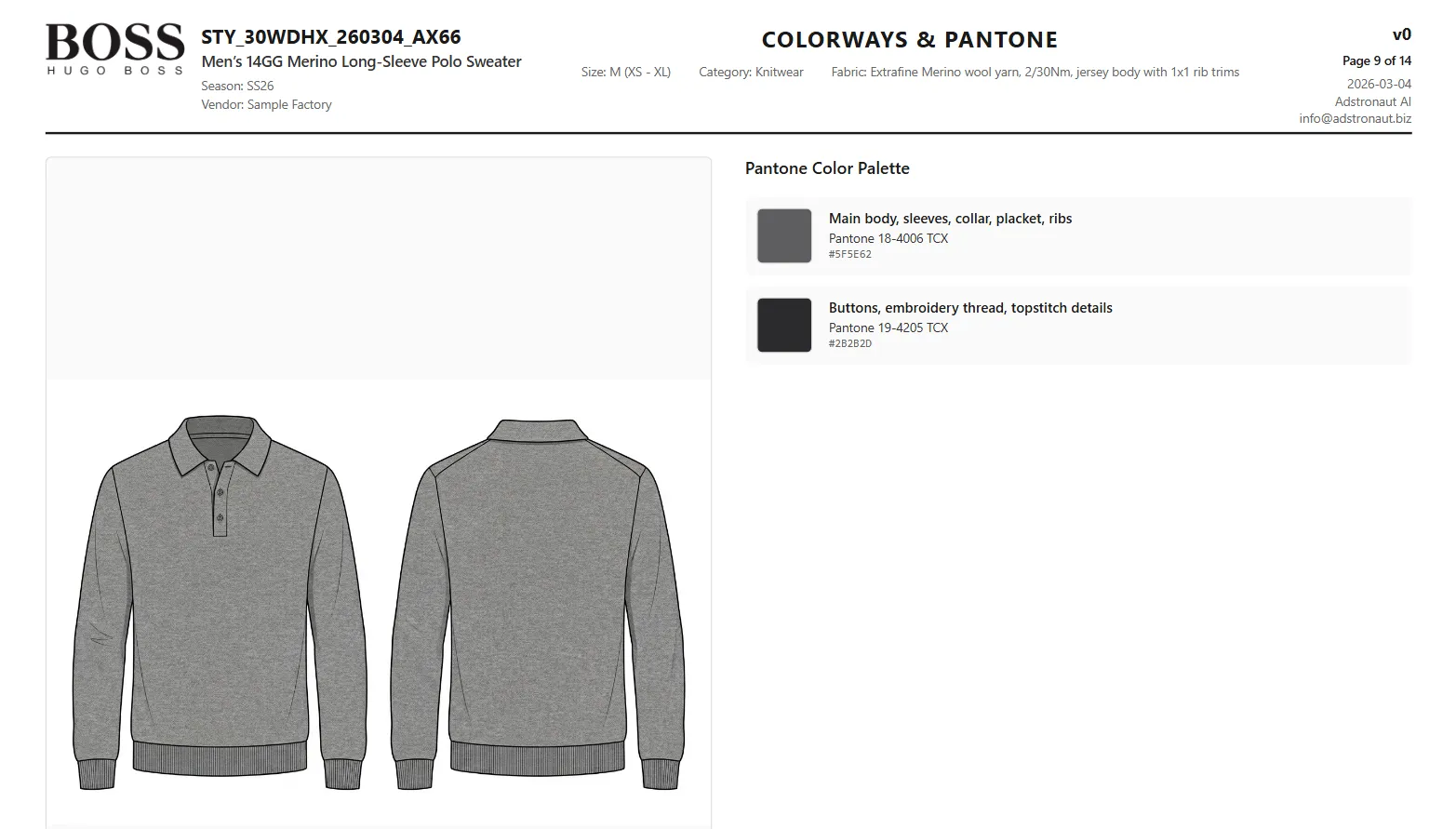 A properly formatted Pantone color section in a tech pack — each component has a TCX code, hex reference, and visual swatch.
Colorway Matrix for Multi-Color Styles
For garments offered in multiple colorways, the tech pack should include a colorway matrix showing every component in every color option:
| Component | Colorway 1 (Black) | Colorway 2 (Navy) | Colorway 3 (Olive) |
|---|---|---|---|
| Shell body | 19-4006 TCX (Caviar) | 19-4026 TCX (Dress Blues) | 18-0422 TCX (Loden Green) |
| Contrast trim | 11-0601 TCX (Bright White) | 11-0601 TCX (Bright White) | 15-1220 TCX (Honey Peach) |
| Zipper tape | Match shell | Match shell | Match shell |
| Hardware | Gunmetal (ref sample) | Silver nickel (ref sample) | Antique brass (ref sample) |
| Lining | 19-4006 TCX (Caviar) | 19-4026 TCX (Dress Blues) | 18-0422 TCX (Loden Green) |
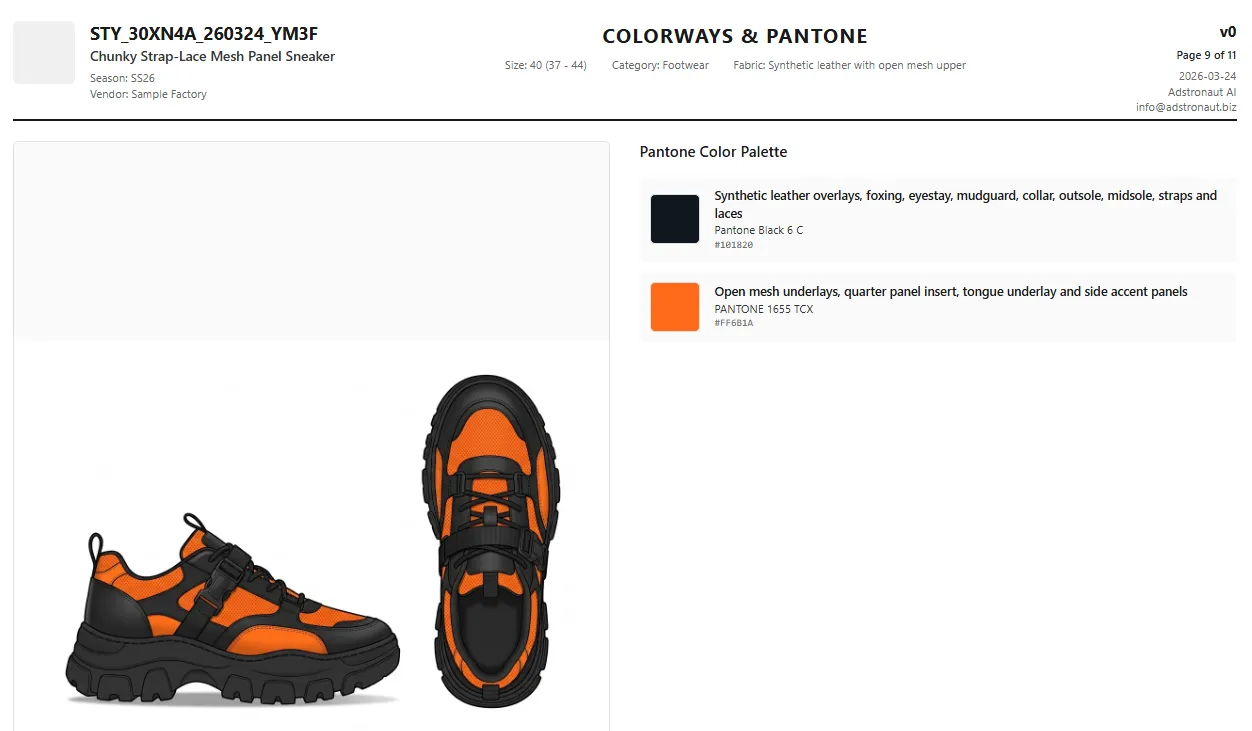 A footwear tech pack specifying both Pantone C (for printed elements) and TCX (for textile components) — note the correct use of different systems for different materials.
How Adstronaut AI Handles Pantone in Tech Packs
Adstronaut AI's tech pack generator automatically identifies the colors in your uploaded garment photo and assigns the nearest Pantone TCX code to each component. The generated tech pack includes:
- Visual color swatches with TCX code and hex value side by side
- Component-level color assignment (shell, trim, lining, hardware)
- Production-ready formatting that factories can use directly for lab-dip requests
This eliminates the most time-consuming part of tech pack creation — manually matching every color against a fan deck and typing out specifications — while maintaining the precision factories require.
Upload a garment photo and get a complete color specification with auto-assigned Pantone codes in minutes.
Match a garment photo to Pantone TCX codes with AI →
Frequently Asked Questions
What does TCX mean in Pantone?
TCX stands for Textile Cotton eXtended. It indicates the color swatch is printed on cotton fabric, making it the most accurate physical reference for apparel production. The "eXtended" designation was added when Pantone expanded the original Textile Color System from 1,925 colors (TC) to 2,800+ colors (TCX) in 2010.
How many Pantone TCX colors are there?
As of 2026, the Pantone Fashion, Home + Interiors system contains 2,845 TCX colors. Pantone adds new colors periodically — the most recent addition was 175 new colors in 2020. These colors are organized into chromatic groups (reds, oranges, yellows, greens, blues, purples) plus neutrals (whites, grays, blacks, browns).
Can I use Pantone hex codes for production?
No. Hex codes are useful for digital design (websites, social media, e-commerce listings) but should never be the primary color specification for textile production. Hex/RGB values describe emitted light from screens, while fabric color depends on dye chemistry, substrate, and reflected light. Always specify the Pantone TCX code as the primary reference and include the hex value as a secondary digital reference only.
How much does a Pantone fan deck cost?
A Pantone FHI TPG Fan Deck costs $300-$500 and contains 2,800+ colors on paper. A Pantone FHI Cotton Passport (TCX) costs $800-$1,200 and contains swatches on actual cotton fabric. Physical guides should be replaced every 12-18 months due to color fading. Pantone Connect digital subscription costs $89.99/year and provides digital access to all libraries.
What Delta E is acceptable for fashion production?
Most fashion brands accept Delta E 1.0-2.0 for shell fabrics and visible components. Luxury brands typically require Delta E below 1.0 (some below 0.5). Non-visible components like internal linings may allow Delta E up to 3.0. The specific tolerance should be stated in your tech pack for each component and colorway.
What is the difference between Pantone C and Pantone TCX?
Pantone C (Coated) is for printing on paper — packaging, hangtags, lookbooks, and other printed materials. Pantone TCX is for textiles and fabrics. They use entirely different pigment systems: Pantone C uses ink pigments; TCX uses textile dye pigments. Even if the Pantone number is the same (e.g., 19-4052), the C and TCX versions will appear as different colors because they are produced with different materials on different substrates.
Do I need a physical Pantone guide, or is Pantone Connect enough?
For production, you need a physical TCX guide (or at minimum a TPG guide) because screens cannot accurately represent fabric color. Pantone Connect is excellent for design exploration, palette building, and communicating codes digitally, but the final color approval process requires physical swatches evaluated under D65 lighting. If budget is limited, start with a TPG fan deck ($300-$500) and use Pantone Connect as a digital supplement.
How do I match a Pantone color if I only have a fabric swatch?
If you have a physical fabric swatch but no Pantone code, you have three options: (1) Use a spectrophotometer (X-Rite Ci64 or Datacolor 800, $5,000-$25,000) to measure the swatch and get the nearest TCX match with Delta E value. (2) Visually compare against a physical Pantone TCX guide under D65 lighting. (3) Use an AI color-matching tool — photograph the swatch and upload it to a platform like Adstronaut AI's Color Changer, which will return the 3 nearest Pantone TCX matches from its 2,300+ code library (2,310 shades as of July 2026).
How does Pantone matching work for different fabric types?
The same Pantone TCX code dyed onto different fabrics will look different due to variations in fiber structure, sheen, and dye absorption. Cotton absorbs dye deeply (matte finish), polyester sits on the surface (slightly brighter), and silk reflects more light (richer, more saturated). This is why tech packs must specify both the Pantone code AND the target fabric. The lab-dip process accounts for these differences — the mill dyes your specific fabric to match the TCX reference, not the other way around.
Sources
- Pantone: Fashion, Home + Interiors Color System — specifications for TCX and TPG libraries referenced throughout this guide.
- Pantone: Color of the Year — official methodology and historical TCX codes used in the Color of the Year table.
- X-Rite Learning Color & Light — spectrophotometer workflow and Delta E measurement standards cited in the production section.
- AATCC Standards and Test Methods — Test Method 173 (CIELAB color difference) and related color evaluation procedures.
- Datacolor: Fashion Color Management Resources — industry guidance on Delta E tolerances in textile production.