Tech Pack vs Spec Sheet — What's the Difference and Which Do You Need?
A spec sheet is a 1–3 page measurement document listing points of measure (POMs), tolerances, and grade rules for a single garment. A tech pack is a 10–15 page complete manufacturing blueprint that contains the spec sheet plus flat sketches, a bill of materials, construction callouts, colorway specifications, artwork placement, labeling, and packaging instructions. According to Maker's Row survey data, brands that submit only a spec sheet to factories experience an average of 4.2 sample revisions before approval, compared to 1.8 revisions for brands submitting a complete tech pack — a difference of $1,200–$3,600 in wasted sampling costs per style.
This guide explains exactly what each document contains, when you need one versus the other, and how to create both efficiently.
Table of Contents
- What Is a Spec Sheet?
- What Is a Tech Pack?
- Side-by-Side Comparison: Tech Pack vs Spec Sheet
- What a Spec Sheet Contains
- What a Tech Pack Contains
- When You Need a Spec Sheet Alone vs a Full Tech Pack
- The Naming Confusion: Why People Say "Spec Sheet" When They Mean "Tech Pack"
- How Factories Respond to Each Document
- How to Create Both with AI
- Frequently Asked Questions
What Is a Spec Sheet?
A spec sheet — short for specification sheet — is a focused document that communicates the dimensional requirements of a garment. It answers one question: what should this garment measure at every point, in every size?
A well-constructed spec sheet includes:
- Points of measure (POMs): 15–40 specific measurement locations depending on garment complexity
- Base size measurements: The exact dimensions for your sample size (typically M or 8)
- Grade rules: The incremental change per size (e.g., +1" chest width per size)
- Tolerances: Acceptable variance at each POM (e.g., ±¼" at chest, ±⅛" at collar)
The spec sheet is essentially the measurement DNA of a garment. The American Society for Testing and Materials (ASTM) publishes standard body measurement tables — such as ASTM D5585 for adult women and ASTM D6240 for men — that many brands use as baselines for their spec sheets (ASTM International, 2023).
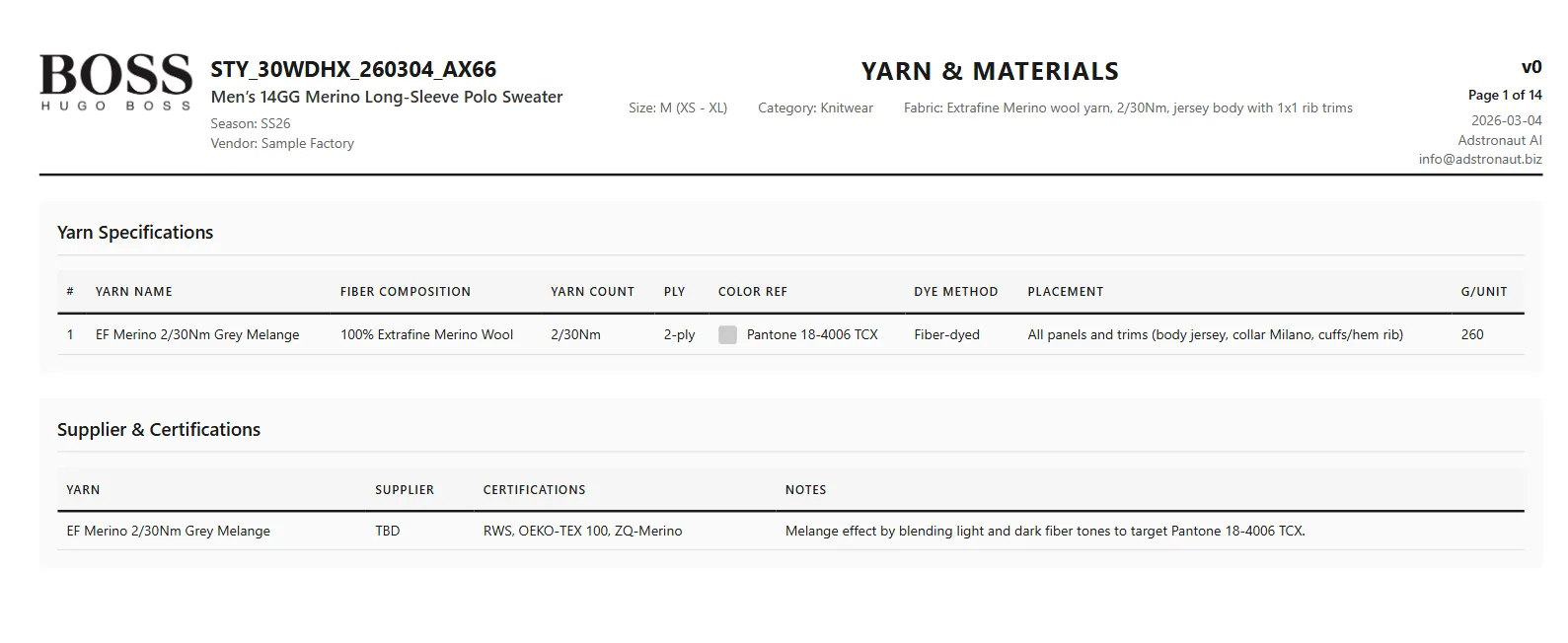 A spec sheet page showing annotated POMs on a flat sketch with corresponding measurement table.
A typical spec sheet for a basic t-shirt contains 18–22 POMs. A tailored blazer may require 35–45 POMs. Outerwear and technical garments often exceed 50 measurement points.
What Is a Tech Pack?
A tech pack — short for technical package — is the complete manufacturing document for a garment. If a spec sheet is the measurement chapter, the tech pack is the entire book. It gives a factory everything needed to quote, sample, and produce a style without back-and-forth questions.
A standard tech pack runs 10–15 pages and includes:
- Cover page with style details
- Technical flat sketches (front, back, and detail views)
- Bill of materials (BOM)
- Colorway specifications with Pantone codes
- Measurement spec sheet with grading
- Construction and sewing details
- Artwork and print placement
- Label and packaging instructions
- Fit notes and revision history
- Special finishing instructions
According to the Fashion Institute of Technology's technical design curriculum, a tech pack functions as a "legally binding communication tool between the designer and manufacturer" — it is the single source of truth for production (FIT, Technical Design Program).
The relationship is straightforward: every tech pack contains a spec sheet, but a spec sheet is not a tech pack.
Side-by-Side Comparison: Tech Pack vs Spec Sheet
| Feature | Spec Sheet | Tech Pack |
|---|---|---|
| Page count | 1–3 pages | 10–15 pages |
| Primary purpose | Define measurements | Define entire garment for manufacturing |
| Flat sketches | Sometimes (basic reference) | Always (detailed front, back, detail views) |
| Points of measure | Yes (core content) | Yes (included as one section) |
| Grade rules | Yes | Yes |
| Tolerances | Yes | Yes |
| Bill of materials | No | Yes — fabric, trim, hardware, labels |
| Construction details | No | Yes — stitch types, seam specs, assembly order |
| Colorways | No | Yes — Pantone codes per component |
| Artwork placement | No | Yes — dimensions, technique, positioning |
| Label/packaging | No | Yes — care labels, hang tags, folding |
| Fit history/revisions | Rarely | Yes — sample comments, revision log |
| Cost to create (freelancer) | $50–$150 | $250–$750+ |
| Cost to create (AI) | Included in tech pack | $5–$20 per style |
| Factory readiness | Partial — triggers follow-up questions | Complete — factory can quote and sample |
Industry benchmarks from Maker's Row indicate that 78% of factories prefer receiving a full tech pack before quoting, and 45% will not begin work with a spec sheet alone (Maker's Row, 2024 Factory Survey).
What a Spec Sheet Contains
Let's break down the three core sections of a professional spec sheet.
1. Points of Measure (POMs)
POMs are specific, named locations on a garment where measurements are taken. Each POM must be:
- Clearly labeled with an industry-standard name (e.g., "Across Shoulder," "Center Back Length," "Armhole Straight")
- Mapped to the flat sketch with numbered arrows or reference lines
- Measured consistently — flat (garment laid flat) or circumference (doubled)
| Garment Type | Typical POM Count | Key Measurements |
|---|---|---|
| T-shirt | 18–22 | Chest, body length, sleeve length, neck width |
| Dress shirt | 25–30 | Collar, yoke width, cuff circumference, placket width |
| Trousers | 20–25 | Waist, inseam, outseam, thigh, knee, leg opening |
| Blazer | 35–45 | Lapel width, gorge height, chest, sleeve pitch |
| Outerwear | 40–55 | All of the above plus hood, cuff elastic, hem elastic |
2. Size Grading Table
The grading table shows how measurements scale across the full size range. It includes:
- Base size (the size your sample is made in)
- Grade rule (the increment per size jump)
- All sizes calculated from the base
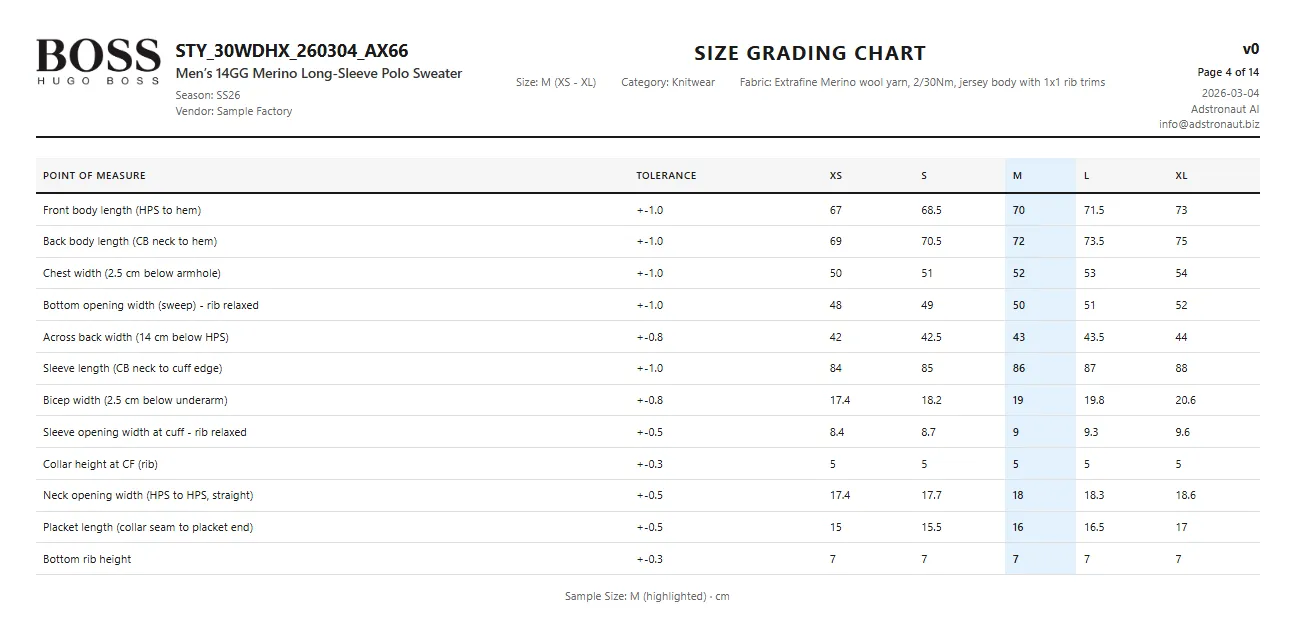 A grading table showing how measurements scale from XS to XL with defined tolerances at each POM.
ASTM D5585 provides standardized grade rules for misses' sizing. For example, the standard chest grade between adjacent sizes is 1.5–2 inches, while waist grade is typically 1.5 inches. Many brands customize these rules to match their target fit profile.
3. Tolerances
Tolerances define the acceptable measurement variance during production. Without them, a factory has no way to determine if a finished garment passes or fails quality control.
| Measurement Area | Typical Tolerance |
|---|---|
| Chest width | ±½" (±1.3 cm) |
| Body length | ±½" (±1.3 cm) |
| Sleeve length | ±¼" (±0.6 cm) |
| Neck opening | ±⅛" (±0.3 cm) |
| Cuff width | ±¼" (±0.6 cm) |
| Collar point | ±⅛" (±0.3 cm) |
Tighter tolerances (±⅛") are applied to high-visibility areas like collars and cuffs, while more relaxed tolerances (±½") are acceptable for body measurements where slight variation is less noticeable.
What a Tech Pack Contains
A tech pack includes everything in a spec sheet, plus the following additional sections. Here is what those extra 8–12 pages cover.
1. Technical Flat Sketches
Flat sketches are 2D line drawings showing the garment front, back, and any necessary detail views. They are not fashion illustrations — they are dimensionally accurate technical drawings that communicate construction intent.
A professional flat sketch includes:
- Proportionally accurate silhouette
- All seam lines, topstitching, and edge finishes
- Pocket placement, closure details, and hardware
- Detail callouts for complex areas (collar construction, cuff design)
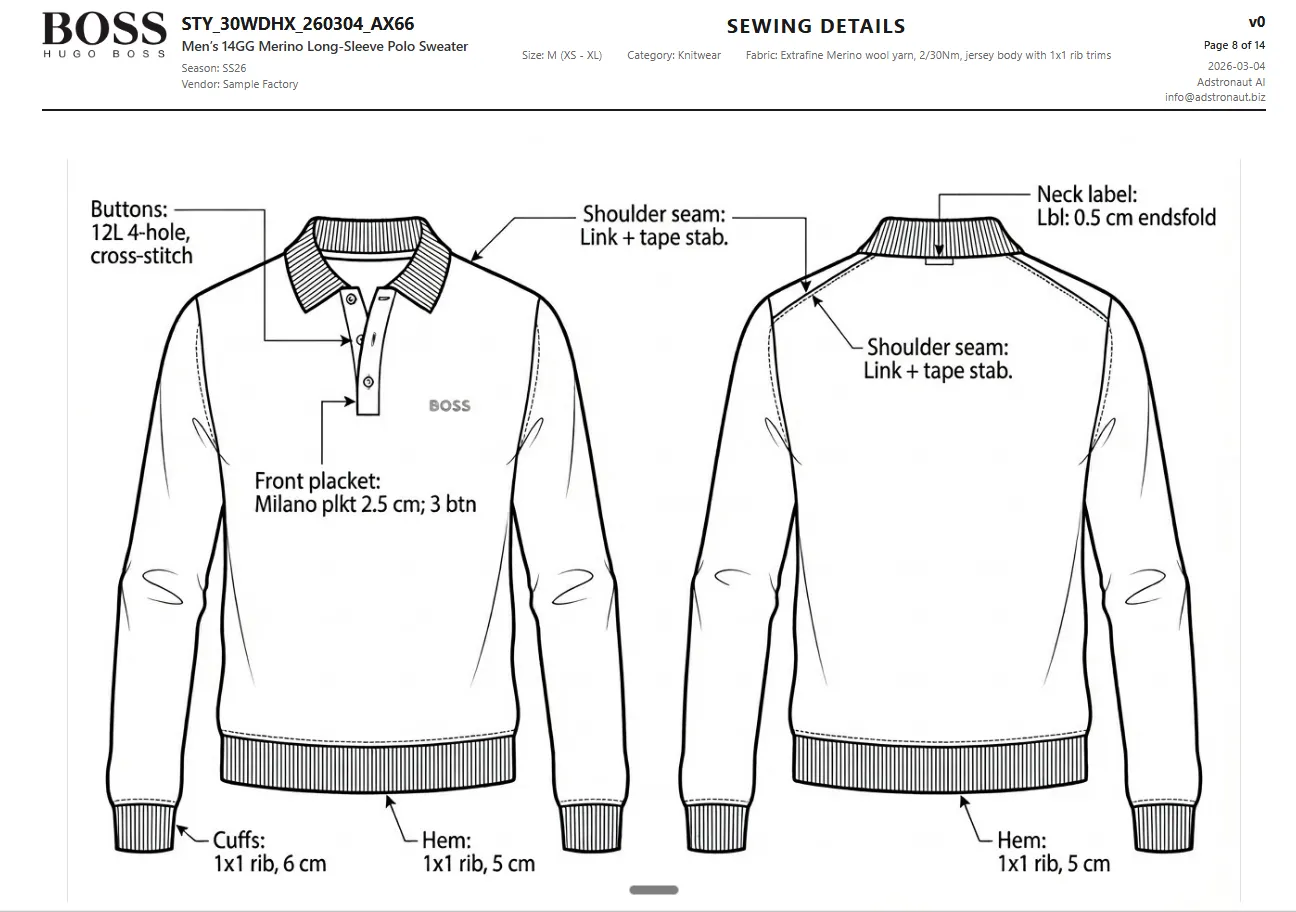 Flat sketch with zoomed detail callouts showing stitch types, seam allowances, and edge finishing.
2. Bill of Materials (BOM)
The BOM lists every physical component needed to produce one unit of the garment. For even a basic t-shirt, this includes 8–12 line items. A lined jacket may require 25–40+ components.
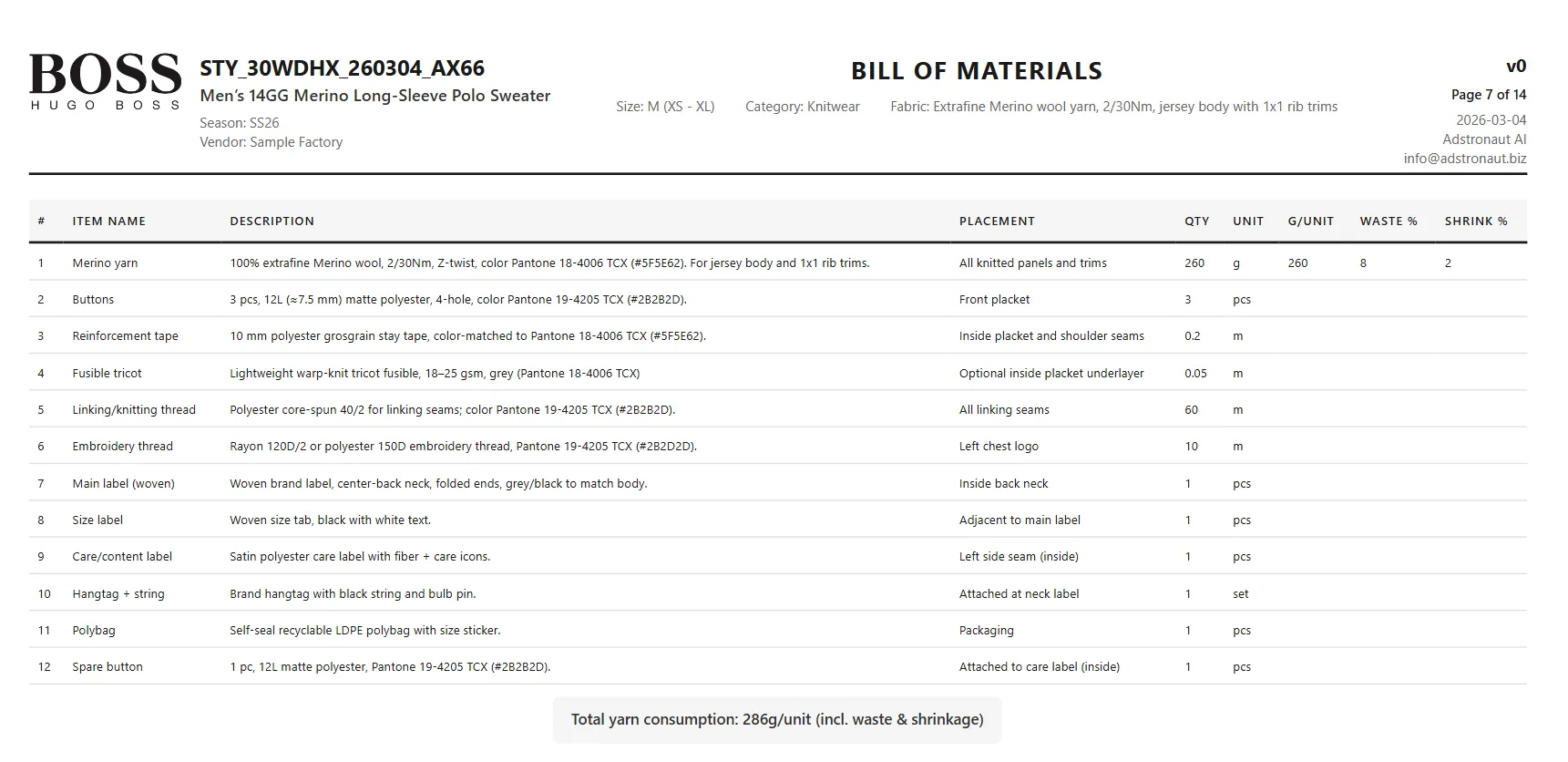 A BOM section listing shell fabric, lining, interlining, thread, zipper, buttons, labels, and packaging components.
A complete BOM entry includes:
- Component name and category (shell, lining, trim, hardware)
- Supplier or reference number
- Fiber content and weight (GSM for fabrics)
- Color with Pantone TCX code
- Quantity per garment
- Placement location
3. Construction and Sewing Details
This section specifies how the garment is assembled:
- Stitch types using ISO 4915 standard codes (e.g., 301 lockstitch, 401 chainstitch, 504 overlock)
- Seam types (e.g., flat-felled, French seam, superimposed)
- Stitch density (stitches per inch/cm)
- Seam allowance widths
- Assembly sequence for complex constructions
4. Colorways and Artwork
Each color variation of the style gets a dedicated specification showing:
- Pantone TCX code for every component (shell, contrast, lining, thread, hardware)
- Print or embroidery artwork with exact placement dimensions
- Print technique (screen print, DTG, sublimation, heat transfer)
- Embroidery specifications (stitch count, thread colors, backing type)
5. Labels and Packaging
The final section covers:
- Main label (brand label) — position, size, attachment method
- Care label — content, required international symbols
- Size label — position and format
- Hang tags and price tickets
- Folding method, polybag specifications, carton packing
When You Need a Spec Sheet Alone vs a Full Tech Pack
Understanding when each document is appropriate can save you both time and money.
When a Spec Sheet Is Enough
| Scenario | Why a Spec Sheet Works |
|---|---|
| Reordering an existing style | Factory already has the tech pack on file; you only need updated measurements |
| Internal fit sessions | Your team is evaluating sample fit and recording corrections |
| Communicating with a pattern maker | Pattern makers need dimensions, not full manufacturing details |
| Blanks/basics with no custom construction | You're customizing a stock garment (e.g., adding a print to a Bella+Canvas blank) |
When You Need a Full Tech Pack
| Scenario | Why a Tech Pack Is Required |
|---|---|
| First production run with a new factory | The factory has zero context about your brand or standards |
| New style development | Any design that hasn't been produced before |
| Complex garments | Outerwear, tailoring, activewear with technical features |
| Overseas manufacturing | Language barriers make detailed documentation critical |
| Scaling production | Multiple factories or large orders need consistent documentation |
A survey by Techpacker found that brands working with overseas factories (which represents 97% of U.S. apparel production) require a full tech pack for every new style — spec sheets alone result in unacceptable ambiguity when working across languages and time zones (Techpacker, 2023 Industry Report).
The Naming Confusion
Here is one of the most common points of confusion in fashion product development: many people say "spec sheet" when they actually mean "tech pack."
This happens for several reasons:
- The spec sheet is the most-referenced page — designers and buyers spend more time reviewing measurements than any other section, so the terms become conflated
- Legacy terminology — before digital tech packs became standard, many factories worked from hand-drawn spec sheets pinned to physical samples
- Template confusion — online searches for "spec sheet template" often return full tech pack templates, reinforcing the mix-up
- Software naming — some PLM systems label the measurement module "spec sheet" even when it lives inside a larger tech pack document
How to tell which one someone means: If they reference materials, construction, or colorways, they mean a tech pack. If they only mention measurements and sizes, they mean a spec sheet.
The practical impact: if a factory asks you for a "spec sheet" and you send only measurements, they will follow up asking for the rest of the tech pack. If a freelancer offers to create your "spec sheet" for $50, clarify whether that includes flat sketches, BOM, and construction details — or just the measurement page.
How Factories Respond to Each Document
The document you send directly affects your timeline, costs, and sample quality.
Sending a Spec Sheet Alone
When a factory receives only a spec sheet:
- They cannot quote accurately — material costs, construction complexity, and time per unit are unknown
- They will send 10–20 follow-up questions before starting: What fabric? What weight? What stitch types? What labels? What packaging?
- First samples take 30–50% longer because of back-and-forth clarification
- More sample rounds are needed — 3.5–4.5 average revisions vs 1.5–2 with a tech pack
- Total cost per style increases by $800–$2,500 due to extra sampling and communication time
Sending a Complete Tech Pack
When a factory receives a full tech pack:
- They can provide an accurate quote within 48–72 hours
- Pattern making begins immediately — no clarification delays
- First samples are closer to approval — fewer surprises
- Average of 1.5–2 sample revisions before production approval
- Production timeline is 2–4 weeks shorter overall
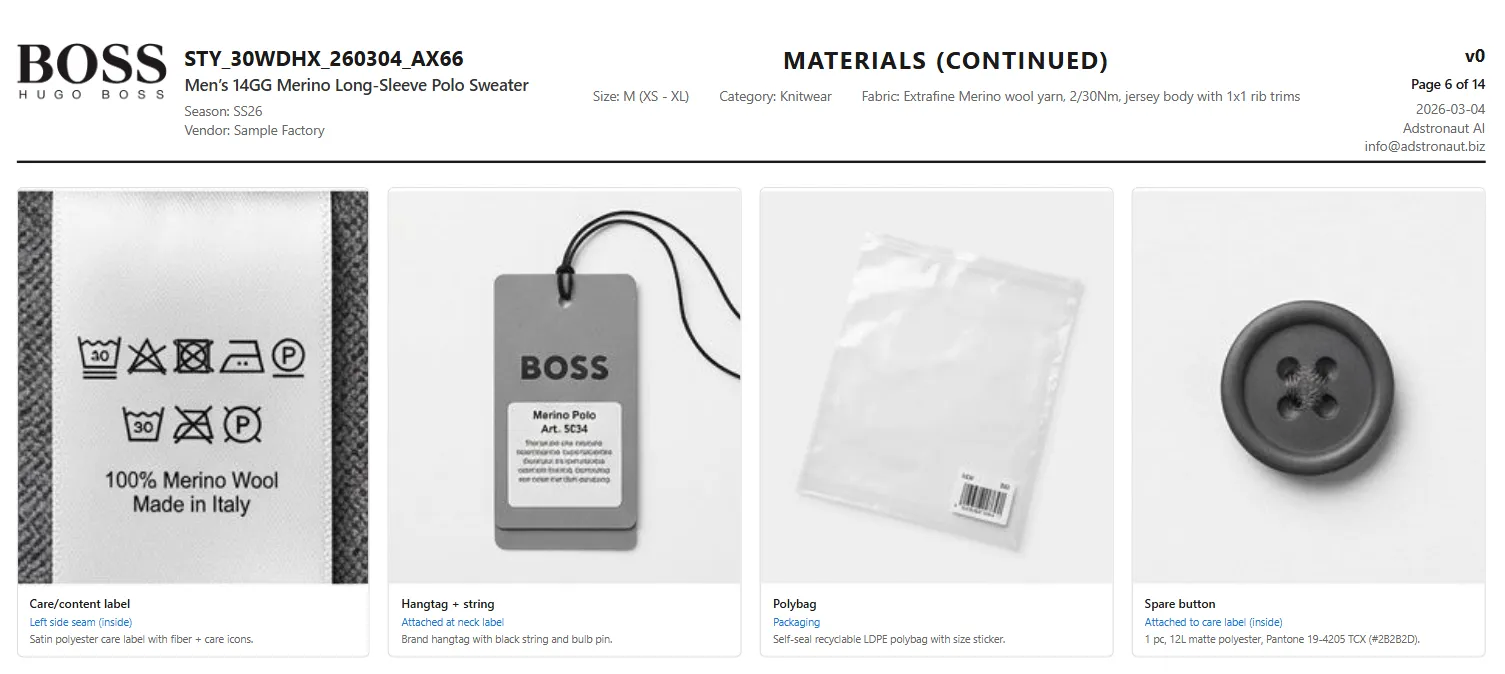 A complete tech pack PDF showing all pages — from flat sketch to BOM to measurements to construction details.
The math is straightforward: a tech pack costs $250–$750 to create with a freelancer (or $5–$20 with AI tools). Skipping it costs $800–$2,500+ in extra revisions and delays. The return on investment is 3–10× for every style.
How to Create Both with AI
Traditional tech pack creation requires Adobe Illustrator proficiency, pattern-making knowledge, and 4–8 hours per style. AI tools have compressed this process dramatically.
Creating a Tech Pack with Adstronaut AI
- Upload your garment image — a photo, sketch, or reference image
- AI generates the flat sketch — clean front and back technical drawings
- Input your base size measurements — the system auto-calculates grading across all sizes
- Review the auto-generated BOM — AI identifies fabric type, trim, and components from the image
- Add construction details — specify stitch types, seam finishes, and special instructions
- Export a factory-ready PDF — a complete 10–15 page tech pack in minutes, not days
The spec sheet is automatically included as a dedicated section within the tech pack, with properly formatted POMs, grade rules, and tolerances.
Time and Cost Comparison
| Method | Time per Style | Cost per Style | Spec Sheet Included? |
|---|---|---|---|
| Freelance technical designer | 4–8 hours | $250–$750 | Yes (within tech pack) |
| In-house technical designer | 2–4 hours | $75–$150 (salary-adjusted) | Yes |
| Adstronaut AI | 10–30 minutes | $5–$20 | Yes |
| Manual spec sheet only | 1–2 hours | $50–$150 | Spec sheet only, no tech pack |
For emerging brands producing 10–50 styles per season, the difference between freelancer costs ($2,500–$37,500) and AI-assisted creation ($50–$1,000) is significant enough to reallocate budget toward sampling and marketing.
Try the AI tech pack generator →
Frequently Asked Questions
Is a spec sheet the same as a tech pack?
No. A spec sheet is a 1–3 page document focused exclusively on garment measurements — points of measure, grade rules, and tolerances. A tech pack is a 10–15 page complete manufacturing document that contains the spec sheet plus flat sketches, bill of materials, construction details, colorways, artwork placement, and packaging instructions. The spec sheet is one section within a tech pack.
Can I send a factory just a spec sheet?
You can, but it's not recommended for new styles. A spec sheet alone lacks material specifications, construction details, and visual references, forcing the factory to guess or ask follow-up questions. Most factories require a full tech pack before they will quote or begin sampling a new style. The exception is reorders of existing styles where the factory already has the original tech pack on file.
How many pages is a typical spec sheet vs a tech pack?
A spec sheet is typically 1–3 pages: a measurement table, a flat sketch reference with POM callouts, and optionally a tolerance chart. A tech pack ranges from 8–15 pages depending on garment complexity. A basic t-shirt tech pack is usually 8–10 pages, while a lined jacket or outerwear piece can reach 15–20 pages.
What does POM mean on a spec sheet?
POM stands for "Point of Measure" — a specific, named location on a garment where a measurement is taken. Examples include "Chest Width (1" below armhole)," "Center Back Length," "Sleeve Length from High Point Shoulder," and "Across Shoulder." ASTM standards define standard POMs for different garment categories to ensure consistency across the industry.
How much does it cost to create a spec sheet vs a tech pack?
A standalone spec sheet created by a freelancer typically costs $50–$150. A complete tech pack from a freelancer costs $250–$750 depending on garment complexity. AI tools like Adstronaut can generate a full tech pack (including the spec sheet) for $5–$20 in 10–30 minutes. Create your tech pack here →
Do I need a new tech pack for each colorway?
No. A single tech pack covers all colorways of a style. The colorway section within the tech pack specifies Pantone codes for every component (shell, lining, trim, thread, hardware) across all color options. You only need a separate tech pack when the construction, fit, or materials change — not just the color.
What software do factories expect tech packs in?
Most factories accept tech packs as PDF files. Some also accept Excel-based tech packs. The format matters less than the content — as long as all required sections are present and clearly organized, factories can work with it. Avoid sending editable Illustrator or Photoshop files; always export a flat PDF for production use.
Who is responsible for creating the tech pack — the designer or the factory?
The brand or designer is responsible for creating and providing the tech pack. The factory's job is to execute the specifications in the tech pack, not to create them. Some full-service factories or agents offer tech pack creation as an add-on service (typically $200–$500 per style), but this gives the factory control over your specifications — which can be a disadvantage during negotiations or if you switch manufacturers.
What happens if my tech pack has errors?
Tech pack errors propagate through every unit produced. A measurement error affects the entire size run. A BOM error means wrong materials are ordered in bulk. According to industry estimates, a single critical tech pack error costs brands $500–$5,000+ depending on when it's caught — during sampling (cheapest), during production (expensive), or after delivery (most expensive). This is why review and revision tracking are essential tech pack practices.
Can I use the same spec sheet for different factories?
Yes, and you should. Your spec sheet (and tech pack) represents your brand's standards, not a factory's preferences. Using consistent documentation across factories ensures consistent product quality regardless of where it's manufactured. The only adjustments should be factory-specific notes about equipment or process preferences, added as supplementary instructions.
Ready to create a factory-grade tech pack — spec sheet included? Adstronaut AI generates complete, professional tech packs from a single garment image. No Illustrator skills required.