Footwear Tech Pack — Sneaker & Shoe Manufacturing Specs Guide
A footwear tech pack is a technical manufacturing document that specifies last shape and dimensions, upper materials and construction, sole unit composition (outsole, midsole, insole), closure and hardware details, size grading across EU 35–48, and Pantone colorway callouts. The global footwear market reached $387.74 billion in 2024 (Grand View Research, 2024), yet sample rejection rates for new shoe brands run 40–60% on first submissions — largely because incomplete tech packs force factories to guess on critical specifications like last curve, sole attachment method, and material layering.
This guide covers every section of a factory-ready footwear tech pack, the key differences from apparel tech packs, common mistakes that destroy first samples, and how to generate one in minutes. Start from the free sneaker tech pack template if you want a ready-made structure. New to tech packs? Start with our complete guide to fashion tech packs.
Table of Contents
- What Is a Footwear Tech Pack?
- Why Shoes Are the Most Complex Product to Spec
- Key Sections of a Footwear Tech Pack
- 1. Technical Sketches — Lateral & Top Views
- 2. Measurements & Size Grading
- 3. Upper Materials Specification
- 4. Sole Unit Specification
- 5. Closure & Hardware
- 6. Colorways & Pantone Callouts
- 7. Construction & Sewing Details
- Footwear vs. Apparel Tech Packs — Key Differences
- Common Footwear Tech Pack Mistakes
- Create Your Footwear Tech Pack in Minutes
- Frequently Asked Questions
What Is a Footwear Tech Pack?
A footwear tech pack is the manufacturing blueprint that tells a shoe factory exactly how to build your product. It goes beyond the visual design and defines the engineering of the shoe — what materials are layered where, how the upper attaches to the sole, what adhesives or stitching methods are used, and how every measurement scales across a full size run.
Where an apparel tech pack might contain 5–8 pages, a footwear tech pack typically runs 8–15 pages because shoes require specifications that clothing simply does not: last dimensions, sole unit breakdowns (outsole, midsole, insole as separate components), heel-to-toe drop calculations, and hardware specs for closures like buckles, D-rings, and aglets.
Without this document, a factory cannot quote accurately, source the right materials, or produce a sample that matches your intent.
Why Shoes Are the Most Complex Product to Spec
A basic sneaker contains 15–30+ individual components. A performance running shoe can exceed 50. For comparison, a t-shirt has 3–5 components and a jacket has 15–25. According to the World Footwear Yearbook (APICCAPS, 2024), global footwear production reached 23.9 billion pairs in 2023, yet the industry's average first-sample approval rate remains below 50%.
Component count by shoe type:
| Shoe Type | Typical Component Count | Key Complexity Driver |
|---|---|---|
| Canvas sneaker | 15–20 | Vulcanized sole attachment |
| Leather dress shoe | 20–30 | Goodyear welt / Blake stitch |
| Running shoe | 30–50 | Multi-density midsole, engineered mesh |
| Hiking boot | 35–55 | Waterproof membrane, crampon compatibility |
| Fashion sneaker (chunky) | 25–40 | Multiple overlay materials, platform sole |
This component density is why footwear tech packs need dedicated sections that apparel packs simply do not require.
Key Sections of a Footwear Tech Pack
1. Technical Sketches — Lateral & Top Views
Unlike apparel (front and back views), footwear requires a lateral (side) view and a top-down view as the primary sketches. The lateral view shows the silhouette, sole profile, and overlay placement. The top view reveals the tongue shape, lacing pattern, and collar opening.
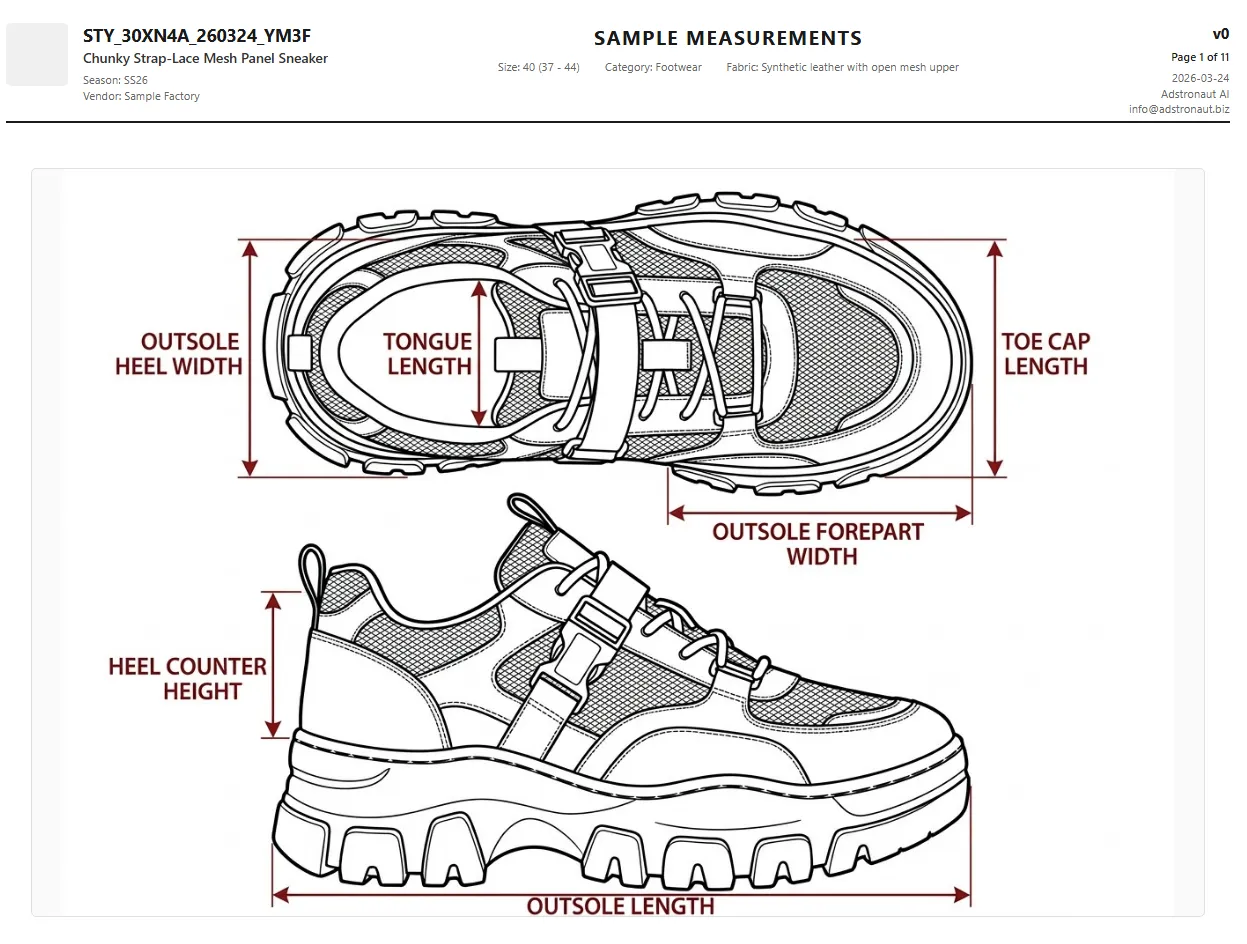 Lateral and top view sketches with measurement annotation points.
What the factory needs from your sketches:
- Lateral view: Heel height, toe spring, sole thickness at ball and heel, overlay edge positions
- Top view: Throat line shape, tongue width, collar opening dimensions, lace stay spacing
- Medial view (optional): If the inner side design differs from the outer
Adstronaut AI Feature: When you upload a shoe photo, the AI generates both lateral and top-down technical sketches automatically — something that traditionally requires a skilled footwear illustrator and 4–8 hours of work per style.
2. Measurements & Size Grading
Footwear sizing is fundamentally different from apparel. Instead of alpha sizes (S, M, L, XL), shoes use numeric sizing systems — and the grading math is completely different.
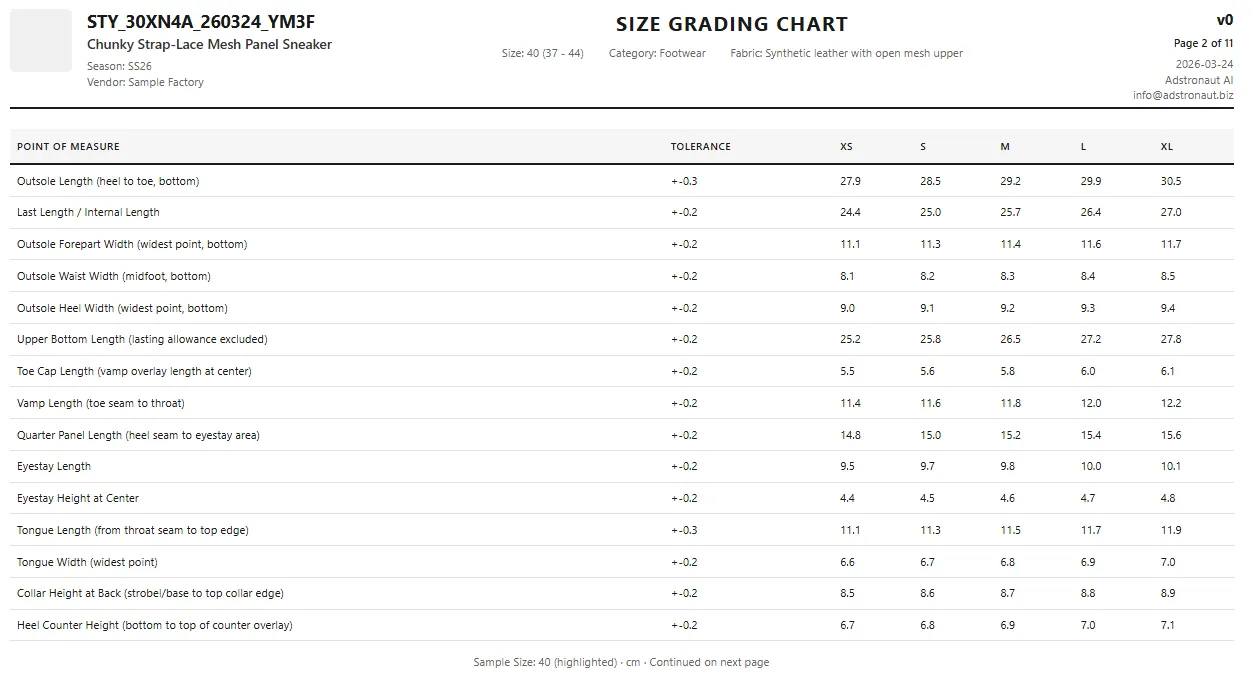 Size grading table showing 16 measurement points across EU 37–44.
Critical footwear measurements (16+ points):
| Measurement | Description | Typical Grade Rule (per EU size) |
|---|---|---|
| Outsole length | Total length of the outsole | 6.67 mm |
| Outsole width (ball) | Width at the widest point | 2–3 mm |
| Vamp length | Toe tip to throat line | 3–4 mm |
| Heel height | Ground to heel collar | 1–2 mm |
| Collar circumference | Opening the foot enters | 3–5 mm |
| Tongue length | Base to tip of tongue | 2–3 mm |
| Heel counter height | Height of the stiffener | 1–1.5 mm |
| Toe spring | Upward curve at the toe | 0.5–1 mm |
| Midsole thickness (heel) | Cushioning at the heel | 0–1 mm |
| Midsole thickness (forefoot) | Cushioning at the ball | 0–1 mm |
The sizing system challenge: Your tech pack must specify the target market's sizing system. A factory in China works in EU sizing, but your US customers expect US sizing. According to the American Orthopaedic Foot & Ankle Society, 88% of people wear shoes that don't properly fit (AOFAS) — much of this originates from conversion errors between sizing systems.
| Region | System | Size Range (Men) | Size Range (Women) |
|---|---|---|---|
| US | US sizing | 7–13 | 5–11 |
| EU | EU/French | 40–47 | 36–42 |
| UK | UK sizing | 6.5–12.5 | 3.5–9 |
| Japan | cm (Mondopoint) | 25.0–30.0 | 22.0–27.0 |
Your tech pack should include a conversion table so the factory grades in one system while your sales team references another.
3. Upper Materials Specification
The upper is everything above the sole — and it is where most of your design differentiation lives. A single sneaker upper can use 6–12 different materials, each requiring its own specification line.
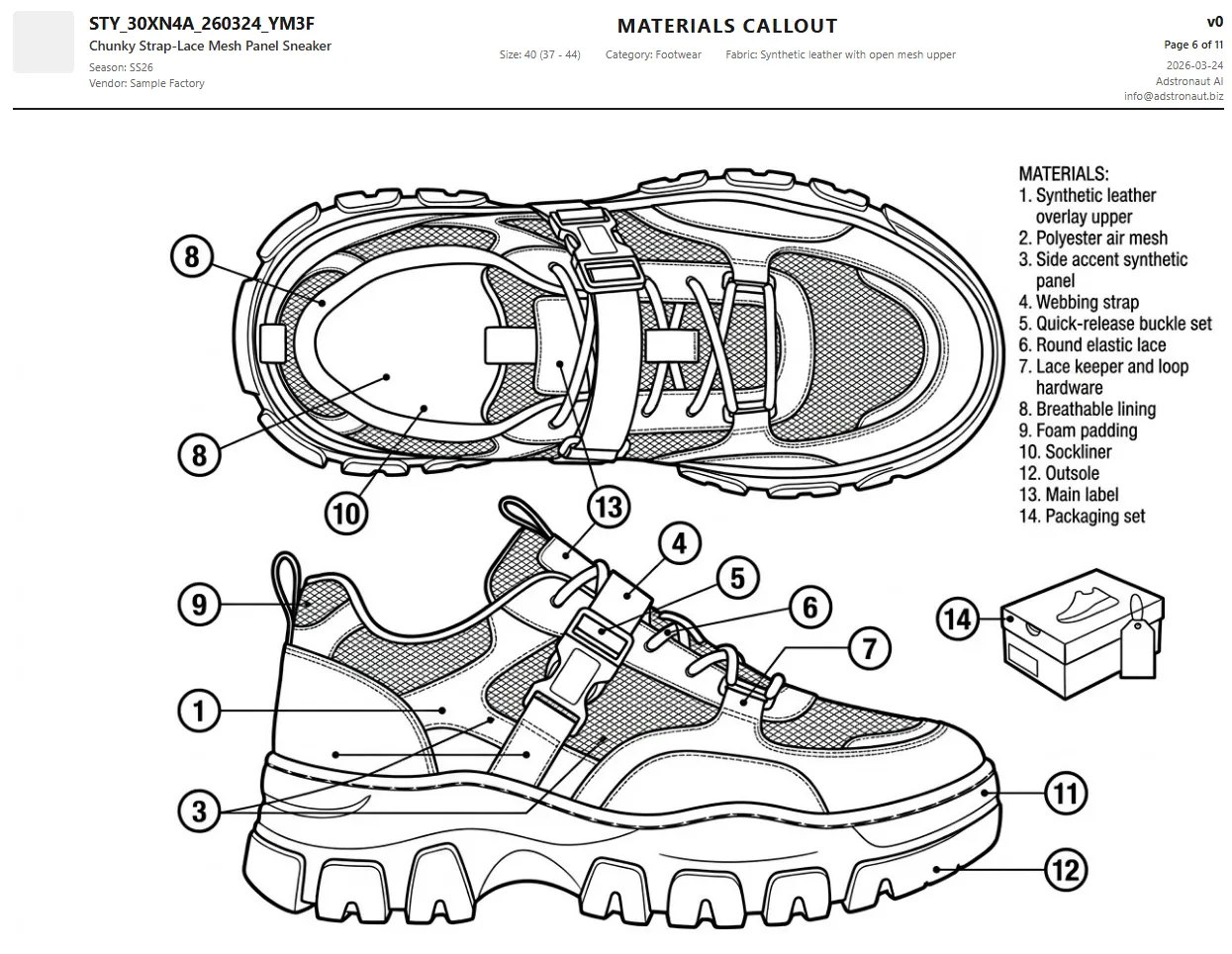 Numbered callout diagram identifying all upper components on the technical sketch.
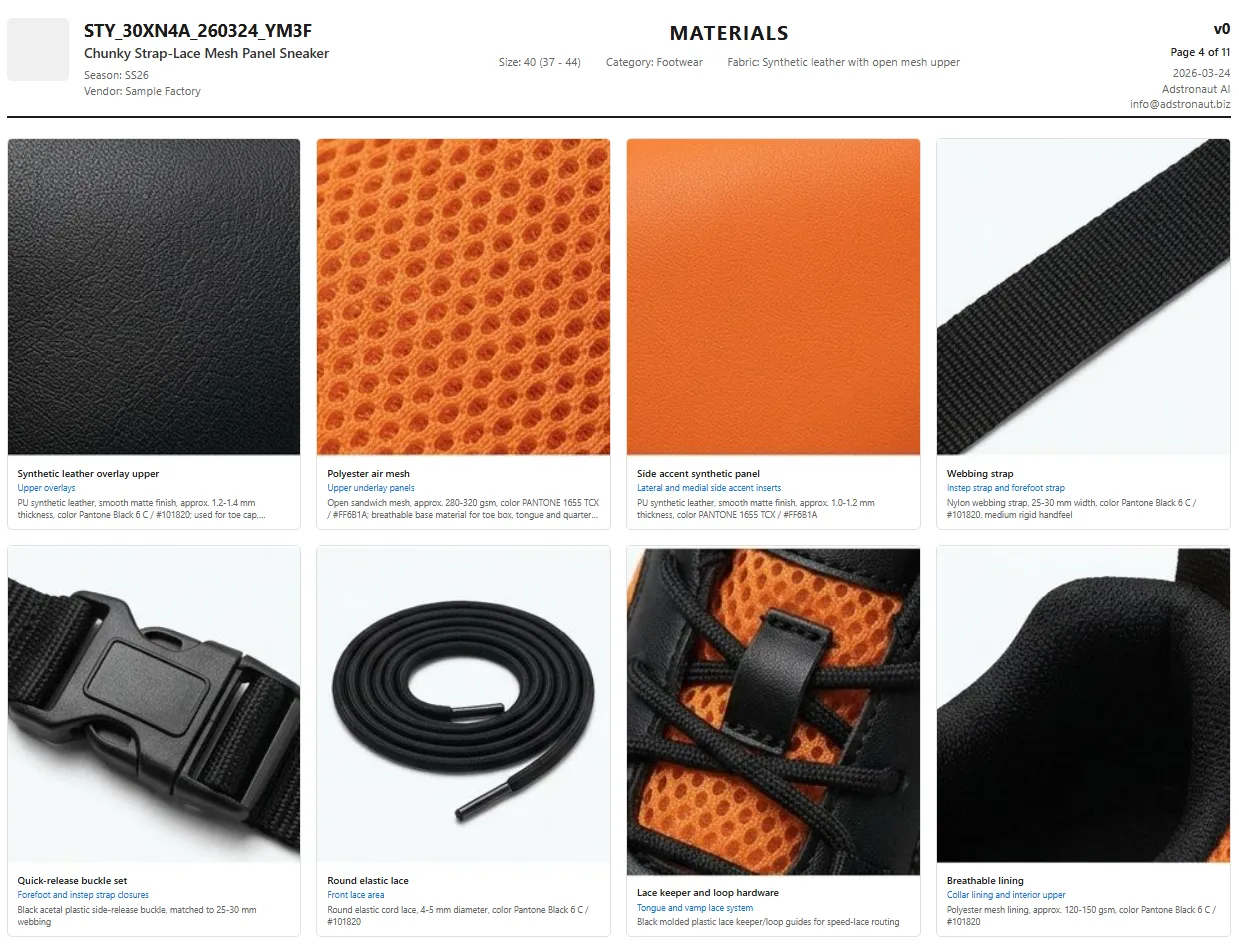 Material sample grid showing reference images for each specified component.
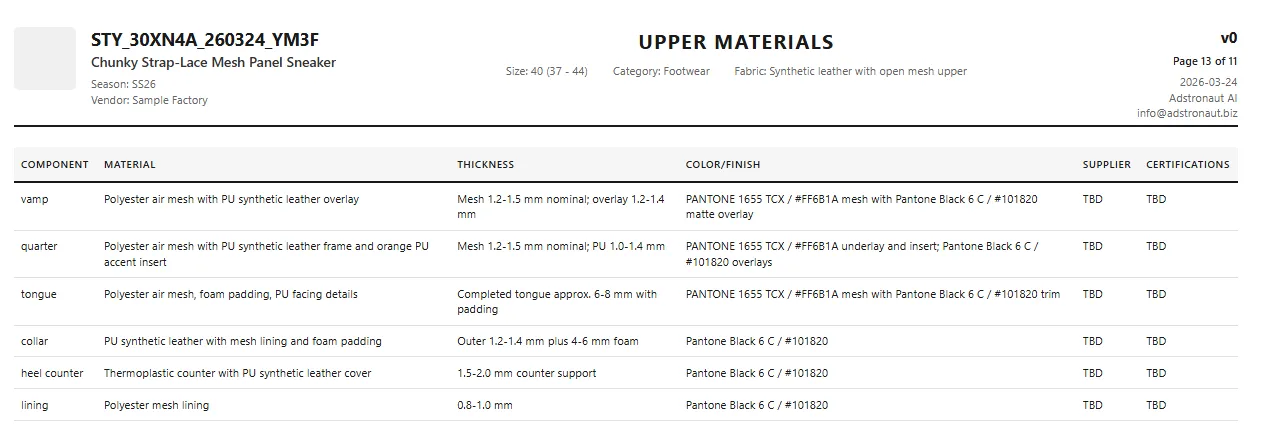 Upper materials table with component name, material type, weight, color, and supplier reference.
Standard upper material specifications:
| Component | Typical Materials | What to Specify |
|---|---|---|
| Vamp (toe box area) | Leather, synthetic, mesh | Thickness (mm), color, finish |
| Quarter (side panels) | Leather, suede, nylon | Thickness, perforations, backing |
| Tongue | Mesh, foam-padded nylon | Thickness, foam density, logo placement |
| Collar / Topline | Padded textile, leather | Foam thickness, binding tape width |
| Heel counter | Thermoplastic, leather | Stiffness rating, height |
| Lining | Textile, leather, mesh | Breathability, moisture-wicking specs |
| Toe cap / mudguard | Rubber, TPU | Thickness, hardness (Shore A) |
| Overlays | Leather, TPU, no-sew film | Thickness, edge treatment |
Each material must include a supplier reference or Pantone color so the factory sources exactly what you intend.
Generate your footwear tech pack from a photo →
4. Sole Unit Specification
The sole unit is where footwear tech packs diverge most dramatically from apparel. A shoe's sole is not one piece — it is typically three separate components that are manufactured independently and then bonded or stitched together.
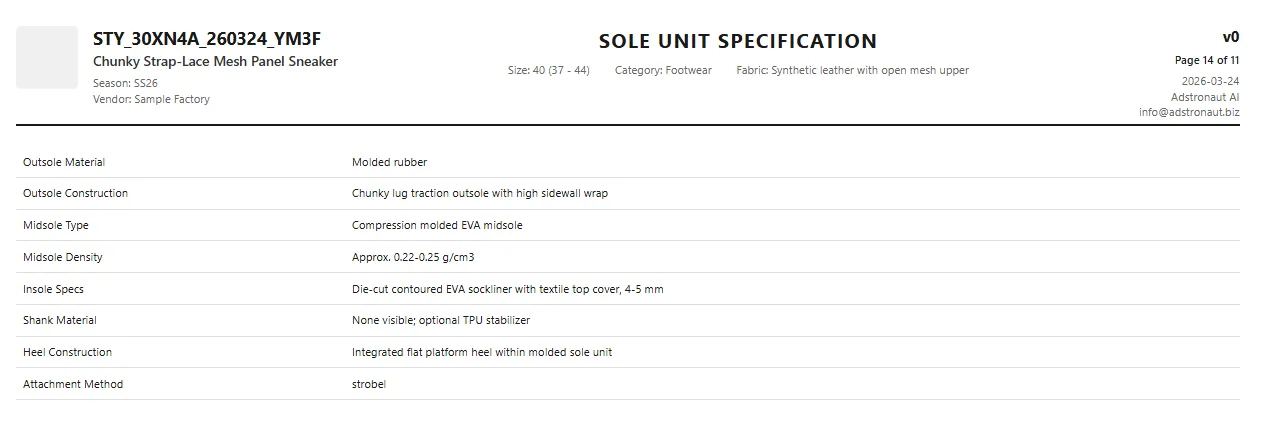 Sole unit breakdown showing outsole, midsole, insole, and attachment method.
Sole unit components:
| Component | Function | Common Materials | Key Spec |
|---|---|---|---|
| Outsole | Ground contact, traction | Rubber (carbon, blown), TPR, EVA | Hardness (Shore A 55–70), tread pattern |
| Midsole | Cushioning, energy return | EVA, PU, TPU, Phylon | Density (g/cm³), heel-to-toe drop (mm) |
| Insole | Comfort, arch support | Molded EVA, OrthoLite, PU foam | Thickness, removable vs. fixed |
| Strobel board | Upper-to-sole connection | Non-woven textile | Weight, flexibility |
Sole attachment methods (critical specification):
| Method | Best For | Description |
|---|---|---|
| Cement / cold-glue | Sneakers, casual shoes | Adhesive bond, most common method |
| Strobel stitching | Athletic shoes | Upper sewn to a fabric board, then glued to midsole |
| Vulcanized | Canvas shoes, skate shoes | Upper and sole bonded under heat and pressure |
| Blake stitch | Dress shoes | Sole stitched directly through the insole |
| Goodyear welt | Boots, luxury dress shoes | Sole stitched to a welt strip, most durable |
The global athletic footwear market alone is projected to reach $248 billion by 2032 (Allied Market Research, 2024), and the vast majority of those shoes use either cement or strobel construction. Specifying the wrong attachment method on your tech pack can add weeks and thousands of dollars to your development cycle.
5. Closure & Hardware
Every buckle, eyelet, D-ring, and lace tip must be specified by material, finish, and dimensions. Factories do not assume — if you omit aglet specs, you will receive the cheapest plastic option.
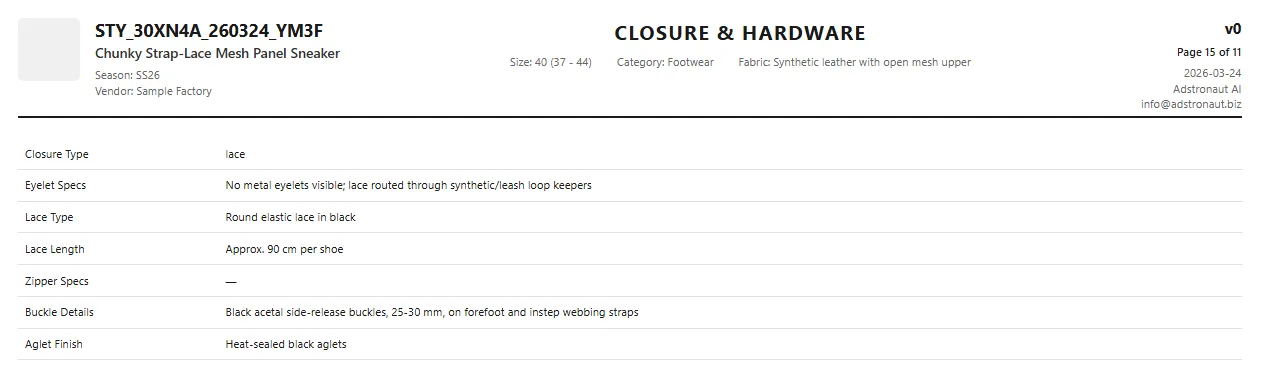 Closure and hardware table with material, finish, and dimension callouts.
Common closure and hardware specs:
| Component | Options | What to Specify |
|---|---|---|
| Laces | Flat, round, rope, elastic | Width (mm), material, length per size, tip treatment |
| Eyelets | Metal, embroidered, blind | Diameter (mm), finish (nickel, matte black, antique brass) |
| Aglets | Metal, heat-shrink, silicone dip | Length (mm), material, logo deboss (Y/N) |
| Buckles | Metal, plastic | Size (mm), finish, spring bar vs. pin |
| D-rings | Metal, plastic | Inner diameter (mm), gauge, finish |
| Zippers | YKK, SBS | Gauge (#3, #5), type (coil, molded), pull shape |
| Velcro / hook-and-loop | Nylon, polyester | Width (mm), strength rating |
Adstronaut AI Feature: The Closure & Hardware tab automatically identifies visible hardware from your uploaded photo and pre-populates specifications, which you can then refine.
6. Colorways & Pantone Callouts
A single shoe style often ships in 3–8 colorways. Each colorway requires a separate Pantone specification for every material zone — and shoes have far more color zones than most garments.
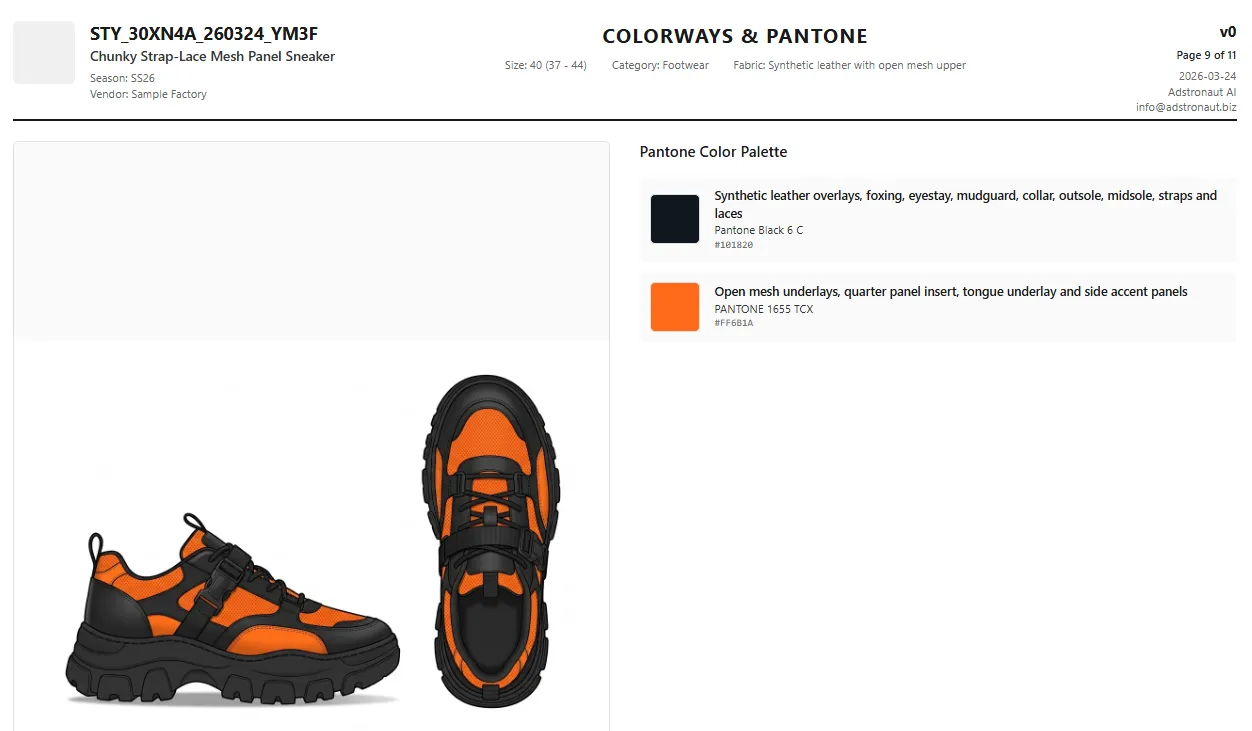 Colorway page with Pantone references for each material zone.
What to include per colorway:
- Pantone reference for every upper component (vamp, quarter, tongue, collar, overlays)
- Outsole color (Pantone or factory standard)
- Midsole color
- Lace color
- Hardware finish (if it changes per colorway)
- Stitching thread color
A typical sneaker with 10 color zones across 4 colorways requires 40 individual Pantone callouts. Missing even one forces the factory to choose for you.
7. Construction & Sewing Details
This section specifies how every seam, edge, and joint is executed. Footwear construction is far more varied than apparel — you are bonding leather to rubber, stitching through multiple material layers, and reinforcing stress points that bear the wearer's full body weight.
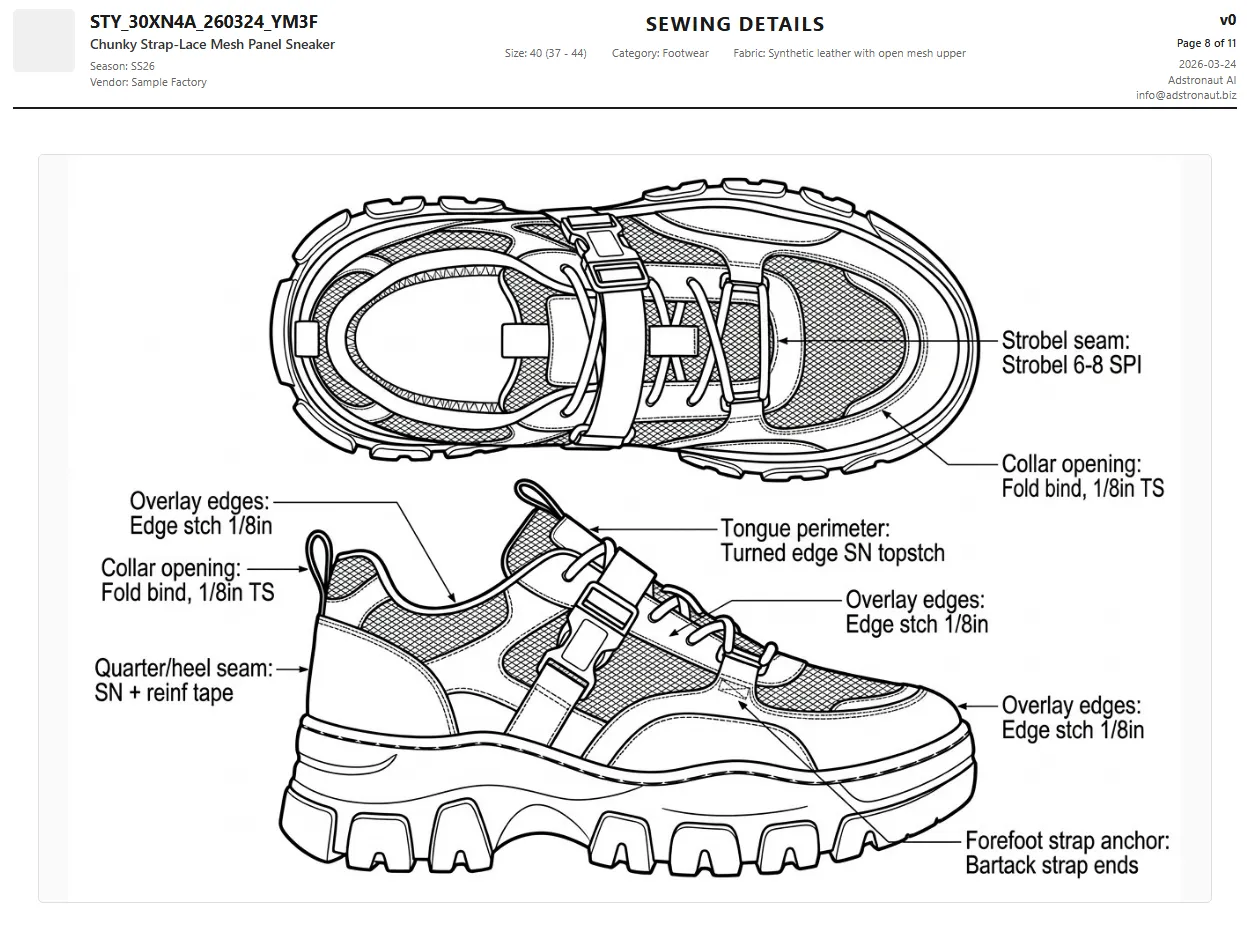 Construction callout diagram showing stitch types, edge treatments, and reinforcement zones.
Key construction callouts:
- Stitch type per seam: Lockstitch, chain stitch, or blind stitch
- Stitch density: Stitches per inch (SPI), typically 8–12 for footwear
- Edge treatments: Folded, raw-cut, bound, heat-sealed, no-sew welded
- Reinforcement zones: Heel, toe box, lace stay anchors
- Lasting method: Board lasted, slip lasted, or combination lasted
Footwear vs. Apparel Tech Packs — Key Differences
If you have experience creating apparel tech packs, footwear will challenge your assumptions. Here are the critical differences:
| Aspect | Apparel Tech Pack | Footwear Tech Pack |
|---|---|---|
| Sizing system | Alpha (XS–3XL) or numeric (0–16) | EU 35–48 / US 5–14 / UK / Mondopoint |
| Primary sketch views | Front & back | Lateral & top-down |
| Component count | 3–25 per garment | 15–50+ per shoe |
| Material sections | 1 BOM table | Upper materials + sole unit + hardware (3 separate sections) |
| Fit reference | Body measurements | Last shape and dimensions |
| Construction attachment | Sewing only | Cementing, stitching, vulcanizing, welting |
| Grading increments | 1–2 inches per size | 6.67 mm per EU size |
| 3D form reference | Dress form / mannequin | Last (wooden or plastic foot form) |
| Testing standards | Shrinkage, pilling, colorfastness | Flex endurance, abrasion (10,000+ cycles), sole adhesion |
The biggest mental shift: apparel is flat pattern work assembled into 3D; footwear is 3D form work (the last) wrapped with flat materials. Your tech pack must reference the last because it determines the entire fit, toe shape, and arch profile of the finished shoe.
Create your shoe tech pack in minutes →
Common Footwear Tech Pack Mistakes
1. Missing Last Specifications
The last is to a shoe what a dress form is to a garment — except far more critical. If you do not specify last shape, toe style (round, pointed, square), and heel height, the factory will use their stock last, which will not match your design intent. Always include last type, toe shape, and heel pitch angle.
2. Wrong Sole Attachment Method
Specifying "glued" when you need strobel construction, or requesting Goodyear welt on a sneaker, will either get rejected by the factory or result in a shoe that falls apart. Match the attachment method to your shoe type and price point.
3. Incomplete Upper Materials
Listing "leather" without specifying thickness, finish (matte, gloss, pebbled), and color is not enough. The factory needs a complete material spec for every numbered zone on your callout diagram. According to Shoe Intelligence, material specification errors account for 35% of first-sample rejections in footwear (Shoe Intelligence, 2024).
4. No Size Conversion Table
Your factory works in EU or Chinese sizing. Your customers order in US or UK sizing. If you do not provide the conversion, the factory grades in their system and discrepancies appear at the retail end.
5. Omitting Hardware Finish Specs
Lace aglets, eyelets, and buckles come in dozens of finishes. "Silver" is not a specification — is it polished nickel, brushed nickel, matte chrome, or antique silver? Specify the exact finish and plating.
6. Ignoring Heel-to-Toe Drop
For any shoe with cushioning (sneakers, running shoes, boots), the drop — the height difference between heel and forefoot — affects gait and comfort. A 10 mm drop feels very different from a 4 mm drop. Specify it explicitly.
Create Your Footwear Tech Pack in Minutes
Traditionally, creating a footwear tech pack requires a specialized footwear designer, 3–5 days of work, and deep knowledge of last construction and sole engineering. Adstronaut's AI tech pack maker is the only tool that generates footwear-specific tech packs with dedicated sections for Last & Fit, Upper Materials, Sole Unit, and Closure & Hardware — all from a single shoe photo. Open the canvas turf sneaker sample pack to see a finished footwear pack, sole unit and all.
How it works:
- Upload a photo of your shoe (sketch, sample, or reference image)
- AI generates lateral and top-down technical sketches with measurement annotations
- Footwear-specific sections auto-populate: Upper materials with numbered callout zones, sole unit breakdown, closure and hardware specs, and size grading across your selected sizing system
- Customize every detail — adjust materials, add colorways, modify measurements
- Export a factory-ready PDF or share directly with your manufacturer
No other tech pack tool on the market offers footwear-specific sections. Generic tech pack templates force you to repurpose apparel fields for shoe specs, which leads to confusion and rejected samples. Producing bags or small leather goods alongside your footwear line? The leather goods tech pack guide covers hardware and edge finishing the same way — and both categories have a free tech pack template to start from.
Generate your footwear tech pack from a photo →
Frequently Asked Questions
How many pages should a footwear tech pack be?
A complete footwear tech pack typically runs 8–15 pages depending on shoe complexity. A basic canvas sneaker might need 8 pages, while a performance running shoe or leather boot can require 12–15 pages. The key sections are: technical sketches (1–2 pages), measurements and size grading (1–2 pages), upper materials (1–2 pages), sole unit (1 page), closure and hardware (1 page), colorways (1–2 pages per colorway), and construction details (1–2 pages).
What is a last, and why does it matter for my tech pack?
A last is a 3D foot-shaped form (traditionally wood, now usually plastic or aluminum) around which the shoe is constructed. It determines the toe shape, arch profile, heel height, and overall fit. Every specification in your tech pack — from vamp length to collar circumference — is measured relative to the last. If you do not specify a last type, the factory uses their stock last, which may produce a completely different silhouette than your design.
How is footwear size grading different from apparel grading?
Apparel grading scales measurements by 1–2 inches per alpha size (S, M, L). Footwear grading scales by 6.67 mm per EU size (one Paris Point), with each measurement point having its own grade rule. A size EU 42 outsole is 6.67 mm longer than EU 41, but the collar circumference may only increase by 3–5 mm. Footwear also requires cross-referencing multiple sizing systems (US, UK, EU, Mondopoint) in a single grading table.
Can I use an apparel tech pack template for shoes?
No. Apparel templates lack critical footwear sections: last specifications, sole unit breakdowns (outsole, midsole, insole), heel-to-toe drop, sole attachment methods, and hardware specs. Using an apparel template forces you to improvise these sections in notes fields, which factories frequently misinterpret. Use a footwear-specific template or a tool like Adstronaut AI that generates footwear-dedicated sections automatically.
What sole attachment method should I specify?
It depends on your shoe type and price point. Cement (cold-glue) is the most common method for sneakers and casual shoes — it is cost-effective and lightweight. Strobel stitching is standard for athletic shoes. Vulcanized is used for canvas and skate shoes. Blake stitch is common in dress shoes. Goodyear welt is the premium choice for boots and luxury shoes, offering resoling capability. Specify the method explicitly; do not leave it to the factory.
How many colorways should I include in my tech pack?
Include all colorways you plan to produce in the initial tech pack — typically 3–8 for a new style. Each colorway gets its own page with Pantone references for every material zone. This allows the factory to quote material costs for the full range upfront and identify any color-specific sourcing challenges (e.g., a specific Pantone that is not available in your chosen leather type).
What testing standards should I reference in my footwear tech pack?
Key footwear testing standards include: SATRA TM60 (sole bond strength — minimum 3.5 N/mm for casual shoes), SATRA TM174 (flex endurance — 100,000+ cycles without crack), SATRA TM144 (abrasion resistance for outsoles), and EN ISO 20345 (safety footwear requirements). Reference the applicable standards in your tech pack so the factory knows what QC benchmarks to test against during production.
How much does a footwear tech pack cost?
A freelance footwear technical designer charges $300–$2,000+ per style depending on complexity, and the process takes 3–7 business days. Specialized footwear design agencies charge $500–$3,000 per style. Adstronaut AI generates a complete footwear tech pack from a single photo for a fraction of the cost in minutes, with all footwear-specific sections included. For a full cost comparison across methods, see our tech pack cost guide.
What file format should I send my footwear tech pack to the factory in?
Send your tech pack as a PDF — it is the universal format that preserves layout, images, and color accuracy across devices and operating systems. Factories in China, Vietnam, and India all work with PDFs. Avoid sending editable files (Illustrator, Excel) as the primary deliverable, since formatting shifts between software versions. Adstronaut AI exports directly to factory-ready PDF format.