The Hidden ROI of AI Fabric Swapping for Fashion Brands
AI fabric swapping saves fashion brands $83,350–$117,350 annually — but only 15% of that comes from the obvious benefit of reduced sampling costs ($12,000–$28,000/year). The remaining 85% comes from five hidden benefits: faster time-to-market ($18,750), fewer production errors ($8,000–$12,000), better material cost decisions ($8,000–$20,000), increased creative output via more SKUs ($33,600), and improved cash flow from shorter development cycles ($3,000–$5,000). At roughly $600/year in usage costs, this represents a 13,900–19,500% return on investment.
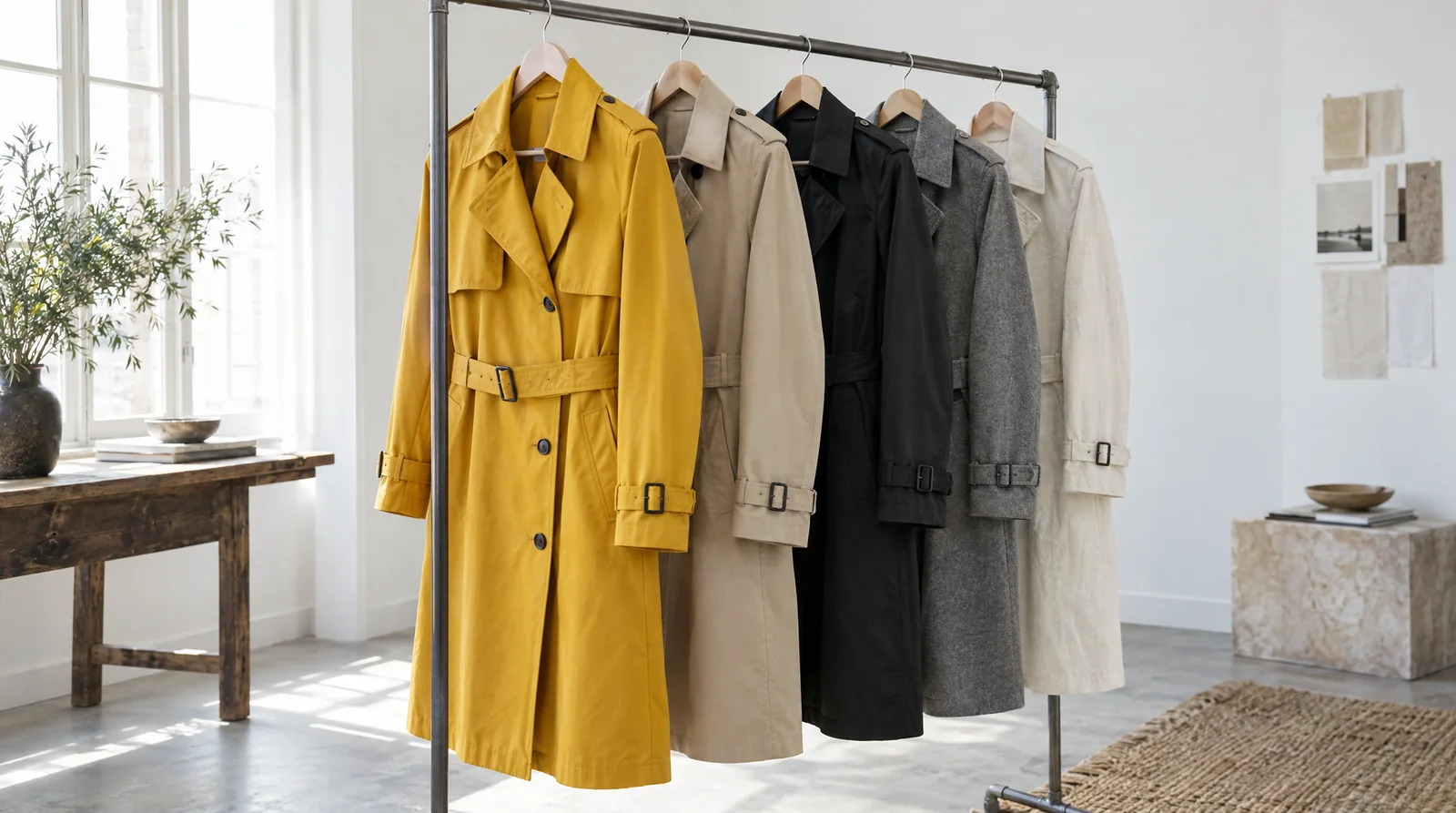
Editorial illustration: a rail of sample rounds is what a fabric decision used to cost.
This analysis breaks down each hidden benefit with detailed financial modeling for a small brand producing two 12-piece collections per year.
Table of Contents
- The Obvious Savings: Reduced Sampling Costs
- Hidden Benefit #1: Faster Time-to-Market
- Hidden Benefit #2: Reduced Production Errors and Waste
- Hidden Benefit #3: Better Decision-Making Under Uncertainty
- Hidden Benefit #4: Increased Creative Output
- Hidden Benefit #5: Improved Cash Flow and Inventory Management
- The Complete ROI Calculation
- From Cost Savings to Competitive Advantage
- Frequently Asked Questions
The Obvious Savings: Reduced Sampling Costs {#the-obvious-savings}
Let's start with the numbers everyone talks about. Traditional fabric sampling for a single design typically costs:
Traditional Fabric Selection Process:
- Fabric samples (3-5 options): $150-500
- Shipping: $20-50
- Mockup creation: $50-150
- Time cost (8-12 hours @ $50/hr): $400-600
- Total per design: $620-1,300
AI Fabric Swapping Process:
- Upload design image: Free
- Test 20 fabric options: $25 (5 credits per swap)
- Time cost (2 hours @ $50/hr): $100
- Total per design: $125
Per-Design Savings: $495-1,175
For a designer creating a 12-piece collection per season, that's $5,940-14,100 in direct savings per season. For two seasons per year, we're looking at $12,000-28,000 annually. Brands running the full 12-piece collection through Adstronaut's fabric swapper typically see the lower-cost end of that range because the AI batch-renders multiple fabric candidates from a single uploaded design image.
That alone justifies the investment. But again, this is just the beginning.
Hidden Benefit #1: Faster Time-to-Market {#faster-time-to-market}
In fashion, speed is money. Every week you shave off your product development cycle is a week closer to market, a week of potential sales, and a week less risk of trend obsolescence.
The Time Savings Breakdown
Traditional Process Timeline:
- Order fabric samples: Week 1
- Wait for delivery: Weeks 2-3
- Create mockups and evaluate: Week 4
- Make decision: Week 5
- Order production sample with chosen fabric: Week 6
- Total: 6+ weeks
AI Fabric Swapping Timeline:
- Upload image and test fabrics: Day 1
- Evaluate results and make decision: Day 2
- Order production sample with chosen fabric: Week 1
- Total: 1 week
You've just cut 5 weeks from your development cycle.
The Financial Impact of Speed
Let's say you're launching a spring jacket that will retail for $150 with 50% margin ($75 profit per unit). You expect to sell 300 units over a 12-week selling season.
Scenario A: Traditional Process (6 weeks to decision)
- Selling window: 6 weeks remaining
- Units sold: 150 (conservative estimate for shortened season)
- Profit: $11,250
Scenario B: With Fabric Swapping (1 week to decision)
- Selling window: 11 weeks remaining
- Units sold: 275 (nearly full season)
- Profit: $20,625
Hidden ROI: $9,375 in additional profit from being in market faster
This doesn't even account for the risk of trend obsolescence. A trend-driven product loses value every week you're not in market. The 5-week acceleration might be the difference between catching a trend and missing it entirely.
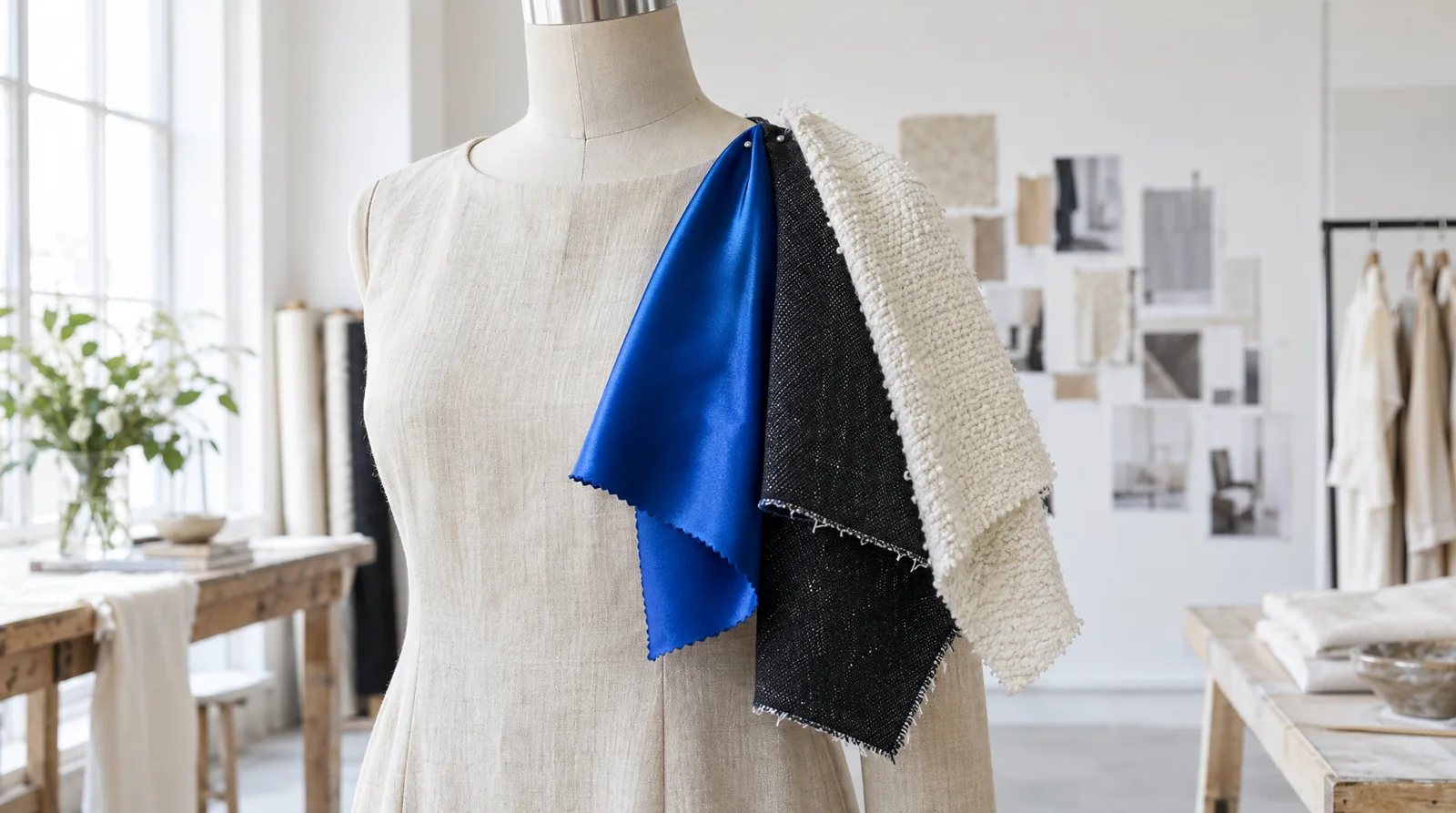
Editorial illustration: the same silhouette read three ways before a single sample is cut.
Hidden Benefit #2: Reduced Production Errors and Waste {#reduced-production-errors}
One of the most expensive mistakes in fashion is choosing the wrong fabric and not discovering it until production samples arrive. When this happens, you have three bad options:
- Restart with new fabric: Lose 4-8 weeks and $1,000-5,000 in wasted samples
- Proceed with wrong fabric: Risk product failure and brand damage
- Cancel the style: Write off all development investment
AI fabric swapping dramatically reduces this risk by letting you visualize the final product before committing to expensive sampling.
The Cost of Fabric Mistakes
Industry data suggests that 25-35% of production samples require material changes after the first sample round. This aligns with findings from Common Objective's supply chain research, which estimates that fabric-related errors account for 30% of all production sample rejections in the apparel industry, with each rejection adding an average of 4–6 weeks to development timelines. For a 12-piece collection:
Without Fabric Swapping:
- 3-4 styles require fabric changes
- Average delay: 6 weeks per style
- Average cost: $2,000 per revision (new samples, labor, shipping)
- Total impact: $6,000-8,000 in hard costs + 18-24 weeks of cumulative delay
With Fabric Swapping:
- 0-1 styles require fabric changes (90%+ confidence in initial decision)
- Average delay: 4 weeks (one style only)
- Average cost: $2,000
- Total impact: $0-2,000 in hard costs + 0-4 weeks delay
Hidden ROI: $4,000-6,000 in avoided revision costs per collection
See the ROI of fabric swapping firsthand →
Hidden Benefit #3: Better Decision-Making Under Uncertainty {#better-decision-making}
Here's a benefit that's hard to quantify but incredibly valuable: making better decisions because you have more information.
When you can only afford to test 3 fabric options, you're making decisions with incomplete data. You might be choosing the "best of three" when the perfect fabric was option #7 that you never tested.
With AI fabric swapping, you can test 20-30 fabric options for the same cost as testing 3 traditionally. This changes your decision quality:
The Value of Options
Consider a style where you're deciding between Cotton Twill ($8/yard), Linen Blend ($12/yard), and Tencel ($15/yard).
Limited Testing (3 options): You pick the Linen Blend because it looks best of the three. Your cost of goods (COGS) is $12/yard × 2 yards = $24 per unit.
Comprehensive Testing (20+ options): You test all three originals plus 17 other options. You discover that a Cotton-Linen blend ($9/yard) looks 95% as good as pure linen but costs 25% less. Your COGS is $18 per unit.
Per-Unit Savings: $6 Collection Savings (300 units): $1,800
But the real value is even higher. Lower COGS means:
- Higher margin at the same retail price (better profitability)
- Or lower retail price (better competitiveness and volume)
- Or reinvestment in better trims, construction, or marketing
Over a full collection, better material decisions can improve your overall margin by 2-5%, which on a $200,000 collection is $4,000-10,000 in additional profit.
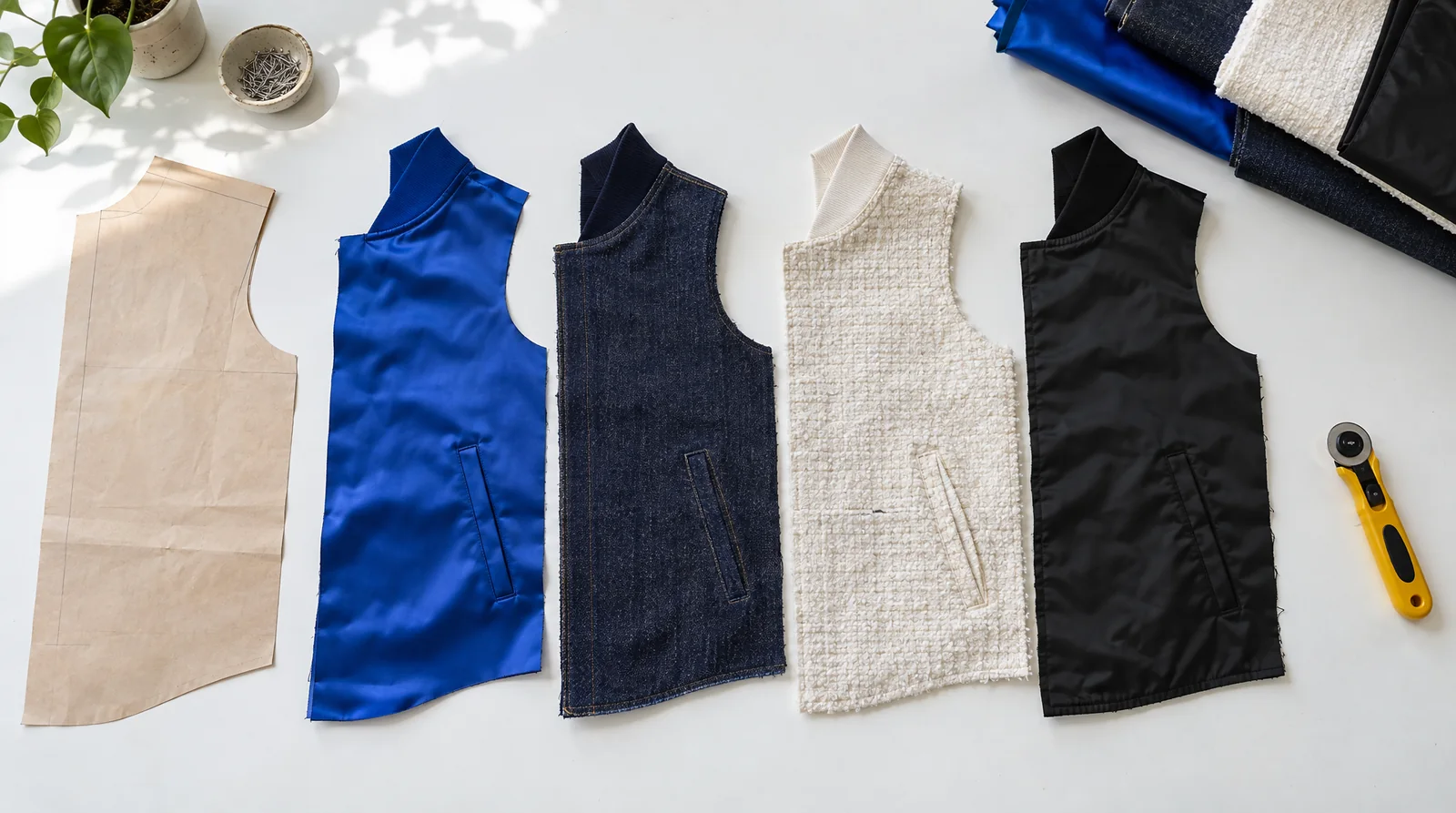
Editorial illustration: one pattern piece, four cloths. Digital swapping answers this question before the cutter does.
Hidden Benefit #4: Increased Creative Output {#increased-creative-output}
When testing fabric options is fast and free, you experiment more. And more experimentation leads to more (and better) products.
The Productivity Multiplier
Designers using AI fabric swapping report creating 30-50% more style variations per season. McKinsey's 2024 analysis of digital tools in fashion found that brands adopting virtual sampling and digital material testing launched 40% more styles per season while reducing time-to-market by 50%, confirming the productivity multiplier effect. Designers can:
- Test a core design in 5 different fabrics (same silhouette, 5 SKUs)
- Experiment with fabrics they wouldn't have traditionally sampled
- Create specialty or limited editions without financial risk
More SKUs means more opportunities to capture sales and serve different customer segments.
The Financial Impact of More SKUs
Let's say your traditional process yields 12 styles per season. With fabric swapping, you create 18 styles (50% increase).
Assuming:
- Average profit per style: $8,000
- Not all styles are winners (70% success rate)
Traditional Output:
- 12 styles × 70% success = 8.4 successful styles
- Profit: $67,200
Increased Output:
- 18 styles × 70% success = 12.6 successful styles
- Profit: $100,800
Hidden ROI: $33,600 in additional profit from increased creative output
Hidden Benefit #5: Improved Cash Flow and Inventory Management {#improved-cash-flow}
Fabric sampling requires upfront cash investment weeks or months before you see any sales revenue. For small brands with tight cash flow, this can be constraining.
AI fabric swapping minimizes upfront costs:
- No fabric sample purchases
- No mockup creation costs
- Faster decision cycles mean faster production
The Cash Flow Advantage
Traditional Process:
- Month 1: Invest $1,500 in fabric samples and mockups
- Month 2-3: Wait for results and make decisions
- Month 4: Invest $5,000 in production samples
- Month 5-6: Production
- Month 7: Launch and first sales revenue
Cash outflow before revenue: 6 months, $6,500 invested
With Fabric Swapping:
- Month 1: Invest $125 in digital testing
- Month 1: Invest $5,000 in production samples (same month!)
- Month 2-3: Production
- Month 4: Launch and first sales revenue
Cash outflow before revenue: 3 months, $5,125 invested
You've cut your upfront investment by 21% and reduced your cash cycle by 3 months. For a brand doing $500K/year in revenue, that's potentially $125K in freed-up working capital that can be used for inventory, marketing, or expansion.
The Complete ROI Calculation {#complete-roi-calculation}
Let's put it all together for a small brand producing two 12-piece collections per year:
| Benefit Category | Annual Value |
|---|---|
| Direct Sampling Savings | $12,000-28,000 |
| Faster Time-to-Market (2 styles per season) | $18,750 |
| Reduced Revision Costs (2 collections) | $8,000-12,000 |
| Better Material Decisions (margin improvement) | $8,000-20,000 |
| Increased Creative Output (6 additional styles/year) | $33,600 |
| Improved Cash Flow (interest savings/opportunity cost) | $3,000-5,000 |
| TOTAL ANNUAL ROI | $83,350-117,350 |
Investment in fabric swapping credits: ~$600/year (a typical Adstronaut usage tier for a two-collection indie brand)
ROI: 13,900-19,500%
From Cost Savings to Competitive Advantage {#competitive-advantage}
The numbers speak for themselves, but ROI isn't just about dollars saved - it's about what those savings enable:
- Reinvestment in Growth: Use savings to fund marketing, hire help, or expand product lines
- Competitive Pricing: Better margins mean you can undercut competitors or offer better value
- Risk-Taking: Financial cushion allows you to experiment with new categories or markets
- Professionalization: Invest in better photography, branding, and customer experience
The brands that embrace AI fabric swapping — whether through Adstronaut or another tool — aren't just saving money, they're building sustainable competitive advantages that compound over time.
Your competitors are making fabric decisions the old way: slowly, expensively, and with limited information. While they're waiting for fabric samples to arrive, you're already in production. While they're testing 3 options, you're testing 20. While they're losing margin to suboptimal materials, you're maximizing profitability.
The question isn't whether fabric swapping has ROI. It's whether you can afford to keep operating without it.
See the complete ROI impact of AI tools across your entire workflow, and learn how to build a unified AI design system that transforms your business.
Frequently Asked Questions
What is AI fabric swapping?
AI fabric swapping is a digital technology that lets fashion designers visualize how a garment would look in different materials without ordering physical fabric samples. You upload a photo of your design and the AI realistically renders it in any fabric — denim, silk, linen, leather, knits — preserving accurate texture, drape, shadows, and light behavior. This eliminates the 2–4 week wait and $150–$500 cost of traditional physical fabric sampling per design.
How much does traditional fabric sampling cost?
Traditional fabric sampling for a single design typically costs $620–$1,300 when you factor in fabric swatches ($150–$500), shipping ($20–$50), mockup creation ($50–$150), and designer time at $50/hour for 8–12 hours of evaluation. For a 12-piece seasonal collection, that's $7,440–$15,600 per season, or $14,880–$31,200 annually for two collections.
How accurate is AI fabric swapping compared to physical samples?
AI fabric swapping achieves 85–95% visual accuracy for most fabric types, accurately representing texture, color, drape, and light behavior. It is most accurate for woven fabrics (denim, twill, linen) and less precise for highly textured or novelty fabrics (bouclé, sequins, heavy knit cables). Most designers use AI swaps for initial decision-making and trend testing, then order 1–2 physical samples of the final selected fabrics for tactile verification before production.
Can AI fabric swapping help reduce fashion industry waste?
Yes. The fashion industry produces an estimated 92 million tons of textile waste annually (UNEP). A significant portion originates in the sampling phase — McKinsey estimates that 60% of physical samples are never used in final production. By reducing the number of physical samples from 15–20 per style to 1–2, AI fabric swapping can eliminate 80–90% of pre-production fabric waste per brand.
What types of fabrics work best with AI fabric swapping?
AI fabric swapping works well with most standard apparel fabrics: cotton, denim, linen, silk, satin, wool, polyester, nylon, leather, and suede. It accurately renders pattern repeats (stripes, plaids, florals) and surface textures (twill weave, herringbone, ribbed knit). Results are less reliable for highly three-dimensional textures like heavy cable knit, sequins, or fabrics with significant pile (like shearling or deep-pile fleece).
How does fabric swapping fit into the broader fashion design workflow?
Fabric swapping typically occurs early in the design process, between initial concept development and production sampling. The recommended workflow is: (1) Create design concept, (2) Use AI fabric swapping to test 15–20 material options digitally, (3) Narrow to 2–3 finalist fabrics, (4) Order physical samples of finalists only, (5) Make final selection and proceed to tech pack and production. This reduces the traditional 5–6 round sampling process to 1–2 rounds.
Calculate your own ROI with fabric swapping using Adstronaut →
Sources and further reading:
- McKinsey & Company — Scaling AI in Fashion (data on digital tool adoption and productivity gains in fashion)
- Common Objective — The True Cost of Fashion Sampling (research on sampling waste and error rates in apparel production)
- UNEP — Fashion's Environmental Impact (data on textile waste in the fashion industry)
- Adstronaut AI — The Complete Guide to AI Fabric Swapping (detailed fabric swapping workflow guide)