Stop the Workflow Chaos: Unifying Your Fashion Tools with AI
A 2024 McKinsey report on fashion operations found that independent brands use an average of 6-8 disconnected software tools across their design-to-delivery workflow, resulting in 15-20 hours per week lost to manual data transfer and context switching alone. For a solo founder juggling Adobe Illustrator, Excel, Dropbox, Shopify, and email chains with manufacturers, that fragmentation is not just inefficient — it is the single largest drain on creative output.
Each of these tools is powerful on its own, but together they create what we call the "fragmentation nightmare." Your workflow is a patchwork of disconnected applications, leading to endless manual data entry, a high risk of version control errors, and a constant, low-grade chaos that drains your most valuable resources: time and creative energy.
What if your entire design-to-delivery process could live in one place? What if the output from one step seamlessly became the input for the next, without ever needing to export, reformat, or re-upload a single file?
This is the promise of a unified AI operating system for fashion. Adstronaut AI was built to solve the workflow chaos by integrating every critical stage of production into a single, intelligent platform. This article explores the hidden costs of a fragmented workflow and reveals how a unified approach can not only make you more efficient but also unlock new levels of creativity and growth.
Table of Contents
- The Fragmentation Nightmare: The Hidden Tax on Your Creativity
- What is a Unified AI Operating System for Fashion?
- From Photoshoot to Product Listing: A Seamless Workflow in Action
- The Strategic Benefits of a Single Source of Truth
- Is a Unified Platform Right for Your Brand?
- End the Chaos, Embrace the Flow
The Fragmentation Nightmare: The Hidden Tax on Your Creativity
"Cobbling together solutions" is a phrase that resonates with almost every small brand owner. While it's a testament to your resourcefulness, this approach carries a heavy, often invisible, tax. Every time you have to switch applications or manually transfer data, you're paying with more than just time.
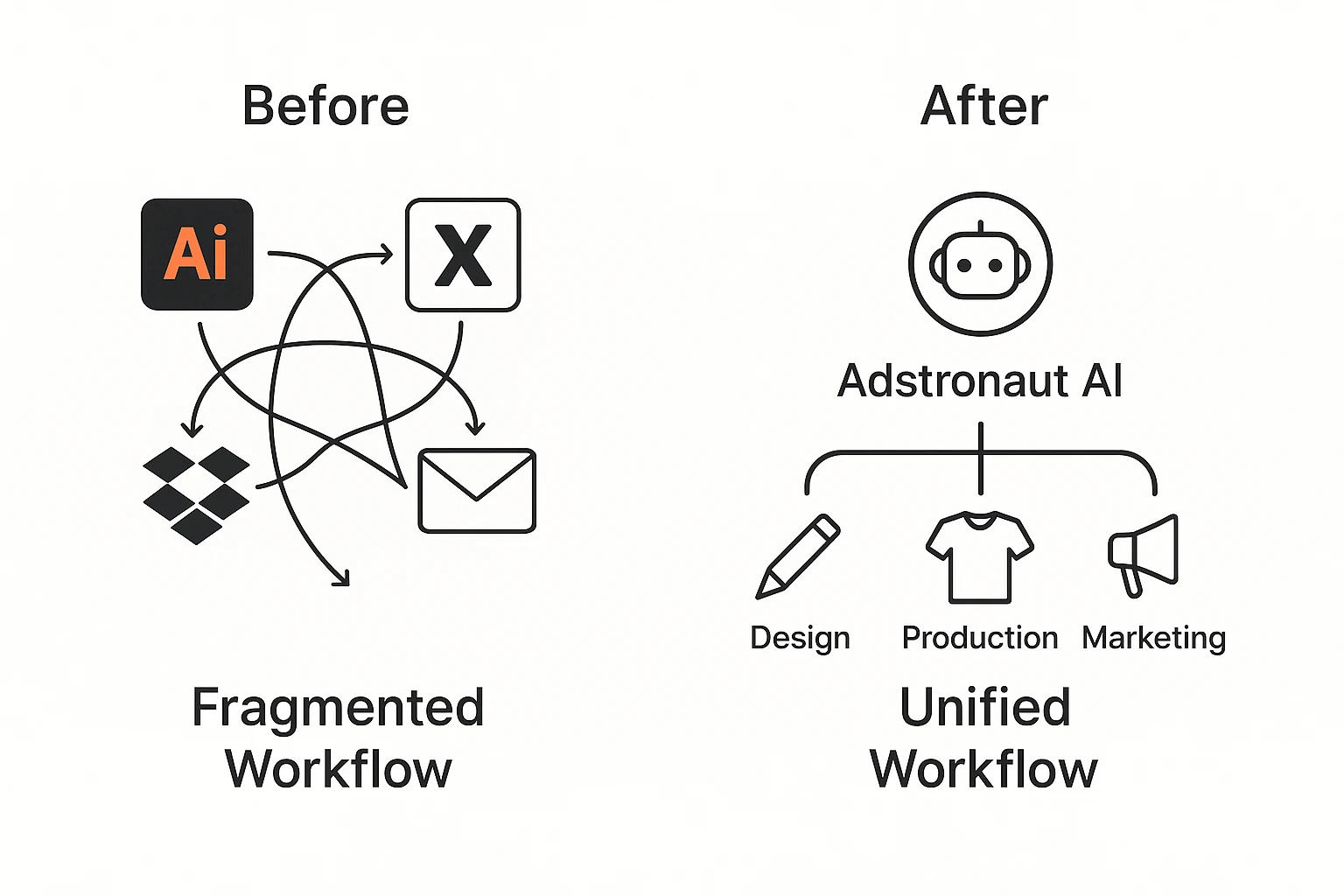 A unified platform replaces the chaos of disconnected tools with a single, streamlined process.
Here are the real costs of a fragmented workflow:
- Duplicate Work & Data Entry: The measurements you put in your Excel tech pack have to be manually referenced when creating your e-commerce listing. The product name you decide on has to be typed into your file folders, your line sheet, and your Shopify backend. Each instance is a small task, but they add up to hours of redundant work.
- Costly Version Control Errors: Which version of the tech pack did you send to the factory? Is the
final_final_v3.aiIllustrator sketch the right one? When data lives in multiple places, the risk of using outdated information skyrockets, leading to incorrect samples and wasted production runs. - Lack of Visibility: When your design, production, and marketing assets are scattered across different platforms, you have no single source of truth. It's impossible to get a quick overview of a product's entire lifecycle, from the initial tech pack to its final marketing imagery.
- Creative Friction: The mental energy it takes to switch between different programs, remember where files are saved, and manually connect the dots is significant. This "context switching" is a creativity killer, pulling you out of a design flow and into an administrative mindset.
What is a Unified AI Operating System for Fashion?
A unified AI operating system — conceptually similar to what enterprise PLM tools like Centric PLM or Lectra offer large brands, but accessible to independents — is the antidote to this chaos. It's a single platform where every stage of your product's journey is connected and powered by intelligence. It’s not just a collection of tools under one login; it's a true ecosystem where data flows seamlessly from one stage to the next.
| Disconnected Tools | Adstronaut AI's Unified Platform |
|---|---|
| Adobe Illustrator for Sketches | AI generates flat sketches from a photo. |
| Excel for BOMs & Measurements | AI extracts the BOM and creates measurement charts. |
| Dropbox / Google Drive for Storage | All assets are stored and organized by project. |
| Professional Photoshoot | AI generates campaign images from your product photo. |
| Manual E-commerce Listing | AI generates all product tags and descriptions. |
The core principle is simple: create once, use everywhere. The tech pack you generate for a new jacket isn't just a static document; its data becomes the foundation for your product listing, and its flat sketch can be used as an input for generating new design variations.
Unify your workflow with AI tech packs →
From Photoshoot to Product Listing: A Seamless Workflow in Action
Let's walk through a real-world example of how a unified workflow in Adstronaut AI transforms the process for a new hoodie design.
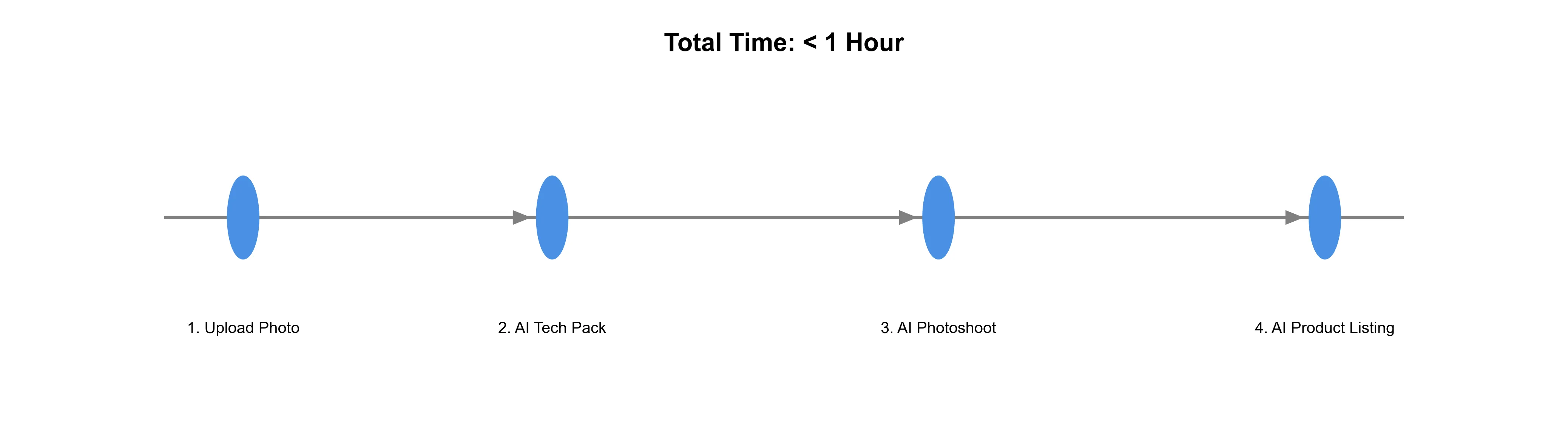 With Adstronaut AI, you can go from a single product photo to a complete launch kit in under an hour.
Input: One Product Photo You start by uploading a single photo of your hoodie sample. This is your only manual input.
Step 1: AI Tech Pack Generation You use the Tech Pack Generator. In minutes, the AI creates the flat sketch, a full Bill of Materials (identifying the fleece fabric, ribbing, drawstring, and metal eyelets), and a construction guide. You add your measurements. The result is a factory-grade tech pack ready for production.
Step 2: AI Photoshoot Creation You navigate to the AI Photoshoots tool. Instead of re-uploading, you can directly use the same product photo from your tech pack project. You select your AI model and background, and instantly generate a dozen on-model images for your campaign. Add multiple angles to create a complete visual story.
Step 3: AI Product Tagging You then move to the Product Tagger. The system already has the data from your tech pack. It automatically populates the material ("Cotton Fleece"), features ("Drawstring Hood," "Kangaroo Pocket"), and other attributes. It then generates an SEO-optimized title and a compelling description based on all this information.
Output: A Complete Product Launch Kit In under an hour, you have everything you need:
- A factory-grade tech pack.
- A full set of campaign images.
- A complete, export-ready e-commerce listing.
All components are perfectly consistent, derived from a single source of truth, and stored in one organized project. This is the power of a truly integrated system. Follow this workflow in detail with our complete e-commerce listing guide.
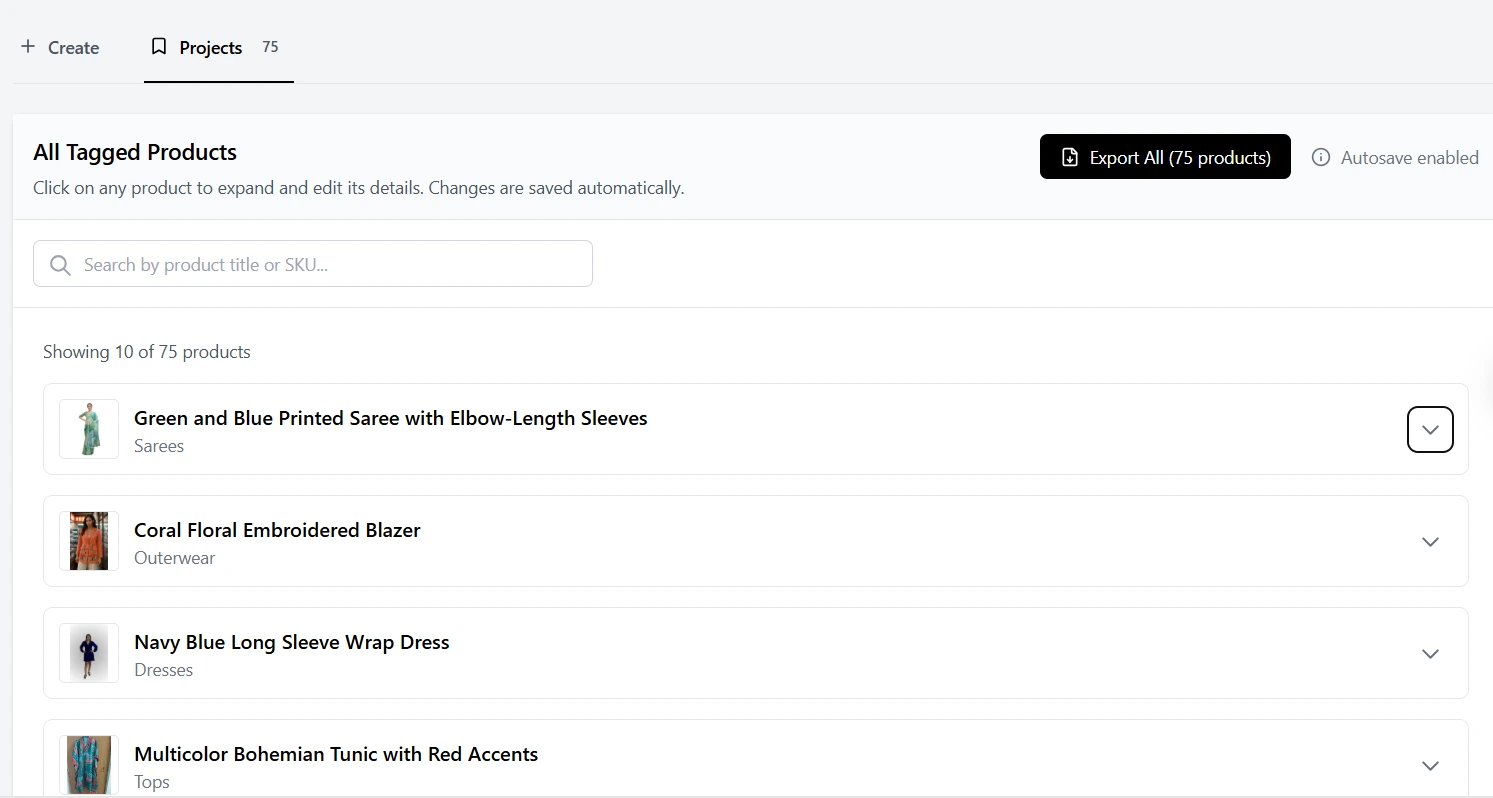 Keep all your design, production, and marketing assets organized in one central hub for a single source of truth.
The Strategic Benefits of a Single Source of Truth
The efficiency gains are obvious, but the long-term strategic benefits of a unified platform are even more powerful for a growing brand.
- Brand Consistency: With all your data in one place, you ensure that the material listed in your tech pack is the same as the material listed on your product page. This consistency builds trust with both your customers and your manufacturing partners.
- Scalability: As your brand grows from 10 styles to 100, a fragmented workflow becomes exponentially more chaotic. A unified system is built to scale with you, keeping your operations lean and organized no matter how large your collection gets.
- Actionable Insights: When all your product data lives in one ecosystem, you can start to see patterns. Which materials are you using most often? What is the average time from tech pack creation to photoshoot generation? A unified platform lays the groundwork for future business intelligence.
- Reduced "Bus Factor": For small teams (often a team of one!), having all critical product information scattered across personal Google Drive, Dropbox, and email accounts is a huge risk. A central platform ensures that your business's most valuable data is secure, accessible, and not dependent on a single person's laptop.
Is a Unified Platform Right for Your Brand?
If you recognize your own workflow in the "fragmentation nightmare," the answer is likely yes. Ask yourself these questions:
The financial impact of this fragmentation goes beyond just time. Calculate your true ROI from unifying your workflow and see how much you could save.
- Do you spend more time managing spreadsheets than you do designing?
- Have you ever sent the wrong file version to a manufacturer?
- Do you waste time searching for assets across different cloud storage folders and email threads?
- Does the thought of launching a new 10-piece collection feel operationally overwhelming?
If you answered yes to any of these, it's a strong sign that your fragmented workflow is holding your brand back.
End the Chaos, Embrace the Flow
Your brand's success shouldn't be limited by administrative friction. The tools you use should empower your creativity, not bog it down. By moving from a collection of disconnected apps to a single, intelligent operating system, you can eliminate the chaos and create a state of "flow" for your entire business.
Stop wasting time managing data and start focusing on what truly matters: building a brand that you and your customers love. Experience how a day in the life of a designer is transformed when all your tools work together seamlessly.
Experience a unified workflow today →
Frequently Asked Questions
What is a unified AI platform for fashion?
A unified AI platform consolidates design, production, and e-commerce tools into a single system where data flows automatically between stages. Instead of using separate tools for sketching, tech packs, photoshoots, and product listings, everything lives in one place.
How does a unified platform differ from enterprise PLM software?
Enterprise PLM tools like Centric PLM or Lectra are designed for large organizations with dedicated technical teams and six-figure budgets. Adstronaut AI provides similar workflow integration but is built for independent designers and small brands, with no technical expertise required and accessible pricing.
Can I still use my existing tools alongside Adstronaut AI?
Yes. The platform exports standard file formats (CSV, JPEG, PDF) that work with Adobe Illustrator, Shopify, WooCommerce, and other tools you may already use. Many designers use Adstronaut AI for speed and automation while maintaining their existing tools for specialized tasks.
How much time does workflow unification actually save?
Based on user workflows, designers typically save 15-20 hours per week by eliminating manual data transfer, file reformatting, and context switching between disconnected applications. The exact savings depend on collection size and workflow complexity.
Is my data secure on a unified platform?
Adstronaut AI stores all project assets securely in the cloud, organized by collection and product. This is generally more secure than having critical business data scattered across personal email attachments, local hard drives, and free cloud storage accounts.
Sources and further reading:
- McKinsey & Company — The State of Fashion 2025 — Research on operational inefficiency and technology fragmentation in fashion
- Business of Fashion — The Independent Designer Report — Analysis of workflow challenges facing small and independent fashion brands
- Shopify — The Future of Commerce 2024 — Data on integrated commerce tools and their impact on merchant efficiency