How to Find a Clothing Manufacturer: The Complete Step-by-Step Guide
Finding the right clothing manufacturer requires searching specialized directories (Maker's Row, Sewport, Alibaba), attending trade shows (MAGIC, Premiere Vision), and leveraging industry referrals. Domestic U.S. factories accept MOQs as low as 50 units at $25-$100+ per garment, while overseas factories in China, India, and Bangladesh typically require 200-1,000+ units at $5-$40 per garment. The difference between a successful production run and a costly disaster comes down to how thoroughly you vet your manufacturer before committing.
According to McKinsey & Company, approximately 97% of clothing sold in the United States is manufactured abroad. Yet the sourcing decision is far more nuanced than "domestic vs. overseas." This guide walks you through every step -- from identifying factory candidates to placing your first production order.
Table of Contents
- Domestic vs. Overseas Manufacturing: A Data-Driven Comparison
- Where to Find Clothing Manufacturers: Platform-by-Platform Guide
- How to Evaluate a Manufacturer: The 10-Point Checklist
- What to Prepare Before Contacting a Factory
- The Vetting Process: From First Contact to First Order
- Red Flags That Should Stop You Immediately
- Frequently Asked Questions
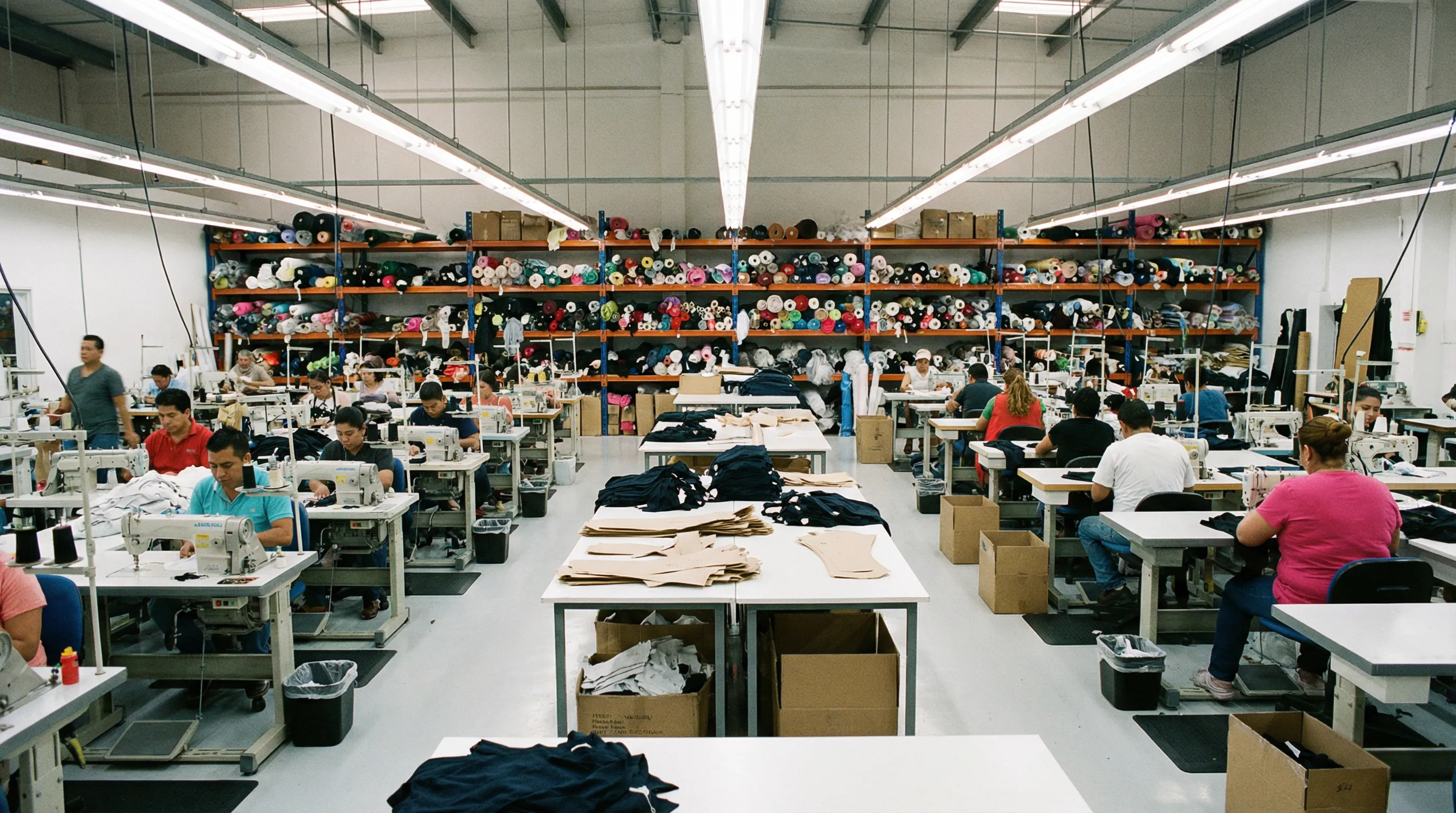 Inside a garment manufacturing factory with rows of industrial sewing machines, workers, and fabric rolls on shelves
Domestic vs. Overseas Manufacturing
The first strategic decision is where to manufacture. Each region has distinct advantages in cost, speed, specialization, and minimum order requirements.
Regional Comparison Table
| Factor | U.S. Domestic | China | India | Bangladesh | Turkey |
|---|---|---|---|---|---|
| Typical MOQ | 50–200 units | 300–1,000+ | 200–500+ | 500–3,000+ | 200–500 |
| Lead time | 4–8 weeks | 8–14 weeks | 8–12 weeks | 10–16 weeks | 6–10 weeks |
| Cost per unit (t-shirt) | $25–$60 | $5–$15 | $4–$12 | $3–$10 | $8–$20 |
| Cost per unit (jacket) | $60–$150+ | $15–$50 | $12–$40 | $10–$35 | $20–$60 |
| Specialization | Premium, small-batch | High-volume, technical | Cotton, embroidery, handwork | Basics, knitwear, high-volume | Denim, leather, premium knits |
| Communication | Same timezone, English | Timezone gap, improving English | English widely spoken | English in business | English in trade, moderate |
| IP protection | Strong | Moderate–weak | Moderate | Moderate | Moderate–strong |
| Shipping to U.S. | 2–5 days ground | 25–40 days sea; 5–7 days air | 25–35 days sea | 25–40 days sea | 20–30 days sea |
Data compiled from the United States Fashion Industry Association's 2025 Benchmarking Study and the International Trade Administration.
When to Choose Domestic
Domestic manufacturing makes sense when you need short production runs (under 200 units), fast turnaround for in-season replenishment, "Made in USA" branding for premium positioning, or tight quality control with regular factory visits. According to the Reshoring Initiative, U.S. garment manufacturing job announcements increased 38% between 2022 and 2025, driven by nearshoring trends and brands seeking supply chain resilience after pandemic-era disruptions.
When to Choose Overseas
Overseas manufacturing is the right call when your target retail price requires unit costs below $15-$20, you need volumes above 500 units per style, you are producing commodity basics where cost drives margin, or you need specialized techniques (e.g., Indian hand embroidery, Turkish denim washing, Bangladeshi knitwear at scale).
Where to Find Clothing Manufacturers
There are five primary channels for finding manufacturers. The best approach combines at least two or three of these methods.
Online Directories and Platforms
| Platform | Focus | Number of Factories | MOQ Range | Cost to Use |
|---|---|---|---|---|
| Maker's Row | U.S. domestic | 10,000+ | 50–200 | Free search; $35–$100/mo for messaging |
| Sewport | Global (strong in Europe/UK) | 5,000+ | 50–500 | Free to post projects |
| Alibaba | China, global | 150,000+ suppliers | 100–5,000+ | Free; Trade Assurance protection |
| Kompass | Global B2B directory | 60 million+ companies | Varies | Free basic; premium plans available |
| Sqetch | Europe | 3,000+ | 100–500 | Free to search |
| Foursource | Global | 10,000+ | Varies | Free basic membership |
Maker's Row is the leading U.S.-focused platform. It allows you to filter factories by location, specialization (knits, wovens, denim, activewear), MOQ range, and certifications. Over 150,000 brands have used the platform since its 2012 launch.
Sewport operates as a matching service. You submit a project brief with your garment type, target quantity, and timeline. Sewport's algorithm matches you with relevant manufacturers who then bid on your project. This reverses the traditional search model -- factories come to you.
Alibaba is the largest but requires the most caution. Use Trade Assurance (Alibaba's buyer protection program), verify suppliers with Gold Supplier status and Verified badges, and always request samples before committing to production. According to Alibaba Group's 2025 annual report, the platform processed over $30 billion in cross-border B2B trade.
Trade Shows
Trade shows let you meet manufacturers face-to-face, examine sample quality firsthand, and compare dozens of factories in a single trip.
| Trade Show | Location | Focus | Frequency |
|---|---|---|---|
| MAGIC Las Vegas | Las Vegas, NV | Full supply chain (sourcing hall) | Twice yearly (Feb, Aug) |
| Premiere Vision | Paris, France | Premium textiles and manufacturing | Twice yearly (Feb, Sep) |
| Texworld USA | New York, NY | Fabrics and sourcing | Twice yearly (Jan, Jul) |
| Canton Fair | Guangzhou, China | Full manufacturing, all categories | Twice yearly (Apr, Oct) |
| Bangladesh Denim Expo | Dhaka, Bangladesh | Denim manufacturing | Annually |
MAGIC Las Vegas alone hosts over 60,000 attendees and 3,000+ exhibitors. The SOURCING at MAGIC hall is specifically designed for brands seeking contract manufacturers. Bring your tech packs, target pricing, and sample garments to maximize every meeting.
Industry Referrals
The fashion industry runs on relationships. Referrals from other brand founders are consistently rated as the most reliable sourcing method. According to a 2024 survey by Common Objective, 62% of brands found their primary manufacturer through a personal or professional referral. Join communities such as Indie Source's network, r/streetwearstartup and r/fashionbusiness on Reddit, fashion-focused Slack and Discord groups, and local garment district associations (LA Fashion District, NYC Garment Center).
Sourcing Agents
If you are sourcing from China or South Asia for the first time, a sourcing agent can handle factory identification, negotiation, and quality inspection on your behalf. Agents typically charge 5-10% of the order value or a flat monthly retainer of $1,000-$3,000. They are particularly valuable when language barriers, timezone differences, or lack of in-country presence make direct management impractical.
How to Evaluate a Manufacturer
Finding factory candidates is the easy part. Evaluating them is where brands succeed or fail. Use this 10-point checklist for every manufacturer you consider.
The 10-Point Manufacturer Evaluation Checklist
1. MOQ Alignment. Does their minimum order quantity match your current volume? A factory with a 3,000-unit MOQ is wrong for a startup needing 100 units, regardless of how good their pricing is.
2. Specialization Match. Factories specialize. A factory that excels at woven shirts may produce mediocre knitwear. Ask specifically: what percentage of their production is your garment type? Target factories where your product category represents at least 40-50% of their output.
3. Lead Time Compatibility. Confirm production lead times for your specific order size. Ask separately about sample lead time (typically 2-4 weeks), pre-production/fabric sourcing (2-6 weeks), and bulk production (4-10 weeks). Total lead time from order confirmation to delivery commonly runs 8-16 weeks.
4. Communication Responsiveness. Send your initial inquiry and measure response time. Factories that take more than 48 hours to respond to a first inquiry will typically be slower once production starts. Test their English proficiency (or relevant language) and willingness to use your preferred communication tools (email, WhatsApp, WeChat).
5. Certifications and Compliance. Depending on your market and brand values, verify relevant certifications:
| Certification | What It Covers |
|---|---|
| GOTS (Global Organic Textile Standard) | Organic fiber content and processing |
| OEKO-TEX Standard 100 | Tested for harmful substances |
| BSCI / WRAP / SA8000 | Social and ethical manufacturing |
| ISO 9001 | Quality management systems |
| SMETA (Sedex) | Ethical trade audit |
6. Reference Clients. Request 2-3 references from brands of similar size and product type. A factory producing 100,000 units/month for a major retailer may deprioritize your 200-unit order. Conversely, a factory whose clients are all at your stage is more likely to give your order proper attention.
7. Pricing Transparency. Request a detailed cost breakdown, not just a final unit price. A legitimate manufacturer will itemize fabric cost, trims, labor, overhead, and margin. If a factory only provides a lump-sum price and refuses to break it down, that is a concern.
8. Sample Quality. Never skip sampling. Evaluate stitching consistency, fabric hand-feel versus specification, measurement accuracy (measure every sample against your spec), and construction details (seam allowance, bartack placement, hem width).
9. Financial Stability. For overseas factories, check how long they have been in business (minimum 3-5 years), look for trade show participation history, and verify through platforms like ImportGenius or Panjiva which show actual shipping records. A factory that has been consistently exporting to the U.S. for 5+ years carries less risk than one with no track record.
10. Scalability. Think 12-18 months ahead. Can this factory handle a 5-10x increase in order volume if your brand grows? Ask about their monthly capacity, current utilization rate, and ability to scale.
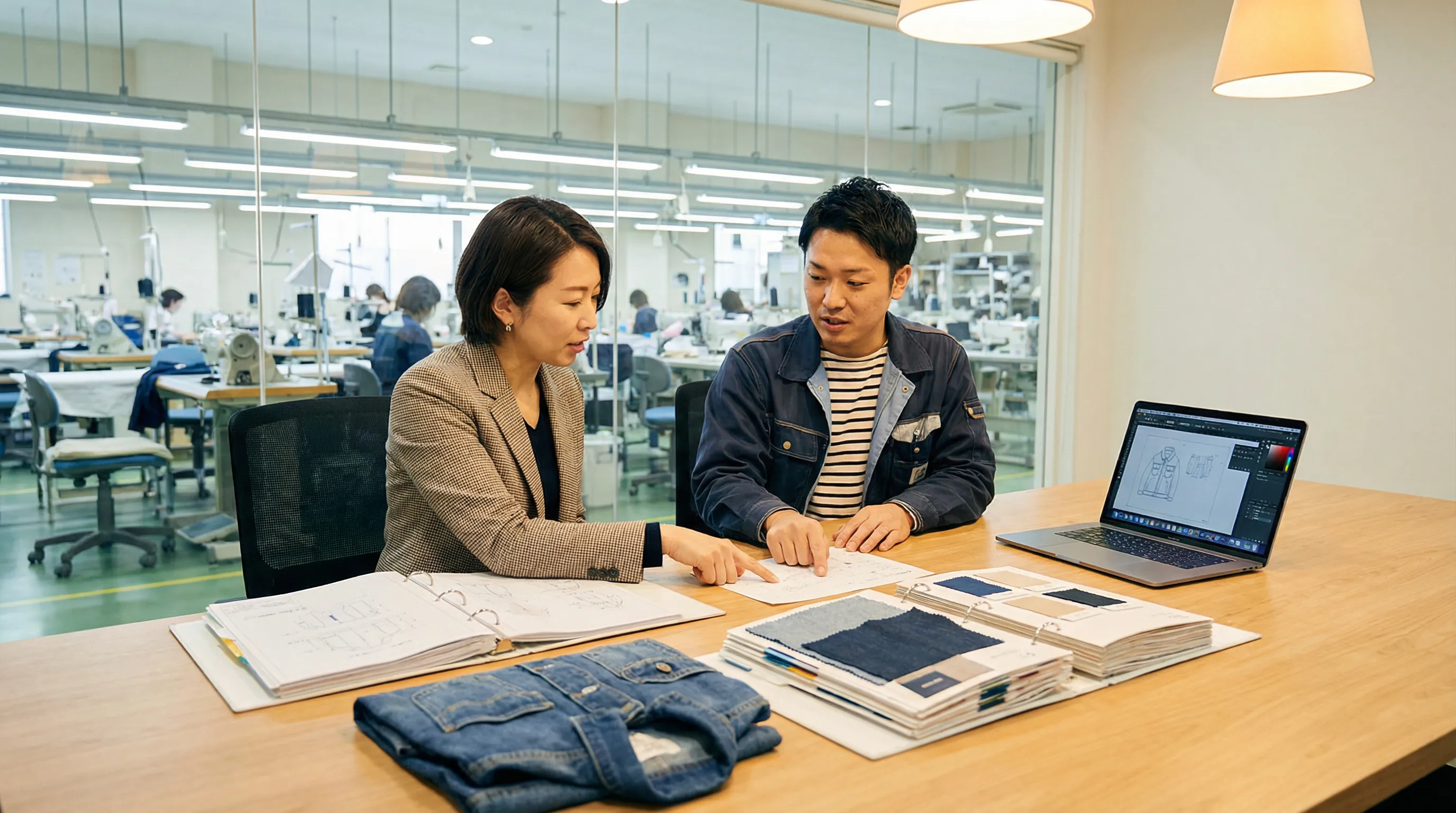 Fashion brand owner meeting with a garment manufacturer at a factory office, reviewing tech pack documents and fabric samples
What to Prepare Before Contacting a Factory
Walking into a manufacturer meeting without documentation is the fastest way to get ignored, overcharged, or both. Factories evaluate you as much as you evaluate them. Professional preparation signals that you are serious and reduces back-and-forth by weeks.
Essential Documentation
1. Tech Packs. A complete tech pack is the single most important document for manufacturer communication. It includes flat sketches (front, back, detail views), a bill of materials (every fabric, trim, and hardware component), graded measurements across your full size range, construction specifications (seam types, stitch density, finishing), and color references (Pantone codes, not screen colors). According to Techpacker's industry data, brands with complete tech packs receive 40% more factory responses and negotiate 10-20% lower pricing because the factory can quote accurately without padding for uncertainty. If you do not have tech packs yet, AI-powered tools like Adstronaut AI can generate a complete, factory-grade tech pack from a single product photo in under 15 minutes at a fraction of freelancer costs. See our complete guide to creating a tech pack.
Create a tech pack before contacting factories →
2. Target Pricing. Know your retail price, desired margin (aim for 60-70% markup at minimum for D2C), and resulting target cost-of-goods. If your retail price is $80 and you need a 65% margin, your landed cost cannot exceed $28.
3. Order Volume Projections. Prepare realistic estimates for your first order, projected quarterly reorders, and 12-month volume forecast. Factories offer better pricing to brands that demonstrate growth potential with concrete numbers.
4. Sample Requirements. Specify exactly what you need: a fit sample (for sizing), a pre-production sample (final approval before bulk), a photo sample (for marketing), and your approval process and timeline.
5. Brand and Compliance Standards. Document any labeling requirements (FTC care label compliance for U.S. market, fiber content accuracy), sustainability certifications needed, restricted substance requirements, and packaging specifications.
The Vetting Process
Once you have your documentation ready and a shortlist of 5-10 factory candidates, follow this structured vetting process.
Step 1: Initial Outreach (Week 1)
Send a standardized RFQ (Request for Quotation) to all candidates simultaneously. Include your tech pack, target quantity for the first order, target delivery date, and a request for their factory profile (capacity, certifications, client list). Sending identical RFQs allows you to compare responses on an equal basis.
Step 2: Evaluate Responses (Week 2)
Score each factory's response against your 10-point checklist. Eliminate any factory that does not respond within 5 business days, cannot meet your MOQ, does not specialize in your garment type, or provides a quote more than 30% above your target cost. You should narrow your list to 3-4 candidates.
Step 3: Request and Evaluate Samples (Weeks 3-7)
Order samples from your top 3-4 candidates. Budget $100-$500 per sample depending on garment complexity. Evaluate each sample against your tech pack specifications using a formal quality checklist. Measure every point of measure. Wash-test at least one sample (3 home washes minimum) to check shrinkage, color fastness, and construction durability.
Step 4: Factory Verification (Weeks 5-7, parallel with sampling)
For overseas factories, consider a third-party factory audit through services like SGS, Bureau Veritas, or QIMA. A pre-production audit costs $300-$800 and verifies the factory's actual capacity, working conditions, and quality systems. For U.S. factories, schedule a factory visit. According to the American Apparel & Footwear Association, 78% of brands that visited their factory before ordering reported higher satisfaction with the first production run compared to those that did not.
Step 5: Negotiate Terms and Place Order (Week 8)
With your preferred factory selected, negotiate payment terms (standard is 30% deposit, 70% on completion; avoid 100% upfront), production timeline with milestone checkpoints, quality acceptance criteria (AQL levels -- industry standard is AQL 2.5 for major defects, AQL 4.0 for minor defects), and remedies for quality failures (rework, discounts, or rejection rights).
Step 6: Pre-Production Approval (Weeks 9-10)
Before bulk production begins, approve a pre-production sample (also called a PP sample or gold seal sample). This is your final sign-off. Confirm fabric (hand-feel, weight, color), all trims and hardware, fit on a live model or dress form, and construction quality. Do not approve bulk production until the PP sample meets your specifications exactly.
Red Flags That Should Stop You Immediately
After reviewing hundreds of brand-factory relationships, these warning signs consistently predict production problems.
No physical address or factory photos. Legitimate factories are proud of their facilities. If a supplier cannot provide photos or a verifiable address, they may be a trading company reselling from unverified subcontractors.
Prices significantly below market rate. If a quote is 40-50% below competing factories for the same garment, the factory is likely cutting corners on fabric quality, labor standards, or both. The International Labour Organization estimates that 1 in 6 garment workers globally is paid below minimum wage.
Unwillingness to provide references. Any established factory will have references. Refusal to provide them is disqualifying.
Pressure to skip sampling. A factory that pushes you to go directly to bulk production without a sample approval process does not prioritize quality control.
Requesting full payment upfront. Standard industry terms are 30-50% deposit with the balance due upon completion or shipment. Requests for 100% upfront payment, especially for first orders, carry substantial risk.
Vague or missing certifications. If a factory claims certifications but cannot provide certificate numbers that you can verify on the certifying body's website, treat the claim as unverified.
Frequent changes in point of contact. High turnover or constantly changing sales contacts often indicate internal instability that will affect your production consistency.
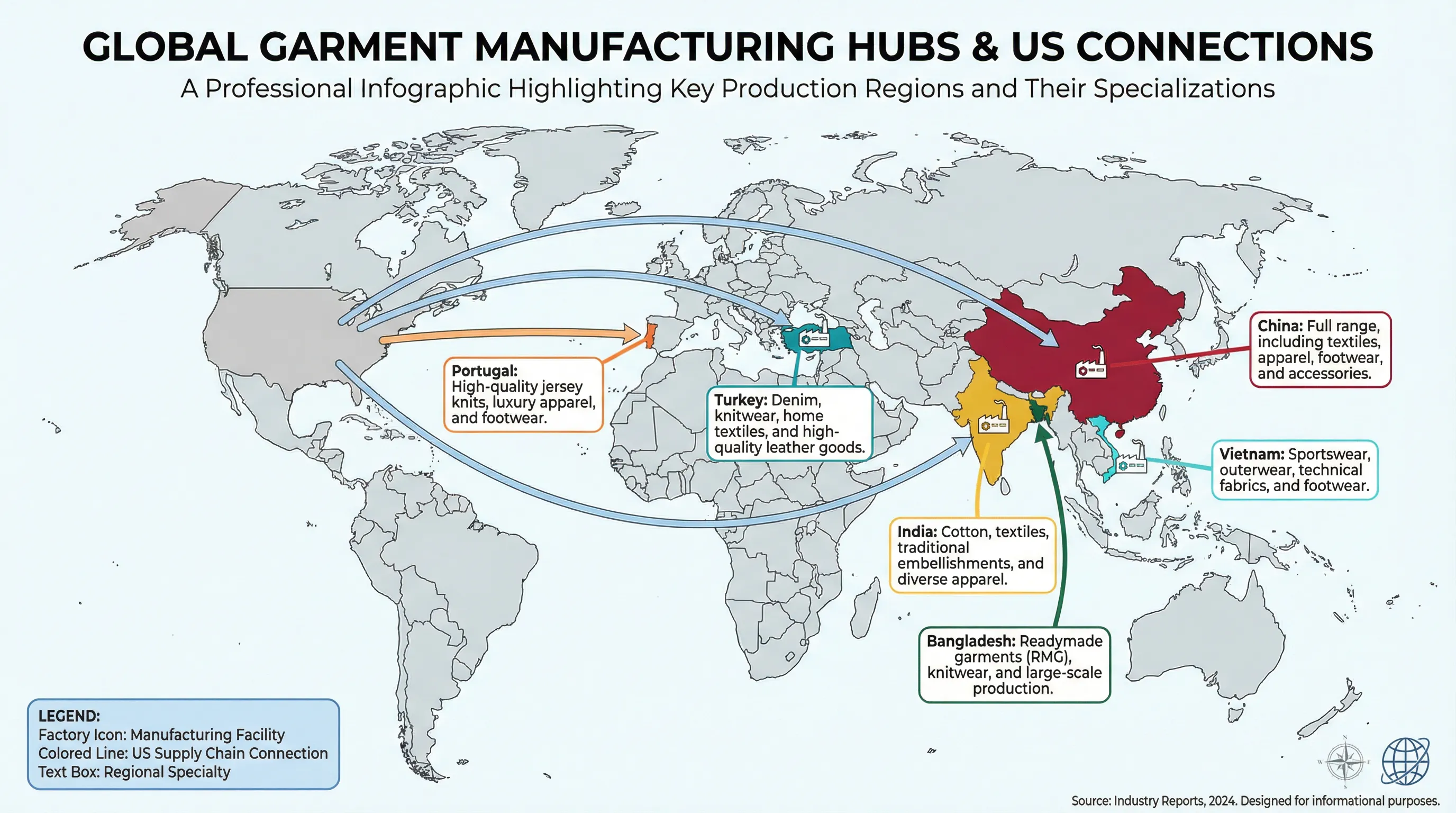 World map highlighting major garment manufacturing regions: China, India, Bangladesh, Turkey, Vietnam, and Portugal with factory icons
Frequently Asked Questions
How do I find a clothing manufacturer for small quantities?
For orders under 200 units, focus on domestic manufacturers (search Maker's Row filtered by 50-unit MOQ), local sewing contractors in garment districts (Los Angeles, New York, San Francisco), Sewport for matched small-batch factories, and CMT (Cut-Make-Trim) contractors who work with your supplied fabric. Small-batch domestic factories typically charge $25-$100+ per unit depending on complexity, but eliminate overseas shipping costs and reduce lead times to 4-8 weeks.
How much does it cost to manufacture clothing overseas?
Overseas manufacturing costs range from $3-$50+ per unit depending on garment type, complexity, and country. A basic cotton t-shirt manufactured in Bangladesh costs $3-$8, in China $5-$15, and in Turkey $8-$20. Complex garments like structured blazers or technical outerwear run $30-$80+ regardless of country. Add 15-25% for shipping, duties, and customs brokerage to calculate your true landed cost.
Should I use a sourcing agent to find a manufacturer?
A sourcing agent is worth the 5-10% commission if you are sourcing internationally for the first time, do not speak the factory's language, cannot visit the factory in person, or are placing orders above $10,000 where quality inspection is critical. For domestic sourcing or if you have prior manufacturing experience, direct relationships are more cost-effective and give you more control.
What is the difference between an OEM and ODM manufacturer?
An OEM (Original Equipment Manufacturer) produces garments based on your designs and specifications. You provide the tech pack, they manufacture to your exact spec. An ODM (Original Design Manufacturer) offers pre-designed products that you can customize with your branding, colorways, or minor modifications. ODMs are faster and cheaper for brands that do not need fully custom designs. Most startups begin with ODM for their first collection and transition to OEM as they develop proprietary designs.
How long does it take to find and start working with a manufacturer?
From initial search to first bulk delivery, expect 4-6 months minimum. The typical timeline breaks down as: research and outreach (2-4 weeks), sample evaluation (4-6 weeks), negotiation and terms (1-2 weeks), pre-production approval (2-3 weeks), and bulk production (4-10 weeks). Rushing this process is the most common mistake new brands make. According to Maker's Row, brands that spend at least 8 weeks on the vetting phase report 60% fewer quality issues on their first production run.
Do I need a tech pack to contact a manufacturer?
Technically no, but practically yes. Contacting a factory without a tech pack results in vague quotes padded with 20-30% uncertainty markup, slower response times (factories prioritize professional inquiries), higher risk of miscommunication and sample failures, and difficulty comparing quotes across factories. A tech pack transforms you from an "idea person" into a serious buyer in the manufacturer's eyes. If creating one from scratch feels overwhelming, tools like Adstronaut AI generate complete tech packs from a product photo in minutes.
How do I protect my designs when working with overseas manufacturers?
Design protection starts before you contact any factory. File provisional patents or design patents for unique elements before sharing. Use Non-Disclosure Agreements (NDAs) -- while enforcement is limited overseas, they establish legal intent. Work with factories through platforms with buyer protection (Alibaba Trade Assurance). Never share your full collection with a single factory. Consider splitting production across 2-3 factories so no single supplier has your complete product line. Register trademarks in both your home country and the manufacturing country.
What questions should I ask a manufacturer on the first call?
Lead with these ten questions: What is your MOQ per style per color? What is your production lead time for my order size? What garment types make up the majority of your production? Can you provide 2-3 references from brands at my production volume? What are your payment terms for first-time clients? What certifications does your factory hold? What is your sample lead time and cost? What is your defect rate and how do you handle quality failures? Can you source fabric or do I need to supply it? What is your monthly production capacity and current utilization?
Generate a factory-grade tech pack in minutes →
Sources and further reading:
- McKinsey & Company - The State of Fashion
- United States Fashion Industry Association - Benchmarking Study
- Maker's Row - U.S. Factory Directory
- Sewport - Global Manufacturer Matching
- Alibaba Group Annual Report
- Common Objective - Sourcing Survey
- Reshoring Initiative - Data Report
- American Apparel & Footwear Association
- International Labour Organization - Garment Sector
- International Trade Administration - Textiles and Apparel