Knitwear Tech Pack — Complete Guide with Yarn, Gauge, and Finishing Specs
A knitwear tech pack is a 10–15 page technical document that includes three specialized sections not found in standard apparel tech packs: yarn specification (fiber composition, yarn count in Nm, ply, twist direction, dye method), gauge and knit structure (machine gauge from 3GG to 18GG, stitch density per cm, swatch dimensions), and finishing and processing (wash method, blocking dimensions, shrinkage tolerances of 3–8%). Without these three sections, factories cannot price, knit, or finish your garment correctly — and knitwear sampling errors cost 2–4x more to fix than woven garments because the entire panel must be re-knit.
This guide covers every section of a production-ready knitwear tech pack, compares flat-knit vs circular-knit specifications, and shows how to generate one from a single photo. Start from the free knit sweater tech pack template — or the free beanie tech pack template for accessories — if you want a ready-made structure. New to tech packs? Start with our complete guide to fashion tech packs.
Table of Contents
- What Makes Knitwear Tech Packs Different?
- 1. Yarn Specification Section
- 2. Gauge and Knit Structure
- 3. Finishing and Processing
- 4. Flat-Knit vs Circular-Knit: Construction Comparison
- 5. Knitwear Measurement Considerations
- 6. Common Knitwear Tech Pack Mistakes
- 7. How Adstronaut AI Handles Knitwear
- Frequently Asked Questions
What Makes Knitwear Tech Packs Different?
A standard woven-apparel tech pack covers fabric, measurements, BOM, construction, and labeling. A knitwear tech pack requires all of those — plus three additional sections that govern how the fabric itself is created.
According to the International Wool Textile Organisation (IWTO), the global knitwear market was valued at $564 billion in 2024, with knitted garments accounting for roughly 40% of all apparel units produced worldwide (IWTO Annual Report, 2024). Despite this volume, knitwear remains the garment category with the highest first-sample rejection rate — an estimated 35–45% of knitwear samples require re-knitting due to incomplete specifications, compared to 15–20% for woven garments (Textile Research Journal, 2023).
The three additional sections that knitwear demands are:
| Section | What It Specifies | Why It Matters |
|---|---|---|
| Yarn Specification | Fiber blend, yarn count (Nm), ply, twist, dye method, certifications | Determines hand feel, cost, drape, and sustainability claims |
| Gauge & Knit Structure | Machine gauge (GG), stitch density, swatch dimensions, stitch patterns by zone | Controls weight, stretch, opacity, and surface texture |
| Finishing & Processing | Wash method, blocking, shrinkage targets, softener treatments | Defines the final hand feel, dimensions, and appearance |
Without these sections, you are asking a factory to guess the three most expensive variables in knitwear production.
Create your knitwear tech pack now — try Adstronaut AI free
1. Yarn Specification Section
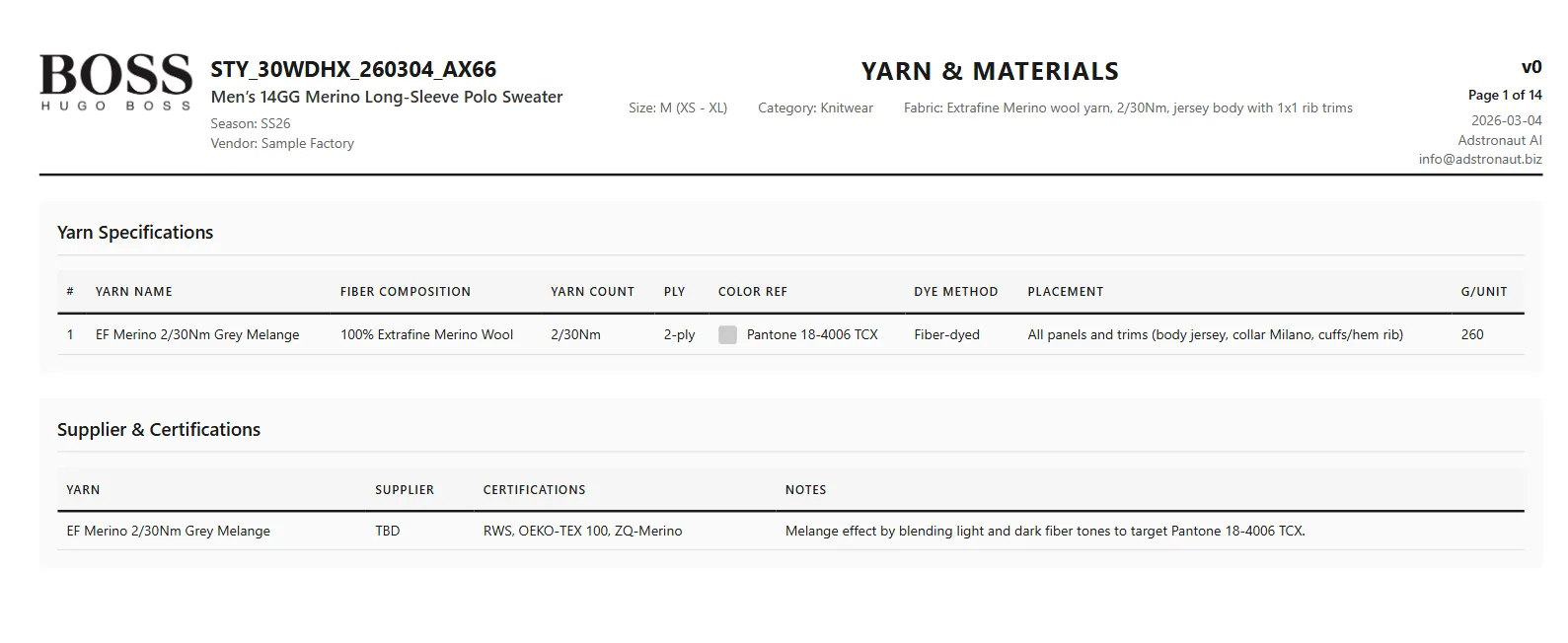
The yarn specification is the single most important section in a knitwear tech pack. In woven apparel, you specify a finished fabric (e.g., "5.5 oz cotton twill"). In knitwear, you specify the raw yarn — the factory creates the fabric from it.
What to Include
| Parameter | Example Value | Notes |
|---|---|---|
| Fiber Composition | 70% Merino Wool / 30% Nylon | Must total 100%; list in descending order |
| Yarn Count (Nm) | 2/28 Nm | Nm = meters per gram; "2/28" means 2-ply, 28 Nm per single |
| Ply | 2-ply | Single, 2-ply, 3-ply, or 4-ply |
| Twist Direction | S-twist | S-twist or Z-twist; affects surface appearance |
| Dye Method | Yarn-dyed (solid) | Yarn-dyed, piece-dyed, space-dyed, or raw/undyed |
| Color Reference | Pantone 19-4052 TCX | Must be TCX (textile) code, not print (C/U) |
| Certifications | RWS, OEKO-TEX Standard 100 | Required for sustainability claims and retail compliance |
Yarn Count Explained
Yarn count is where most non-knitwear designers get confused. The Nm (metric number) system measures fineness: higher Nm = finer yarn.
| Yarn Count | Typical Use | Machine Gauge | Approx. Weight (per m2) |
|---|---|---|---|
| 1/4 Nm | Chunky hand-knit scarves | 3GG–5GG | 500–700 g |
| 2/15 Nm | Heavy winter sweaters | 5GG–7GG | 350–500 g |
| 2/28 Nm | Standard sweaters, cardigans | 7GG–12GG | 200–350 g |
| 2/48 Nm | Lightweight knits, fine gauge | 12GG–14GG | 120–200 g |
| 2/60 Nm | Ultra-fine jersey knits | 14GG–18GG | 80–150 g |
The Woolmark Company reports that specifying the wrong yarn count is the leading cause of knitwear re-sampling, accounting for 28% of all first-sample rejections in their certified supply chain (Woolmark Technical Bulletin, 2024).
Certifications to Specify
If you are selling to EU or UK retailers, OEKO-TEX Standard 100 certification is effectively mandatory — over 80% of European fashion retailers require it for garments with direct skin contact (OEKO-TEX Market Report, 2024). Key certifications for knitwear yarn:
- RWS (Responsible Wool Standard) — Chain-of-custody wool traceability
- GOTS (Global Organic Textile Standard) — Organic fiber certification
- OEKO-TEX Standard 100 — Tested for harmful substances
- GRS (Global Recycled Standard) — For recycled fiber blends
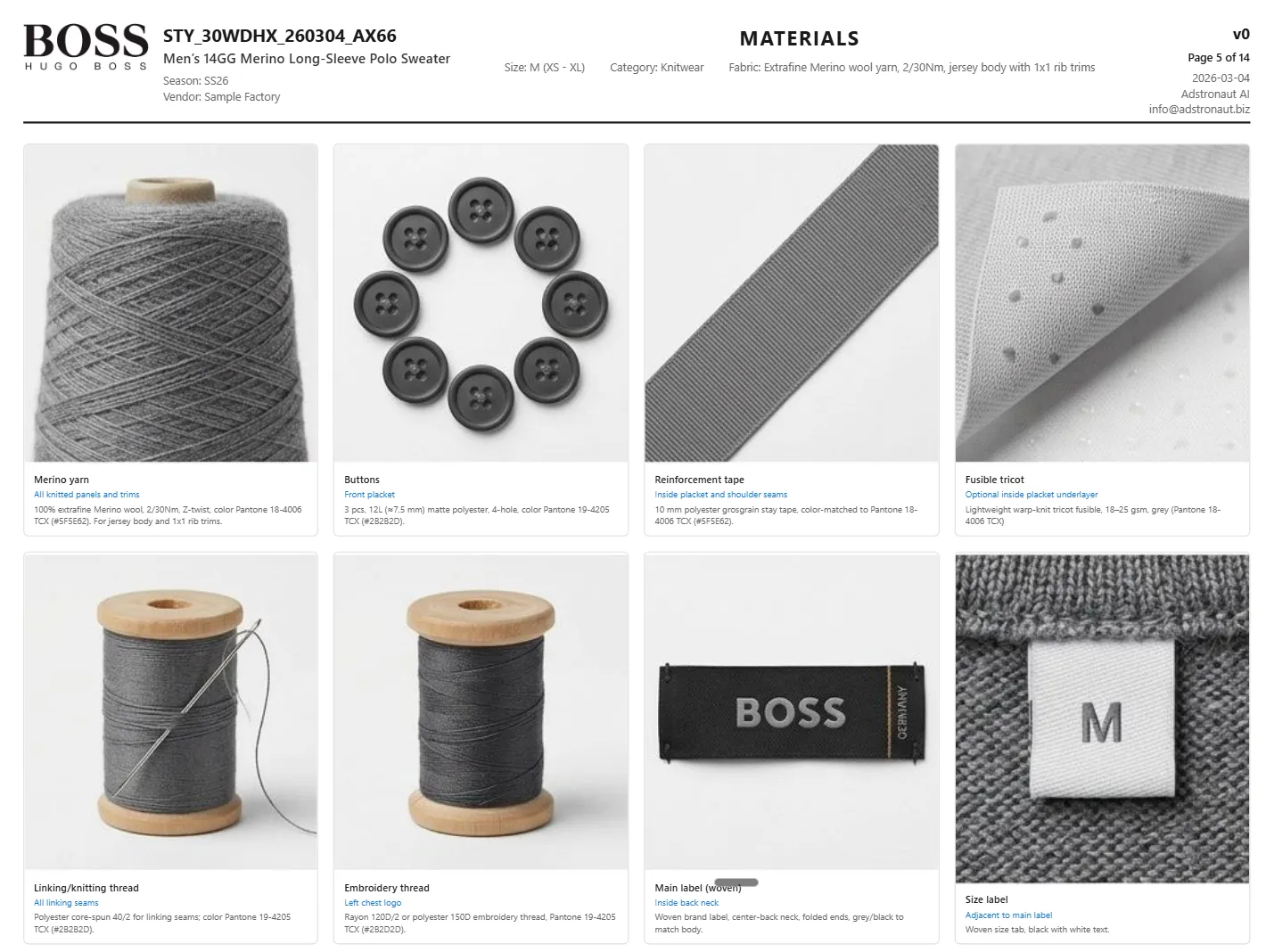 Adstronaut AI automatically generates the materials section with fiber composition, weight, and supplier references.
2. Gauge and Knit Structure
Gauge defines how tight or loose the fabric is knitted. It is the knitting equivalent of thread count in wovens — but with a direct impact on weight, stretch, drape, and opacity.
Machine Gauge (GG)
Machine gauge refers to the number of needles per inch on the knitting machine. A higher gauge number means finer knitting.
| Machine Gauge | Category | Typical Products | Stitch Visibility |
|---|---|---|---|
| 3GG–5GG | Coarse gauge | Chunky sweaters, scarves, beanies | Individual stitches clearly visible |
| 5GG–7GG | Heavy gauge | Winter cardigans, cable-knit sweaters | Stitches visible; textured patterns prominent |
| 7GG–12GG | Standard gauge | Everyday sweaters, pullovers, vests | Stitches visible but compact |
| 12GG–14GG | Fine gauge | Lightweight knits, polo shirts | Smooth surface; stitches barely visible |
| 14GG–18GG | Ultra-fine gauge | Jersey knits, seamless sportswear | Surface appears woven |
Stitch Density Specification
Beyond machine gauge, your tech pack must specify stitch density — the number of stitches and rows per centimeter in the finished, washed swatch.
Example specification:
- Courses (rows): 8 rows per cm
- Wales (stitches): 6 stitches per cm
- Swatch size: 15 cm x 15 cm, measured after washing and relaxation
- Knit structure: 1x1 rib (body), jersey (sleeves), 2x2 rib (cuffs/hem)
Zone-Based Stitch Mapping
A single knitwear garment often uses multiple stitch structures across different zones. The Knitting Trade Journal estimates that 60% of knitwear styles use two or more distinct stitch structures within the same garment (Knitting Trade Journal, Issue 47, 2024).
| Zone | Stitch Structure | Machine Gauge | Notes |
|---|---|---|---|
| Body front/back | Jersey (stockinette) | 12GG | Main body fabric |
| Sleeves | Jersey (stockinette) | 12GG | Match body gauge exactly |
| Collar/neckband | 2x2 rib | 12GG | Tighter tension for recovery |
| Cuffs | 2x2 rib | 12GG | Match collar tension |
| Hem band | 1x1 rib | 12GG | Slightly looser than collar |
| Cable panel (front) | 3x3 cable, 8-row repeat | 12GG | Cables consume ~15% more yarn |
Your tech pack should include a flat sketch with each zone labeled and referenced to the stitch table.
 Annotated flat sketch with measurement points — knitwear tech packs must specify pre-wash and post-wash dimensions for each point.
3. Finishing and Processing
Finishing is what transforms raw knitted panels into the garment the customer actually touches. A sweater straight off the machine feels nothing like the finished product — it is stiff, oversized, and structurally unstable.
Finishing Specification Table
| Parameter | Specification | Tolerance |
|---|---|---|
| Wash Method | Enzyme wash at 40°C, 30 min | +/- 5°C |
| Softener Treatment | Silicone softener, medium hand | Per factory standard |
| Blocking Method | Steam press to template dimensions | +/- 0.5 cm |
| Shrinkage Target (length) | -5% from raw knit | +/- 1.5% |
| Shrinkage Target (width) | -3% from raw knit | +/- 1.5% |
| Pilling Resistance | Grade 3.5+ (Martindale, 5000 cycles) | Minimum Grade 3 |
| Anti-pilling Treatment | Singeing or enzyme bio-polish | Per yarn type |
| Dimensional Stability | Within 3% after 5 home washes (ISO 6330) | Required for quality labels |
Why Finishing Matters for Measurements
This is the critical point most designers miss: knitwear measurements must be specified on a post-wash, post-blocking basis. Raw knitted panels can be 5–10% larger than the finished garment. If your tech pack provides measurements without specifying the basis, the factory does not know whether to hit those numbers before or after finishing.
The Textile Research Journal found that knitwear garments without explicit pre-wash/post-wash measurement basis had a 52% dimensional failure rate at quality inspection, compared to 11% when the basis was clearly stated (Textile Research Journal, Vol. 93, 2023).
Stop guessing on finishing specs — generate a complete knitwear tech pack
4. Flat-Knit vs Circular-Knit: Construction Comparison
How your garment is knitted determines the entire construction specification. This is a decision that must be made before sampling — you cannot switch between flat-knit and circular-knit without re-specifying the entire tech pack.
| Feature | Flat-Knit (Fully Fashioned) | Circular-Knit (Cut & Sew) |
|---|---|---|
| How it's made | Panels shaped on the machine; edges are finished | Tubular fabric is knit, then cut into pattern pieces |
| Assembly method | Linking (loop-by-loop joining) | Sewing (overlocked seams) |
| Seam appearance | Smooth, nearly invisible seams | Visible overlocked seam allowance |
| Waste | 3–5% yarn waste | 15–25% fabric waste (cutting loss) |
| Cost | Higher (slower production, skilled operators) | Lower (faster, standard sewing) |
| Best for | Premium sweaters, cashmere, luxury knitwear | T-shirts, casual knits, sportswear, high-volume |
| Tech pack must specify | Linking method, fashioning marks, panel shapes | Seam type, seam allowance, cutting layout |
| Typical MOQ | 200–500 units per color/size | 500–3,000 units per color/size |
Flat-Knit: Linking Specification
For fully fashioned knitwear, your tech pack must specify:
- Linking method: Point-to-point, 1:1 linking, or 2:1 linking
- Fashioning marks: Number of fashioning marks at armhole, neckline, and shoulder (e.g., "3-needle fashioning, 2 rows apart")
- Panel list: Front panel, back panel, left sleeve, right sleeve, collar (each with separate gauge specs)
Circular-Knit: Seaming Specification
For cut-and-sew knitwear, your tech pack must specify:
- Seam type: 4-thread overlock, flatlock, or coverstitch
- Seam allowance: Typically 1 cm for knits (vs 1.5 cm for wovens)
- Cutting direction: Wale direction must be marked on pattern pieces
- Edge finishing: Rolled hem, rib trim, or coverstitch hem
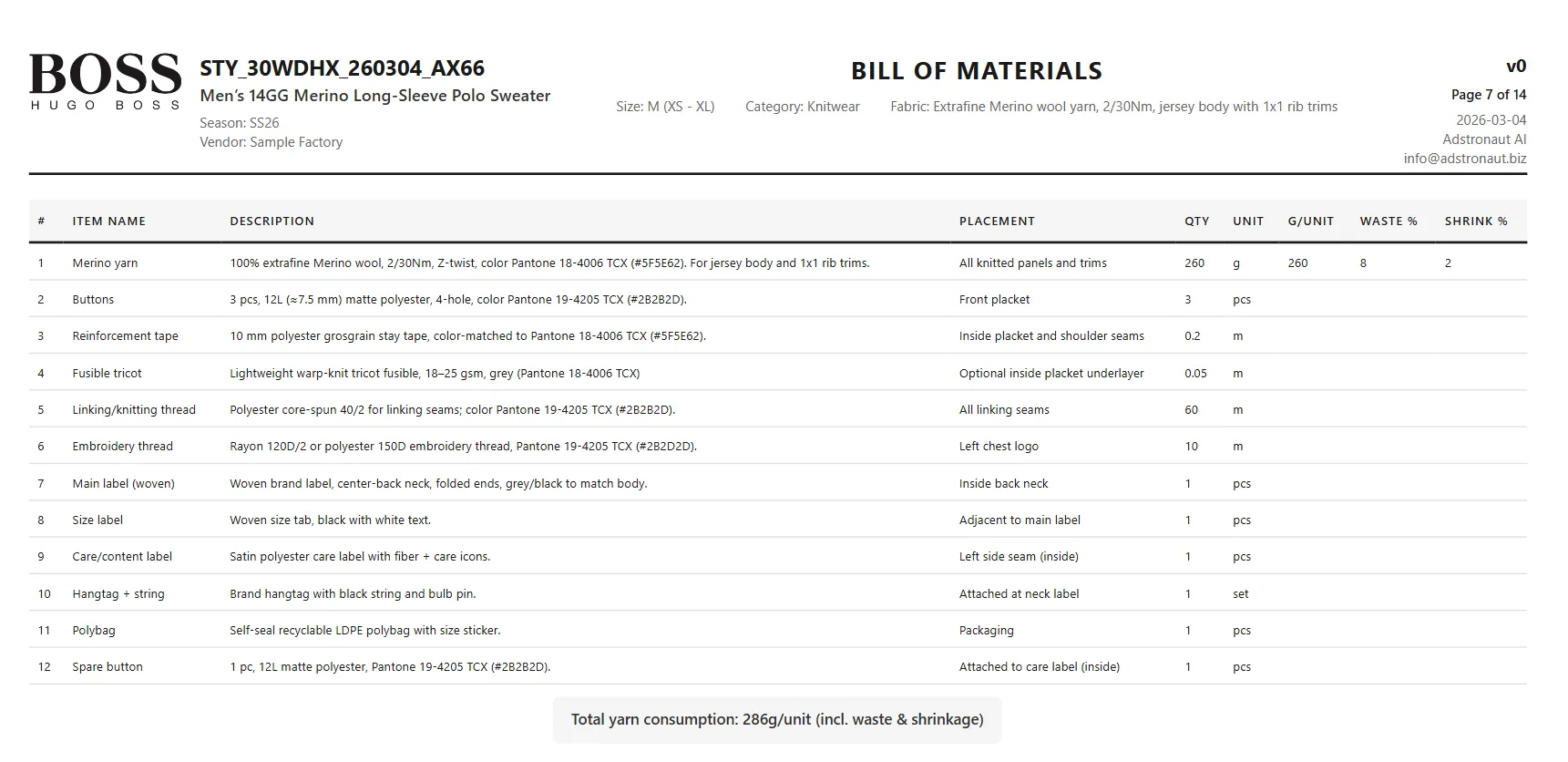 Bill of Materials for a knitwear garment — note the yarn specification row that replaces the standard "shell fabric" in woven tech packs.
5. Knitwear Measurement Considerations
Knitwear measurements follow different rules than woven apparel. Knit fabric stretches, relaxes, and changes dimensions through washing and wearing. Your tech pack must account for this.
Pre-Wash vs Post-Wash Measurement Basis
Every measurement in your knitwear tech pack must state the basis:
| Measurement Point | Pre-Wash (Off Machine) | Post-Wash (Finished) | Shrinkage Applied |
|---|---|---|---|
| Chest width (1/2) | 53 cm | 50 cm | -5.7% |
| Body length (HPS) | 70 cm | 66.5 cm | -5.0% |
| Sleeve length | 64 cm | 61 cm | -4.7% |
| Shoulder width | 46 cm | 44 cm | -4.3% |
| Hem width (1/2) | 50 cm | 48 cm | -4.0% |
Best practice: Specify all measurements on a post-wash basis and include a separate shrinkage column so the factory can calculate their knitting dimensions.
Stretch and Recovery
Unlike woven garments, knitwear must specify stretch percentage and recovery rate:
- Stretch %: How much the fabric extends under load (e.g., "25% stretch widthwise, 15% lengthwise")
- Recovery %: How much it returns after stretching (e.g., "95% recovery after 30% extension")
- Growth allowance: Expected relaxation during wear (e.g., "allow 2 cm body length growth over 8 hours of wear")
6. Common Knitwear Tech Pack Mistakes
These are the errors that cause rejected samples, wasted yarn, and delayed production runs.
Mistake 1: No Yarn Count Specified
The problem: Writing "use lambswool" without specifying 2/28 Nm vs 2/15 Nm. The factory picks their cheapest stock yarn, and you receive a garment that is either paper-thin or heavy as a blanket.
Mistake 2: Measurements Without Wash Basis
The problem: Listing "chest width: 50 cm" without stating whether this is pre-wash or post-wash. The factory knits to 50 cm on the machine, and after finishing the garment shrinks to 47 cm.
Mistake 3: Missing Gauge Specification
The problem: Not specifying machine gauge or stitch density. A 7GG sweater and a 12GG sweater from the same yarn will look, feel, and weigh completely different.
Mistake 4: Single Stitch Structure for Multi-Zone Garments
The problem: Specifying "jersey knit" for the entire garment when the collar, cuffs, and hem should be ribbed. The collar will not hold its shape and the hem will curl.
Mistake 5: No Pilling Specification
The problem: Omitting pilling resistance targets. The factory delivers a garment that pills after two washes. Without a specification, there is no basis for a quality claim.
Mistake 6: Ignoring Flat-Knit vs Circular-Knit Classification
The problem: Sending a tech pack for a fully fashioned sweater to a cut-and-sew factory (or vice versa). The factory either cannot produce it or produces it incorrectly.
Mistake 7: No Finishing Specification
The problem: Assuming the factory will wash and block the garment to your standard. Every factory has different default finishing processes. Without specifications, results vary wildly between suppliers.
7. How Adstronaut AI Handles Knitwear
When you upload a knitwear photo to Adstronaut AI, the system does something no other tech pack tool offers: it auto-detects that the garment is knitwear and classifies it as flat-knit or circular-knit construction.
What Happens When You Upload
- Garment detection: AI identifies the garment type (sweater, cardigan, knit vest, etc.)
- Knitwear classification: System detects knitted construction and classifies as flat-knit or circular-knit
- Section generation: 15 specialized sections are generated, including the three knitwear-specific sections (yarn specification, gauge & knit structure, finishing & processing)
- Stitch analysis: AI estimates visible stitch structure (jersey, rib, cable, etc.) from the photo
- Measurement extraction: Measurements are generated with post-wash basis as default
The 15 Knitwear Tech Pack Sections
| # | Section | Knitwear-Specific? |
|---|---|---|
| 1 | Cover Page | No |
| 2 | Technical Flat Sketch | No |
| 3 | Colorway & Pantone Codes | No |
| 4 | Sample Measurements | Modified (pre/post-wash basis) |
| 5 | Size Grading Table | Modified (shrinkage-aware grading) |
| 6 | Bill of Materials | Modified (yarn replaces fabric) |
| 7 | Construction Details | Modified (linking vs sewing) |
| 8 | Label & Packaging | No |
| 9 | Artwork & Print Placement | No |
| 10 | Yarn Specification | Yes — knitwear only |
| 11 | Gauge & Knit Structure | Yes — knitwear only |
| 12 | Finishing & Processing | Yes — knitwear only |
| 13 | Quality Standards | Modified (pilling, dimensional stability) |
| 14 | Trim & Hardware | No |
| 15 | Comments & Notes | No |
No other tech pack tool auto-detects knitwear construction type or generates yarn, gauge, and finishing sections. Most tools produce the same generic template whether you upload a t-shirt or a cable-knit sweater — leaving you to fill in the most technical sections manually. To see the difference in a finished document, open the intarsia crewneck sweater sample pack — a complete knitwear pack you can generate from a photo for your own design. If your knit piece is fleece-adjacent (cut-and-sew sweatshirts rather than fully-fashioned knits), the hoodie tech pack guide is the better reference.
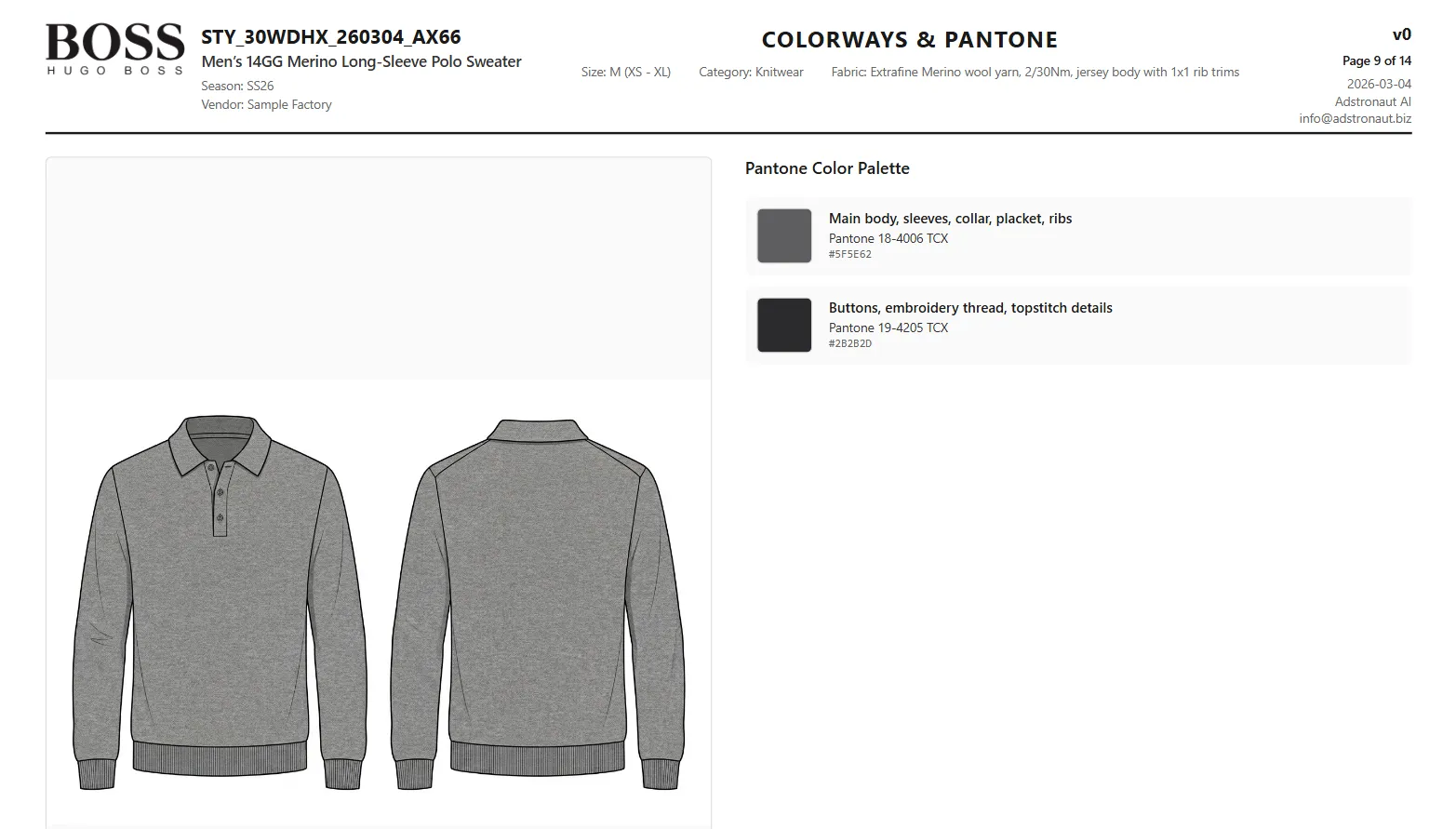 Pantone TCX color specification — critical for knitwear where yarn must be dyed to exact color standards before knitting begins.
Upload your knitwear photo and get all 15 sections instantly — try it free
Frequently Asked Questions
What is a knitwear tech pack?
A knitwear tech pack is a technical manufacturing document that specifies yarn composition, machine gauge, stitch structure, finishing process, and construction method for a knitted garment. It includes 3 additional sections beyond a standard apparel tech pack: yarn specification, gauge & knit structure, and finishing & processing.
How is a knitwear tech pack different from a regular tech pack?
A standard tech pack specifies a finished fabric (e.g., "cotton twill, 200 GSM"). A knitwear tech pack specifies the raw yarn and the instructions for creating the fabric on the knitting machine — including yarn count (Nm), machine gauge (GG), stitch density, and zone-based stitch mapping. It also requires separate pre-wash and post-wash measurements.
What yarn count should I specify for a sweater?
For a standard-weight sweater (autumn/winter), 2/28 Nm is the most common yarn count, typically knitted on a 7GG–12GG machine. For lightweight spring knits, use 2/48 Nm on 12GG–14GG machines. For chunky winter sweaters, use 2/15 Nm or 1/4 Nm on 3GG–7GG machines.
What is machine gauge (GG) in knitwear?
Machine gauge refers to the number of needles per inch on a knitting machine. A 12GG machine has 12 needles per inch, producing a relatively fine, compact fabric. A 3GG machine has 3 needles per inch, producing a chunky, open-stitch fabric. The gauge must match your yarn count — fine yarn on a coarse-gauge machine produces fabric full of holes.
Should knitwear measurements be pre-wash or post-wash?
Best practice is to specify all measurements on a post-wash basis (the finished garment after washing and blocking). Include a separate shrinkage target column (typically 3–8% for knitwear) so the factory can calculate the pre-wash knitting dimensions. This prevents the most common knitwear sampling error — garments that shrink below target after finishing.
What is the difference between flat-knit and circular-knit?
Flat-knit (fully fashioned) garments are knitted as shaped panels on a flatbed machine and assembled by linking (loop-by-loop joining). Circular-knit (cut & sew) garments are made from tubular knitted fabric that is cut into pattern pieces and sewn together. Flat-knit is premium (less waste, smoother seams) but more expensive and slower to produce.
How do I specify pilling resistance in a tech pack?
Specify pilling resistance using the Martindale method (ISO 12945-2) or the ICI Pilling Box method (ISO 12945-1). For consumer-grade knitwear, target Grade 3.5+ after 5,000 Martindale cycles. For premium knitwear, target Grade 4+ after 7,000 cycles. Include anti-pilling treatment requirements (singeing or enzyme bio-polish) in the finishing section.
What certifications should a knitwear tech pack include?
At minimum, specify OEKO-TEX Standard 100 for harmful substance testing. For wool products, add RWS (Responsible Wool Standard) for ethical sourcing. For organic claims, require GOTS (Global Organic Textile Standard). For recycled fiber, specify GRS (Global Recycled Standard). EU and UK retailers increasingly require these certifications for purchase orders.
Can AI generate a knitwear tech pack from a photo?
Yes. Adstronaut AI auto-detects knitwear from a product photo, classifies the construction type (flat-knit vs circular-knit), and generates all 15 sections including yarn specification, gauge & knit structure, and finishing & processing. The system estimates visible stitch patterns and generates post-wash measurements by default.
How many pages is a knitwear tech pack?
A complete knitwear tech pack is typically 10–15 pages — about 30% longer than a standard woven-garment tech pack due to the three additional knitwear-specific sections. Complex styles with multiple stitch zones, cable patterns, or intarsia colorwork can reach 18–20 pages.
Ready to create a factory-ready knitwear tech pack? Upload your design and get all 15 sections in minutes — try Adstronaut AI free.