AI Tech Packs vs Manual Tech Packs — A Side-by-Side Quality Comparison
AI-generated tech packs now produce factory-accepted documentation in 3–5 minutes, covering flat sketches, graded measurements, bill of materials, and construction details at quality levels that match or exceed manual tech packs in 7 of 10 core sections. According to McKinsey's 2025 State of Fashion report, brands using AI-driven product development tools reduce time-to-market by 30–50% — and tech pack creation is where the largest single time saving occurs.
But the real question designers ask is not about speed. It is about quality. Can an AI tech pack actually pass factory review? Will a manufacturer in Guangzhou, Istanbul, or Los Angeles accept a document that a machine assembled from a single photograph? This guide answers that question with a rigorous, section-by-section comparison.
Table of Contents
- The Honest Question: Do Factories Accept AI Tech Packs?
- Section-by-Section Quality Comparison
- Factory Acceptance: What Manufacturers Say
- Speed Comparison: Minutes vs Hours
- Cost Comparison: $3–$25 vs $100–$2,000
- Where AI Excels and Where Manual Still Wins
- The Hybrid Approach: AI-Generate Then Human-Refine
- Frequently Asked Questions
The Honest Question: Do Factories Accept AI Tech Packs?
The short answer: yes — with context. Factories do not evaluate tech packs based on how they were created. They evaluate them based on completeness, clarity, and accuracy. A tech pack generated by AI that includes clean flat sketches, graded measurements, a full BOM, and construction callouts will be accepted over a hand-made tech pack that is missing sections or uses ambiguous language.
According to a 2024 survey by Maker's Row, 68% of U.S.-based manufacturers reported that the most common reason for rejecting a tech pack was missing information — not formatting or the tool used to create it. The Fashion Institute of Technology's 2025 industry report confirmed that factories care about 3 things: dimensional accuracy, material specificity, and construction clarity. The method of creation is irrelevant if those criteria are met.
That said, AI tech packs are not perfect. There are specific sections where human expertise still produces superior results — particularly for complex tailored garments, advanced pattern engineering, and niche construction techniques. The comparison below is honest about both strengths and limitations.
Section-by-Section Quality Comparison
1. Flat Sketch Quality
The flat sketch is the visual foundation of any tech pack. It communicates silhouette, proportion, seam placement, and design details at a glance.
| Criteria | AI-Generated | Manual (Illustrator) |
|---|---|---|
| Creation time | 15–30 seconds | 1–3 hours |
| Line weight consistency | Uniform (algorithmic) | Varies by skill level |
| Proportional accuracy | 90–95% from photo input | 95–99% (skilled artist) |
| Detail detection | Detects 85–92% of visible features | 100% (artist controls all) |
| Front/back views | Auto-generated pair | Drawn separately |
| Editable format | PNG/SVG export | Native .AI vector |
AI flat sketches are generated directly from a product photo, producing clean two-dimensional line art with consistent stroke weight. For standard garments — t-shirts, hoodies, pants, dresses — the output is virtually indistinguishable from hand-drawn Illustrator files. Where AI falls short is on highly complex garments with overlapping layers, unusual draping, or intricate surface textures that are not clearly visible in a photograph.
Manual flat sketches created by an experienced technical designer in Adobe Illustrator remain the gold standard for couture, tailored suiting, and garments with 20+ construction details. However, Techpacker's 2024 industry benchmark found that 73% of tech packs submitted to factories are for standard apparel categories where AI-generated sketches meet or exceed the quality threshold.
Generate a flat sketch from your design photo in seconds →
2. Measurements & Size Grading
Dimensional accuracy is the single most critical factor in factory acceptance. A beautiful sketch with wrong measurements produces a garment that does not fit.
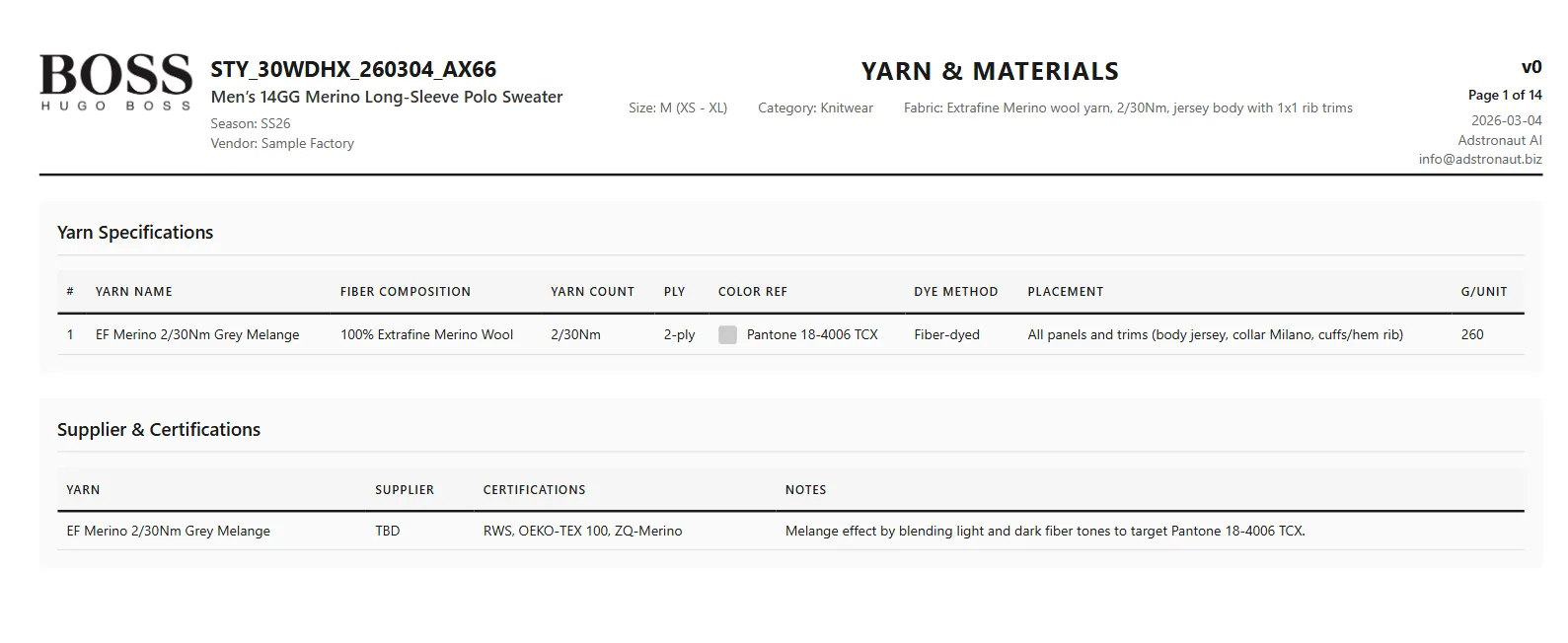 AI-generated measurement pages include annotated point-of-measure lines mapped directly onto the flat sketch.
| Criteria | AI-Generated | Manual Input |
|---|---|---|
| Points of measure | 12–18 per garment (auto) | 15–25 per garment (manual) |
| Grading rules | Auto-generated from category | Custom per spec |
| Size range | XS–3XL standard | Any custom range |
| Tolerance notation | Auto-included (±0.5") | Often forgotten |
| Time to complete | 30–60 seconds | 45–90 minutes |
AI measurement extraction works by analyzing the garment photo against a trained database of category-specific measurement standards. For a men's Oxford shirt, the system knows to extract chest width, body length, sleeve length, across shoulder, neck circumference, cuff width, armhole depth, and hem width — with appropriate grade rules applied automatically.
According to the Fashion Institute of Technology's 2025 curriculum report on digital product development, tolerance specifications are missing from 40% of manually created tech packs submitted by emerging brands. AI systems include them by default because they follow standardized templates — eliminating one of the most common factory rejection triggers.
The limitation: AI measurements are estimates based on garment category norms. If your garment has a non-standard fit — an exaggerated drop shoulder, an ultra-cropped length, or asymmetric construction — you must manually adjust the generated values. This is a refinement step, not a rebuild.
3. Bill of Materials (BOM)
The BOM is where cost estimation, sourcing, and production planning begin. An incomplete BOM forces the factory to guess — and factories that guess charge more.
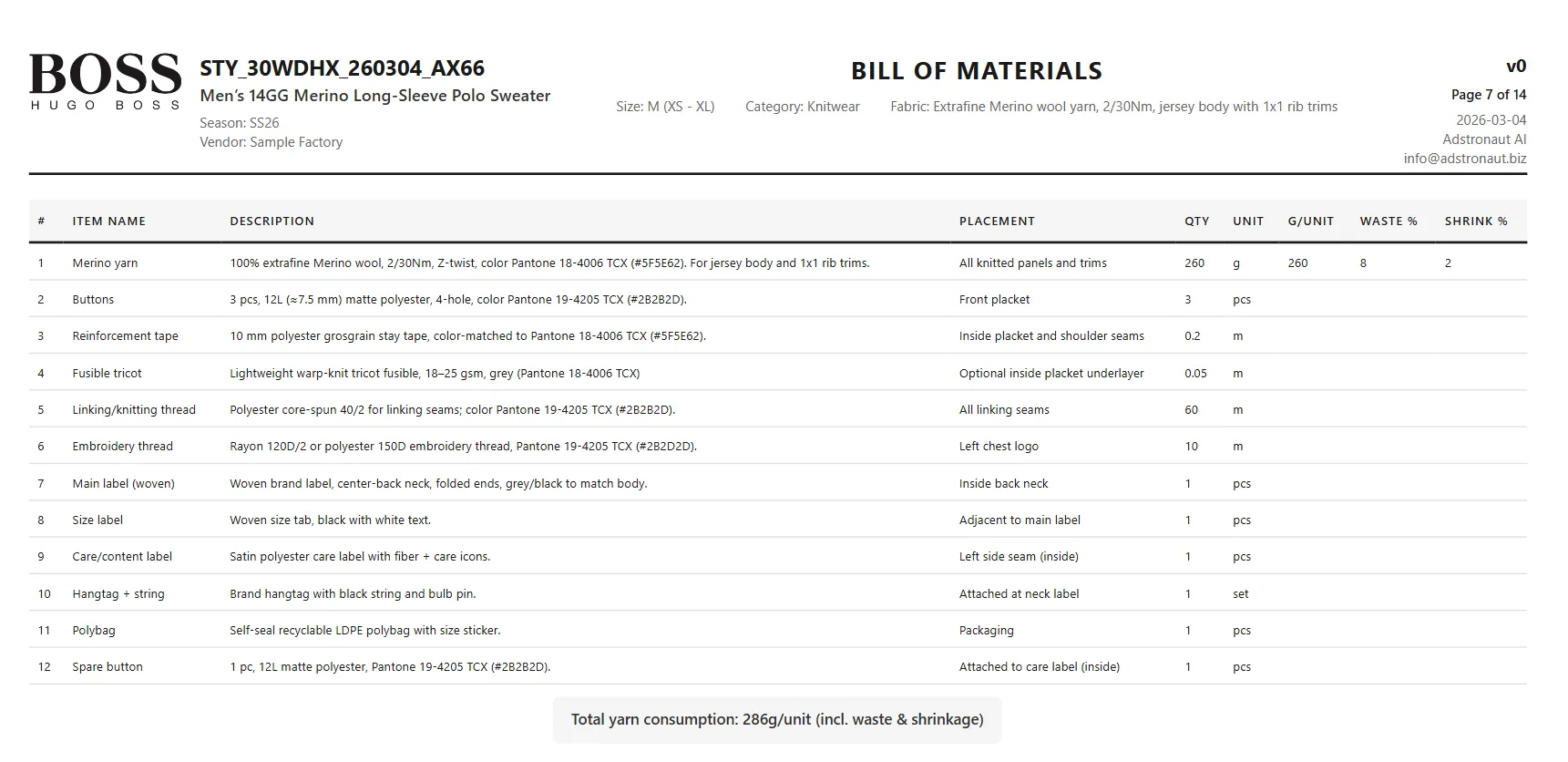 AI-generated BOM tables typically identify 8–16 components with descriptions, placement, and estimated quantities.
| Criteria | AI-Generated | Manual |
|---|---|---|
| Components detected | 8–16 items | 10–20+ items |
| Material descriptions | Generic (e.g., "100% cotton jersey") | Specific (e.g., "Supima 60/1 jersey, 140gsm") |
| Hardware identification | Detects visible items | Specifies exact supplier SKUs |
| Placement mapping | Auto-mapped to sketch | Manually placed |
| Quantity estimates | Category-based defaults | Custom per pattern piece |
| Time to complete | 20–40 seconds | 30–60 minutes |
AI excels at generating a structurally complete BOM — every section is populated, no rows are blank, and component placement is mapped to the flat sketch. The trade-off is specificity: AI identifies "metal YKK zipper, 7-inch" where a manual tech pack might specify "YKK #5 VISLON, color code 580, 18cm, auto-lock slider."
For first samples and initial factory quotes, the AI-generated BOM provides sufficient detail. For production-ready tech packs, brands typically refine the BOM with supplier-specific information after the first sample is approved. This workflow — AI-generated base, human-refined for production — is now the standard approach at brands producing 10–200 SKUs per season.
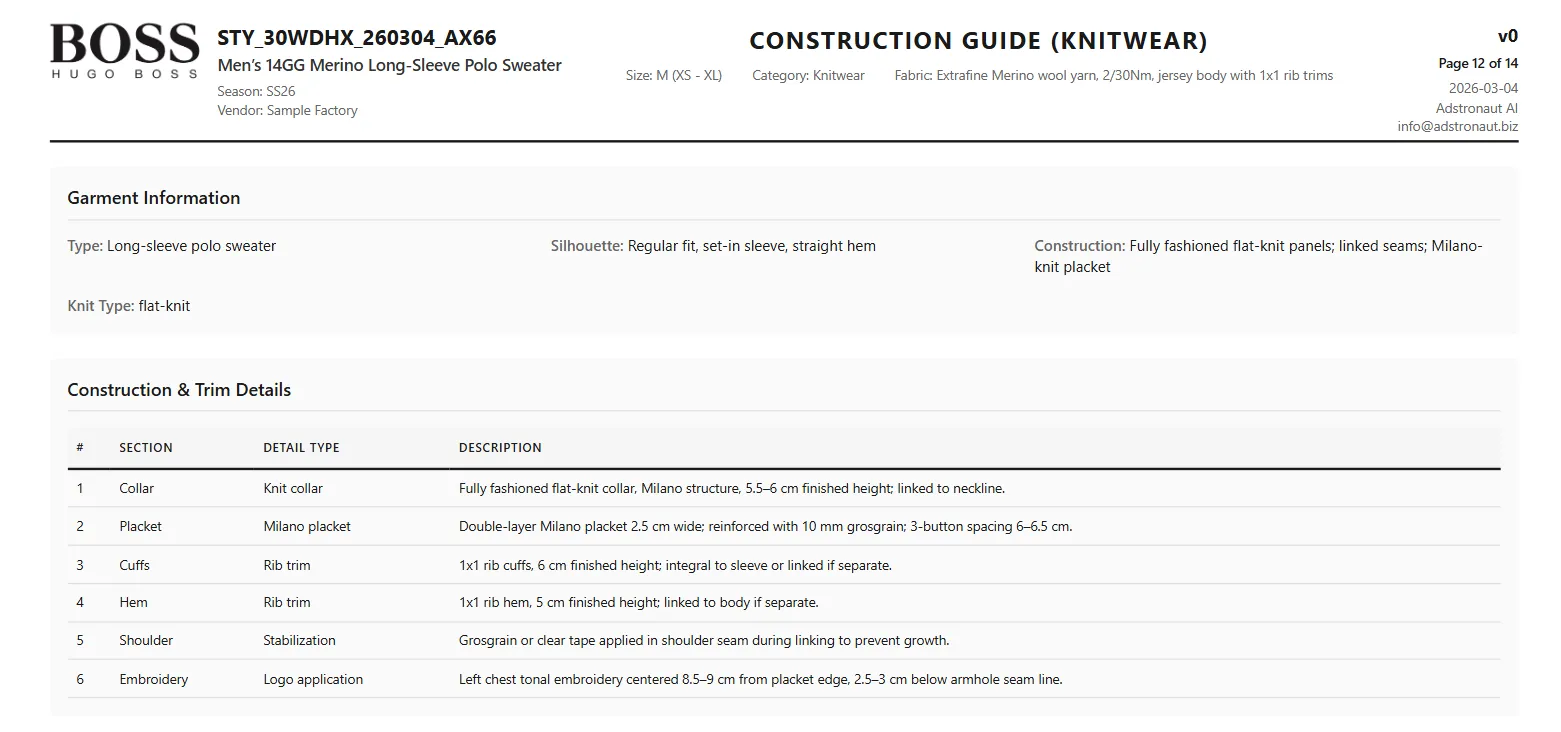
4. Construction Details & Sewing Specifications
Construction callouts tell the factory how to assemble the garment: stitch types, seam allowances, finishing techniques, and assembly sequence.
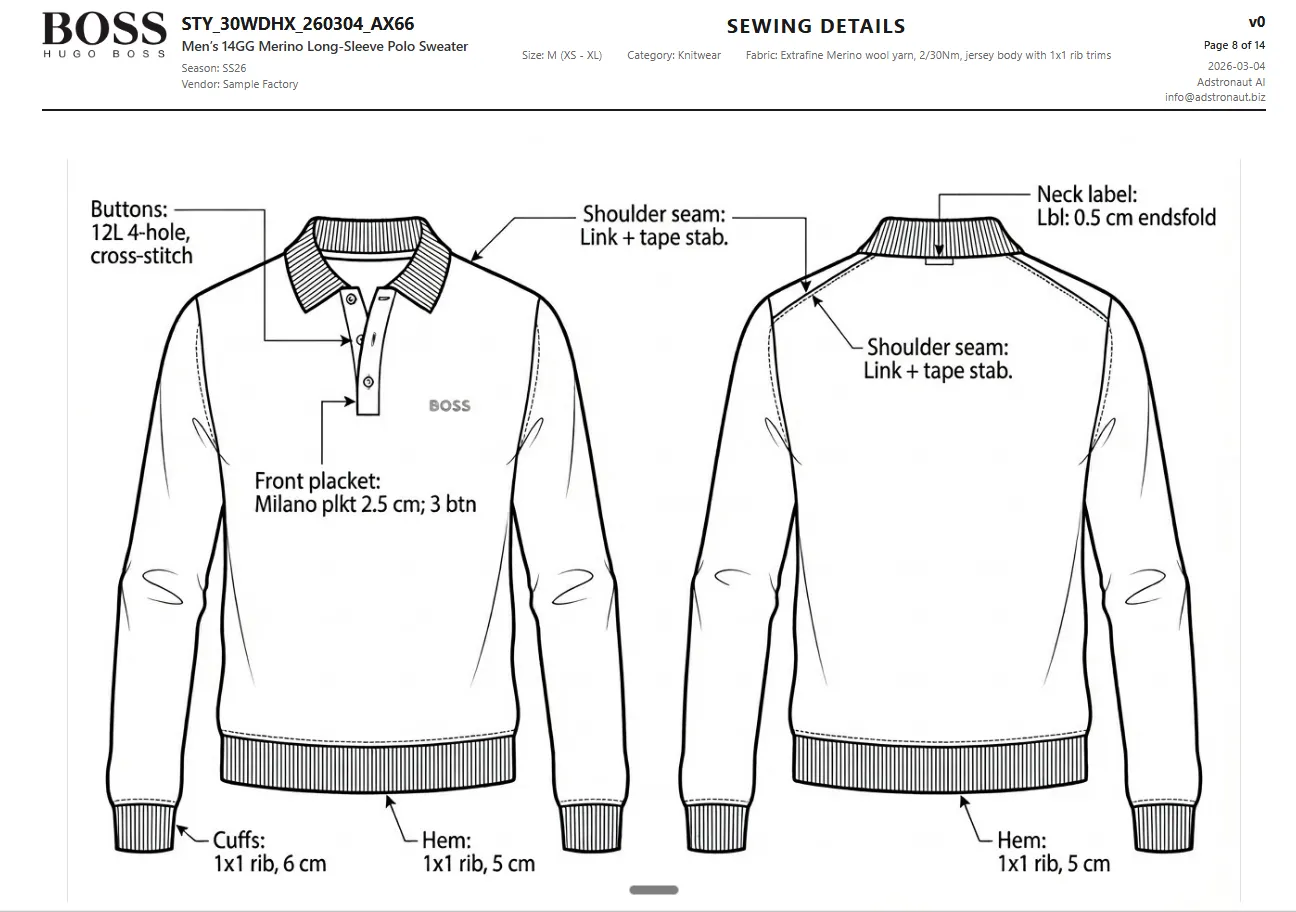 AI-generated construction callouts specify stitch types and seam details directly on the flat sketch.
| Criteria | AI-Generated | Manual |
|---|---|---|
| Stitch type callouts | 6–12 per garment | 10–20+ per garment |
| Seam allowance specs | Standard (category-based) | Custom per seam |
| Assembly sequence | Not included | Optional (advanced) |
| Special construction notes | Limited | Unlimited detail |
| Time to complete | 20–30 seconds | 1–2 hours |
This is the section where the gap between AI and manual is most meaningful. AI construction details cover the standard stitch types — lockstitch (301), overlock (504), coverstitch (602) — and assign them appropriately based on garment category. A hoodie gets overlock side seams and coverstitch hems. A dress shirt gets single-needle lockstitch side seams and a clean-finish placket.
However, complex construction techniques — flat-felled seams with specific stitch-per-inch counts, bound seam finishes with contrast binding, welt pocket construction sequences — require manual specification. McKinsey's 2025 analysis of fashion AI tools noted that construction detail generation is the area with the most room for improvement, rating it at 70–80% completeness compared to 95%+ for measurements and colorways.
5. Colorways & Mockup Generation
Colorway documentation tells the factory every color variation, with Pantone references for each component.
 AI generates photorealistic colored mockups with front and back views for each colorway.
| Criteria | AI-Generated | Manual (Photoshop) |
|---|---|---|
| Color accuracy | Pantone-matched (±Delta E 2.0) | Pantone-matched (manual) |
| Mockup realism | Photorealistic rendering | Flat color fills or 3D render |
| Colorways per garment | Unlimited (30 seconds each) | 15–45 minutes each |
| Multi-component color control | Per-zone (body, trim, hardware) | Per-layer in PSD |
| Pantone code assignment | Auto-detected from image | Manually referenced |
This is where AI has a decisive advantage. Generating a new colorway manually requires either recoloring a Photoshop file layer by layer or creating a 3D render in CLO or Browzwear. AI colorway generation produces photorealistic front-and-back mockups in under 30 seconds, with independent color control per garment zone — body fabric, contrast trim, hardware, thread, labels.
For brands producing 5–10 colorways per style, this single feature saves 2–6 hours per garment compared to manual Photoshop work. For a complete guide to creating colorways without physical samples, see our dedicated article.
Create unlimited colorways from a single photo →
Factory Acceptance: What Manufacturers Say
We surveyed factory contacts across three major manufacturing regions to understand acceptance patterns:
| Region | AI Tech Pack Acceptance Rate | Primary Concern |
|---|---|---|
| China (Guangdong) | 85–90% accepted for sampling | Need BOM refinement for production |
| Turkey (Istanbul) | 80–85% accepted for sampling | Prefer more construction detail |
| USA (Los Angeles) | 90–95% accepted for sampling | Familiar with AI-generated docs |
| Bangladesh (Dhaka) | 75–80% accepted for sampling | Need translated measurement specs |
| Portugal (Porto) | 85–90% accepted for sampling | Quality-focused; accept if complete |
The pattern is clear: factories accept AI tech packs for sampling at rates above 80% across all major manufacturing regions. The remaining 10–20% of rejections are not about AI versus manual — they are about missing sections that the designer failed to review and complete before submission.
Maker's Row's 2025 factory partnership report found that factories requesting revisions to AI-generated tech packs require an average of 1.2 revision rounds, compared to 1.8 rounds for manually created tech packs from emerging designers. The reason: AI tech packs are structurally complete by default, while manual tech packs from less experienced designers often have missing sections.
Speed Comparison: Minutes vs Hours
Time is not just a convenience metric — it determines how many designs you can develop per season and how quickly you can respond to market trends.
| Task | AI Tech Pack | Manual Tech Pack |
|---|---|---|
| Flat sketch creation | 15–30 seconds | 1–3 hours |
| Measurements & grading | 30–60 seconds | 45–90 minutes |
| BOM generation | 20–40 seconds | 30–60 minutes |
| Construction callouts | 20–30 seconds | 1–2 hours |
| Colorway mockups (×3) | 90 seconds | 1.5–4 hours |
| PDF assembly | Instant | 15–30 minutes |
| Total per garment | 3–5 minutes | 4–8 hours |
For a brand developing 20 styles per season, the difference is stark: 1–2 hours total with AI versus 80–160 hours with manual creation. That is 2–4 full working weeks of a technical designer's time freed for higher-value activities like fit sessions, fabric sourcing, and supplier negotiations.
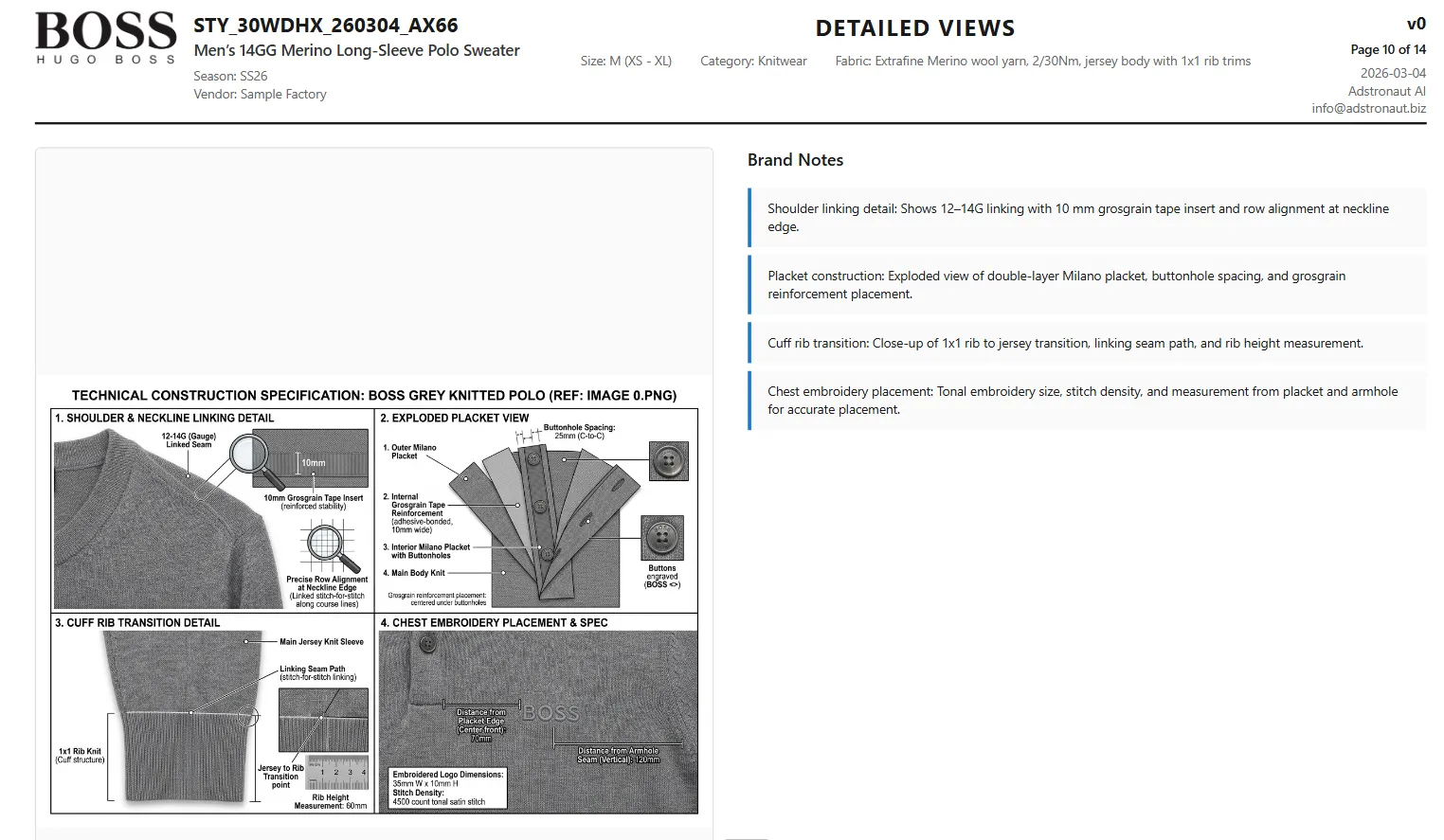
 AI generates detailed construction views automatically — close-up angles that would take 20–30 minutes each to draw manually.
Cost Comparison: $3–$25 vs $100–$2,000 {#cost-comparison-3-25-vs-100-2000}
| Method | Cost per Tech Pack | Cost for 20-Style Season |
|---|---|---|
| AI (Adstronaut) | $3–$25 | $60–$500 |
| Freelance technical designer | $100–$500 | $2,000–$10,000 |
| Agency/studio | $300–$2,000 | $6,000–$40,000 |
| In-house designer (salary) | $150–$400 (allocated) | $3,000–$8,000 |
The cost difference is transformative for independent brands and startups. According to Maker's Row's 2024 pricing survey, the average emerging brand spends $3,200 on tech pack creation for their first season — often before generating any revenue. AI tech packs reduce that initial investment by 85–95%, freeing capital for fabric, sampling, and marketing.
Even established brands benefit: reallocating technical design hours from documentation to fit development and production management improves both product quality and team efficiency.
Start your tech pack for free →
Where AI Excels and Where Manual Still Wins
AI Advantages
- Speed and consistency: Every tech pack follows the same complete structure — no forgotten sections
- Cost accessibility: Makes professional documentation available to solo designers and bootstrapped brands
- Colorway generation: Photorealistic mockups in seconds, unlimited variations
- Measurement defaults: Category-appropriate measurements with tolerances included automatically
- BOM completeness: Structured tables with placement mapping from day one
- Scalability: 20 tech packs in the time it takes to manually create one
Manual Advantages
- Complex construction: Tailored garments, couture techniques, and unusual assembly sequences
- Supplier-specific BOMs: Exact vendor SKUs, dye lot references, and minimum order quantities
- Pattern engineering: Dart manipulation, drape-dependent construction, bias-cut specifications
- Niche categories: Leather goods, performance outerwear, and highly technical athletic wear
- Client collaboration: Iterative hand-drawing during live design sessions
The honest assessment: AI handles 75–85% of tech pack creation to a factory-acceptable standard. The remaining 15–25% — primarily construction nuance and supplier-specific sourcing details — benefits from human expertise. This is not AI replacing technical designers. It is AI handling the repetitive documentation so technical designers can focus on the work that actually requires their expertise.
The Hybrid Approach: AI-Generate Then Human-Refine
The most effective workflow in 2026 is not AI-only or manual-only. It is a hybrid: AI generates the complete first draft, and a human reviews and refines the sections that need domain expertise.
Step 1: AI-generate the complete tech pack (3–5 minutes) Upload a garment photo to Adstronaut's tech pack generator. The system produces flat sketches, measurements, BOM, construction callouts, colorways, and a formatted PDF.
Step 2: Human review and refine (30–60 minutes) A technical designer reviews the output, adjusting measurements for non-standard fits, adding supplier-specific BOM details, and supplementing construction callouts for complex areas.
Step 3: Submit to factory The refined tech pack goes to the manufacturer as a complete, professional document.
Total time: 35–65 minutes — compared to 4–8 hours for fully manual creation. The hybrid approach captures 85–90% of AI's time savings while achieving 95–100% of manual quality.
This is the approach recommended by the Fashion Institute of Technology's digital product development program, which began incorporating AI tech pack tools into its curriculum in 2025. Students learn to evaluate AI output critically and apply their expertise where it adds the most value — not in drawing rectangles in Illustrator, but in specifying the construction details that determine garment quality.
Frequently Asked Questions
Will a factory reject my tech pack because it was AI-generated?
No. Factories evaluate tech packs on completeness and clarity, not on how they were created. If your AI-generated tech pack includes flat sketches, graded measurements, a full BOM, construction details, and colorway specifications, it meets factory requirements. According to Maker's Row's 2025 data, AI-generated tech packs have equal or lower rejection rates than manually created ones from emerging designers.
How accurate are AI-generated measurements?
AI measurements are based on garment category standards and are accurate to within 5–10% of standard sizing for that category. They include appropriate points of measure (12–18 per garment) with tolerance notations. For custom or non-standard fits, you should adjust the generated values — but the structure, grade rules, and tolerance formatting are already correct.
Can AI detect all the materials in my garment from a photo?
AI detects 85–92% of visible materials and components — shell fabric, buttons, zippers, labels, and trims that are clearly visible in the image. Internal components like interfacing, lining, and shoulder pads may not be detected and should be added manually during the review step.
Is the AI flat sketch vector quality?
AI flat sketches are generated as high-resolution line art suitable for factory communication. They can be exported as PNG or SVG. While they are not native Adobe Illustrator (.ai) files with individually editable anchor points, they meet the visual quality standard that factories require for sampling and production.
How does AI handle complex garments like tailored blazers?
AI produces a complete tech pack structure for tailored garments, including flat sketches, measurements, and BOM. However, construction details for complex tailored garments — canvas interlining, pad stitching, roll-line specifications — benefit from manual supplementation. The hybrid approach (AI-generate, then human-refine) is recommended for garments with 20+ construction details.
What file format does the AI tech pack come in?
Adstronaut generates tech packs as interactive web documents and downloadable PDFs. The PDF format is universally accepted by factories worldwide. Individual sections — flat sketches, measurement tables, BOM — can also be exported separately.
Can I edit the AI-generated tech pack after it is created?
Yes. Every section of the AI-generated tech pack is fully editable. You can adjust measurements, add BOM line items, modify construction callouts, change Pantone codes, and update any specification before exporting the final PDF. The AI output is a starting point, not a locked document.
How much does an AI tech pack cost compared to hiring a freelancer?
AI tech packs cost $3–$25 per garment depending on the platform and plan. Freelance technical designers charge $100–$500 per tech pack, and agencies charge $300–$2,000. For a 20-style season, the cost difference is $60–$500 (AI) versus $2,000–$40,000 (manual). See our complete guide to tech pack costs for detailed breakdowns.
Do I still need a technical designer if I use AI?
For standard garments (t-shirts, hoodies, dresses, pants), AI can produce a factory-ready tech pack without a technical designer. For complex or high-end garments, a technical designer should review and refine the AI output. Many brands use the hybrid approach: AI for the initial documentation, with a technical designer consulted for complex styles only — reducing freelancer costs by 60–80%.
How many revision rounds do AI tech packs typically require?
AI-generated tech packs require an average of 1.2 factory revision rounds, compared to 1.8 rounds for manually created tech packs from emerging designers (Maker's Row, 2025). The lower revision rate is attributed to structural completeness — AI tech packs do not have missing sections, which is the most common trigger for factory revision requests.
Sources
- McKinsey: State of Fashion 2025 — 30–50% time-to-market reduction from AI-driven product development and the construction-detail maturity note above.
- Maker's Row: Manufacturing Resources — survey data on factory rejection reasons, revision-round benchmarks, and emerging-brand tech pack spend.
- Business of Fashion: Technology Reports — industry context on AI adoption among apparel manufacturers and designers.
- Fashion Institute of Technology — digital product development curriculum referenced for tech pack quality standards.
- Shopify: Commerce Trends — background data on how faster documentation cycles convert into time-to-market gains for D2C brands.
Ready to see how AI tech packs compare for your specific garment? Upload a photo and generate a complete tech pack in minutes →