How to Price a Clothing Line — Complete Pricing Formula, Markup & Margin Guide
The standard pricing formula for a clothing line is Wholesale Price = Cost of Goods (COGS) x 2.0–2.5, and Retail Price = Wholesale Price x 2.0–2.5. This is called the "keystone" markup model. A t-shirt with $8 COGS wholesales at $16–$20 and retails at $32–$50. Your target gross margin should be 50–65% at wholesale and 55–70% at retail. Getting this formula wrong is the single most common reason fashion startups fail — price too low and you cannot sustain operations; price too high and you lose sales to competitors.
This guide breaks down every component of fashion pricing, provides real cost examples by garment type, explains the differences between D2C, wholesale, and marketplace pricing, and gives you a working spreadsheet framework.
Get an itemized BOM to price your garment accurately →
Table of Contents
- The Fashion Pricing Formula
- Understanding COGS: What Actually Goes Into Your Cost
- Full COGS Breakdown for a Garment (Line by Line)
- Real Pricing Examples by Garment Type
- D2C vs Wholesale vs Marketplace Pricing
- Common Pricing Mistakes That Kill Margins
- How to Set Your First Prices (Step-by-Step)
- When and How to Raise Prices
- Frequently Asked Questions
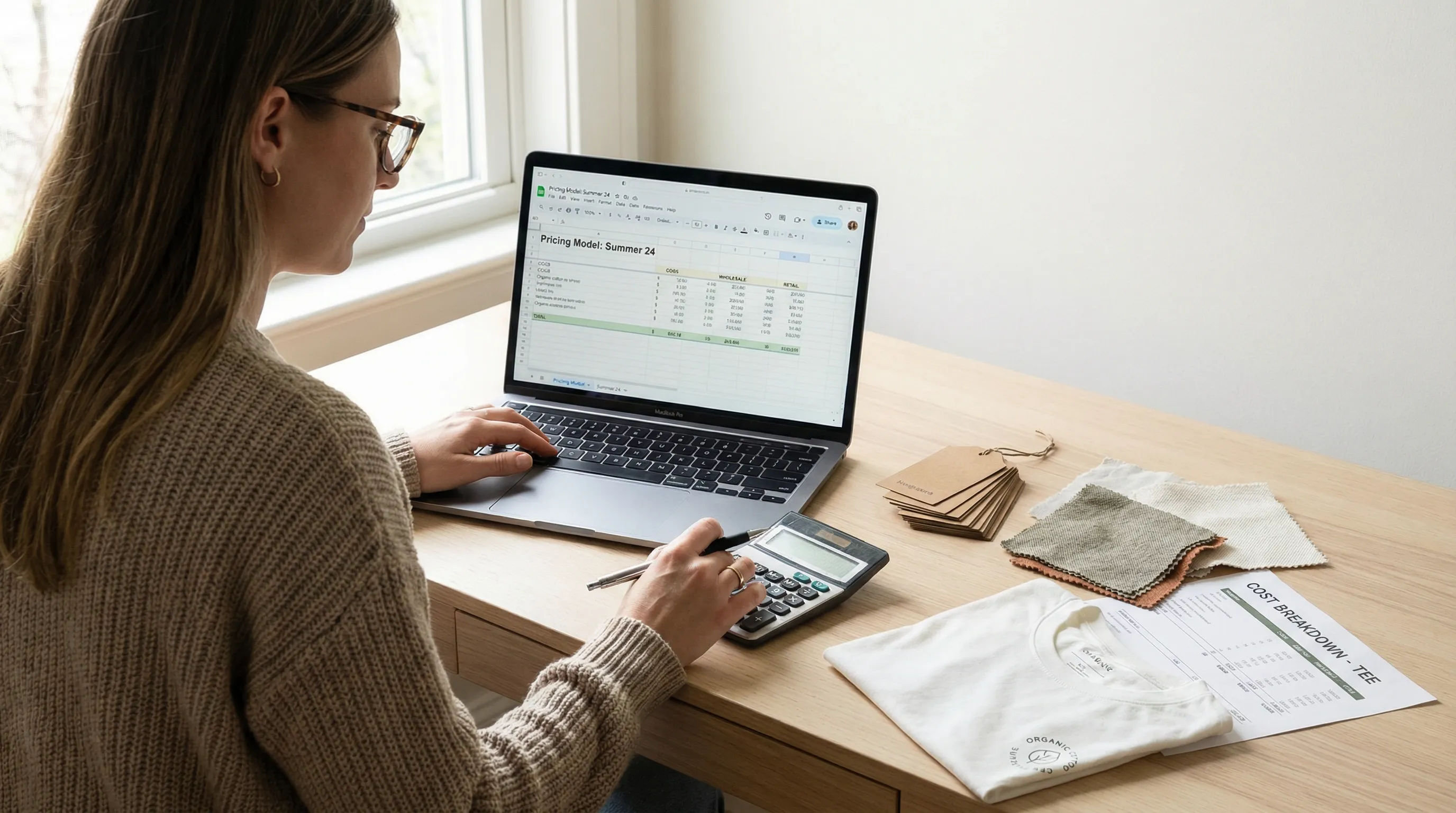 Fashion entrepreneur calculating clothing line pricing with a calculator, COGS spreadsheet, fabric swatches, and garment samples on desk
The Fashion Pricing Formula {#the-fashion-pricing-formula}
Fashion pricing follows a layered markup structure. Each layer must provide enough margin to cover the costs of that channel.
The Core Formula
COGS (Cost of Goods Sold)
  × 2.0–2.5 = Wholesale Price
    × 2.0–2.5 = Retail Price (MSRP)
This means your retail price is approximately 4x–6.25x your COGS. This is not markup greed — it is the minimum required to sustain a healthy fashion business when you account for discounts, returns, marketing, overhead, and channel costs.
Margin targets by channel:
| Channel | Gross Margin Target | What This Covers |
|---|---|---|
| D2C (own website) | 65–80% | Marketing (25–35% of revenue), shipping, returns (20–30% in fashion), platform fees, overhead |
| Wholesale | 50–65% | Production, design, sampling, overhead, profit |
| Marketplace (Amazon, etc.) | 55–70% | Platform fees (15–30%), advertising, fulfillment, returns |
According to NYU Stern's database of industry financial margins, the average gross margin for apparel companies is 53.5%. Premium and luxury brands operate at 60–75%. Fast fashion operates at 45–55% with higher volume.
Why the Keystone Markup Exists
The 2x–2.5x multiplier at each level is not arbitrary. Here is where the money goes:
At wholesale (your margin: 50–65%):
- Raw materials and manufacturing: 35–50% of wholesale
- Design, sampling, and tech packs: 3–5%
- Warehousing and fulfillment: 5–8%
- Overhead (rent, salaries, insurance): 10–15%
- Profit: 10–20%
At retail (retailer's margin: 50–65%):
- Inventory carrying cost: 5–10%
- Store operations (rent, staff): 20–30%
- Markdowns and clearance: 10–15% (average 30% of fashion inventory is marked down per McKinsey)
- Shrinkage and returns: 5–8%
- Profit: 10–15%
Understanding COGS: What Actually Goes Into Your Cost {#understanding-cogs}
Your COGS (Cost of Goods Sold) is the total cost to produce one finished unit, ready to sell. Most new designers underestimate COGS by 20–40% because they forget indirect costs.
Complete COGS Breakdown
| Cost Component | Description | Typical Range |
|---|---|---|
| Fabric | Shell, lining, ribbing, contrast | 40–60% of COGS |
| Trims | Buttons, zippers, labels, hang tags | 5–15% |
| Thread and notions | Sewing thread, elastic, tape | 2–5% |
| CMT (Cut, Make, Trim) | Labor cost charged by factory | 20–35% |
| Packaging | Polybag, tissue, box, stickers | 2–5% |
| Shipping (factory to warehouse) | Freight, customs, duties | 5–15% |
| Sampling | Divided across production run | Variable |
| Quality control | Inspection costs | 1–3% |
Example: T-Shirt COGS Calculation
| Line Item | Cost |
|---|---|
| Fabric (1.5 yards × $4/yard) | $6.00 |
| Neck ribbing | $0.40 |
| Thread | $0.20 |
| Labels (main + care + size) | $0.45 |
| Hang tag | $0.25 |
| CMT (cut, sew, finish) | $2.50 |
| Polybag + packaging | $0.30 |
| Shipping (allocated per unit) | $0.90 |
| Total COGS | $11.00 |
Using the keystone formula:
- Wholesale price: $11.00 × 2.2 = $24.20 (round to $24)
- MSRP: $24 × 2.2 = $52.80 (round to $48 or $52)
- D2C price (no wholesale): $11.00 × 4.0 = $44.00
According to the American Apparel & Footwear Association, fabric accounts for the single largest cost component in garment production, averaging 50–55% of total COGS across all garment types. Tools like Adstronaut auto-generate itemized BOMs from a product photo, which helps new brands avoid the 20–40% COGS underestimation that leads to chronic underpricing.
Get an itemized BOM to calculate your true COGS →
Full COGS Breakdown for a Garment (Line by Line) {#full-cogs-breakdown}
Here is the complete landed cost of one mid-weight fleece hoodie, produced overseas in a 300-unit run. Every figure is per finished unit in USD (with GBP, EUR, and AUD on the total), including the indirect costs most founders forget: cutting waste, inbound freight, and import duties. This is the level of detail your BOM needs before you apply any markup formula.
| Cost line | What it covers | Cost per unit (USD) |
|---|---|---|
| Fabric (shell + rib) | 2.0 yd @ $5.00/yd | $10.00 |
| Cutting waste | 12% marker/fabric loss | $1.20 |
| Trims | Drawcord, metal eyelets, elastic, sewing thread | $1.10 |
| Labels + hang tags | Woven main, care, size, printed tag | $0.60 |
| Labor — CMT (Cut, Make, Trim) | Factory sewing and finishing charge | $4.50 |
| Packaging | Polybag, tissue, sticker | $0.45 |
| Inbound freight | Ocean + drayage, allocated per unit | $0.80 |
| Duties | US apparel tariff (cotton knit ~16.5% MFN), allocated | $1.30 |
| Overhead | Sampling amortized, QC inspection, customs brokerage | $1.05 |
| Total landed COGS | $21.00 |
At $21.00 per unit (≈ £16.50 / €19.50 / A$32), that hoodie wholesales at roughly $46 and retails at $95–$110 under keystone markup. Miss the $5.40 of indirect cost (waste, freight, duties, overhead — 26% of this COGS) and every markup downstream is built on a false floor. The American Apparel & Footwear Association notes fabric alone averages 50–55% of COGS, but the freight-and-duty layer is what most first costings omit entirely.
Gross-Margin Benchmarks by Category
Target margin varies sharply by where your brand sits. Use these retail gross-margin ranges as guardrails, not rules:
| Category | Retail gross-margin range | Notes |
|---|---|---|
| Basics / blanks | 55–65% | High volume, thin margins, price-sensitive buyers |
| Streetwear | 60–72% | Brand and drop scarcity support premium markup |
| Contemporary | 65–75% | Design and fabric quality justify higher pricing |
| Luxury / designer | 72–85%+ | Willingness-to-pay, not cost-plus, sets price |
Real Pricing Examples by Garment Type {#real-pricing-examples}
These are realistic pricing ranges for an indie brand producing 200–500 units per style overseas, with moderate-quality materials.
| Garment | COGS | Wholesale | MSRP (Retail) | D2C Price |
|---|---|---|---|---|
| Basic t-shirt | $6–$12 | $14–$28 | $28–$58 | $24–$48 |
| Hoodie | $12–$22 | $28–$52 | $55–$110 | $48–$95 |
| Jeans | $15–$30 | $35–$70 | $70–$150 | $58–$128 |
| Dress (casual) | $10–$25 | $24–$58 | $48–$120 | $40–$98 |
| Blazer | $25–$60 | $58–$140 | $120–$300 | $98–$250 |
| Swimwear (bikini set) | $8–$18 | $18–$42 | $38–$90 | $32–$75 |
| Outerwear (puffer) | $30–$70 | $70–$165 | $140–$350 | $120–$295 |
| Activewear leggings | $8–$18 | $18–$42 | $38–$90 | $32–$75 |
Note: Domestic U.S. production costs 2–3x more than overseas. Adjust COGS accordingly. See our guide on finding clothing manufacturers for regional cost comparisons.
D2C vs Wholesale vs Marketplace Pricing {#dtc-vs-wholesale-vs-marketplace}
The channel you sell through fundamentally changes your pricing strategy. Many brands sell through multiple channels simultaneously, which creates pricing tension.
D2C (Direct to Consumer) — Your Own Website
Advantage: You capture the full retail margin (no wholesale discount). Challenge: You pay for all customer acquisition (marketing costs 25–35% of D2C revenue on average).
D2C pricing formula: COGS × 3.5–5.0 = D2C Price
According to Shopify's 2025 Commerce Report, the average D2C fashion brand spends $32–$45 to acquire a new customer through paid advertising. With an average order value of $75–$120, you need 65–70% gross margins to remain profitable after acquisition costs.
Wholesale — Selling to Retailers
Advantage: Bulk orders with predictable revenue. No marketing cost per unit. Challenge: Lower margin per unit. Retailers expect 50–60% off MSRP.
Wholesale pricing formula: COGS × 2.0–2.5 = Wholesale Price
Standard wholesale terms: The retailer buys at wholesale and marks up to MSRP. If your wholesale price is $24 and MSRP is $52, the retailer makes $28 per unit (54% gross margin). This must be attractive enough for them to carry your brand.
Marketplace — Amazon, Etsy, etc.
Advantage: Built-in traffic. No customer acquisition cost (theoretically). Challenge: Platform fees (15–30%), heavy competition, price pressure.
Marketplace pricing formula: COGS × 3.0–4.0 = Marketplace Price
Amazon's referral fee for clothing is 17%. Plus FBA fees of $3–$5 per unit. Plus advertising cost (Amazon PPC averages $0.81 per click in apparel). Your effective platform cost is 25–35% of revenue.
Multi-Channel Pricing Tension
The biggest pricing challenge for brands selling wholesale AND D2C: your D2C price should not undercut your retail partners. If a retailer sells your hoodie for $85 and you sell it on your own site for $60, the retailer will drop your brand.
Solution: Set your D2C price at or slightly above MSRP. Offer occasional D2C-exclusive promotions (gift with purchase, bundles) rather than price discounts that undercut retail partners.
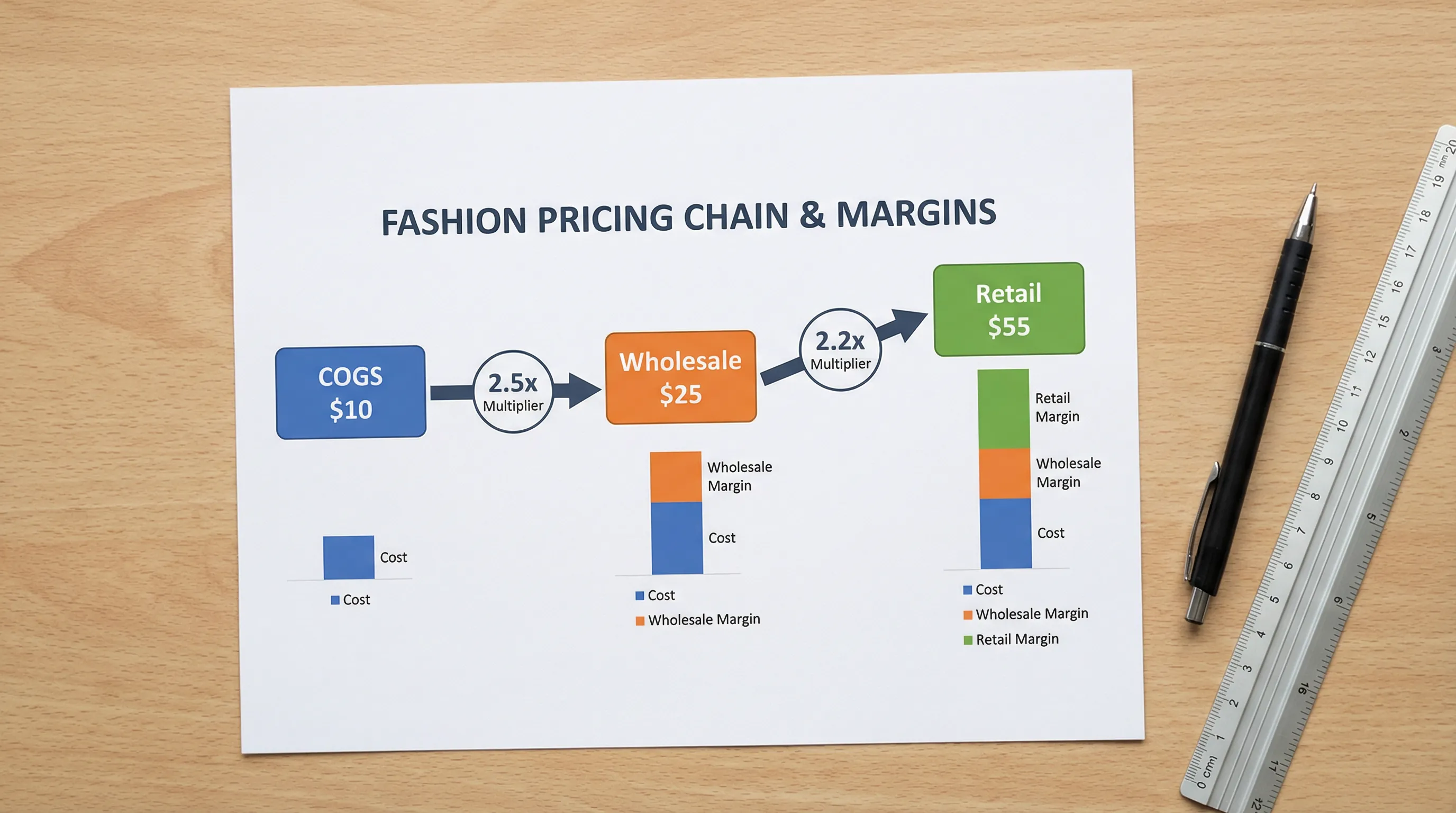 Visual diagram showing the clothing pricing chain from COGS to wholesale price to retail price with markup multipliers
Common Pricing Mistakes That Kill Margins {#common-pricing-mistakes}
1. Pricing based on competitor comparison alone "My competitor sells similar t-shirts for $35, so I'll price at $32." This ignores your actual COGS. If your COGS is $14 and you sell at $32, your gross margin is 56% — viable for D2C but unsustainable for wholesale. Always start with COGS, then validate against the competitive landscape.
2. Forgetting landed cost in COGS Many brands calculate COGS as factory price only. Your true COGS includes shipping, duties (varies by country: 12–32% for apparel entering the U.S. depending on fabric and country of origin), customs brokerage fees ($50–$150 per shipment), and quality inspection costs.
3. Not building in markdown allowance According to McKinsey, the average fashion brand marks down 30–40% of inventory at end-of-season. If your pricing has no markdown buffer, every clearance sale eats directly into your profit. Build 10–15% markdown allowance into your wholesale price.
4. Underpricing to "build the brand" Raising prices later is significantly harder than launching at the right price. A 2024 study by Wharton's retail research center found that 68% of consumers perceive a price increase of more than 10% negatively, regardless of the reason. Start at your target price and offer introductory promotions instead.
5. Ignoring customer acquisition cost (CAC) D2C brands often price based on COGS + desired margin, forgetting that they need to spend $30–$50 to acquire each new customer. If your gross margin doesn't cover CAC plus operating expenses, you lose money on every first-time order.
How to Set Your First Prices (Step-by-Step) {#how-to-set-your-first-prices}
Step 1: Calculate True COGS
List every cost that goes into producing one finished unit (see the COGS breakdown table above). Do not use your factory quote as COGS — add landed costs, packaging, and allocated sampling costs. If you are modeling landed cost across a multi-style collection, Adstronaut's tech pack and BOM tools standardize the line-item format so every style uses the same cost structure before you apply the markup formula.
Step 2: Apply the Markup Formula
- If selling D2C only: COGS × 3.5–5.0
- If selling wholesale + D2C: COGS × 2.0–2.5 (wholesale), then wholesale × 2.0–2.5 (MSRP = D2C)
- If selling on marketplaces: COGS × 3.0–4.0 (to absorb platform fees)
Step 3: Validate Against the Market
Research 5–10 competitors selling similar products to a similar customer. Your price should fall within the range of brands with comparable quality and positioning. If your calculated price is above the market, you need to reduce COGS (source cheaper materials, increase volume) or move upmarket with branding and quality.
Step 4: Run the Margin Check
After setting your price, calculate the gross margin:
Gross Margin = (Price – COGS) ÷ Price × 100
If your D2C margin is below 60%, your business model is at risk. If your wholesale margin is below 45%, you cannot sustain operations. Go back to Step 1 and find cost savings.
Step 5: Test with Real Customers
Launch at your calculated price. If conversion rates are healthy (2–4% for D2C fashion, per Shopify benchmarks), your pricing is validated. If conversion is below 1%, test whether price is the barrier (A/B test a lower price vs improved product photography).
Use (or Embed) the Free Pricing Calculator {#use-or-embed-the-free-pricing-calculator}
You don't have to run the formula by hand. The free clothing pricing calculator does the COGS → wholesale → retail math live, with margin checks built in — no signup, no email.
If you write for founders yourself — a blog, a newsletter, a course page — you can also put the live calculator on your own site. Paste this snippet where you want it to appear and keep the credit line underneath:
<!-- Free clothing pricing calculator by Adstronaut -->
<div style="max-width:720px;margin:1rem 0">
  <iframe src="https://www.adstronaut.net/embed/clothing-pricing-calculator"
    title="Clothing pricing calculator" width="100%" height="560" loading="lazy"
    style="border:1px solid #e5e7eb;border-radius:12px"></iframe>
  <p style="font-size:12px;color:#6b7280;margin:6px 0 0">
    Powered by <a href="https://www.adstronaut.net/free-tools/clothing-pricing-calculator?utm_source=embed&utm_medium=referral&utm_campaign=pricing-calculator" target="_blank" style="color:#111827">Adstronaut — free clothing pricing calculator</a>
  </p>
</div>
If your platform strips iframes (most email newsletters do), link to it instead:
<p>Try the free <a href="https://www.adstronaut.net/free-tools/clothing-pricing-calculator?utm_source=embed&utm_medium=referral&utm_campaign=pricing-calculator">clothing pricing calculator by Adstronaut</a> — no signup, no email.</p>
When and How to Raise Prices {#when-and-how-to-raise-prices}
When to raise prices:
- Raw material costs increase (cotton prices rose 28% between 2023 and 2025 per the USDA)
- Your brand perception and demand increase
- You expand into premium retail accounts
- Your operating costs increase (shipping, labor, marketing)
How to raise prices without losing customers:
- Raise by 5–10% at a time — not 20%+ in one jump
- Time it with new collection launches — new season = new pricing
- Add value simultaneously — improved packaging, better fabric, faster shipping
- Communicate openly — "We've upgraded our fabric to organic cotton" justifies a price increase
- Grandfather wholesale accounts — give existing retail partners 30–60 days notice before new wholesale pricing takes effect
- Re-run your costing — when raw material costs move, refresh your BOM (an AI tool like Adstronaut can regenerate an updated BOM in minutes) so your new wholesale and MSRP numbers reflect the current cost base, not last season's
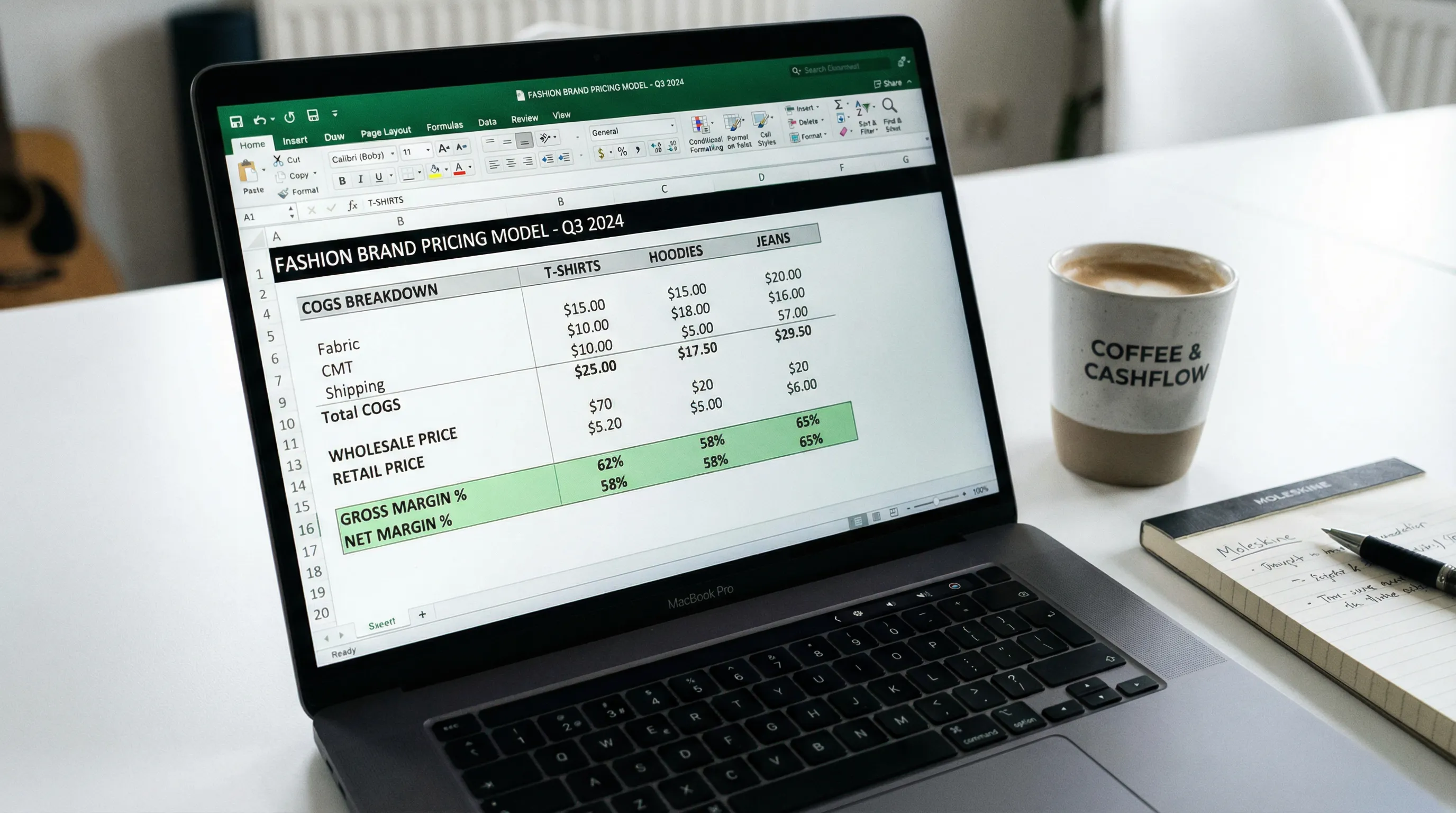 Laptop showing a clothing brand financial model with pricing tiers, margin analysis, and cost projections in a spreadsheet
Spec your garment for the factory — generate a tech pack and BOM →
Frequently Asked Questions
What markup should I use for a clothing line?
The industry standard is a 2.0–2.5x markup from COGS to wholesale, and another 2.0–2.5x from wholesale to retail. This means your retail price is approximately 4–6x your production cost. For D2C-only brands, a 3.5–5.0x markup from COGS is standard to cover marketing and customer acquisition costs.
How do I price my clothing if I only sell direct-to-consumer?
Multiply your full COGS (including landed costs) by 3.5–5.0x. Target a 65–80% gross margin. This accounts for the 25–35% of revenue you will spend on marketing and customer acquisition, plus shipping, returns (20–30% in fashion), platform fees, and operating overhead.
Should I price my clothing based on what competitors charge?
Competitor pricing should validate your price, not determine it. Always start with your actual COGS and work up using the markup formula. If your calculated price is significantly above competitors, either reduce COGS (better sourcing, higher volume) or differentiate with branding, quality, or exclusivity to justify the premium.
How much profit should a clothing brand make per item?
After all costs (COGS, marketing, shipping, returns, overhead), a healthy fashion brand nets 10–20% profit per item sold D2C and 8–15% per item sold wholesale. For a $50 retail t-shirt with $10 COGS: gross margin is $40 (80%), but after marketing ($15), shipping ($5), returns allocation ($5), and overhead ($5), net profit is approximately $10 (20%).
What is the average return rate for online fashion?
According to the National Retail Federation, the average return rate for online apparel purchases is 24.4% — nearly double the 8–10% rate for in-store purchases. This means for every 100 units you sell online, approximately 24 will be returned. Your pricing must account for the cost of processing returns (shipping, inspection, restocking) and lost sales on items that cannot be resold.
How do I set prices for a luxury clothing brand?
Luxury pricing is less formulaic. While the COGS markup may reach 8–12x, luxury pricing is driven by brand perception, exclusivity, and willingness-to-pay rather than cost-plus formulas. However, your margins should still cover COGS (10–15% of retail), design and creative (10–15%), marketing (15–20%), retail operations (20–25%), and profit (15–25%).
How do I handle pricing for wholesale vs my own website?
Your D2C price should equal or slightly exceed your MSRP (the suggested retail price you give wholesale accounts). Never undercut your retail partners — it destroys the relationship. Instead, offer D2C-exclusive value: free shipping thresholds, gift wrapping, loyalty points, or exclusive colorways not available through retail partners.
When should I offer sales or discounts?
Limit discounting to strategic moments: end-of-season clearance (30–50% off outgoing inventory), new customer welcome offers (10–15% off first order), and holiday events (Black Friday, etc.). Avoid permanent discount codes or frequent sales — they train customers to wait for promotions and erode perceived value. According to McKinsey, brands that discount more than 30% of their assortment annually see a 15–20% decline in brand perception scores.
Sources and further reading:
- NYU Stern: Industry Margin Database (53.5% average apparel gross margin)
- McKinsey: State of Fashion 2025 (30–40% markdown rates, brand perception data)
- Shopify: Commerce Report 2025 ($32–$45 CAC for fashion, 2–4% D2C conversion benchmarks)
- National Retail Federation: Consumer Returns Report (24.4% online apparel return rate)
- American Apparel & Footwear Association (fabric as 50–55% of COGS)
- How Much Does It Cost to Start a Clothing Brand? (startup cost framework)
- How to Find a Clothing Manufacturer (regional production cost comparison)