How to Create a Line Sheet for Your Fashion Brand — Templates, Examples & Best Practices
A line sheet is a 1–4 page wholesale sales document that presents your collection to retail buyers with product images, wholesale pricing, style numbers, available sizes and colors, fabric composition, and minimum order quantities. Unlike a lookbook (which sells a lifestyle), a line sheet is designed for a buyer to place an order directly from it. Every fashion brand selling wholesale — from indie labels at trade shows to established brands with 500+ retail accounts — needs line sheets to convert buyer interest into purchase orders.
This guide covers every component of a professional line sheet, provides template structures, explains common mistakes, and shows how to create one efficiently without a graphic designer. To start from a finished file, download the free wholesale line sheet template in Excel and PDF, with a 12-style worked example.
Table of Contents
- What Is a Line Sheet and Why Do You Need One?
- Line Sheet vs Lookbook: What's the Difference?
- Essential Components of a Fashion Line Sheet
- Line Sheet Template Structure
- How to Create a Line Sheet (Step-by-Step)
- Common Line Sheet Mistakes That Cost You Orders
- Digital vs Print Line Sheets
- Frequently Asked Questions
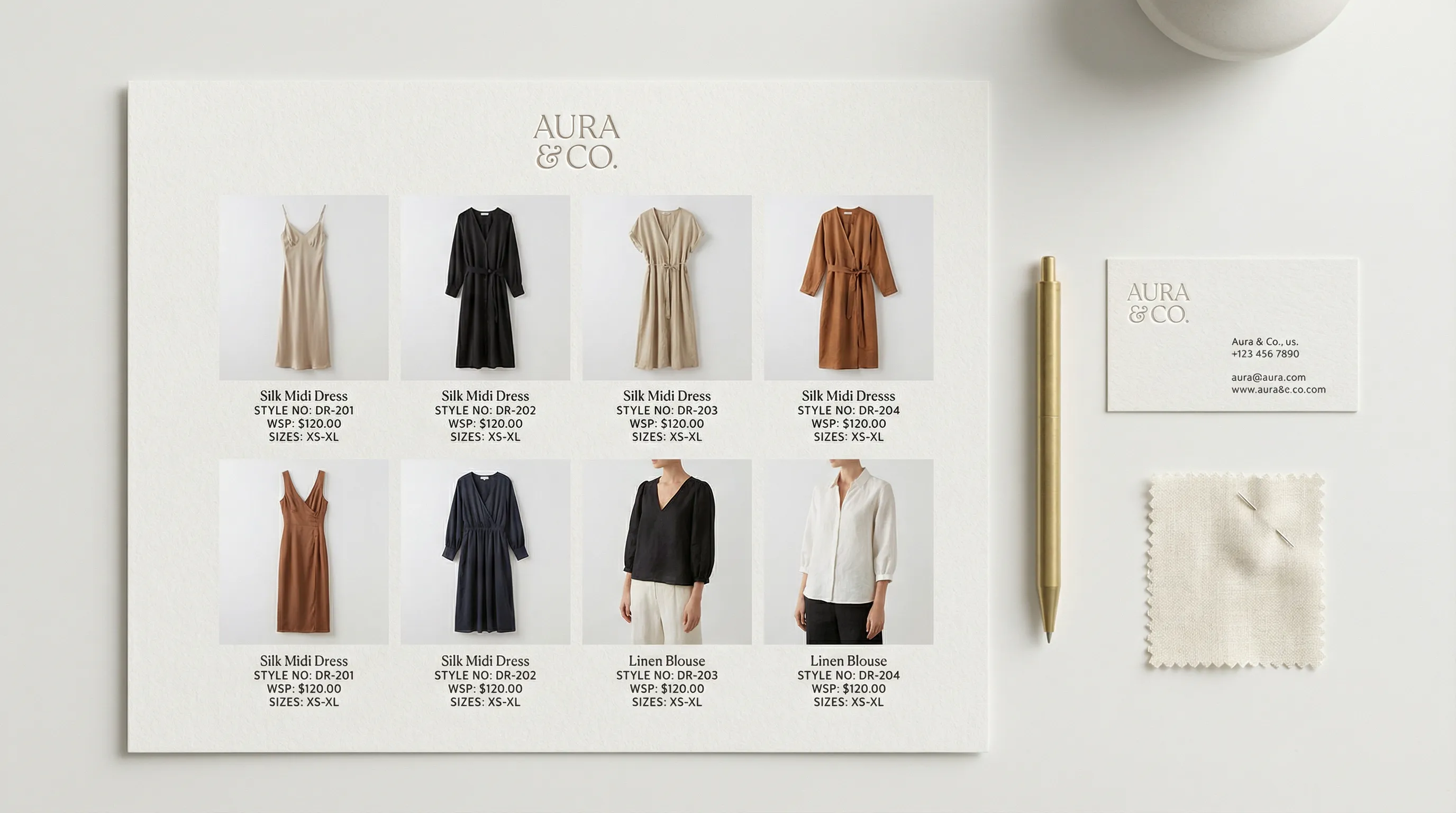 Professional fashion line sheet document on a desk showing product grid with wholesale pricing, style numbers, and clean product photography
What Is a Line Sheet and Why Do You Need One? {#what-is-a-line-sheet}
A line sheet is the primary sales tool for wholesale fashion. When a retail buyer evaluates your brand for their store, the line sheet is what they use to decide which styles to order, in which sizes and colors, and at what price. It is the bridge between your creative brand story and a concrete purchase order.
According to a survey by the National Retail Federation, buyers at mid-size and large retailers evaluate an average of 200–400 brands per buying season. Your line sheet has 30–60 seconds to communicate your collection clearly enough for a buyer to decide whether to place an order or move on. This means the format must be clean, information-dense, and instantly scannable.
Who needs a line sheet?
- Any brand selling to retail stores (boutiques, department stores, specialty retailers)
- Brands exhibiting at trade shows (MAGIC, Coterie, Capsule, Premiere Vision)
- Brands working with sales reps or showrooms
- Brands pitching to online wholesale platforms (Faire, Bulletin, JOOR)
- Even D2C brands exploring their first wholesale accounts
What a line sheet is NOT:
- It is not a lookbook (no lifestyle photography, no editorial spreads)
- It is not a tech pack (no construction details, no measurement charts)
- It is not a catalog (no brand story, no seasonal narrative)
Line Sheet vs Lookbook: What's the Difference? {#line-sheet-vs-lookbook}
These two documents serve completely different functions in the sales process, yet they are frequently confused by new brand owners.
| Feature | Line Sheet | Lookbook |
|---|---|---|
| Purpose | Place an order | Generate interest and tell brand story |
| Audience | Retail buyers, purchasing managers | Buyers, press, consumers |
| Photography | Clean product shots (flat-lay or ghost mannequin) | Editorial, on-model, lifestyle |
| Pricing | Wholesale price and MSRP listed | Rarely includes pricing |
| Product details | Style #, sizes, colors, fabrics, MOQs | Minimal — style names at most |
| Format | 1–4 pages, grid layout, dense | 8–20+ pages, editorial spreads |
| When used | During the order meeting | Before the meeting (generates interest) |
Best practice: Send the lookbook first to get the buyer excited, then present the line sheet at the order meeting. The lookbook says "here's why you should care." The line sheet says "here's how to buy."
Essential Components of a Fashion Line Sheet {#essential-components}
Every professional line sheet must include these elements. Missing any one of them creates friction in the buying process and can cost you orders.
1. Brand Header
- Brand name and logo
- Season / Collection name (e.g., "Spring/Summer 2026 — Coastal Collection")
- Contact information: name, email, phone
- Website URL
- Wholesale terms page reference (if separate document)
2. Product Images
Clean, consistent product photos are the most important element. Buyers need to see the garment clearly without distracting backgrounds or styling.
Image requirements:
- White or light gray background (flat-lay, ghost mannequin, or hanger)
- Consistent lighting, angle, and scale across all products
- Minimum 300 DPI for print line sheets; 150 DPI for digital/PDF
- Show front view minimum; back view recommended for detailed styles
- Include a color swatch for each available colorway
According to Faire (the largest wholesale marketplace, processing $1B+ in annual GMV), listings with professional product images receive 3.4x more buyer inquiries than listings with amateur or lifestyle-only photography.
Get clean product shots for your line sheet →
3. Product Details (Per Style)
| Field | Example | Notes |
|---|---|---|
| Style number | SS26-TK-001 | Unique identifier for ordering |
| Style name | "Coastal Breeze Tee" | Optional but helpful |
| Wholesale price | $18.00 | What the retailer pays |
| MSRP / Suggested retail | $38.00 | What the consumer pays |
| Available sizes | XS – XL | Full size range |
| Available colors | White, Navy, Sage, Blush | List all colorways |
| Fabric composition | 100% Organic Cotton, 180 GSM | Buyers need this for their customers |
| Country of origin | Made in Portugal | Required by many retailers |
4. Order Terms and Policies
This can be on the line sheet itself or on a separate terms page that accompanies it.
Must include:
- Minimum order quantity (per style, per color, or total order)
- Payment terms (Net 30, Net 60, COD, prepay for first order)
- Delivery window (ship date range)
- Reorder minimums (if different from opening order)
- Return/exchange policy
- Freight terms (FOB origin, prepaid, threshold for free shipping)
5. Order Form (Optional but Recommended)
Include a simple grid at the bottom or as a separate page:
| Style # | Color | XS | S | M | L | XL | Total Units |
|---|---|---|---|---|---|---|---|
| SS26-TK-001 | White | ___ | ___ | ___ | ___ | ___ | ___ |
| SS26-TK-001 | Navy | ___ | ___ | ___ | ___ | ___ | ___ |
Line Sheet Template Structure {#line-sheet-template-structure}
A standard line sheet follows a grid layout that maximizes information density while remaining scannable.
Single-Page Line Sheet (Small Collection: 6–12 Styles)
┌──────────────────────────────────────────┐
│  BRAND LOGO    Season / Collection Name  │
│  Contact: email@brand.com | 555-0123     │
├──────────────────────────────────────────┤
│                                          │
│  [Image]   [Image]   [Image]   [Image]   │
│  Style #   Style #   Style #   Style #   │
│  Name      Name      Name      Name      │
│  $WS/$MSRP $WS/$MSRP $WS/$MSRP $WS/MSRP│
│  Sizes     Sizes     Sizes     Sizes     │
│  Colors    Colors    Colors    Colors    │
│  Fabric    Fabric    Fabric    Fabric    │
│                                          │
│  [Image]   [Image]   [Image]   [Image]   │
│  Style #   Style #   Style #   Style #   │
│  ...       ...       ...       ...       │
│                                          │
├──────────────────────────────────────────┤
│  TERMS: MOQ 6 units/style | Net 30      │
│  Ships: March 15 – April 15, 2026       │
└──────────────────────────────────────────┘
Multi-Page Line Sheet (Larger Collection: 20+ Styles)
- Page 1: Brand header + tops/blouses
- Page 2: Bottoms/skirts
- Page 3: Dresses/jumpsuits
- Page 4: Accessories + order terms
Group products by category, not by delivery date or price point. Buyers shop by category.
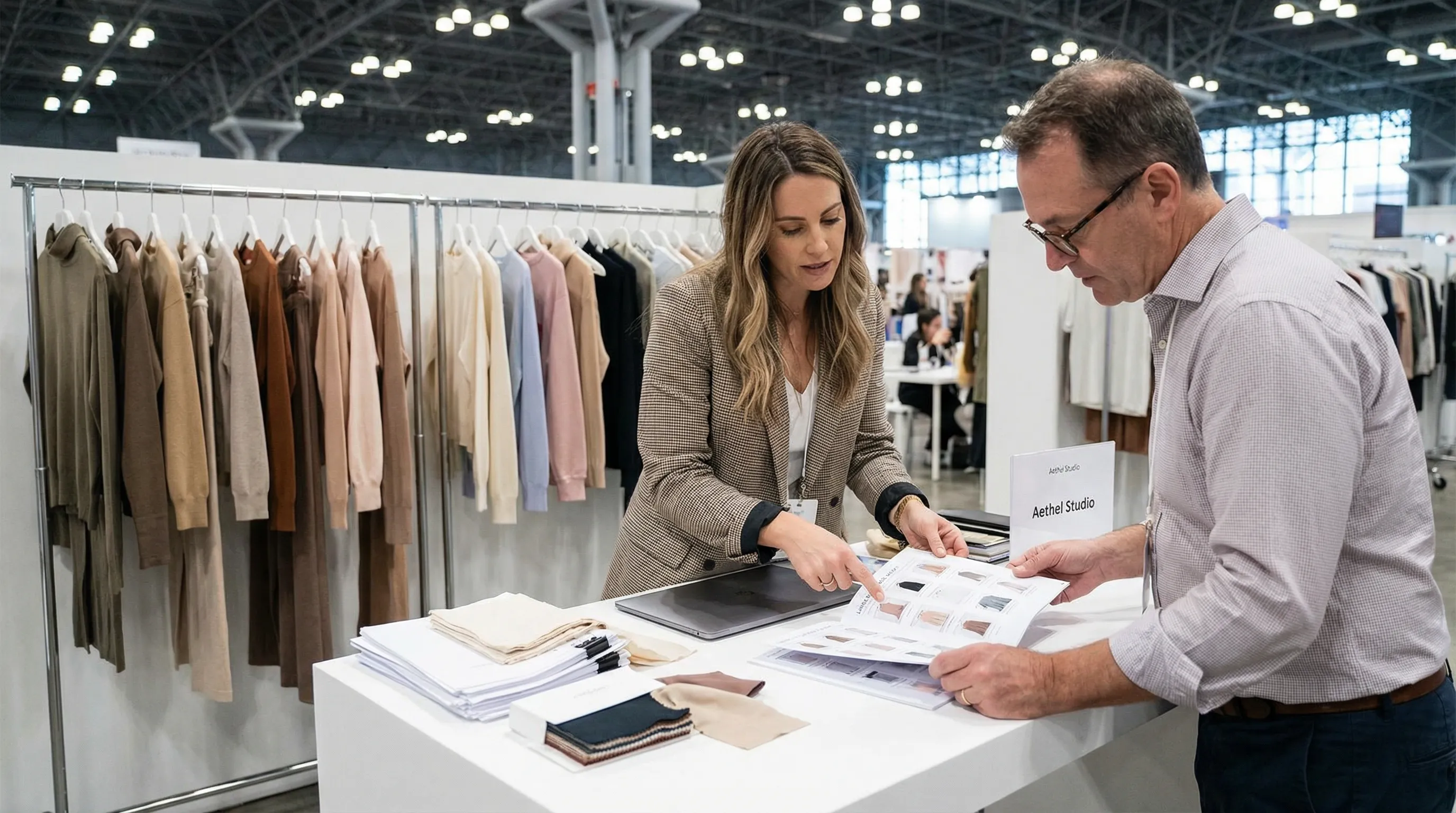 Fashion brand owner presenting a line sheet to a retail buyer at a trade show booth with garment samples on display
How to Create a Line Sheet (Step-by-Step) {#how-to-create-a-line-sheet-step-by-step}
Step 1: Prepare Product Images
You need clean, consistent product photos. There are three approaches:
Option A: DIY flat-lay photography Lay each garment flat on white paper or fabric. Shoot from directly above with even lighting. Edit for consistent white balance. Cost: $0 (your time). Quality: acceptable for indie brands.
Option B: Ghost mannequin photography Shoot on an invisible mannequin for a 3D look without a model. Cost: $200–$500 for mannequin + photography. Quality: professional.
Option C: AI-generated product images Upload a single photo (flat-lay, mannequin, or hanger) to an AI tool like Adstronaut AI to generate clean product shots, on-model images, and even multiple angles from one input. Cost: $0.50–$1 per image. Quality: professional. Speed: 30 seconds per image.
Step 2: Assign Style Numbers
Create a consistent numbering system. A common format:
[Season][Year]-[Category]-[Sequential Number]
Examples:
SS26-TP-001= Spring/Summer 2026, Top, Style 1FW26-BT-003= Fall/Winter 2026, Bottom, Style 3SS26-DR-012= Spring/Summer 2026, Dress, Style 12
Step 3: Set Wholesale Pricing
The standard wholesale-to-retail markup in fashion is 2.2x–2.5x (known as the "keystone" markup). If your wholesale price is $20, the suggested retail price should be $44–$50.
Your wholesale price must cover your cost of goods (COGS) plus a healthy margin. A common target is 50–60% gross margin at wholesale. For a deeper dive into pricing strategy, see our guide on how to price a clothing line.
Step 4: Choose Your Format
| Tool | Cost | Best For | Output Quality |
|---|---|---|---|
| Canva | Free – $13/mo | Simple, template-based line sheets | Good |
| Adobe InDesign | $23/mo | Professional, print-ready layouts | Excellent |
| Google Slides | Free | Quick, collaborative, easy to update | Acceptable |
| NuORDER / JOOR | $500+/mo | Digital wholesale platforms with built-in line sheets | Professional |
| Excel / Google Sheets | Free | No-frills, data-dense format | Functional |
For most indie brands, Canva with a line sheet template is the fastest and most cost-effective option. Download as a high-resolution PDF for emailing and printing.
Step 5: Distribute
- Email: Send as a PDF attachment or link. Subject line: "[Brand Name] SS26 Line Sheet — [Category]"
- Trade shows: Print on high-quality paper (minimum 100 lb cover stock). Bring 100+ copies.
- Wholesale platforms: Upload to Faire, JOOR, or Bulletin for digital discovery.
- Sales reps: Provide both digital and print versions. Update immediately when pricing or availability changes.
Common Line Sheet Mistakes That Cost You Orders {#common-mistakes}
1. Using lifestyle/editorial images instead of clean product shots Buyers need to see the garment clearly. A model in a field at sunset does not help them evaluate stitching, color accuracy, or silhouette. Save editorial images for the lookbook.
2. Missing wholesale pricing Buyers will not ask you for pricing — they will move to the next brand. Every style must have wholesale and MSRP clearly visible.
3. No style numbers Without unique style numbers, buyers cannot reference specific products when placing orders. "The blue top" is ambiguous. "SS26-TP-007 in Navy" is an order.
4. Inconsistent or missing size ranges Every style must list the full available size range. If a style runs XS–XL but your line sheet only shows "S, M, L," you lose sales on the extremes.
5. Not including order minimums Buyers need to know the MOQ before they decide to order. If they discover at checkout that the minimum is 24 units per color when they assumed 6, they will drop the order.
6. Poor image quality Blurry, poorly lit, or inconsistent product photos signal an amateur operation. According to Faire, 72% of wholesale buyers say product image quality is the single most important factor in their purchasing decision.
Digital vs Print Line Sheets {#digital-vs-print}
| Factor | Digital (PDF) | |
|---|---|---|
| Cost | Free to distribute | $0.50–$2.00 per sheet (quality paper) |
| Update speed | Instant — resend updated PDF | Must reprint |
| Trade show use | Share via QR code or email | Hand directly to buyers |
| Environmental impact | Zero paper waste | 100+ printed copies per show |
| Buyer preference | Growing — 60% of buyers prefer digital (JOOR 2025 survey) | Still expected at in-person trade shows |
| Interactivity | Clickable links, embedded order forms | Static |
Best practice: Maintain a digital PDF as your master version. Print physical copies only for trade shows and in-person meetings. Always have both ready.
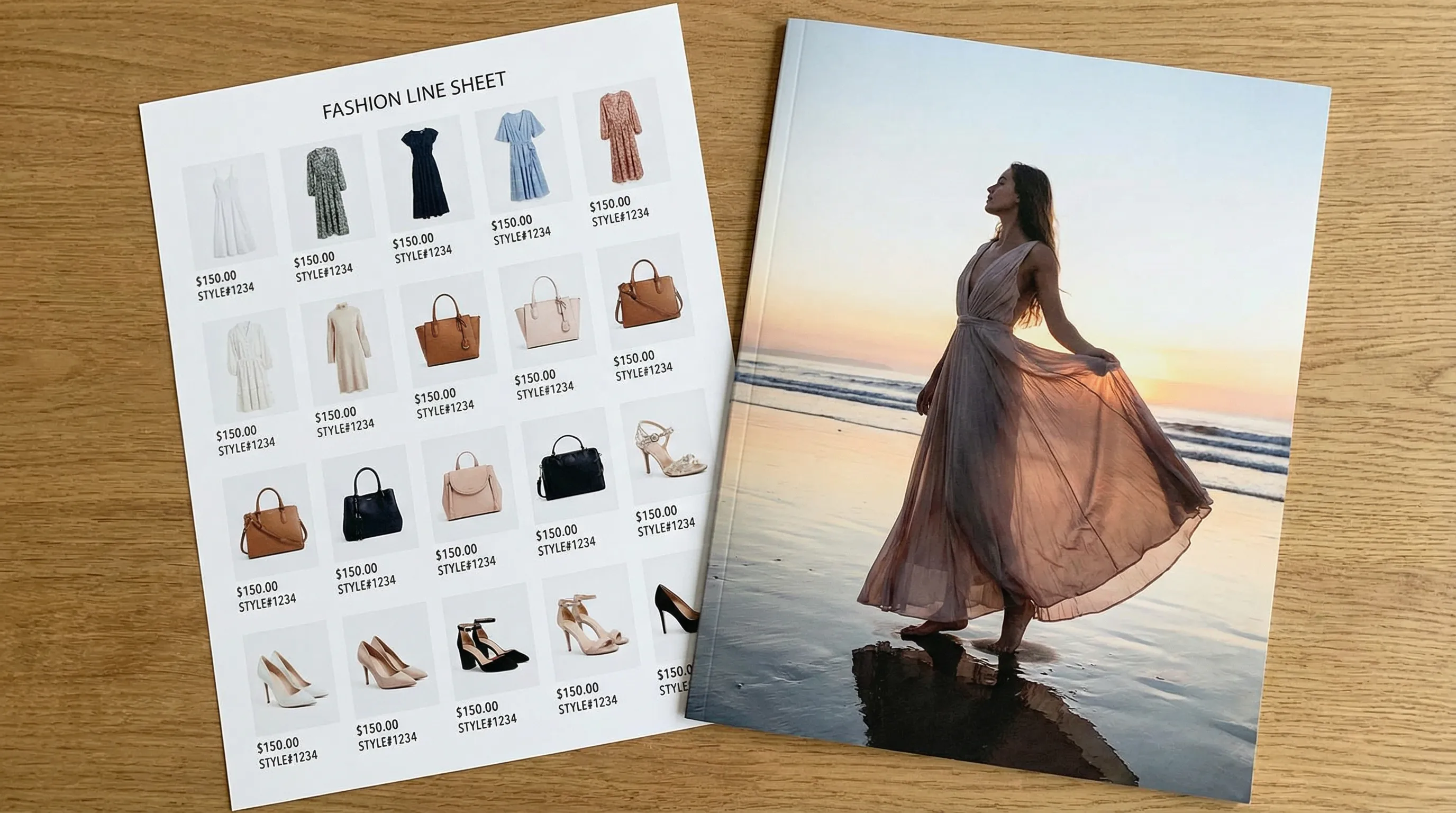 Side by side comparison of a fashion line sheet (product grid with pricing) and a lookbook (editorial lifestyle photos)
Frequently Asked Questions
How many products should be on a line sheet?
A single-page line sheet typically fits 8–12 styles. Multi-page line sheets can include 40+ styles across 3–5 pages. Group by category (tops, bottoms, dresses, accessories), not by color or price. Buyers shop by category and need to compare similar items side by side.
Should I put retail prices or wholesale prices on my line sheet?
Both. Always list the wholesale price (what the retailer pays) and the MSRP (manufacturer's suggested retail price). Use the format "$18 WS / $38 MSRP" or a two-column layout. The MSRP tells the buyer what margin they will make and whether your pricing is competitive for their customer base.
How often should I update my line sheet?
Create a new line sheet for each collection or season (typically 2–4 per year). Update pricing, size availability, and product images whenever they change. Distribute updated versions immediately — an outdated line sheet with discontinued styles damages buyer trust.
What file format should I use for a digital line sheet?
PDF is the industry standard. It preserves layout consistency across devices, can be printed at full quality, and is universally viewable. Save at 300 DPI for buyers who may print it. File size should be under 10 MB for easy email attachment. For larger files, use a shareable link (Google Drive, Dropbox).
Do I need a line sheet if I only sell D2C?
Not unless you plan to expand into wholesale. However, a simplified version of a line sheet (product grid with pricing and details) is useful for internal planning, sales team communication, and approaching potential retail partners. Having one ready signals professionalism when wholesale opportunities arise.
What's the difference between a line sheet and a catalog?
A catalog is a comprehensive brand presentation (20–50+ pages) combining editorial imagery, brand story, collection narrative, and product details. A line sheet is a condensed ordering tool (1–4 pages) with only the information needed to place a purchase order. Large brands distribute catalogs seasonally and update line sheets more frequently as inventory changes.
How do I handle multiple colorways on a line sheet?
Show one product image (in the primary colorway) with small color swatches below it for each available color. List all available colors as text. Do not create a separate line item for each colorway — this wastes space and makes the sheet harder to scan. Exception: if the colorway significantly changes the garment's appearance (e.g., a printed vs solid version), show both images.
What trade shows should I bring line sheets to?
The major fashion wholesale trade shows in the U.S. are MAGIC Las Vegas (February and August, 60,000+ attendees), Coterie New York (February and September), Capsule (concurrent with MAGIC), and Atlanta Apparel Market (five times per year). For international brands, Premiere Vision Paris and Texworld are the largest fabric and fashion sourcing events.
Generate consistent product images for your line sheet →
Sources and further reading:
- National Retail Federation: Buyer Sourcing Benchmarks (200–400 brands evaluated per season)
- Faire: Wholesale Marketplace Data (3.4x more inquiries with professional images, 72% prioritize image quality)
- JOOR: Digital Wholesale Survey 2025 (60% buyer preference for digital line sheets)
- How Much Does It Cost to Start a Clothing Brand? (wholesale cost planning)
- How to Find a Clothing Manufacturer (production sourcing for wholesale)