How to Create a Tech Pack for Leather Goods and Bags
A leather goods tech pack is a 10–15 page technical document that specifies leather type, thickness (typically 0.8–2.0mm for bags), tannery source, edge treatment method, hardware plating and finish, closure systems (zippers, magnetic snaps, turn locks, buckles), lining material, and graded measurements for all compartments. The global leather goods market reached $258.5 billion in 2024 (Grand View Research, 2024), yet over 60% of first-sample rejections in accessories manufacturing trace back to incomplete hardware or material specs.
This guide covers the eight essential sections of a factory-ready leather goods tech pack, the most common specification mistakes, and how to generate production-ready specs in minutes. Start from the free backpack tech pack template if you want a ready-made structure. New to tech packs? Start with our complete guide to fashion tech packs.
Table of Contents
- What Is a Leather Goods Tech Pack?
- Key Sections Unique to Leather Goods
- 1. Materials & Finishes
- 2. Measurements & Compartment Dimensions
- 3. Bill of Materials (BOM)
- 4. Hardware & Closure Specifications
- 5. Edge Finishing Specifications
- 6. Construction & Sewing Details
- 7. Colorways & Pantone Standards
- 8. Artwork & Branding Details
- Leather Certification Requirements (LWG)
- Common Leather Goods Tech Pack Mistakes
- Create Your Leather Goods Tech Pack with Adstronaut AI
- Frequently Asked Questions
What Is a Leather Goods Tech Pack?
A leather goods tech pack is the manufacturing blueprint for bags, wallets, belts, cardholders, and other leather accessories. Unlike garment tech packs that focus on fabric weight and drape, leather goods tech packs center on material thickness, edge treatment, hardware specification, and structural reinforcement.
A professional leather goods tech pack must define:
- Leather Type & Thickness: Is it full-grain cowhide at 1.2mm or chrome-tanned lambskin at 0.8mm?
- Hardware Plating: Are the zippers, buckles, and rivets in polished nickel, antique brass, or matte gunmetal?
- Edge Treatment: Are edges painted, burnished, raw-cut, or folded and stitched?
- Structural Elements: Where is reinforcement interfacing placed? What stiffener is used in the base?
Without these specifications, a factory cannot provide an accurate cost quote. According to the Leather Working Group, incomplete material specs account for the single largest source of production delays in the leather accessories sector (LWG, 2024).
| Leather Goods Complexity | Typical BOM Items | Tech Pack Pages | Avg. Factory Quote Time |
|---|---|---|---|
| Wallet / Cardholder | 8–12 | 5–7 | 3–5 days |
| Belt | 6–10 | 4–6 | 2–4 days |
| Crossbody / Clutch | 15–25 | 8–10 | 5–7 days |
| Backpack / Tote | 25–40+ | 10–15 | 7–14 days |
| Briefcase / Luggage | 30–50+ | 12–18 | 10–21 days |
Key Sections Unique to Leather Goods
Leather accessories differ from garments in three fundamental ways: (1) materials are measured by thickness in millimeters rather than weight in GSM, (2) hardware can account for 30–50% of total COGS, and (3) edge finishing is a standalone specification that does not exist in apparel tech packs. These differences mean you cannot simply repurpose a garment tech pack template for a bag.
When you upload your leather goods design to Adstronaut AI, the system automatically detects the product category and generates dedicated Materials & Finishes and Hardware & Closure sections — the first AI tool to offer leather goods-specific tech pack generation.
1. Materials & Finishes
The materials section is the foundation of any leather goods tech pack. You must specify not just the leather type but its finish, origin, thickness, and supplier.
Critical Material Specifications:
| Specification | What to Define | Example |
|---|---|---|
| Leather Type | Animal, tanning method | Full-grain cowhide, vegetable-tanned |
| Thickness | Measured in mm | 1.0–1.2mm for body, 1.8–2.0mm for straps |
| Finish | Surface treatment | Aniline, semi-aniline, pigmented, nubuck |
| Tannery / Supplier | Origin source | Conceria Walpier (Italy), Seidel (Germany) |
| Lining | Interior material | Suede, cotton twill, microfiber, nylon |
| Reinforcement | Structural stiffeners | EVA foam, Tex-on board, iron-on interfacing |
A study by the Sustainable Leather Foundation found that specifying tannery source and leather grade in the tech pack reduces material-related sample rejections by 45% (SLF Annual Report, 2024).
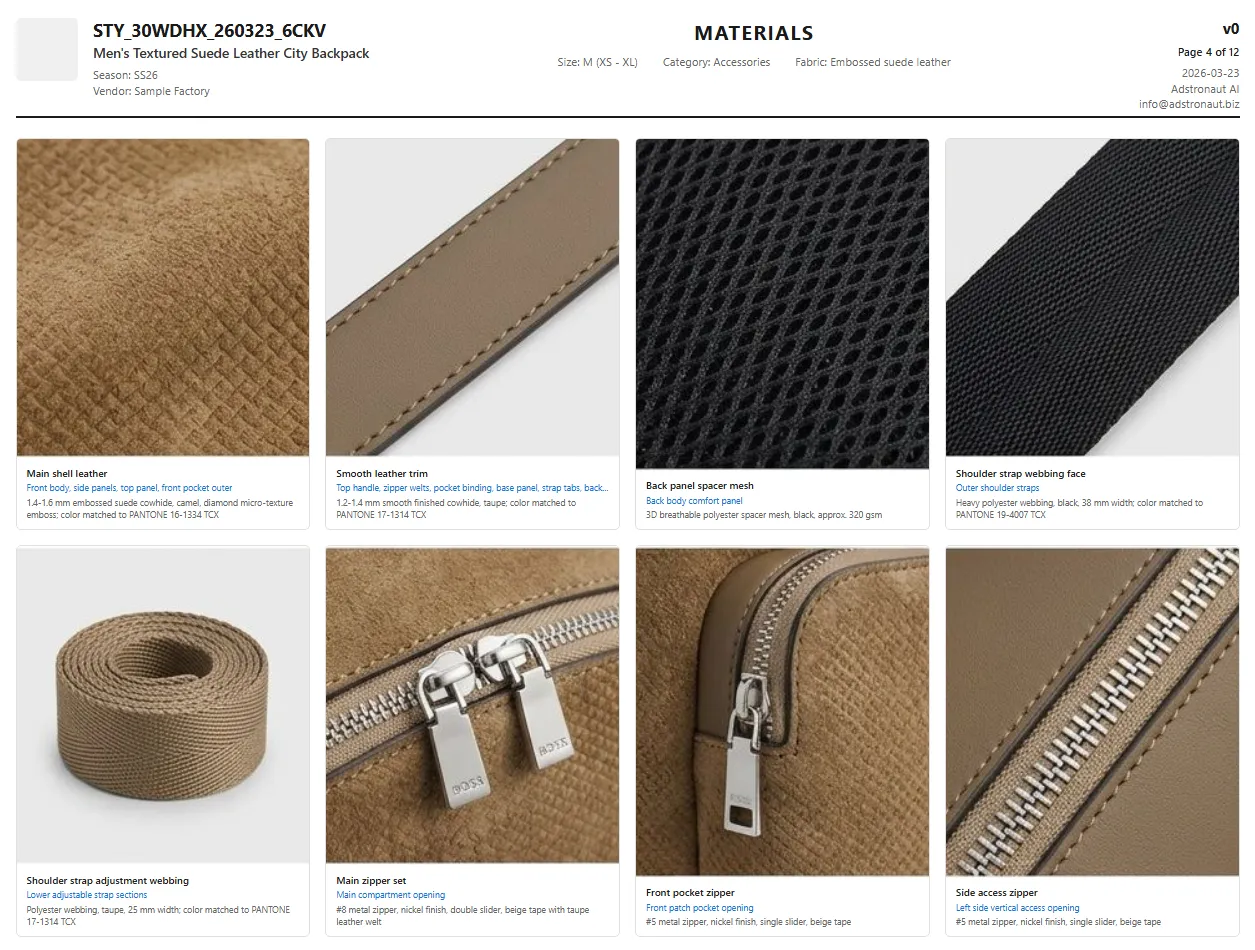 Material reference grid showing all components: shell leather, suede lining, mesh panels, webbing, zippers, and metal hardware.
Adstronaut AI Feature: The dedicated Materials & Finishes section auto-generates a visual material grid from your uploaded image, identifying each distinct material in the product. You can then specify thickness, supplier, and finish for each component directly in the interface.
2. Measurements & Compartment Dimensions
Leather goods require a different measurement approach than garments. Instead of body measurements (chest, waist, hip), you are measuring product dimensions, compartment depths, strap lengths, and drop heights.
Key Measurement Points for a Bag:
- Overall Dimensions: Height x Width x Depth (e.g., 42cm x 30cm x 15cm)
- Strap Length: Adjustable range (e.g., 65–115cm)
- Strap Drop: Distance from top of strap to top of bag
- Compartment Depth: Interior pocket measurements
- Hardware Placement: Distance from edges for zipper pulls, buckles, and logo hardware
- Base Width: Critical for structured bags
Tolerance in leather goods is tighter than in garments. A standard apparel tolerance is +/- 1cm; for leather accessories, the industry standard is +/- 3mm for visible dimensions and +/- 5mm for internal compartments.
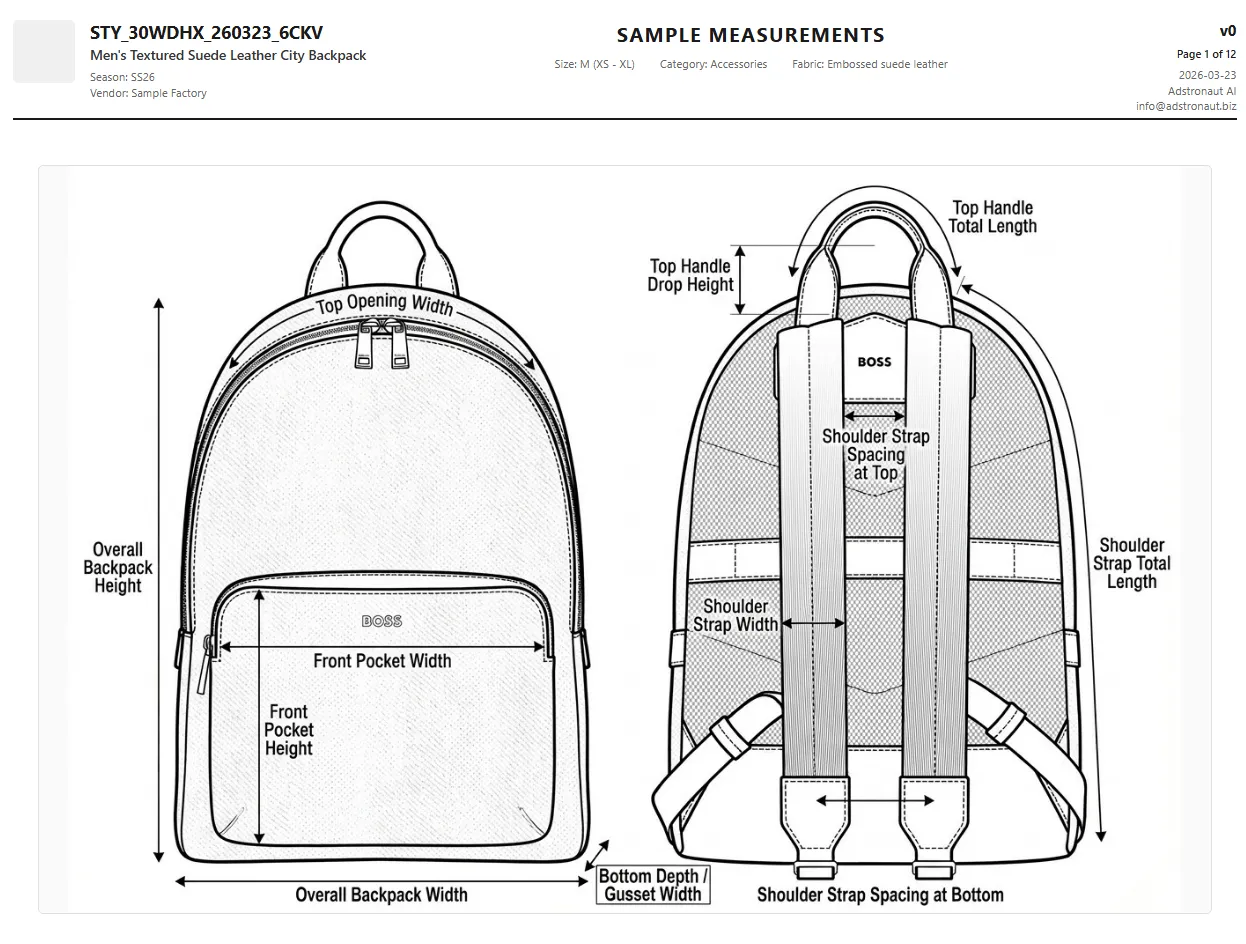 Front and back measurement annotations showing overall height, width, strap length, pocket placement, and hardware positioning.
Create your leather goods tech pack — measurements, BOM, and hardware specs →
3. Bill of Materials (BOM)
A leather bag BOM is significantly more complex than a garment BOM. A standard T-shirt BOM might have 5–8 line items. A leather backpack BOM can exceed 30+ components spanning leather, fabric, webbing, zippers, metal hardware, thread, adhesive, reinforcement, and packaging.
Leather Backpack BOM Example:
| # | Component | Material | Color / Finish | Size / Spec | Supplier |
|---|---|---|---|---|---|
| 1 | Shell — Body | Full-grain cowhide | Camel, matte | 1.2mm | TBD |
| 2 | Shell — Base | Full-grain cowhide | Camel, matte | 1.8mm | TBD |
| 3 | Lining — Main | Suede split | Taupe | 0.6mm | TBD |
| 4 | Lining — Pocket | Poly-cotton twill | Black | 150GSM | TBD |
| 5 | Mesh Panel | Breathable mesh | Black | 3mm spacer | TBD |
| 6 | Webbing — Straps | Nylon webbing | Black | 38mm width | TBD |
| 7 | Main Zipper | Metal teeth | Antique silver | #5, 45cm | YKK |
| 8 | Pocket Zipper | Metal teeth | Antique silver | #3, 20cm | YKK |
| 9 | Strap Adjuster | Zinc alloy | Silver, matte | 38mm | TBD |
| 10 | D-Ring | Zinc alloy | Silver, matte | 25mm | TBD |
| 11 | Rivet — Decorative | Brass | Antique silver | 8mm cap | TBD |
| 12 | Logo — Metal Letters | Zinc alloy | Silver, polished | 15mm height | TBD |
| 13 | Logo — Embossed Patch | Leather | Camel, debossed | 50x30mm | TBD |
| 14 | Thread | Nylon bonded | Tonal / Camel | Tex 70 | Guttermann |
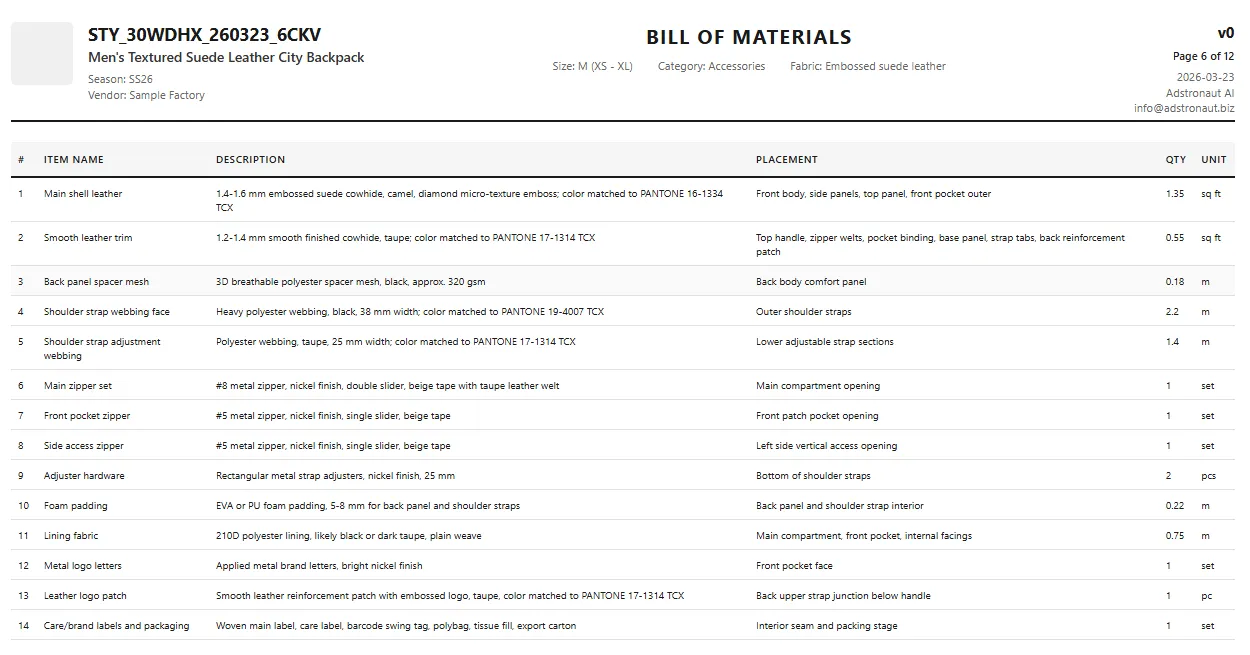 Complete BOM table listing every component with material type, color/finish, size specification, and supplier fields.
Adstronaut AI Feature: The BOM tab auto-populates components detected from your uploaded image. The AI distinguishes between leather panels, metal hardware, fabric linings, and webbing — pre-formatting each row with the correct specification fields. You refine suppliers and exact grades before exporting.
4. Hardware & Closure Specifications
Hardware is where leather goods tech packs diverge most dramatically from garment specs. A single bag can contain 10–20 distinct hardware components, each requiring material, plating finish, size, and function specifications. According to industry data, hardware accounts for 25–40% of total material cost in premium leather goods (Fashion Institute of Technology, Accessories Design Program).
Hardware Plating Finish Reference:
| Plating Finish | Base Metal | Appearance | Durability | Price Tier |
|---|---|---|---|---|
| Polished Nickel | Zinc alloy | Bright silver, mirror | High | $ |
| Brushed Nickel | Zinc alloy | Matte silver, satin | High | $ |
| Antique Brass | Zinc alloy | Warm gold, aged | Medium | $ |
| Light Gold | Zinc alloy | Soft gold, subtle | Medium | $$ |
| Gunmetal | Zinc alloy | Dark grey, matte | High | $ |
| Rose Gold PVD | Stainless steel | Pink gold, mirror | Very High | $$ |
Critical closure specifications to include:
- Zippers: Brand (YKK, RiRi, Lami-Li), gauge (#3, #5, #8), teeth material (metal, coil, molded), tape color, pull shape
- Magnetic Snaps: Pull strength (measured in grams), diameter, plating
- Turn Locks: Rotation direction, plate shape, tongue width
- Buckles: Pin diameter, roller width, frame dimensions
- Rivets: Cap diameter, post length, decorative vs structural
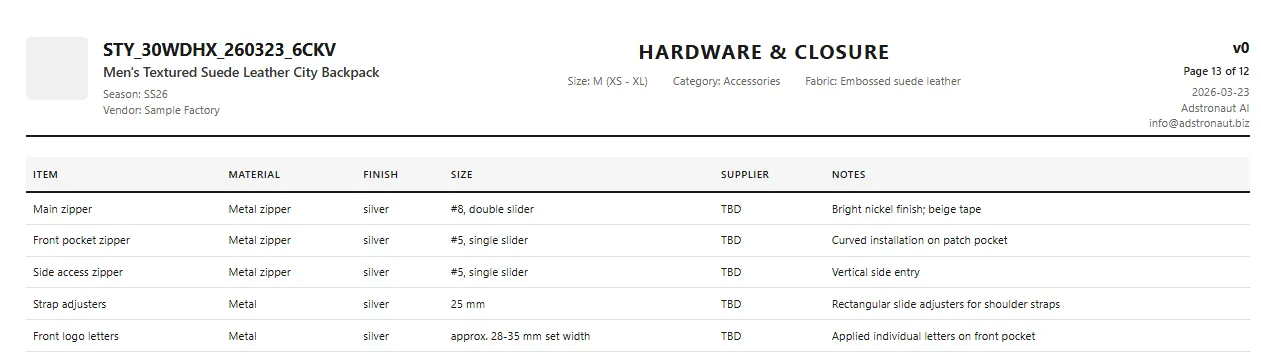 Hardware specification table with detailed entries for each closure and decorative hardware component.
5. Edge Finishing Specifications
Edge finishing is a specification category that exists only in leather goods. It defines how the raw cut edge of every leather panel is treated. This single detail separates a $50 bag from a $500 bag.
Edge Finishing Methods Comparison:
| Method | Process | Look | Durability | Cost | Best For |
|---|---|---|---|---|---|
| Painted Edge | Acrylic or resin paint applied in 2–4 coats | Smooth, glossy or matte | High (if multi-coat) | $ | Mid to luxury bags |
| Burnished Edge | Heat + friction + wax compound | Natural, warm tone | Very High | $$ | Premium vegetable-tanned goods |
| Raw / Cut Edge | Untreated, natural cut | Rough, rustic | Low | $ | Heritage / artisan styles |
| Folded & Stitched | Edge folded under and topstitched | Clean, structured | Very High | $$ | Luxury bags, wallets |
| Bound Edge | Fabric or leather binding strip | Contrasting detail | High | $ | Canvas-leather combos |
Your tech pack must specify the edge treatment for every panel — and it is common to use different methods on different parts. For example: painted edges on the flap, folded edges on straps, raw edges on interior dividers.
Adstronaut AI Feature: The construction callouts section lets you tag each panel edge with its specific finishing method, so the factory receives unambiguous instructions per component.
6. Construction & Sewing Details
Leather sewing is fundamentally different from fabric sewing. Leather cannot be pinned (pin holes are permanent), seams are typically glued before stitching, and thread tension must be higher. Your tech pack must specify these construction details.
Key Construction Callouts:
- Stitch Type: Saddle stitch (hand) vs lockstitch (machine)
- Stitch Length: Measured in SPI (stitches per inch) — typically 6–8 SPI for bags
- Thread Type: Nylon bonded (Tex 70–138) or polyester bonded
- Seam Allowance: Usually 5–8mm for leather (narrower than garments)
- Adhesive: Contact cement type for pre-gluing panels before stitching
- Reinforcement Points: Where bar tacks, rivets, or gusset plates are needed
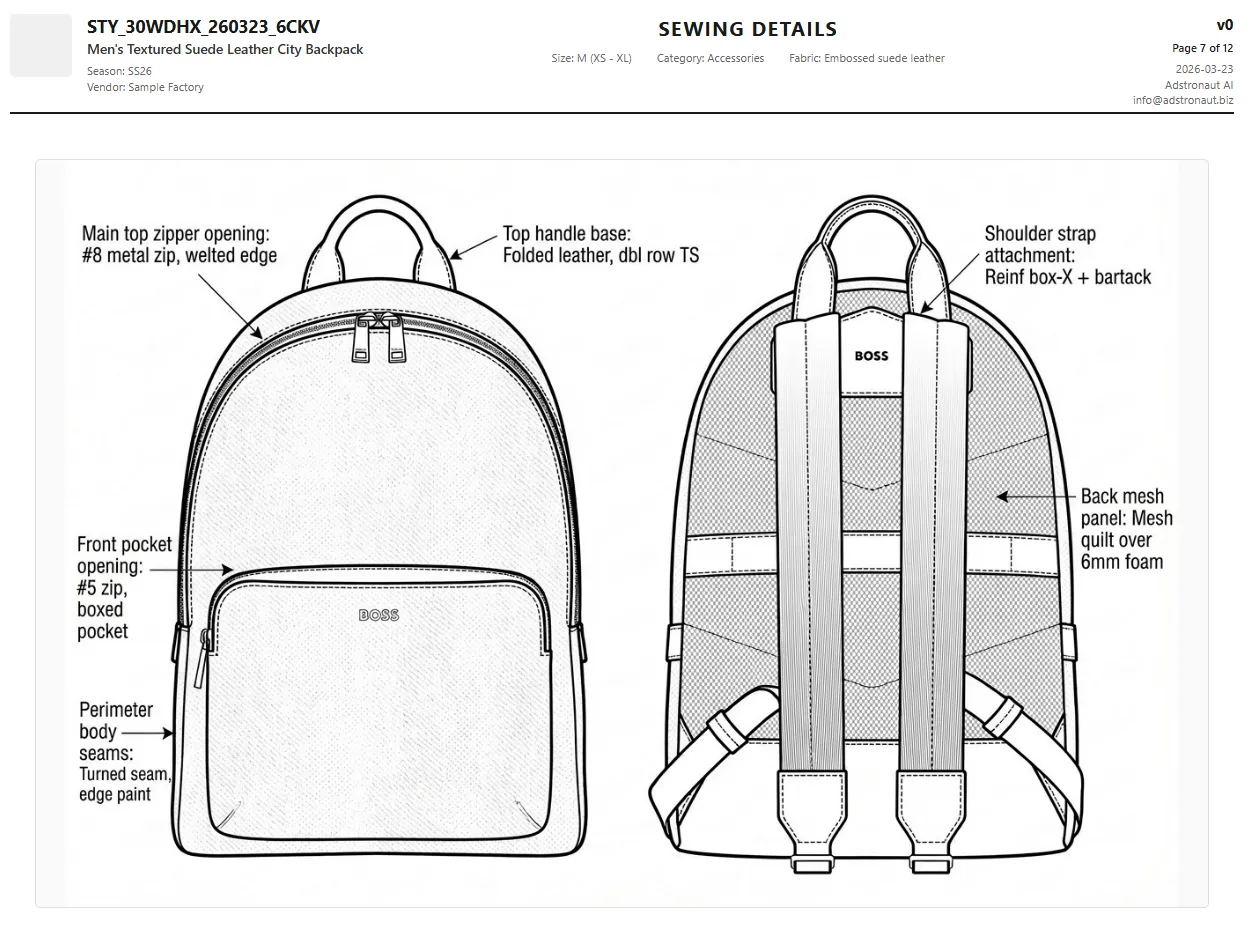 Numbered construction callouts identifying zipper installation method, handle attachment reinforcement, strap anchor points, and seam details.
Build your leather goods tech pack with construction callouts →
7. Colorways & Pantone Standards
Leather dye lots vary significantly between tanneries and even between production runs. Specifying Pantone TPX (textile) or Pantone SkinTone references in your tech pack gives the factory a universal color target.
Colorway Specification Requirements:
- Shell Leather: Pantone reference + acceptable dye variation tolerance
- Lining: Pantone reference (matching or contrasting)
- Hardware: Plating finish name + reference sample requirement
- Thread: DTM (dyed-to-match) or contrasting with Pantone reference
- Edge Paint: Pantone reference (often matches or contrasts shell)
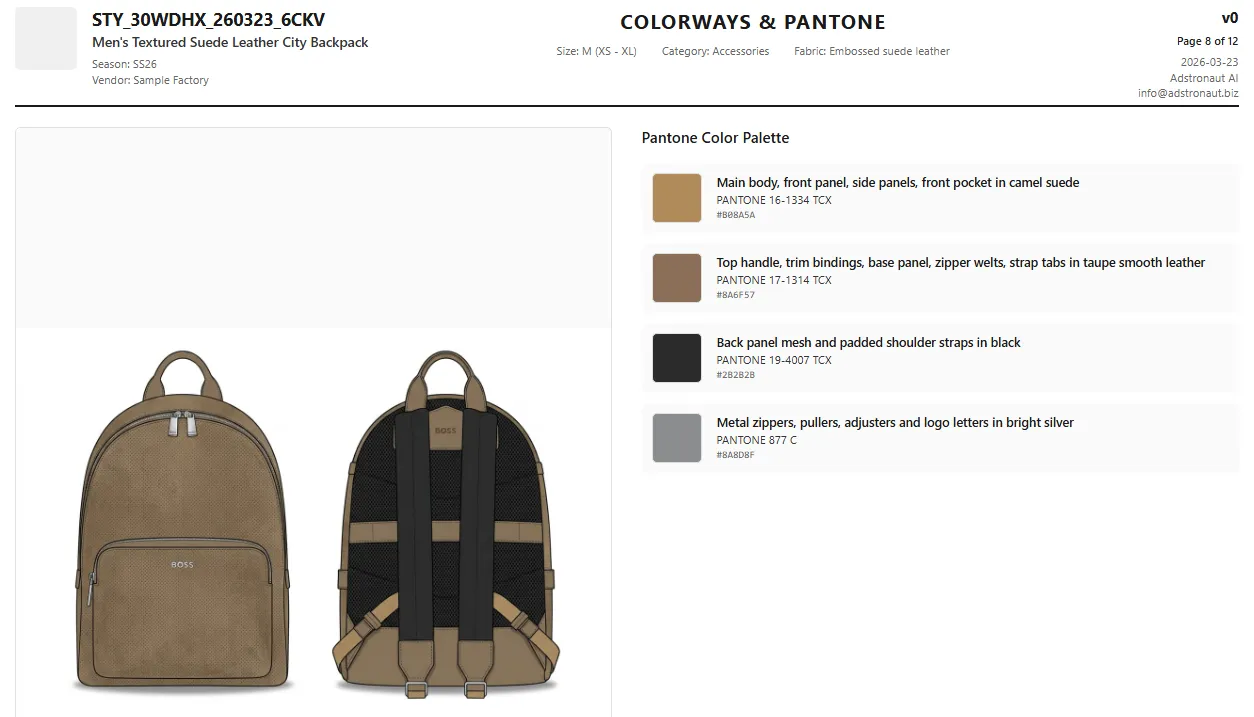 Colorway specification page with Pantone swatches for every material component — shell, lining, trim, hardware, and thread.
8. Artwork & Branding Details
Branding on leather goods requires specialized specifications: embossing depth, debossing pressure, hot foil stamping temperature, metal logo casting dimensions, and placement coordinates measured from panel edges.
Common Branding Methods for Leather Goods:
| Method | Process | Best For | Spec Requirements |
|---|---|---|---|
| Blind Emboss / Deboss | Heat + pressure, no color | Minimalist luxury | Depth (mm), die dimensions, temperature, dwell time |
| Foil Stamp | Heat + metallic foil transfer | Logo on leather | Foil color, temperature, die dimensions |
| Metal Logo | Cast or CNC-cut metal piece | Hardware accent | Metal type, plating, dimensions, attachment method |
| Laser Engrave | Laser etching on surface | Detail work, serial numbers | DPI, depth, file format (vector) |
| Woven Label | Fabric label sewn inside | Interior branding | Thread count, dimensions, fold type |
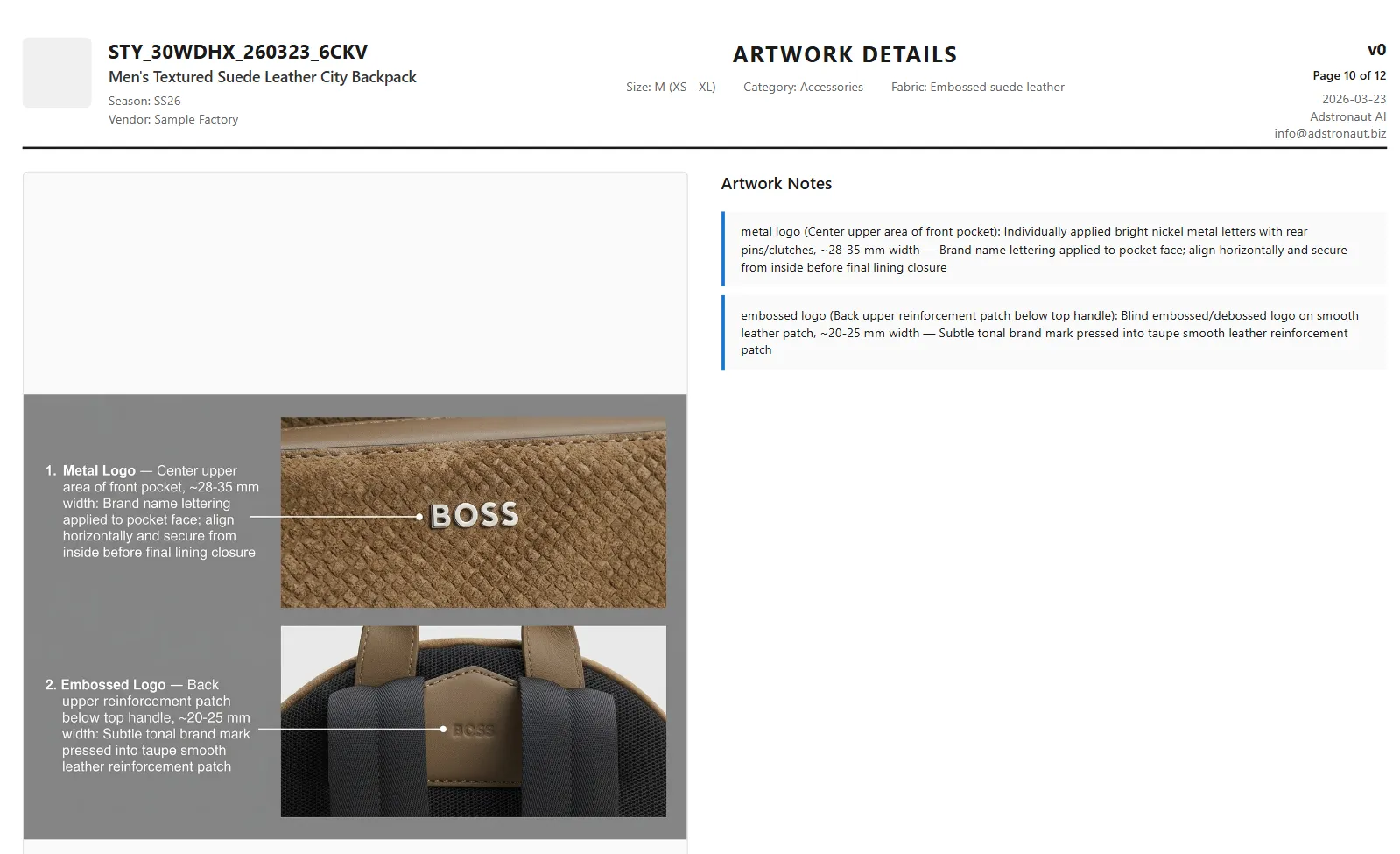 Artwork and branding details page specifying metal logo letter dimensions, embossed logo patch size, and placement coordinates.
Leather Certification Requirements (LWG)
If you are selling into EU markets, major retailers (Nordstrom, Selfridges, Net-a-Porter), or building a sustainability-conscious brand, Leather Working Group (LWG) certification matters. LWG audits tanneries on environmental compliance, chemical management, water usage, and traceability.
Why LWG Matters for Your Tech Pack:
- Over 40% of global leather production now comes from LWG-certified tanneries (LWG, 2024)
- Major retailers increasingly require LWG Gold or Silver certification as a sourcing condition
- Your tech pack should specify "LWG-certified tannery preferred" in the material sourcing notes
- LWG traceability allows you to document leather origin for consumer-facing transparency
Including LWG requirements in your tech pack signals to factories that you are a serious, informed buyer — which often results in better pricing and priority production slots.
Common Leather Goods Tech Pack Mistakes
Not Specifying Leather Thickness Per Panel. The body, base, and straps of a bag require different thicknesses. If you write "1.2mm cowhide" for the entire bag, the straps will be too thin and the body may be too stiff. Specify thickness per component: 1.0–1.2mm for body panels, 1.8–2.0mm for straps and handles, 0.8–1.0mm for gussets.
Ignoring Hardware Plating Consistency. Mixing a polished nickel zipper with an antique brass buckle looks intentional only if your tech pack specifies it. If you leave the plating field blank, the factory will source whatever is cheapest — and you will receive mismatched hardware finishes.
No Edge Finishing Specification. If your tech pack does not specify edge treatment, the factory defaults to raw-cut edges. You will receive a sample that looks unfinished and unprofessional. Always specify the method, number of coats (for paint), and color.
Missing Reinforcement Specs. Leather bags need internal stiffeners (base boards, side panels), interfacing, and reinforcement at stress points (strap attachments, handle bases, zipper ends). Omitting these results in a bag that collapses or tears at load-bearing points within weeks.
Using Garment Tolerances. Garment tech packs use +/- 1cm tolerances. Leather goods require +/- 3mm for exterior dimensions. If you use garment-standard tolerances, a wallet could be 2cm off-spec and still pass QC.
Forgetting Zipper Brand. Generic zippers fail 3–5x faster than branded alternatives. Always specify YKK, RiRi, or an equivalent brand-name zipper. The cost difference is $0.50–$2.00 per zipper; the replacement cost of a failed zipper is the entire product.
Create Your Leather Goods Tech Pack with Adstronaut AI
Building a leather goods tech pack from scratch in Illustrator or Excel takes 8–15 hours per style. Adstronaut's AI tech pack generator is the first tool to generate leather goods-specific tech packs with dedicated Materials & Finishes and Hardware & Closure sections — purpose-built for bags, wallets, belts, and accessories. The suede city backpack sample pack shows a finished bag spec, hardware plating and edge finishing included.
How it works:
- Upload your leather goods photo or design image.
- Review the auto-generated materials grid — the AI identifies leather panels, hardware, lining, and trim.
- Refine specifications: set leather thickness, hardware plating, edge finishing method, and zipper brand.
- Annotate measurements and construction callouts directly on the flat sketch.
- Export a factory-ready PDF with every section formatted to industry standards.
The result is a 10–15 page tech pack that any leather goods factory will recognize and accept — complete with BOM, hardware specs, edge finishing callouts, colorway references, and graded measurements.
Learn the full step-by-step process in our how to create a tech pack guide, or browse tech pack examples across all garment categories. Footwear shares much of the same materials-and-hardware logic — see the footwear tech pack guide — and every category has a free tech pack template to start from.
Generate your leather goods tech pack now →
Frequently Asked Questions
What is a leather goods tech pack?
A leather goods tech pack is a comprehensive manufacturing document — typically 5–18 pages — that specifies every detail a factory needs to produce a leather bag, wallet, belt, or accessory. It includes technical flat sketches, material specifications (leather type, thickness, tannery), hardware details (plating, size, supplier), edge finishing method, construction callouts, graded measurements, BOM (bill of materials), colorways with Pantone references, and artwork/branding placement.
How is a leather goods tech pack different from a garment tech pack?
Three major differences: (1) materials are specified by thickness in millimeters instead of weight in GSM, (2) hardware specifications are far more extensive — a bag may have 10–20 distinct hardware components each requiring material, plating, and size specs, and (3) edge finishing is a standalone section that does not exist in garment tech packs. Leather goods also use tighter tolerances (+/- 3mm vs +/- 1cm for garments).
What leather thickness should I specify for a bag?
Thickness varies by component. For bag body panels: 1.0–1.2mm. For the base and structural panels: 1.4–1.8mm. For straps and handles: 1.8–2.5mm. For wallets and small leather goods: 0.6–1.0mm. For belts: 3.0–4.0mm. Always specify thickness per component, not a single thickness for the entire product.
What hardware plating finishes are standard for leather goods?
The six most common plating finishes are: polished nickel (bright silver), brushed nickel (matte silver), light gold, antique brass (warm aged gold), gunmetal (dark matte grey), and rose gold PVD. Always ensure all hardware on a single product uses the same plating finish unless a contrast is intentionally designed. Specify the plating in your tech pack BOM to prevent mismatched factory sourcing.
What is edge finishing and why does it matter?
Edge finishing is the treatment applied to the raw cut edge of leather panels. The four primary methods are: painted (acrylic/resin in 2–4 coats), burnished (heat + friction + wax), raw/cut (untreated), and folded & stitched (edge tucked under and topstitched). Edge finishing is one of the biggest quality indicators in leather goods — it separates budget products from premium ones. If you do not specify a method, the factory will default to raw edges.
Do I need LWG certification for my leather goods?
LWG (Leather Working Group) certification is not legally required, but it is increasingly demanded by major retailers, wholesale buyers, and EU regulators. Over 40% of global leather production comes from LWG-certified tanneries. If you plan to sell through department stores, luxury e-commerce platforms, or EU markets, specifying "LWG-certified tannery preferred" in your tech pack is strongly recommended.
How many BOM line items does a typical leather bag have?
A simple clutch or wallet has 8–12 BOM items. A crossbody or small handbag has 15–25 items. A backpack or tote has 25–40+ items. A briefcase or structured bag can exceed 50 BOM items. Each line item must specify material, color/finish, size, and supplier. This is why leather goods tech packs are longer than most garment tech packs.
What zipper brand should I specify?
YKK is the industry standard for leather goods zippers and accounts for approximately 45% of the global zipper market. For premium and luxury products, RiRi (Swiss-made) and Lami-Li are common alternatives. Always specify zipper brand, gauge (#3 for wallets, #5 for bags, #8 for luggage), teeth material (metal or coil), tape color, and pull design. Generic unbranded zippers fail 3–5x faster and are the most common point of product failure in leather goods.
Can I use Adstronaut AI for wallets and belts, not just bags?
Yes. Adstronaut AI supports all leather goods categories including bags, wallets, cardholders, belts, and leather accessories. The system detects the product type from your uploaded image and adjusts the tech pack structure accordingly — generating appropriate measurement points, BOM complexity, and hardware sections for each category.
What measurements should a leather bag tech pack include?
At minimum: overall height, width, and depth; strap length (with adjustable range); strap drop; handle height; all compartment dimensions (width x height x depth); pocket placement measured from panel edges; hardware placement coordinates; base dimensions; and zipper lengths. Use +/- 3mm tolerance for all exterior measurements and +/- 5mm for interior dimensions.
Sources and further reading:
- Grand View Research — Leather Goods Market Size & Trends Report, 2024 (global market valuation and growth data)
- Leather Working Group — LWG Environmental Audit Protocol (tannery certification standards and traceability requirements)
- Sustainable Leather Foundation — Annual Impact Report, 2024 (specification quality and sample rejection data)
- Fashion Institute of Technology — Accessories Design Program (hardware cost allocation in leather goods manufacturing)
- Adstronaut AI — The Complete Guide to Fashion Tech Packs (comprehensive tech pack overview)