What Is a BOM in Fashion? Examples, Template & Guide (2026)
A bill of materials (BOM) in fashion is a structured document that catalogs every physical component needed to manufacture a single garment — fabrics, trims, threads, labels, packaging, and hardware. A basic t-shirt BOM typically contains 8-12 line items; a technical outerwear jacket can exceed 30. Per McKinsey's State of Fashion report, materials account for 60-70% of a garment's total cost.
Generate a factory-ready tech pack free — 25 credits on signup, no card required →
An incomplete or inaccurate BOM is the leading cause of factory re-quotes, production delays, and margin erosion — it is the most cost-sensitive document in product development. This guide breaks down what goes into a fashion BOM, provides full example tables for both simple and complex garments, explains the difference between a BOM and a spec sheet, and gives you a reusable template structure. If you need broader context on the full tech pack document that houses the BOM, start with our complete guide to fashion tech packs.
Table of Contents
- What Exactly Goes in a Garment BOM?
- Full BOM Example: Basic T-Shirt
- Full BOM Example: Technical Jacket
- BOM vs Spec Sheet: What Is the Difference?
- Who Creates the BOM and When?
- BOM Template Structure
- Common BOM Mistakes That Cost You Money
- Frequently Asked Questions
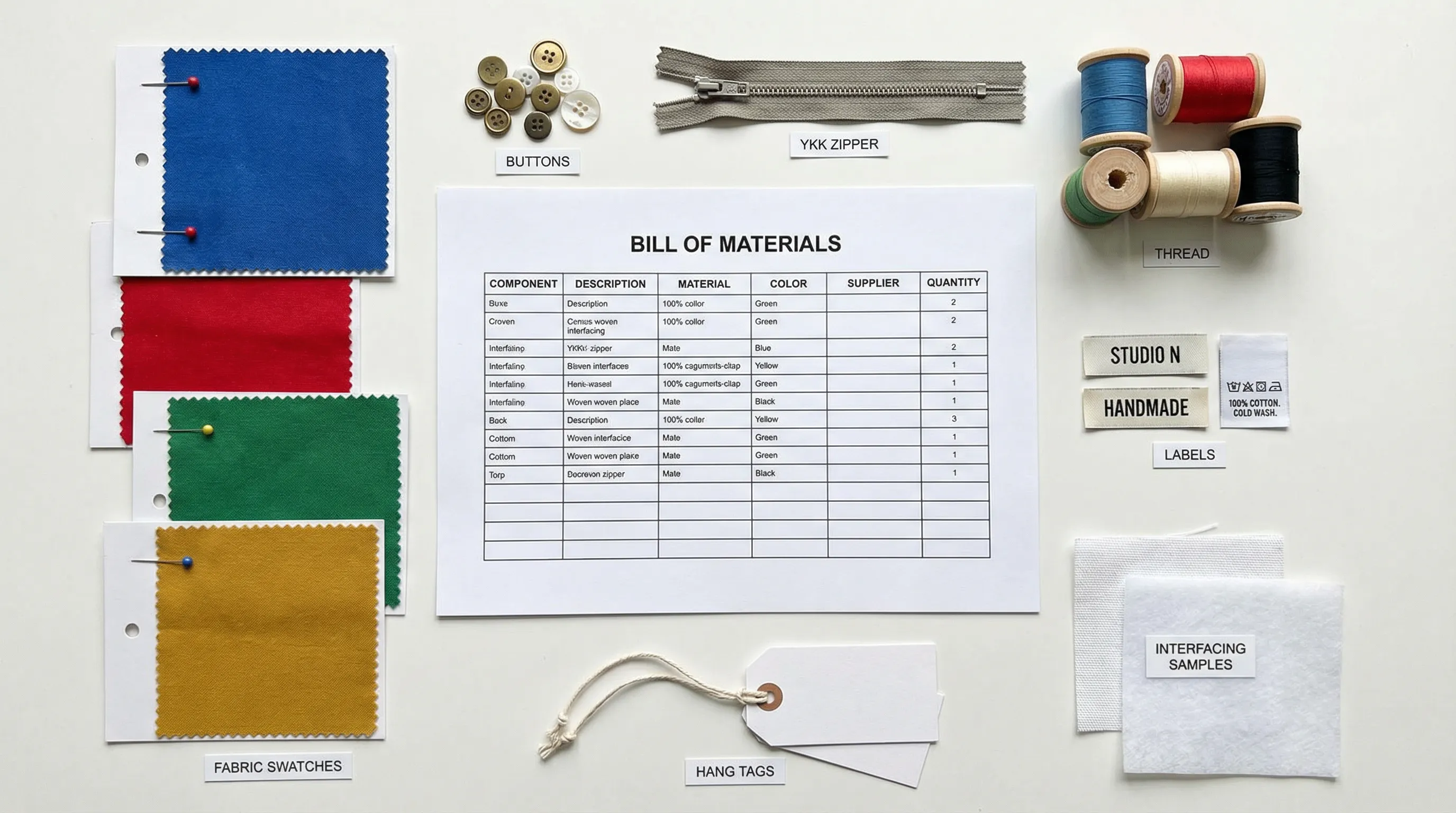 Fashion bill of materials document surrounded by garment components: fabric swatches, buttons, zippers, thread spools, and labels
What Exactly Goes in a Garment BOM?
A garment BOM is organized into component categories. Each line item must include enough detail for a factory to source, price, and assemble the garment without ambiguity. ASTM D5489, the standard terminology for fabric care labeling, and ASTM D123, the standard terminology for textiles, provide the classification framework most manufacturers reference when interpreting BOM entries.
The core categories in any fashion BOM are:
1. Shell Fabric (Body) The primary material. Specified by fiber content, weight (GSM or oz/yd), weave/knit type, width, and finish. Example: "100% Cotton Jersey, 180 GSM, 60 inches wide, Combed & Ring Spun, Pre-shrunk."
2. Secondary Fabrics Linings, interlinings, ribbing, mesh panels, contrast fabrics. A lined blazer may have three secondary fabrics. A t-shirt has one (neck ribbing).
3. Thread Sewing thread specified by fiber (polyester core-spun is standard), ticket number (Tex 40 or Tex 60), and color. According to Coats Group, the world's largest thread manufacturer, a single dress shirt consumes 150-200 meters of thread. A jacket uses 400-800 meters.
4. Closures and Hardware Zippers (type, gauge, length, brand), buttons (material, size in ligne, holes), snaps, hooks, D-rings, buckles, eyelets, and drawcord stoppers.
5. Labels and Branding Main label, care label, size label, hang tag, brand patch, woven flag label. Care labels must comply with FTC 16 CFR Part 423 in the United States and EU Regulation 1007/2011 in Europe — our laundry symbols guide decodes every wash, dry, and iron icon your care label must carry.
6. Packaging Polybag (thickness in microns), tissue paper, cardboard insert, stickers, carton specifications. These are often overlooked but represent 2-5% of unit cost.
7. Trims and Embellishments Elastic (width, stretch %), drawcord, piping, bias tape, reflective tape, embroidery thread, print transfers, appliques.
Each line item should include: item name, detailed description, quantity per unit, unit of measure, supplier or brand, and color/specification reference. Omitting any of these fields is where costly errors begin.
Build a factory-ready BOM without missing a line item →
Full BOM Example: Basic T-Shirt
A crew-neck cotton t-shirt is one of the simplest garments to manufacture, yet its BOM still requires 10 distinct line items to be factory-complete.
| Item | Description | Qty/Unit | Unit | Supplier | Color/Spec |
|---|---|---|---|---|---|
| Shell Fabric | 100% Cotton Jersey, 180 GSM, 60" wide, Combed Ring Spun | 1.5 | Yards | Pacific Textiles | Pantone 19-4052 TCX (Classic Blue) |
| Neck Ribbing | 95% Cotton / 5% Spandex 1x1 Rib, 280 GSM | 0.15 | Yards | Pacific Textiles | Pantone 19-4052 TCX (match body) |
| Sewing Thread | Polyester Core-Spun, Tex 40 | 150 | Meters | Coats Epic | Color-matched to body |
| Coverstitch Thread | Polyester Core-Spun, Tex 27 | 40 | Meters | Coats Epic | Color-matched to body |
| Neck Tape | Self-fabric tape, 1/2" wide | 16 | Inches | Cut from shell fabric | Same as shell |
| Main Label | Woven Damask, center fold, 40mm x 30mm | 1 | Piece | SinaTag | White ground / black text |
| Care Label | Printed Satin, 25mm x 80mm, FTC compliant | 1 | Piece | SinaTag | White ground / black text |
| Size Label | Woven, 10mm x 25mm, heat-sealed | 1 | Piece | SinaTag | White ground / black text |
| Hang Tag | 350 GSM coated cardstock, 2" x 3.5", with string | 1 | Piece | Local Print | Brand artwork |
| Polybag | Clear LDPE, 12" x 16", 1.5 mil, suffocation warning | 1 | Piece | Packaging Supplier | Clear |
Total BOM line items: 10. Total material cost at scale (1,000+ units): approximately $2.80-$4.50 per unit, depending on fabric quality and sourcing region. According to Maker's Row, fabric alone accounts for 50-60% of a basic t-shirt's material cost.
For a deeper dive into t-shirt manufacturing specifications, see our t-shirt tech pack guide.
Full BOM Example: Technical Jacket
A mid-weight technical jacket with a lining, hood, and multiple pockets demonstrates why complex garments require rigorous BOM discipline. Missing a single trim line can halt a production run.
| Item | Description | Qty/Unit | Unit | Supplier | Color/Spec |
|---|---|---|---|---|---|
| Shell Fabric | 100% Nylon Ripstop, 70D, DWR Coated, 115 GSM | 2.8 | Yards | Toray Industries | Pantone 19-0303 TCX (Jet Black) |
| Lining Fabric | 100% Polyester Taffeta, 50D, 55 GSM | 2.2 | Yards | Asahi Kasei | Pantone 17-1463 TCX (Tangerine Tango) |
| Insulation | 80/20 Down Fill, 650 Fill Power | 120 | Grams | Allied Feather | Natural Grey |
| Hood Fabric | Same as shell | 0.5 | Yards | Toray Industries | Match shell |
| Pocket Lining | 100% Polyester Mesh, 75 GSM | 0.6 | Yards | Local Source | Black |
| Center Front Zipper | YKK Vislon #5, 2-way separating, 28" | 1 | Piece | YKK | Black |
| Pocket Zipper (chest) | YKK Coil #3, 7" closed-end, auto-lock | 1 | Piece | YKK | Black |
| Pocket Zipper (hand) | YKK Coil #3, 8" closed-end, auto-lock | 2 | Piece | YKK | Black |
| Pocket Zipper (internal) | YKK Coil #3, 6" closed-end | 1 | Piece | YKK | Black |
| Snap Buttons | Prym 15mm cap snap, 4-part | 4 | Sets | Prym | Matte Black |
| Elastic Drawcord | 3mm round polyester, with cord lock | 1.2 | Meters | Trim Supplier | Black |
| Cord Stopper | Spring-loaded single-hole, 18mm | 2 | Piece | Trim Supplier | Matte Black |
| Velcro (cuff) | 20mm hook & loop, sew-on | 4 | Inches | Velcro Brand | Black |
| Sewing Thread | Polyester Core-Spun, Tex 60 | 600 | Meters | Coats Epic | Black |
| Seam Tape | PU seam sealing tape, 22mm | 15 | Meters | Bemis | Translucent |
| Main Label | Woven Damask, center fold, 50mm x 35mm | 1 | Piece | SinaTag | Brand artwork |
| Care Label | Printed Satin, 25mm x 120mm, multi-language | 1 | Piece | SinaTag | White/black |
| Size Label | Woven, heat-sealed to care label | 1 | Piece | SinaTag | White/black |
| Hang Tag | 400 GSM cardstock, custom die-cut, with J-hook | 1 | Piece | Local Print | Brand artwork |
| Polybag | Clear LDPE, 18" x 24", 2 mil, suffocation warning | 1 | Piece | Packaging Supplier | Clear |
| Spare Button Bag | Small zip bag with 1 spare snap set | 1 | Piece | Packaging Supplier | Clear |
Total BOM line items: 21. Estimated material cost at scale: $28-$55 per unit depending on down quality and YKK grade. A single sourcing error on the center-front zipper — wrong gauge, wrong length, wrong pull style — can delay production by 2-4 weeks while the factory waits for replacement stock, according to Common Objective's manufacturing lead time data.
For complete outerwear specifications, see our jacket tech pack guide.
BOM vs Spec Sheet: What Is the Difference?
These two documents are frequently confused, but they serve different purposes within a tech pack.
| Bill of Materials (BOM) | Spec Sheet | |
|---|---|---|
| Purpose | Lists every physical component in the garment | Defines measurements, tolerances, and fit |
| Answers | "What is it made of?" | "What size is it?" |
| Contains | Fabrics, trims, thread, labels, packaging | Point-of-measure table, grading rules, tolerances |
| Used By | Sourcing team, costing department, warehouse | Pattern maker, QC inspector, fit technician |
| Cost Impact | Directly determines 60-70% of unit cost | Indirectly affects cost through fabric yield and complexity |
In practice, both documents live inside the tech pack. The BOM feeds into the factory's costing sheet. The spec sheet feeds into pattern development and quality control. Neither replaces the other. A tech pack without a BOM forces the factory to guess at materials — and they will always guess expensive to protect their margin. A tech pack without a spec sheet produces garments that do not fit. For a full breakdown of tech pack components, see our what is a tech pack guide.
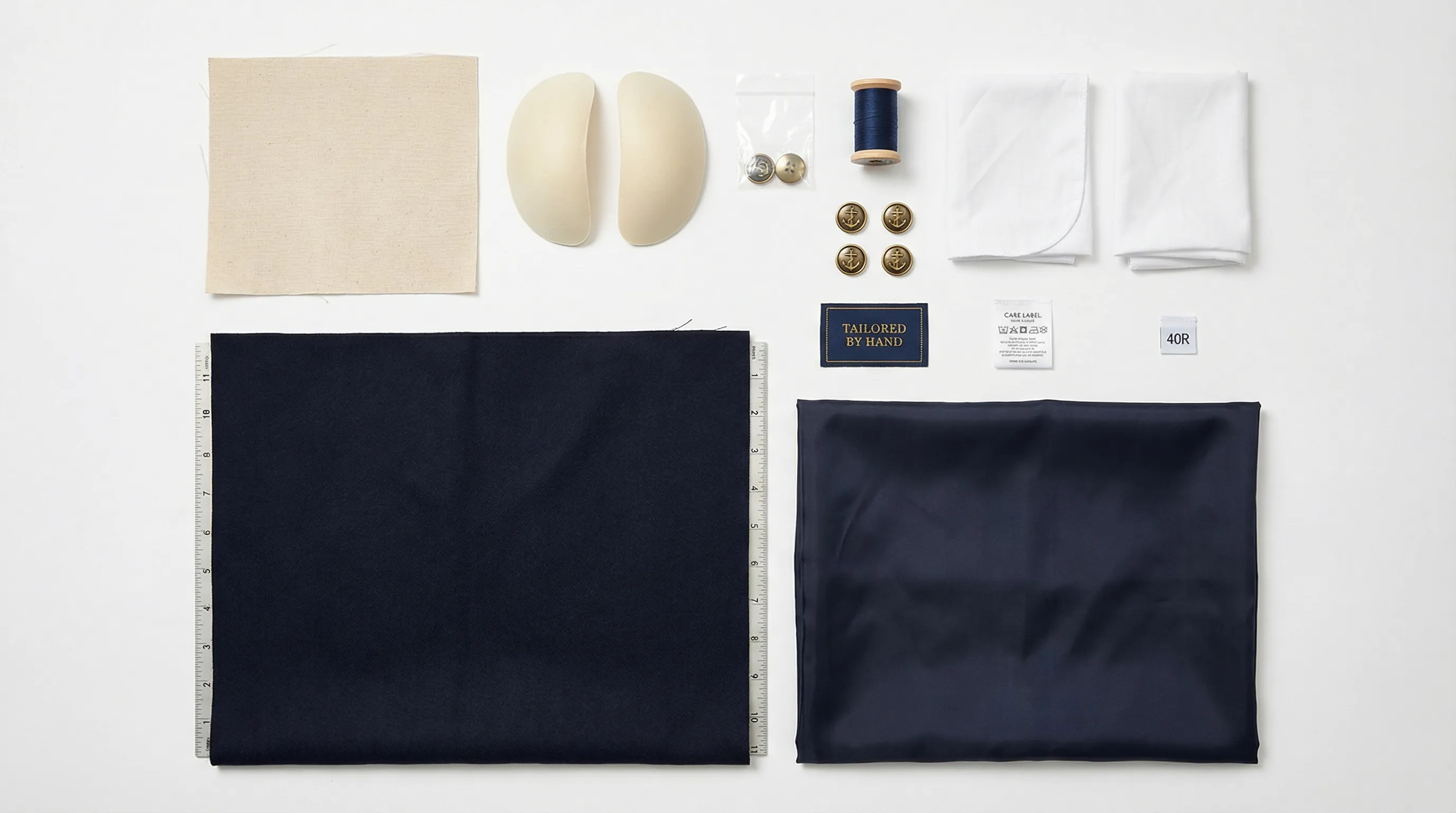 Deconstructed jacket showing every individual component: shell fabric, lining, buttons, zipper, interfacing, labels, and thread
Who Creates the BOM and When?
The BOM is typically created by the technical designer or product developer during the pre-production phase, after the design is finalized but before the factory is engaged for sampling.
The BOM development timeline:
- Design Phase — Designer selects intended fabrics and trims (preliminary BOM, 60-70% complete).
- Sourcing Phase — Product developer confirms availability, MOQs, and lead times. Supplier names and reference numbers are added.
- Sampling Phase — Factory reviews BOM and flags substitutions. The BOM is revised based on sample feedback.
- Pre-Production Phase — Final BOM is locked. Any changes after this point require a formal change order.
- Production Phase — BOM serves as the factory's purchase order reference for all raw materials.
According to McKinsey's research on fashion supply chains, brands that finalize their BOM before sampling reduce their sample-to-production timeline by 25-35%. The reason is straightforward: factories cannot accurately cost or schedule production without a confirmed materials list.
For small brands and independent designers, the BOM is often the most neglected part of the tech pack. Designers tend to focus on the visual sketch and measurements while treating materials as an afterthought. This is a costly mistake. A factory's first question after receiving your tech pack will almost always be: "Where is the BOM?"
BOM Template Structure
A production-ready BOM should follow a standardized column structure. Here is the template framework used across most garment manufacturers:
Required Columns:
| Column | Description | Example |
|---|---|---|
| Item # | Sequential line number | 001, 002, 003 |
| Category | Component type | Shell Fabric, Trim, Hardware, Label, Packaging |
| Item Name | Specific component name | Center Front Zipper |
| Description | Full technical specification | YKK Vislon #5, 2-way separating, 28", auto-lock |
| Color/Spec | Color reference or specification code | Pantone 19-0303 TCX / Matte Black |
| Quantity | Amount per single unit | 1 |
| Unit of Measure | Yards, meters, pieces, grams | Piece |
| Supplier | Vendor name or source | YKK |
| Placement | Where on the garment | Center Front |
| Cost (Optional) | Unit material cost | $2.45 |
Best Practices for BOM Organization:
- Group by category. All fabrics together, all hardware together, all labels together. This helps the sourcing team send consolidated POs to each supplier.
- Include reference numbers. If a fabric has a mill reference (e.g., "FY-2240"), include it. This eliminates confusion when the supplier stocks multiple similar options.
- Specify tolerances. If you accept +/- 5 GSM on fabric weight, state it. Silence implies zero tolerance, which increases rejection rates.
- Version control. Date every BOM revision. Factories work from the latest version, and conflicting BOMs are a leading cause of production disputes. ASTM D5489 recommends maintaining a revision log as part of the product specification package.
Adstronaut AI Feature: When you generate a tech pack with the AI tech pack generator, the BOM tab is automatically populated based on the AI's garment classification. If it detects a hoodie, it pre-fills rows for shell fabric, hood lining, ribbing, drawcord, eyelets, and aglets. You edit and refine rather than build from scratch.
Auto-generate your BOM from a garment photo →
Common BOM Mistakes That Cost You Money
Based on data from Maker's Row's manufacturer surveys and Common Objective's factory compliance reports, these are the errors that most frequently cause production delays and cost overruns:
1. Missing Packaging Components Approximately 40% of first-time brand BOMs omit packaging entirely. The factory will add their default polybag and cardboard, then bill you. You lose control over presentation and pay a markup of 15-30% versus sourcing packaging yourself.
2. Unspecified Thread Color and Type Thread is cheap — $0.02-$0.05 per garment — but the wrong color is immediately visible on contrast stitching. Specifying "matching thread" is insufficient. Provide a Pantone reference or physical swatch. Specify fiber content (polyester core-spun is standard for most garments).
3. Generic Zipper Specifications Writing "black zipper, 7 inches" leaves the factory to choose the cheapest option. You need: brand (YKK, SBS, or equivalent), type (coil, Vislon, metal), gauge (#3, #5, #8), end type (closed-end, separating), pull style (auto-lock, non-lock), and exact length. A YKK #5 Vislon costs 3x more than an SBS #3 coil. The difference in perceived quality is significant.
4. No Supplier or Reference Numbers Without supplier names, the factory sources from their default vendors. Their defaults may not match your quality expectations. Always provide at least a supplier name and, ideally, a supplier reference number or catalog code.
5. Forgetting Secondary Fabrics As detailed in our t-shirt tech pack guide, even a simple crew neck uses two fabrics: shell jersey and neck ribbing. Jackets commonly use three to five. Every distinct fabric must have its own BOM row with full specifications.
6. No Quantity Per Unit A BOM row that says "Snap buttons" without specifying "4 sets" forces the factory to count from your sketch — and they may count wrong. Specify exact quantities for every line item.
The cumulative cost of BOM errors is substantial. McKinsey estimates that poor specification quality adds 8-15% to total garment cost through re-sampling, material waste, and production rework.
 Fashion designer entering bill of materials data on a laptop with physical garment components and fabric swatches on the desk
Frequently Asked Questions
How many line items should a fashion BOM have?
A basic garment like a t-shirt or tank top requires 8-12 BOM line items. A mid-complexity garment like a hoodie or dress requires 15-20. A complex garment like a tailored jacket, down coat, or technical outerwear can require 25-50+ line items. The count depends on the number of distinct fabrics, hardware pieces, trims, labels, and packaging components.
Is a BOM the same as a tech pack?
No. A BOM is one section within a tech pack. A complete tech pack includes the flat sketch, BOM, measurement/grading tables, construction details, colorway specifications, label placement, and packaging instructions. The BOM specifically covers materials and components. Think of it as the "ingredients list" inside the larger "recipe" document. See our complete guide to fashion tech packs for the full structure.
Who is responsible for creating the BOM?
In larger companies, the technical designer or product developer creates and maintains the BOM. In small brands and startups, the founder or head designer typically handles it. Some brands outsource BOM creation to their manufacturer, but this gives the factory control over material selection, which often results in lower quality or higher cost. Creating your own BOM keeps you in control of quality and costing.
When should the BOM be finalized?
The BOM should be 90-100% complete before you submit your tech pack for the first sample. It is formally locked during the pre-production phase, after sample approval. Changes after lockdown require a formal change order and often incur additional costs or lead time delays.
How does the BOM affect garment costing?
The BOM is the primary input for the factory's costing sheet. Material costs typically account for 60-70% of a garment's FOB (Free On Board) price. The remaining 30-40% covers labor, overhead, and profit. An incomplete BOM forces the factory to estimate material costs, and their estimates will always include a risk buffer — meaning you pay more.
What is the difference between a BOM and a cost sheet?
A BOM lists what materials are needed and in what quantities. A cost sheet takes the BOM data and adds pricing: unit material costs, consumption rates, waste factors, and total material cost per garment. The cost sheet also includes labor cost, overhead, and margin to arrive at the final FOB price. The BOM feeds the cost sheet, but they are separate documents.
Should packaging be included in the BOM?
Yes. Polybags, tissue paper, hang tags, stickers, cardboard inserts, and carton specifications should all appear as BOM line items. Packaging components represent 2-5% of unit cost and directly affect the customer's unboxing experience. Omitting them from the BOM means the factory will use their default materials, which may not match your brand standards.
Can AI tools generate a BOM automatically?
Yes. AI-powered tech pack tools like Adstronaut AI analyze your garment image, classify the garment type, and auto-generate a BOM with pre-filled rows for expected components. A detected hoodie will automatically include rows for shell fabric, ribbing, drawcord, eyelets, and hood lining. You review and refine the AI output rather than building each row manually. This reduces BOM creation time from 1-2 hours to under 15 minutes.
Generate your BOM and full tech pack in minutes →
Sources and further reading:
- ASTM D5489 - Standard Guide for Care Symbols for Care Instructions on Textile Products — astm.org
- ASTM D123 - Standard Terminology Relating to Textiles — astm.org
- McKinsey & Company, The State of Fashion 2025 — mckinsey.com
- Maker's Row, Guide to Tech Packs — makersrow.com
- Common Objective, How Fashion Manufacturing Works — commonobjective.co
- FTC 16 CFR Part 423 - Care Labeling of Textile Wearing Apparel — ftc.gov
- EU Regulation 1007/2011 - Textile Fibre Names and Labelling — eur-lex.europa.eu
- Coats Group, Thread Consumption Guide — coats.com