Denim Jeans Tech Pack: Free Template, Measurements & Example (2026)
A denim jeans tech pack is an 8–12 page technical document that specifies denim weight (typically 10–14 oz), weave type (twill, selvedge, or stretch), wash treatment (raw, stone wash, enzyme wash, acid wash, or distressed), hardware specifications (rivets, buttons, zippers — typically YKK or equivalent), construction details (5-pocket vs carpenter, flat-felled seams, bartack reinforcement), and graded measurements across all sizes. Denim is one of the most specification-heavy garments to manufacture due to the number of variables in wash, weight, and hardware.
Generate a factory-ready tech pack free — 25 credits on signup, no card required →
This guide covers every component of a factory-ready denim tech pack, from wash specifications to rivet placement, common mistakes that derail production, and how to generate one in minutes. Start from the free denim jeans tech pack template if you want a ready-made structure. New to tech packs? Start with our complete guide to fashion tech packs.
Table of Contents
- What Is a Denim Jeans Tech Pack?
- Key Components of a Denim Jeans Tech Pack
- 1. Flat Sketch (Front & Back)
- 2. Denim Fabric Specifications
- 3. Wash Specifications
- 4. Hardware & Trims
- 5. Measurements & Grading
- 6. Construction Details
- Common Denim Tech Pack Mistakes
- Create Your Denim Tech Pack in Minutes
- Frequently Asked Questions
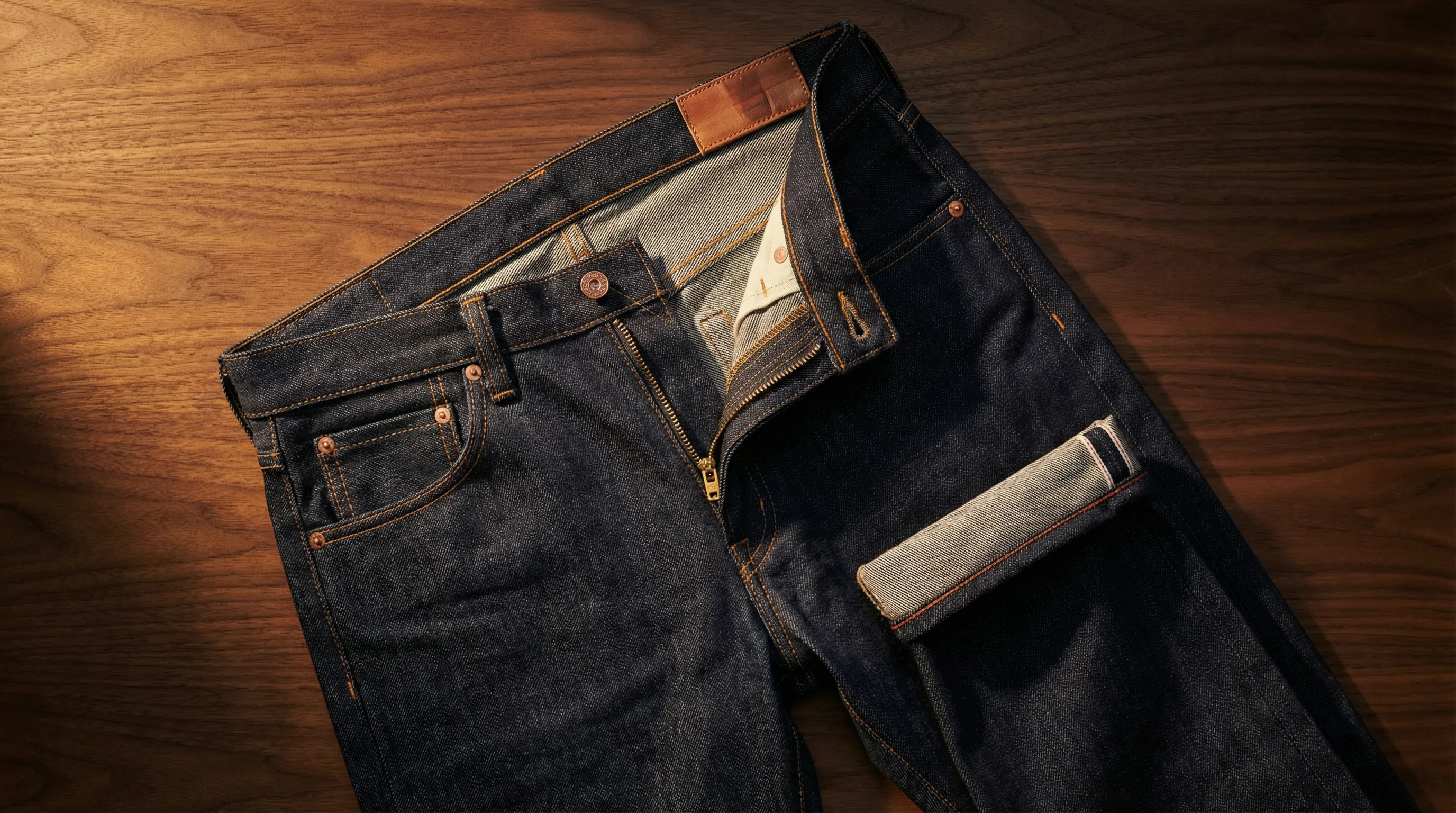 Flat lay of raw selvedge denim jeans showing copper rivets, YKK brass zipper, leather patch, and contrast stitching details
What Is a Denim Jeans Tech Pack?
A Denim Jeans Tech Pack is the manufacturing blueprint that instructs a factory how to cut, sew, wash, and finish your jeans. Unlike a t-shirt tech pack or a hoodie tech pack, denim requires an entirely separate category of specifications — wash treatments, hardware finishes, and pre-wash vs post-wash measurements — that do not exist for other garment types.
The global denim market is valued at approximately $92 billion and is projected to exceed $105 billion by 2030 (Grand View Research, 2025). With that kind of volume, factories process thousands of styles simultaneously. A complete tech pack is the only way to ensure your specific wash, fit, and hardware combination is produced correctly.
A professional denim tech pack must define:
- Fabric: What is the denim weight in ounces? Is it rigid, comfort stretch, or super stretch?
- Wash: Is it raw, stone-washed, or distressed? How dark or light should the final shade be?
- Hardware: What are the rivet, button, and zipper specs? What metal finish — brass, antique brass, nickel, or black oxide?
- Fit: What are the exact measurements at waist, hip, rise, inseam, and leg opening?
- Construction: What seam types are used? Flat-felled inseam or overlock outseam? Chain-stitch or lock-stitch hem?
Without these answers documented in a single spec sheet, you are guaranteed to receive a sample that does not match your intent.
Turn a jeans photo into a wash-and-hardware-ready denim tech pack →
Key Components of a Denim Jeans Tech Pack
When you upload your jeans design to Adstronaut AI, the system organizes your project into the essential tabs needed for denim production. Denim requires more tabs than any other garment type — typically 8–12 pages versus 6–8 for simpler garments.
1. Flat Sketch (Front & Back)
A denim flat sketch must show significantly more detail than a standard garment sketch. The factory needs to see every pocket, seam, and hardware placement point.
Critical Sketch Details for Jeans:
- Front View: Waistband shape, fly construction (button fly vs zipper), front pocket shape and angle, coin pocket placement, belt loop positions, rivet placement (5 standard positions)
- Back View: Yoke shape and seam, back pocket shape and placement, back pocket arcuate design (the decorative stitching — this is often the brand's signature), label placement
- Side View (optional but recommended): Outseam curve, side pocket opening depth
Adstronaut AI Feature: When you upload your jeans reference photo, our AI generates a clean line drawing that captures the pocket angles, yoke lines, and overall silhouette. This prevents the factory from defaulting to their standard 5-pocket pattern when you need a specific pocket angle or yoke height.
2. Denim Fabric Specifications
Denim fabric is measured in ounces per square yard (oz/yd²), not GSM like most other fabrics. This is defined under ASTM D3776, the standard test method for fabric weight. Getting the weight wrong by even 1 oz changes the drape, durability, and production cost significantly.
Denim Weight Categories:
- Lightweight: 5–9 oz (chambray shirts, summer pants)
- Midweight: 10–12 oz (standard everyday jeans)
- Heavyweight: 13–16 oz (workwear, premium selvedge)
- Super Heavyweight: 17+ oz (specialty selvedge, heritage denim)
Stretch Specifications: Your tech pack must specify the stretch percentage and fabric composition:
- Rigid (0% stretch): 100% cotton. Traditional denim. No give.
- Comfort Stretch (1–3%): Typically 98% cotton / 2% elastane. Subtle movement without a "jegging" feel.
- Super Stretch (5%+ stretch): Typically 92% cotton / 6% polyester / 2% elastane. Common in skinny fits and women's denim.
Selvedge vs Open-Width: Selvedge (self-edge) denim is woven on narrow shuttle looms, producing a clean, finished edge visible when cuffs are rolled up. Open-width denim is woven on modern projectile looms at widths of 60–70 inches — it is more cost-effective and accounts for over 90% of global denim production. Your tech pack must specify which type you require, as selvedge denim costs 2–5x more and has limited supplier availability.
Adstronaut AI Feature: The BOM tab provides structured fields for denim weight, weave type, stretch percentage, and fiber composition. This prevents vague descriptions like "medium blue denim" from reaching the factory floor.
Build your denim tech pack from a photo →
3. Wash Specifications
Wash specifications are the most complex and error-prone part of any denim tech pack. According to industry data, wash-related miscommunication accounts for roughly 40% of denim production errors and sample rejections. Every wash type changes the color, hand feel, shrinkage, and cost of the final garment.
Denim Wash Comparison Table:
| Wash Type | Description | Shrinkage Range | Cost Impact | Common Use |
|---|---|---|---|---|
| Raw / Unwashed | No wash applied; stiff, dark indigo | 5–10% | Lowest | Heritage / selvedge brands |
| One-Wash | Single rinse to remove starch, minimal softening | 3–5% | Low | Japanese denim, clean dark looks |
| Stone Wash (Light) | Pumice stones abrade surface for 20–40 min | 3–5% | Medium | Casual everyday jeans |
| Stone Wash (Medium) | Longer stone cycle, 40–60 min | 3–5% | Medium | Classic vintage look |
| Stone Wash (Dark) | Short stone cycle with minimal fading | 2–4% | Medium | Dark casual jeans |
| Enzyme Wash | Cellulase enzymes break down surface fibers | 2–4% | Medium | Soft hand feel, even fading |
| Acid Wash | Chlorine-soaked pumice creates high-contrast mottled look | 3–6% | High | Retro / 80s aesthetic |
| Bleach Wash | Chemical bleaching for very light color | 3–5% | Medium-High | Light fashion denim |
| Distressed (Whiskers) | Hand-sanding or laser at crease points (front thigh) | 1–2% (localized) | High | Premium fashion denim |
| Distressed (Honeycombs) | Hand-sanding or laser behind the knee | 1–2% (localized) | High | Premium fashion denim |
| Distressed (Grinding) | Mechanical abrasion to create holes or thinning | 1–2% (localized) | Very High | Streetwear, fashion-forward |
How to Spec a Wash Correctly: Saying "medium wash" is meaningless to a factory — every laundry interprets "medium" differently. Your tech pack must include:
- A wash name or code (e.g., "Wash A: Medium Stone")
- A physical swatch or Pantone reference for the target shade
- Specific treatment steps in order (e.g., "Enzyme desizing > stone wash 40 min > rinse > softener")
- Distressing map showing the exact location and intensity of whiskers, honeycombs, and grinding
- Before/after shrinkage targets for each measurement point
The American Association of Textile Chemists and Colorists (AATCC) publishes standardized wash test methods — referencing these standards (e.g., AATCC TM96 for dimensional change) in your tech pack ensures the factory's laundry department speaks the same language.
Adstronaut AI Feature: Use the Construction Guide and Garment Callouts tabs to document each wash step. You can annotate the flat sketch to show exactly where whiskers, honeycombs, and hand-sanding should be applied, with intensity levels (light, medium, heavy) for each zone.
4. Hardware & Trims
Denim hardware is one of the distinguishing features of jeans. Every rivet, button, and zipper must be specified by type, size, material, and finish. Missing a single hardware spec forces the factory to guess — and they will choose whatever is cheapest in stock.
Rivet Type and Placement: Standard jeans have 5 rivets at stress points:
- Both sides of the front left pocket opening
- Both sides of the front right pocket opening
- Coin pocket (watch pocket) corner
Your tech pack must specify: rivet style (cap rivet vs burr rivet), cap diameter (typically 8–9mm), material (copper, brass, or zinc alloy), and finish (raw brass, antique brass, nickel, black oxide, or painted).
Shank Button: The waistband button is typically a 17mm shank button (also called a tack button). Specify: diameter (15mm, 17mm, or 20mm), material (brass or zinc alloy), finish (matching rivet finish for consistency), and logo engraving if applicable.
Zipper: Standard jeans use a #4 or #5 brass or nickel zipper. Specify: brand (YKK is the industry standard — roughly 45% of global zipper market share), gauge (#4, #5), tape color (DTM — dyed to match the denim), teeth material (brass, antique brass, nickel, or oxidized), and slider style (auto-lock).
Bar-Tacks: Bar-tack reinforcement stitches are placed at every stress point: belt loop tops and bottoms, fly corners, pocket openings, back pocket corners, and crotch point. Your tech pack should specify bar-tack length (typically 8–12mm), thread color, and exact placement.
Belt Loops: Standard jeans have 5–7 belt loops. Specify: width (typically 10–12mm), length (varies by waistband height), placement positions, and whether the loop is folded or cut-edge.
Back Pocket Arcuate: The arcuate is the decorative stitching on the back pockets. This is often trademarked (Levi's "Batwing" arcuate is legally protected). If you are creating a custom arcuate, include an exact stitch diagram with dimensions, thread color, and stitch type (single-needle or multi-needle).
Adstronaut AI Feature: The BOM tab provides structured rows for each hardware component. You can upload reference images of your desired rivet finish or button style so the factory sees exactly what "antique brass" means to your brand — not their interpretation of it.
5. Measurements & Grading
Denim measurement specs are more complex than most garments because every measurement exists in two states: pre-wash and post-wash. Your tech pack must include both.
Key Denim Measurement Points: Waist, hip (measured at crotch level), front rise, back rise, inseam, outseam, upper thigh, knee (measured at a specified distance from crotch, typically 13–14 inches), and leg opening.
Sample Measurement Table — Men's Straight-Leg Jeans (Post-Wash, in inches):
| Point of Measure | 28 | 30 | 32 | 34 | 36 | 38 | 40 | Tolerance |
|---|---|---|---|---|---|---|---|---|
| Waist (relaxed) | 28 | 30 | 32 | 34 | 36 | 38 | 40 | +/- 0.5" |
| Hip (8" below waist) | 35 | 37 | 39 | 41 | 43 | 45 | 47 | +/- 0.5" |
| Front Rise | 10 | 10.25 | 10.5 | 10.75 | 11 | 11.25 | 11.5 | +/- 0.25" |
| Back Rise | 14 | 14.25 | 14.5 | 14.75 | 15 | 15.25 | 15.5 | +/- 0.25" |
| Inseam | 32 | 32 | 32 | 32 | 32 | 32 | 32 | +/- 0.5" |
| Outseam | 42 | 42.25 | 42.5 | 42.75 | 43 | 43.25 | 43.5 | +/- 0.5" |
| Upper Thigh | 22.5 | 23.5 | 24.5 | 25.5 | 26.5 | 27.5 | 28.5 | +/- 0.5" |
| Knee (14" from crotch) | 16 | 16.5 | 17 | 17.5 | 18 | 18.5 | 19 | +/- 0.5" |
| Leg Opening | 15 | 15.5 | 16 | 16.5 | 17 | 17.5 | 18 | +/- 0.25" |
Denim-Specific Grading Notes: Grade rules change depending on the fit. A skinny fit grades the leg opening by only 0.25" per size to maintain the tapered silhouette, while a relaxed fit may grade the leg opening by 0.75" or more. Your tech pack must specify the fit name and corresponding grade rules — do not assume the factory understands "slim" or "relaxed" the same way you do.
Pre-Wash vs Post-Wash: Denim shrinks 3–10% depending on the wash treatment and fabric composition (rigid 100% cotton shrinks the most; stretch blends shrink the least). Your tech pack must specify whether your measurement table reflects the pre-wash (cut) state or the post-wash (finished) state. Industry standard is to provide post-wash measurements and include a shrinkage allowance table so the factory can calculate the pre-wash cut dimensions.
Adstronaut AI Feature: The Size Table tab allows you to input your base size measurements and define custom grade rules for each measurement point. You can create separate columns for pre-wash and post-wash specs, ensuring the factory has no ambiguity about target dimensions.
6. Construction Details
Denim uses specialized construction methods that differ significantly from standard garment sewing. Each seam type affects the strength, appearance, and cost of the finished jean.
Seam Types:
- Flat-Felled Seam (Inseam): Both raw edges are folded and stitched with two rows of visible topstitching. This is the traditional denim seam — extremely durable, with no exposed raw edges. Used on the inseam and yoke.
- Overlock / Serged Seam (Outseam): Edges are serged and pressed open. Faster and cheaper than flat-felled. Common on the outseam of mid-market jeans.
- Flat-Felled Everywhere: Premium and selvedge brands often flat-fell both inseam and outseam for full structural integrity.
Hemming:
- Chain-Stitch Hem: Creates the coveted "roping" effect when washed — the thread puckers in a rope-like pattern along the hem. This is the signature of vintage and premium denim. Requires a Union Special 43200G or equivalent machine.
- Single-Needle Lock-Stitch Hem: Cleaner, flatter finish. More common in fashion denim and women's styles. Does not produce roping.
Pocket Bag Fabric: The front pocket bags are not made of denim — they use a lighter weight fabric (typically 3–4 oz cotton drill or polycotton blend) to reduce bulk at the hip. Your tech pack must specify the pocket bag fabric, weight, and color.
Fly Construction:
- Zipper Fly: Standard for most men's and women's jeans. The fly shield (the fabric behind the zipper) must be specified — single layer or double layer.
- Button Fly: Uses 4–5 shank buttons (typically 15mm, smaller than the waistband button). Requires buttonhole placement specs with exact spacing.
Thread Specifications: Denim typically uses two thread colors: a gold/amber topstitch thread (Tex 60–80 for visible seams) and a matching denim-colored thread for blind seams. Your tech pack must specify thread color, weight (Tex size), and fiber (polyester-wrapped cotton core is the industry standard for denim).
Adstronaut AI Feature: The Construction Guide tab provides structured fields for seam type, stitch type, and thread specs. The Garment Callouts tab lets you annotate the sketch at each seam to specify: "Inseam: flat-felled, gold thread Tex 70" and "Outseam: 5-thread overlock, pressed open."
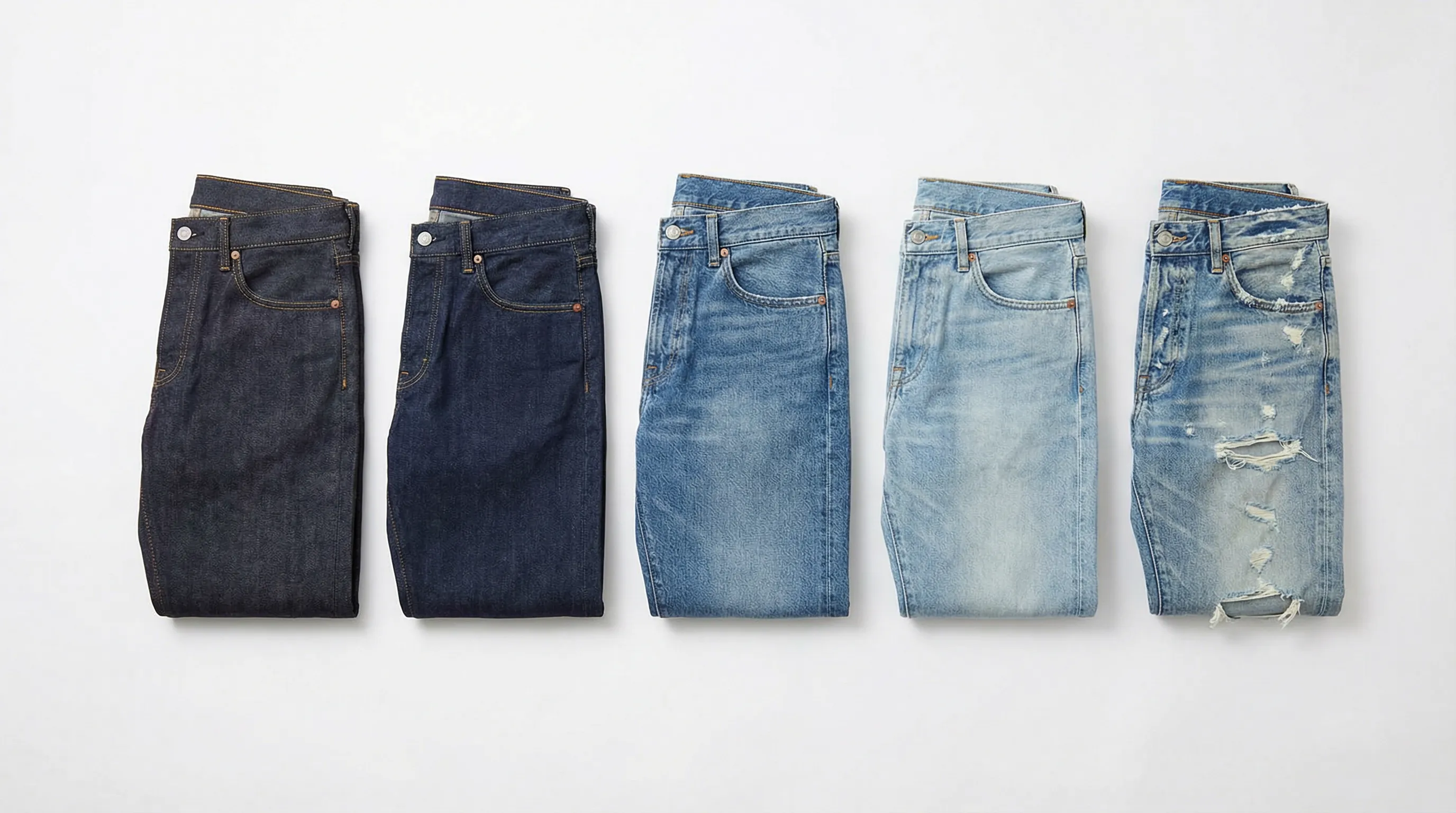 Five pairs of denim jeans showing progressive wash treatments from raw indigo to heavy stone wash to distressed
Common Denim Tech Pack Mistakes
Denim has the highest sample rejection rate of any garment category. Here are the four mistakes that cause the majority of production errors:
Not Specifying Pre-Wash vs Post-Wash Measurements. Denim shrinks 3–10% depending on the wash treatment and fabric type. If your measurement table does not state whether the numbers are pre-wash or post-wash, the factory will cut to your exact numbers — and the finished garment will be 1–3 sizes smaller after washing. Always label your measurement table clearly and provide shrinkage allowances.
Vague Wash Descriptions. Writing "medium wash" or "vintage look" in a tech pack is the single most common cause of denim sample failures. "Medium wash" means something different to every factory and every laundry. Instead, provide a physical swatch, a Pantone reference, and a step-by-step wash recipe.
Missing Hardware Finish Specs. Specifying "brass rivets" is not enough. Brass, antique brass, polished brass, brushed brass, and lacquered brass all look different and cost different amounts. Include a finish reference photo or a hardware supplier catalog number for every metal component.
Not Including a Wash Swatch Reference. Even with a detailed wash recipe, color output varies between laundries. The gold standard is to include a physical fabric swatch washed to your target shade. If a physical swatch is not available, include a high-resolution photo of the target wash with a Pantone reference for color matching.
Create Your Denim Tech Pack in Minutes
Denim is the most specification-heavy garment you will ever produce. Between wash recipes, hardware finishes, and dual measurement states, a jeans tech pack can take days to compile manually.
With Adstronaut you can generate a tech pack from a photo — the professional structure needed to organize your denim fabric, wash, hardware, and measurement specs into a single, cohesive document that any factory can read. The high-rise denim jeans sample pack shows the finished output, wash and hardware specs included.
- Upload your jeans photo or reference image.
- Define your denim weight, wash, and hardware in the BOM.
- Annotate rivet placements, pocket positions, and distressing zones on the AI-generated sketch.
- Specify your pre-wash and post-wash measurements in the size table.
- Export a factory-ready PDF.
Want to learn the full process? Read our how to create a tech pack step-by-step guide, or see more tech pack examples across different garment types. For comprehensive size grading strategies, see our guide on how to grade sizes for clothing — and grab the free denim jeans tech pack template (plus 13 other garments) from the templates hub.
Generate your denim jeans tech pack for free →
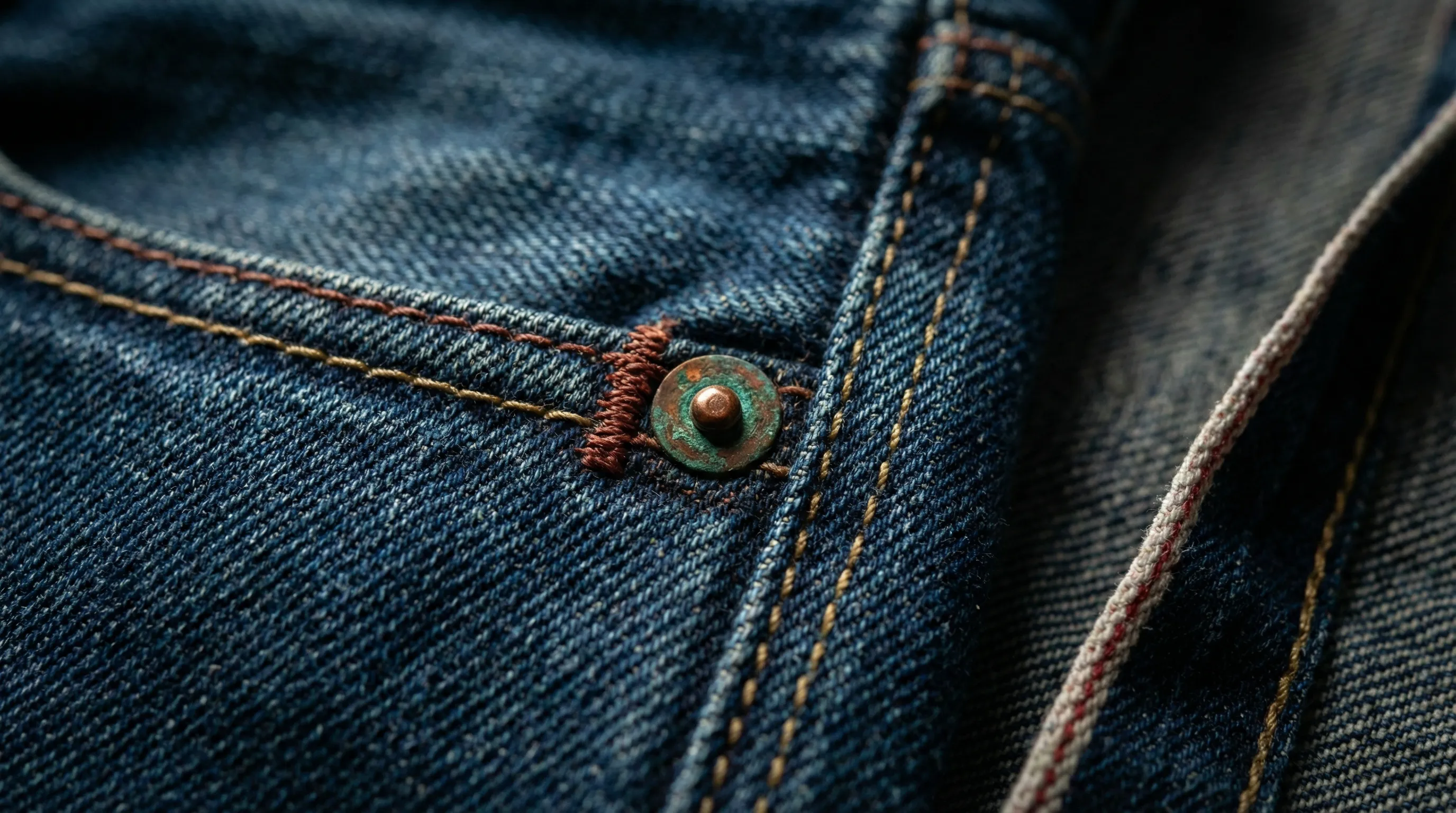 Macro close-up of denim jeans construction details: bartack stitching, brass rivet, and flat-felled seam chain stitch
Frequently Asked Questions
What oz denim should I specify?
For standard everyday jeans, specify 10–12 oz denim. For premium or workwear, specify 13–16 oz. Lightweight denim (5–9 oz) is used for shirts and summer styles, not traditional jeans. The weight directly affects drape, durability, and production cost — heavier denim costs more per yard and requires heavier-duty sewing machines. Always specify the weight in your BOM per ASTM D3776 testing standards.
How do I describe a wash to a factory?
Never use subjective terms like "medium wash" or "vintage feel." Instead, provide three things: (1) a physical swatch or high-resolution reference photo, (2) a Pantone color code for the target shade, and (3) a step-by-step wash recipe listing each treatment in order (e.g., "desizing > stone wash 45 min, 8:1 stone ratio > enzyme rinse 15 min > softener > tumble dry"). This eliminates interpretation and gives the laundry a repeatable process.
What hardware is standard for jeans?
Standard 5-pocket jeans require: one 17mm shank button (waistband), five cap rivets (front pocket stress points), one YKK #4 or #5 brass zipper (or 4–5 button-fly buttons at 15mm), and 5–7 belt loops. All metal hardware should be specified with a consistent finish — mixing brass rivets with nickel zippers looks unintentional unless it is a deliberate design choice.
How much does denim shrink?
Shrinkage depends on fabric composition and wash treatment. Raw (unwashed) 100% cotton denim shrinks 5–10% on the first wash. One-wash denim shrinks 3–5%. Stretch denim (with elastane) shrinks 2–4%. Stone-washed and enzyme-washed denim has already been pre-shrunk during the wash process, so residual shrinkage is typically 1–3%. Your tech pack must specify whether measurements are pre-wash or post-wash to account for this.
What is the difference between rigid and stretch denim?
Rigid denim is 100% cotton with zero elastane — it has no stretch, holds its shape, and softens only through wear and washing. Stretch denim contains 1–3% elastane (spandex/Lycra) blended into the weft for comfort stretch, or 5%+ elastane for super stretch. Rigid denim is preferred for heritage and selvedge styles; stretch is standard for modern fits, especially skinny and slim cuts. Your tech pack must specify the exact fiber composition (e.g., "98% cotton / 2% elastane") — not just "stretch denim."
Do I need a separate wash spec sheet?
For complex washes — especially distressed finishes with whiskers, honeycombs, and grinding — yes, a separate wash development sheet is recommended. This sheet should include a flat sketch marked with distressing zones, intensity levels for each zone (light / medium / heavy), a step-by-step wash recipe, and before/after color references. For simple washes (raw, one-wash, basic stone), the wash details can be included within the main tech pack. AATCC test methods (such as TM96 for dimensional stability and TM61 for colorfastness to laundering) should be referenced as performance benchmarks.
What stitch type is used for jeans hems?
Two options: (1) Chain stitch — uses a Union Special 43200G or similar machine, creates the iconic "roping" effect when washed, and is the standard for premium and vintage-style denim. (2) Lock stitch (single-needle) — creates a flat, clean hem with no roping, common in fashion denim and women's styles. Your tech pack must specify which one you want. If you choose chain stitch, also note the thread color (typically gold/amber, Tex 60–80) and stitch gauge (7–8 stitches per inch).
How do I spec selvedge denim?
Selvedge denim is woven on narrow shuttle looms (28–32 inch width) and has a finished "self-edge" visible when the hem is cuffed. Your tech pack should specify: (1) the selvedge ID color (the colored thread running along the edge — red is classic, but brands use custom colors), (2) fabric width (narrow, typically 28–32"), (3) the intended cuff width to display the selvedge edge (usually 1–1.5 inch turn-up), and (4) that the outseam must be constructed to expose the selvedge edge. Note that selvedge denim typically costs 2–5x more than open-width denim and has longer lead times due to limited loom availability. Reference Cone Denim (historically the most recognized US selvedge mill) as an industry benchmark when communicating with suppliers.
Sources and further reading:
- ASTM D3776 — Standard Test Methods for Mass Per Unit Area (Weight) of Fabric (the standard for measuring denim weight in oz/yd²)
- AATCC TM96 — Dimensional Changes in Commercial Laundering (wash shrinkage testing standard for denim)
- AATCC TM61 — Colorfastness to Laundering (standard for evaluating dye retention through wash treatments)
- Cone Denim — Selvedge and Open-Width Denim Reference (industry benchmark for denim fabric specifications)
- Grand View Research — Global Denim Jeans Market Report ($92 billion market valuation and growth projections)
- Adstronaut AI — The Complete Guide to Fashion Tech Packs (comprehensive tech pack overview)