Fashion Sampling Costs: A Complete Guide to Physical vs Digital Sampling
A physical garment sample costs $200-$1,500 per style per round, with most styles requiring 2-4 rounds before production approval. Total pre-production sampling costs reach $900-$5,000+ per style — meaning a 30-style collection can cost $27,000-$150,000 in sampling alone before a single unit ships to customers. Digital sampling alternatives reduce these costs by 60-80%, cutting the number of physical prototypes from 15-25 per style to 1-2.
This guide breaks down every cost in the physical sampling process by garment type, calculates the true per-style expense across all rounds, compares physical and digital alternatives side by side, and provides a framework for calculating your brand's potential savings.
Table of Contents
- How Much Does a Physical Garment Sample Cost?
- Total Cost Per Style: The Full Sampling Lifecycle
- Physical vs Digital Sampling: Cost Comparison by Garment Type
- Timeline Comparison: Physical vs Digital Sampling
- The Hidden Costs of Physical Sampling
- ROI of Switching to Digital Sampling
- Frequently Asked Questions
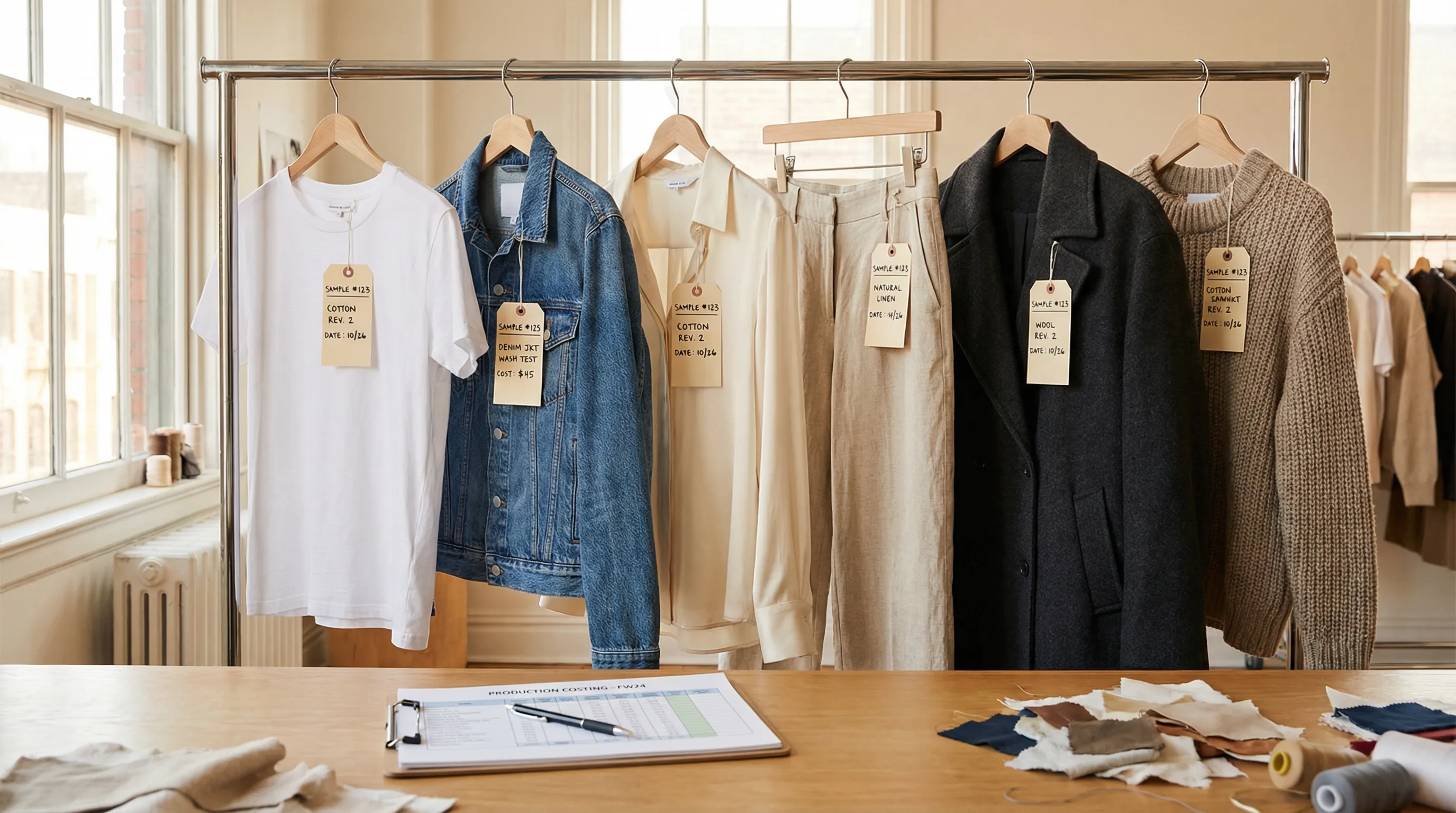 Physical fashion garment samples hanging on a rack with sample tags, measurement sheets, and fabric swatches
How Much Does a Physical Garment Sample Cost?
A single physical sample costs $200-$1,500 depending on garment complexity, fabric cost, and manufacturer location. Simple garments like t-shirts and tank tops sit at the lower end; structured garments like tailored blazers and outerwear occupy the upper range.
Here is what manufacturers typically charge for a first prototype sample, based on Maker's Row pricing data and industry benchmarks:
| Garment Type | First Sample Cost | Fabric Complexity | Typical Rounds Needed |
|---|---|---|---|
| T-shirt / Tank Top | $200-$350 | Low | 2-3 |
| Hoodie / Sweatshirt | $300-$600 | Medium | 2-3 |
| Dress (unlined) | $350-$700 | Medium | 2-4 |
| Dress (lined) | $500-$900 | High | 3-4 |
| Denim Jeans | $400-$800 | High | 3-4 |
| Tailored Blazer | $600-$1,200 | Very High | 3-5 |
| Outerwear / Jacket | $700-$1,500 | Very High | 3-5 |
| Activewear Leggings | $250-$500 | Medium | 2-3 |
| Swimwear | $200-$400 | Medium | 2-3 |
| Knitwear Sweater | $400-$900 | High | 3-4 |
These figures represent the sample maker's charge only. They do not include fabric sourcing, shipping, designer review time, or revision communication — costs that can double the effective per-sample expense.
According to McKinsey's State of Fashion report, pre-production sampling accounts for 15-20% of total product development costs across the apparel industry. For small brands producing 30-100 styles per year, sampling is often the single largest pre-production line item, consuming $30,000-$200,000 annually.
Total Cost Per Style: The Full Sampling Lifecycle
The first sample is never the only sample. The industry average is 2-4 rounds of sampling before production approval, with complex garments requiring up to 5 rounds. Each round includes the sample creation fee, shipping (often international), and designer review time.
Here is the full per-style cost across a typical sampling lifecycle:
| Cost Component | Round 1 | Round 2 | Round 3 | Round 4 (Pre-Production) | Total |
|---|---|---|---|---|---|
| Fabric sourcing & swatches | $50-$200 | — | — | — | $50-$200 |
| Sample creation | $200-$1,500 | $200-$600 | $200-$600 | $200-$500 | $800-$3,200 |
| International shipping | $40-$80 | $40-$80 | $40-$80 | $40-$80 | $160-$320 |
| Designer review time | $100-$300 | $100-$300 | $100-$300 | $50-$150 | $350-$1,050 |
| Communication & revision notes | $50-$100 | $50-$100 | $50-$100 | — | $150-$300 |
| Per-round subtotal | $440-$2,180 | $390-$1,080 | $390-$1,080 | $290-$730 | — |
| Cumulative total | — | — | — | — | $1,510-$5,070 |
For a 30-style collection, this translates to $45,000-$150,000 in total sampling costs. A 50-style collection reaches $75,000-$250,000. Common Objective's supply chain research found that 60% of all physical samples produced during development never make it to production — meaning the majority of this spend results in garments that are manufactured, shipped, reviewed, and discarded.
The financial burden is disproportionate for independent and emerging brands. A startup with a $50,000 seasonal budget may spend 40-60% of that budget on sampling alone, leaving minimal capital for production, marketing, and operations.
Physical vs Digital Sampling: Cost Comparison by Garment Type
Digital sampling uses AI and 3D technology to create virtual representations of garments — testing fabrics, colorways, and on-model presentations — without producing physical prototypes. Here is a direct cost comparison across garment categories.
| Garment Type | Physical Sampling (All Rounds) | Digital Sampling + 1 Physical Sample | Savings Per Style | Savings % |
|---|---|---|---|---|
| T-shirt / Tank Top | $900-$1,800 | $250-$500 | $650-$1,300 | 65-72% |
| Hoodie / Sweatshirt | $1,200-$2,500 | $350-$700 | $850-$1,800 | 70-72% |
| Dress (unlined) | $1,400-$3,000 | $400-$800 | $1,000-$2,200 | 71-73% |
| Dress (lined) | $2,000-$4,200 | $550-$1,000 | $1,450-$3,200 | 72-76% |
| Denim Jeans | $1,800-$3,800 | $450-$900 | $1,350-$2,900 | 75-76% |
| Tailored Blazer | $2,500-$5,500 | $650-$1,300 | $1,850-$4,200 | 74-76% |
| Outerwear / Jacket | $3,000-$6,500 | $750-$1,600 | $2,250-$4,900 | 75% |
| Activewear Leggings | $1,000-$2,200 | $300-$600 | $700-$1,600 | 70-73% |
| Swimwear | $800-$1,800 | $250-$500 | $550-$1,300 | 69-72% |
| Knitwear Sweater | $1,800-$4,000 | $450-$1,000 | $1,350-$3,000 | 75% |
The digital sampling column assumes using AI-powered tools for fabric testing, color variation, and on-model imagery (fabric swapping at $0.50-$5 per swap, AI photoshoots at $0.50-$3 per image, color variation at $0.50-$2 per colorway) plus one physical confirmation sample for final fit and tactile approval. Adstronaut bundles these modules into a single pre-production workflow, which is how most of the savings above are realized without juggling three separate subscriptions.
The more complex and expensive the garment, the greater the absolute savings. A brand producing 10 outerwear styles saves $22,500-$49,000 per collection on sampling alone by switching to a digital-first workflow.
Skip the physical samples — test fabrics digitally →
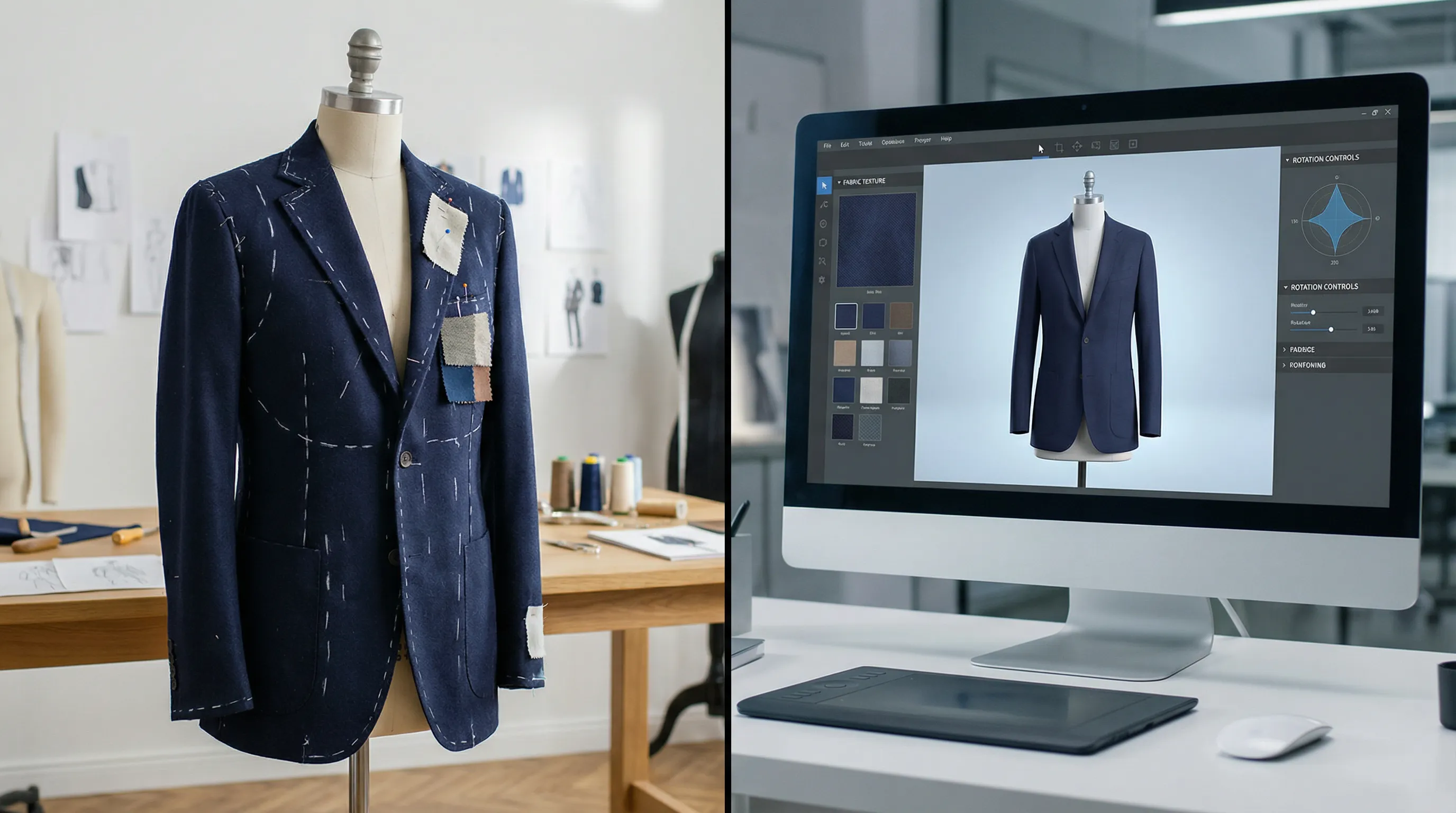 Split comparison of physical garment sample on a dress form versus digital 3D garment rendering on a computer monitor
Timeline Comparison: Physical vs Digital Sampling
Cost is only half the equation. The time consumed by physical sampling delays your entire go-to-market schedule, pushing back sales, marketing, and revenue.
| Phase | Physical Sampling Timeline | Digital Sampling Timeline |
|---|---|---|
| Fabric sourcing & swatch ordering | 1-2 weeks | 1 day (AI fabric testing) |
| First sample production | 2-4 weeks | 1-2 days (digital iterations) |
| Shipping to designer | 1-2 weeks | Instant (digital delivery) |
| Designer review & revision notes | 1 week | Same day |
| Second sample production | 2-3 weeks | 1-2 days (digital revisions) |
| Second sample shipping & review | 1-2 weeks | Instant |
| Third sample (if needed) | 2-3 weeks | N/A (resolved digitally) |
| Pre-production sample | 2-3 weeks | 2-3 weeks (one physical sample) |
| Total | 12-20 weeks | 3-5 weeks |
McKinsey's State of Fashion Technology report found that brands using digital sampling brought products to market an average of 6 weeks faster than those relying entirely on traditional sampling. For seasonal fashion — where a 4-week delay can mean missing a selling window — that speed advantage translates directly to revenue.
The compounding effect is significant: faster development means more design iterations within the same calendar window. A brand that previously tested 3-5 fabric options per style due to time constraints can now test 20-30 options digitally, producing better final products with higher sell-through rates.
The Hidden Costs of Physical Sampling
The per-sample fees quoted by manufacturers represent only 50-60% of the true cost of physical sampling. Several categories of cost are routinely underestimated or invisible in brand budgets.
Wasted samples. Common Objective's research on fashion supply chains found that the average brand produces 15-25 physical samples per style during development. Of these, 60% are rejected and discarded. For a 30-style collection, that is 270-450 wasted garments per season — garments that consumed raw materials, factory labor, and international shipping for no commercial return.
Environmental cost. UNEP estimates the fashion industry produces 92 million tons of textile waste annually and accounts for 10% of global carbon emissions. Pre-production sampling is a measurable contributor: each discarded sample carries the embodied carbon of its raw material extraction, fabric production, garment construction, and international shipping. A mid-size brand's sample room generates 5-15 tons of textile waste per year according to Common Objective supply chain data.
Opportunity cost. Every week spent waiting for a physical sample is a week your design team cannot iterate, your sales team cannot present to buyers, and your marketing team cannot produce content. At a loaded labor cost of $5,000-$15,000 per week for a small brand's core team, a 16-week sampling cycle represents $80,000-$240,000 in team capacity consumed by waiting.
Communication overhead. Physical sampling requires detailed revision notes sent across time zones, often through email chains and messaging apps with no version control. Miscommunication — a measurement noted in inches when the factory works in centimeters, a color described verbally instead of by Pantone code — causes additional sampling rounds. Complete, well-structured tech packs reduce this friction, but even with perfect documentation, physical distance introduces errors that digital workflows avoid entirely.
ROI of Switching to Digital Sampling
The return on investment for digital sampling depends on your collection size, garment complexity, and current sampling volume. Here is a framework for calculating your brand's specific savings.
For a small brand (20 styles, 2 collections/year):
| Category | Physical Sampling Cost | Digital-First Cost | Annual Savings |
|---|---|---|---|
| Sample creation (all rounds) | $60,000-$160,000 | $12,000-$32,000 | $48,000-$128,000 |
| Shipping | $6,400-$12,800 | $1,600-$3,200 | $4,800-$9,600 |
| Designer review time | $14,000-$42,000 | $4,000-$10,000 | $10,000-$32,000 |
| AI tool subscriptions | — | $1,200-$3,600 | ($1,200-$3,600) |
| Net annual savings | — | — | $61,600-$166,000 |
For a mid-size brand (80 styles, 4 collections/year):
| Category | Physical Sampling Cost | Digital-First Cost | Annual Savings |
|---|---|---|---|
| Sample creation (all rounds) | $480,000-$1,280,000 | $96,000-$256,000 | $384,000-$1,024,000 |
| Shipping | $51,200-$102,400 | $12,800-$25,600 | $38,400-$76,800 |
| Designer review time | $112,000-$336,000 | $28,000-$84,000 | $84,000-$252,000 |
| AI tool subscriptions | — | $3,600-$12,000 | ($3,600-$12,000) |
| Net annual savings | — | — | $502,800-$1,340,800 |
These figures are conservative. They do not account for faster time-to-market revenue gains, reduced overstock from better pre-production testing, or the compounding benefits of more design iterations per style.
The break-even point for digital sampling tools is almost immediate. A brand spending $1,200/year on AI sampling tools recoups that investment after digitally sampling just 1-2 styles — the equivalent of skipping a single round of physical prototyping. In practice, many indie labels using Adstronaut hit break-even on their very first style because the first-round sample cost ($200–$1,500) exceeds an entire year of digital subscription credits.
For a detailed cost analysis of the complete pre-production workflow, see the hidden costs of manual tech packs. To understand how digital fabric testing specifically drives ROI beyond direct cost savings, see the hidden ROI of AI fabric swapping.
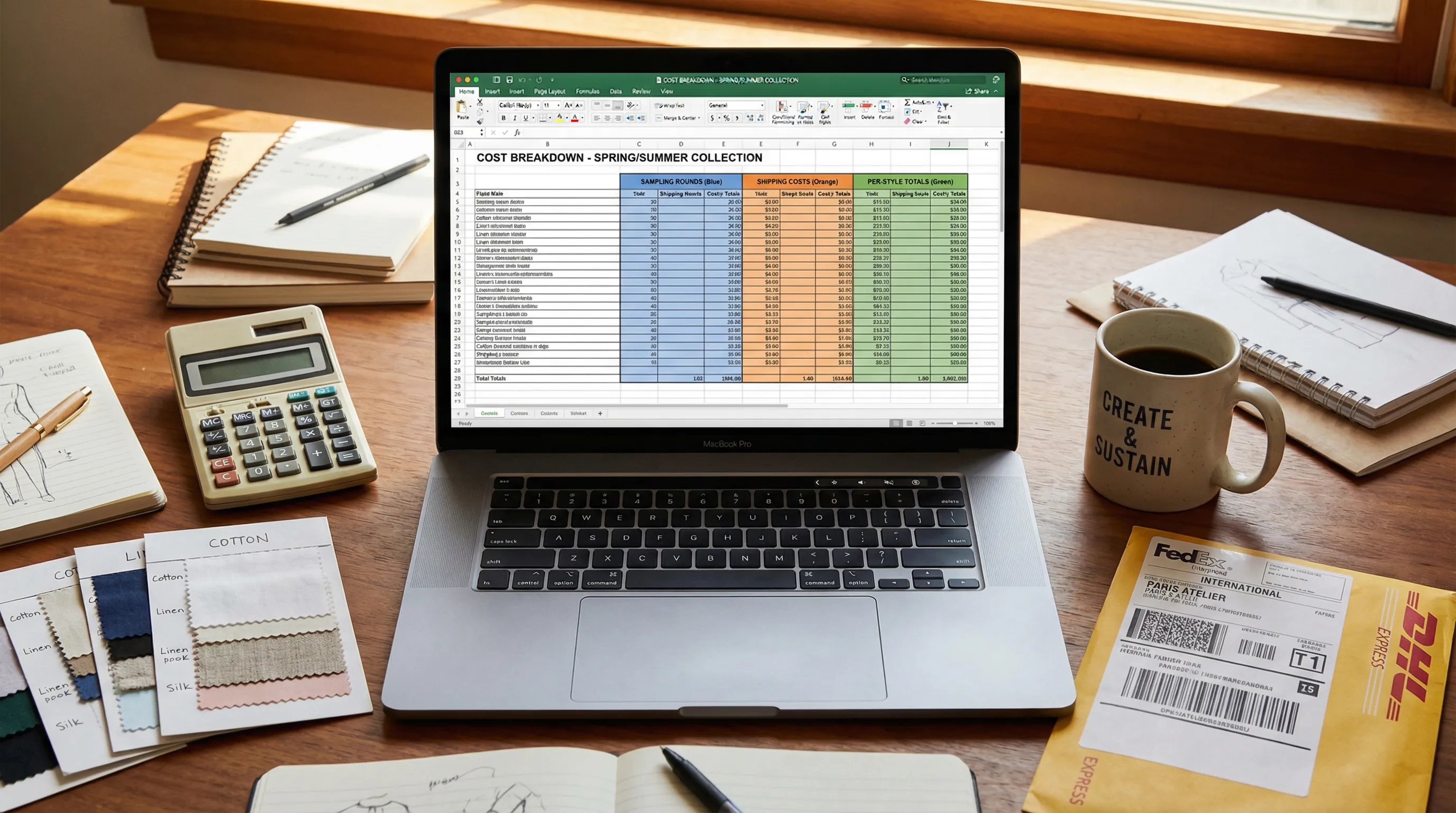 Fashion sampling cost breakdown spreadsheet on a laptop with fabric samples, calculator, and shipping documents on a desk
Frequently Asked Questions
How much does it cost to sample a garment?
A single physical garment sample costs $200-$1,500 depending on garment complexity and manufacturer location. Simple items like t-shirts cost $200-$350 per sample; complex items like tailored blazers and outerwear cost $600-$1,500. These figures cover the sample maker's production charge only — add $40-$80 for international shipping and $100-$300 in designer review time per round.
How many sampling rounds are needed before production?
Most garments require 2-4 rounds of sampling before production approval. Simple garments like t-shirts may need only 2 rounds; complex garments like tailored blazers, outerwear, and lined dresses typically require 3-5 rounds. Each round involves sample production, international shipping, designer review, and revision notes sent back to the manufacturer.
What is the total sampling cost for a full collection?
For a 30-style collection with an average of 3 sampling rounds per style, total physical sampling costs are $45,000-$150,000. This includes sample creation, fabric sourcing, shipping, and designer review time across all rounds. Digital-first workflows reduce this to $9,000-$30,000 by replacing 2-3 physical rounds with AI-powered virtual iterations and producing only 1 physical confirmation sample per style.
How does digital sampling reduce costs?
Digital sampling replaces the early rounds of physical prototyping with virtual alternatives. Instead of producing 3-5 physical samples to test fabrics, colors, and fit, you use AI fabric swapping ($0.50-$5 per swap), AI color variation ($0.50-$2 per colorway), and AI photoshoots ($0.50-$3 per image) for exploration and decision-making. You then produce one physical confirmation sample for final fit and tactile approval. This reduces physical samples from 15-25 per style to 1-2.
Do factories accept digital samples for production approval?
Factories still require a final physical pre-production sample for production sign-off. Digital sampling does not replace this step — it replaces the 2-4 iterative rounds that precede it. By resolving fabric, color, and design decisions digitally before producing the first physical sample, brands achieve a higher first-sample approval rate, reducing wasted rounds. A well-prepared tech pack further improves first-sample accuracy.
How much can a small brand save with digital sampling?
A small brand producing 20 styles across 2 collections per year can save $61,000-$166,000 annually by switching to a digital-first sampling workflow. This includes direct savings on sample creation, shipping, and designer review time, minus the cost of AI tool subscriptions ($1,200-$3,600/year). The break-even point is reached after digitally sampling just 1-2 styles.
What is the environmental impact of physical sampling?
Physical sampling generates significant textile waste. The average brand produces 15-25 samples per style, 60% of which are discarded. UNEP reports the fashion industry produces 92 million tons of textile waste annually, with pre-production sampling as a measurable contributor. Digital sampling reduces physical samples by 88-95% per style, cutting pre-production textile waste by 80-90% and international shipments by 75%.
Is digital sampling accurate enough for production decisions?
AI-powered digital sampling achieves 85-95% visual accuracy for standard apparel fabrics, effectively handling fabric texture, color, drape, and light behavior. It is highly reliable for narrowing fabric and color options before committing to physical samples. However, digital tools cannot replicate tactile hand-feel or guarantee exact dye-lot color matching. The industry-standard approach is to use digital sampling for all exploration and decision-making phases, then produce one physical sample for final validation before production.
Start reducing your sampling costs with AI →
Sources and further reading:
- McKinsey & Company — The State of Fashion (data on pre-production sampling costs, digital adoption rates, and supply chain efficiency benchmarks)
- UNEP — Sustainability and Fashion (fashion industry environmental impact data, 92 million tons annual textile waste)
- Common Objective — Sustainable Fashion Business (supply chain research on sample rejection rates, sampling waste, and production error costs)
- Maker's Row — Find a Manufacturer (garment sampling cost benchmarks and manufacturing pricing data)
- Business of Fashion — The State of Fashion Technology (digital sampling market analysis and time-to-market data)
- Adstronaut AI — What Is Digital Sampling in Fashion? and The Hidden ROI of AI Fabric Swapping (detailed digital sampling workflows and financial modeling)