Swimwear Tech Pack — Stretch Fabrics, Lining & Construction Guide
A swimwear tech pack is a 6–10 page technical document specifying stretch fabric composition (typically 78–82% nylon / 18–22% spandex), lining requirements (mandatory for all swimwear), elastic edge specifications, chlorine resistance ratings (AATCC Test Method 162), and graded measurements that account for 15–25% fabric stretch and recovery. Swimwear is one of the most technically demanding garments to spec because every component — fabric, thread, elastic, and hardware — must withstand UV exposure, chlorine, salt water, and hundreds of stretch cycles without degrading.
This guide covers every component of a factory-ready swimwear tech pack, from fabric specifications to construction details, common mistakes that derail production, and how to create one in minutes. New to tech packs? Start with our complete guide to fashion tech packs.
Table of Contents
- What Is a Swimwear Tech Pack?
- Key Components of a Swimwear Tech Pack
- 1. Flat Sketch (Front & Back)
- 2. Fabric Specifications
- 3. Lining Requirements
- 4. Elastic & Edge Finishing
- 5. Hardware & Closures
- 6. Measurements & Grading
- 7. Print & Sublimation Specs
- Common Swimwear Tech Pack Mistakes
- Create Your Swimwear Tech Pack in Minutes
- Frequently Asked Questions
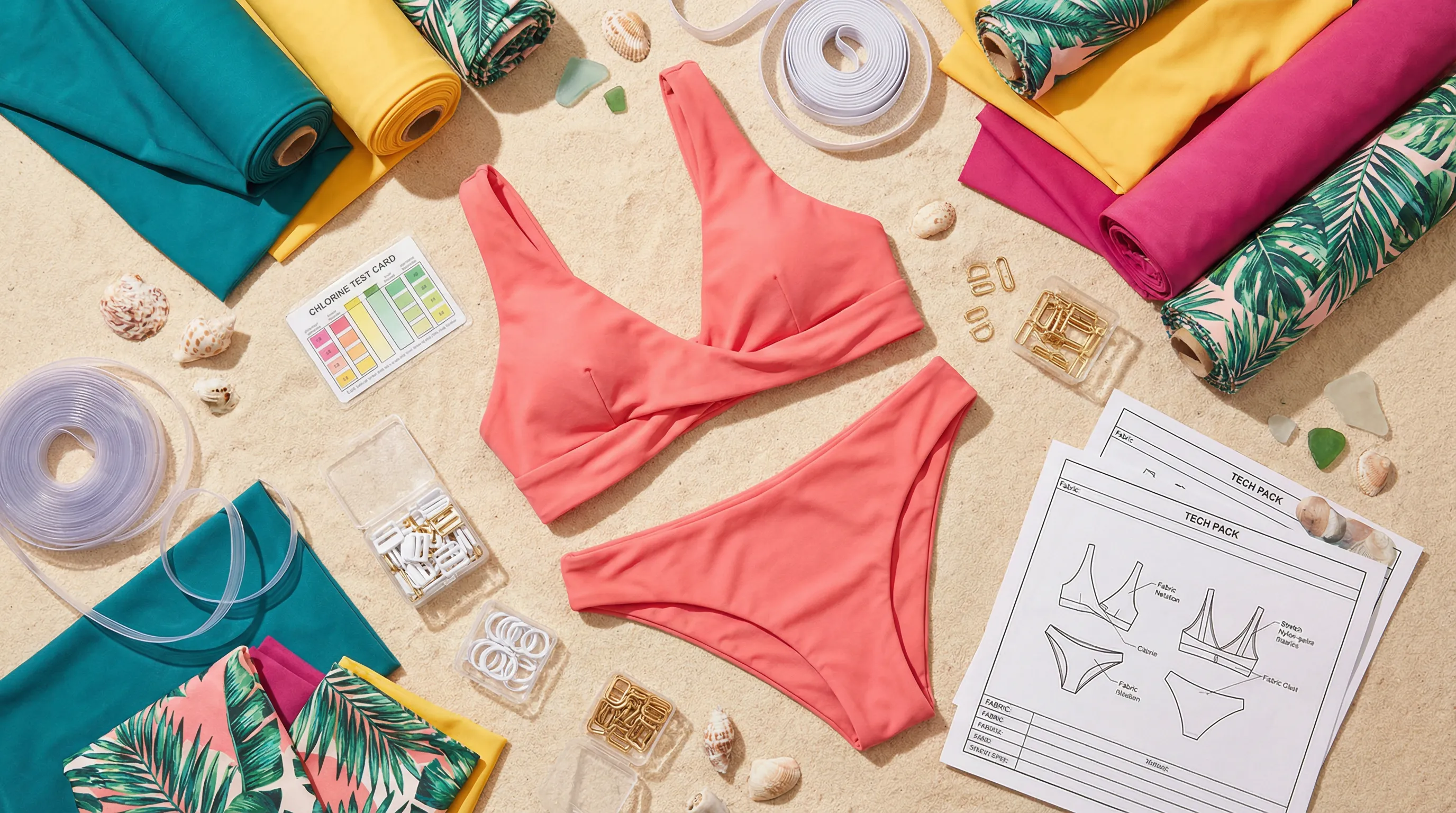 Flat lay of colorful bikini designs alongside stretch fabric swatches, elastic samples, and hardware components for swimwear manufacturing
What Is a Swimwear Tech Pack?
A swimwear tech pack is the manufacturing blueprint that instructs a factory how to cut, sew, and finish your swimsuit. Unlike a t-shirt tech pack or a hoodie tech pack, swimwear requires specialized specifications for stretch recovery, chlorine resistance, UV protection, and wet performance that do not apply to other garment categories.
The global swimwear market reached $22.5 billion in 2025 and is projected to grow to $30.7 billion by 2030 (Grand View Research). With thousands of D2C swim brands entering the market annually, factories process high volumes of styles and a complete tech pack is the only way to ensure your specific fabric, fit, and construction combination is produced correctly.
A professional swimwear tech pack must define:
- Fabric: What is the stretch percentage? Is it chlorine-resistant? What is the UPF rating?
- Lining: What type — power mesh, tricot, or self-lining? Is it body-lined only or fully lined?
- Construction: What seam type — flatlock, overlock, or zigzag? What stitch count per inch?
- Elastic: What width, type, and placement — leg opening, waist, neckline?
- Hardware: What material — plastic, stainless steel, or coated metal? Will it corrode in salt water?
- Measurements: Graded with stretch allowance — are measurements given relaxed or stretched?
Without these answers documented in a single spec sheet, you will receive a sample that does not hold its shape after the first wash.
Key Components of a Swimwear Tech Pack
1. Flat Sketch (Front & Back)
Swimwear flat sketches require more callout detail than most garments because the construction is minimal — every seam and edge treatment is visible to the customer.
Critical Sketch Details for Swimwear:
- Tops/Bikini Top: Cup shape (triangle, molded, bandeau, underwire), strap routing (halter, cross-back, tie-back, fixed), center front detail (ring, knot, clasp), boning placement if applicable
- Bottoms: Rise height (low, mid, high), leg opening shape (cheeky, moderate, full), side width, waistband type (fold-over, elastic, drawstring)
- One-Piece: Neckline shape, back opening depth, leg opening height, tummy control panel placement
According to ASTM D6193, the standard guide for stitches and seams used in swimwear, every seam line and elastic placement must be clearly indicated on the flat sketch for the factory to accurately construct the garment.
2. Fabric Specifications
Swimwear fabric is measured by weight (GSM), stretch percentage, and recovery rate. The most critical specification is stretch recovery — how well the fabric returns to its original shape after being stretched.
Standard Swimwear Fabric Compositions:
| Fabric Type | Composition | Weight | Stretch | Best For |
|---|---|---|---|---|
| Standard swim | 80% Nylon / 20% Spandex (Elastane) | 180–220 GSM | 4-way, 50–70% | Bikinis, one-pieces |
| Chlorine-resistant | 53% PBT Polyester / 47% PBT | 200–240 GSM | 4-way, 40–60% | Competitive/athletic swim |
| Sustainable | 78% ECONYL / 22% Elastane | 190–230 GSM | 4-way, 45–65% | Eco-conscious brands |
| Textured/ribbed | 82% Nylon / 18% Spandex | 220–280 GSM | 2-way or 4-way, 30–50% | Premium, textured looks |
| Crochet/lace | 90% Nylon / 10% Spandex | 150–180 GSM | 2-way, 20–40% | Cover-ups, overlay details |
Key specifications to include:
- Stretch direction: 4-way stretch is standard for swimwear. 2-way stretch is only acceptable for cover-ups and non-functional pieces.
- Stretch recovery: Minimum 95% recovery after 50% elongation (ASTM D4964). Below 90% recovery, the garment will bag out after one wear.
- Chlorine resistance: Rated in hours of exposure. Standard: 100+ hours. Competition grade: 300+ hours. Specify per AATCC Test Method 162.
- UPF rating: UPF 50+ blocks 98% of UV radiation. Increasingly expected by consumers, especially in resort and children's swimwear.
- Colorfastness: Minimum rating of 4 on the gray scale (AATCC Test Method 16) for lightfastness. Sublimated prints must withstand chlorine without fading.
The Textile Exchange's 2025 report found that 41% of swimwear brands now specify recycled nylon (ECONYL or Repreve) in their BOMs, up from 18% in 2022. AI tools like Adstronaut auto-populate this fabric composition field with the correct GSM, stretch, and chlorine-resistance defaults so that a first-time swim designer does not have to memorize every AATCC test code before submitting to a factory.
Generate your swimwear tech pack from a photo →
3. Lining Requirements
Lining is mandatory for all swimwear — there are no exceptions. The lining serves multiple functions: opacity when wet, comfort against skin, support and shaping, and modesty. Your tech pack must specify the lining for every panel.
Common Lining Types:
| Lining | Composition | Weight | Use Case |
|---|---|---|---|
| Power mesh | 85% Nylon / 15% Spandex | 100–140 GSM | Tummy control, shaping panels |
| Tricot | 80% Nylon / 20% Spandex | 120–160 GSM | Standard body lining, comfortable |
| Self-lining | Same as shell fabric | Same as shell | Premium brands, reversible designs |
| Bra lining | 90% Nylon / 10% Spandex, brushed | 140–180 GSM | Cup lining, soft against skin |
Critical lining specifications:
- Coverage: Specify which panels are lined. Minimum: front crotch panel (bottoms) and front bust panel (tops). Full lining means every shell panel has a corresponding lining panel.
- Color: Lining color must match or complement the shell. For light-colored or white swimwear, specify a nude/skin-tone lining for opacity. A white shell with white lining becomes transparent when wet.
- Attachment method: Lining is typically caught in the seam allowances, not stitched to the shell. This allows independent stretch and prevents puckering.
4. Elastic & Edge Finishing
Elastic application is where swimwear construction gets technical. Incorrect elastic width, tension, or type will ruin the fit entirely.
Elastic Specifications:
| Placement | Width | Type | Application |
|---|---|---|---|
| Leg opening | 6–10 mm | Clear silicone or fold-over | Zigzag or coverstitch, moderate tension |
| Waistband | 10–15 mm | Plush-back or fold-over | Enclosed in fold-over or casing |
| Neckline | 4–6 mm | Clear silicone | Zigzag, light tension |
| Strap edges | 4–6 mm | Clear silicone or self-fabric binding | Binding or rolled edge |
| Underwire channel | N/A (channel width 8–12 mm) | Self-fabric casing | Topstitch channel |
Edge finishing methods:
- Fold-over elastic (FOE): Clean, professional edge. Standard width: 15 mm folded to 7.5 mm. Specify matte or shiny finish.
- Binding: Self-fabric or contrast binding. Width: 10–12 mm finished. More labor-intensive but premium appearance.
- Rolled/lettuce edge: Narrow zigzag on raw edge. Minimal, fashion-forward look. Less support than FOE.
- Bonded edge: No-stitch adhesive bonding. Smooth, seamless finish. Requires specialized factory equipment.
5. Hardware & Closures
Every piece of swimwear hardware must be corrosion-resistant. Salt water, chlorine, and sunscreen will corrode standard metal within weeks.
Hardware Specifications Table:
| Component | Material Options | Standard Size | Corrosion Notes |
|---|---|---|---|
| Slider/adjuster | Coated metal, nylon, acetal plastic | 10–15 mm | Nylon/plastic recommended for longevity |
| Ring | Coated metal, nylon | 10–25 mm | Metal gives premium feel but must be coated |
| Hook closure | Nylon, stainless steel | 12–20 mm | Avoid uncoated brass — turns green |
| Underwire | Stainless steel, nylon-coated | A–DD sizing | Must specify tip caps to prevent fabric puncture |
| Bra cups (removable) | Molded foam, push-up inserts | S/M/L sets | Specify density (soft, medium, firm) and shape |
Critical rule: Never specify uncoated brass or zinc alloy hardware for swimwear. Specify corrosion-resistant materials (nylon, acetal, stainless steel, or epoxy-coated metal) for every component.
6. Measurements & Grading
Swimwear measurements require special handling because of fabric stretch. Your tech pack must specify whether measurements are relaxed (garment lying flat, not stretched) or stretched (pulled to maximum intended wear stretch).
Standard Swimwear Measurement Points (Bikini Bottom):
| Point of Measure | S | M | L | XL | Tolerance |
|---|---|---|---|---|---|
| Waist (relaxed) | 26" | 28" | 30" | 32" | ± 0.5" |
| Hip (relaxed) | 30" | 32" | 34" | 36" | ± 0.5" |
| Front rise | 8.5" | 9" | 9.5" | 10" | ± 0.25" |
| Back rise | 10" | 10.5" | 11" | 11.5" | ± 0.25" |
| Leg opening (relaxed) | 18" | 19" | 20" | 21" | ± 0.5" |
| Side width | 3" | 3.5" | 4" | 4.5" | ± 0.25" |
Grading rules for swimwear:
- Standard grade between sizes: 1–2 inches for circumference measurements (waist, hip)
- Grade 0.5 inches for rise and length measurements
- Grade 1 inch for leg openings
- All measurements specified relaxed unless explicitly noted as stretched
- Include stretch percentage for reference: "Waist relaxed 28", stretches to 36" (28% stretch)"
According to ASTM D5585, the standard body measurements for adult female misses figure type, swimwear grading should follow the same base body measurement grading as other garments, with additional notes on stretch allowance for the specific fabric being used.
7. Print & Sublimation Specs
Approximately 60% of swimwear styles involve printed or sublimated fabric. Your tech pack must specify the print method, artwork specifications, and color requirements.
Print Methods:
| Method | Best For | Min Order | Color Fidelity | Durability |
|---|---|---|---|---|
| Sublimation | All-over prints on polyester/nylon | 50+ yards | High | Excellent — chlorine-safe |
| Digital print | Small runs, complex artwork | 10+ yards | Very high | Good — specify chlorine-safe inks |
| Screen print | Spot prints, logos, repeat patterns | 100+ yards | Medium–high | Very good |
| Engineered print | Placement prints (specific body position) | Custom | High | Excellent |
Sublimation specifications:
- Artwork resolution: minimum 300 DPI at actual print size
- Color profile: CMYK — specify Pantone references for critical colors
- Bleed: minimum 2 cm beyond cut lines (sublimation shifts during heat transfer)
- Repeat: specify if seamless repeat, mirror repeat, or engineered placement
- Heat press: 380–400°F, 45–60 seconds, medium pressure (factory handles this, but include for reference)
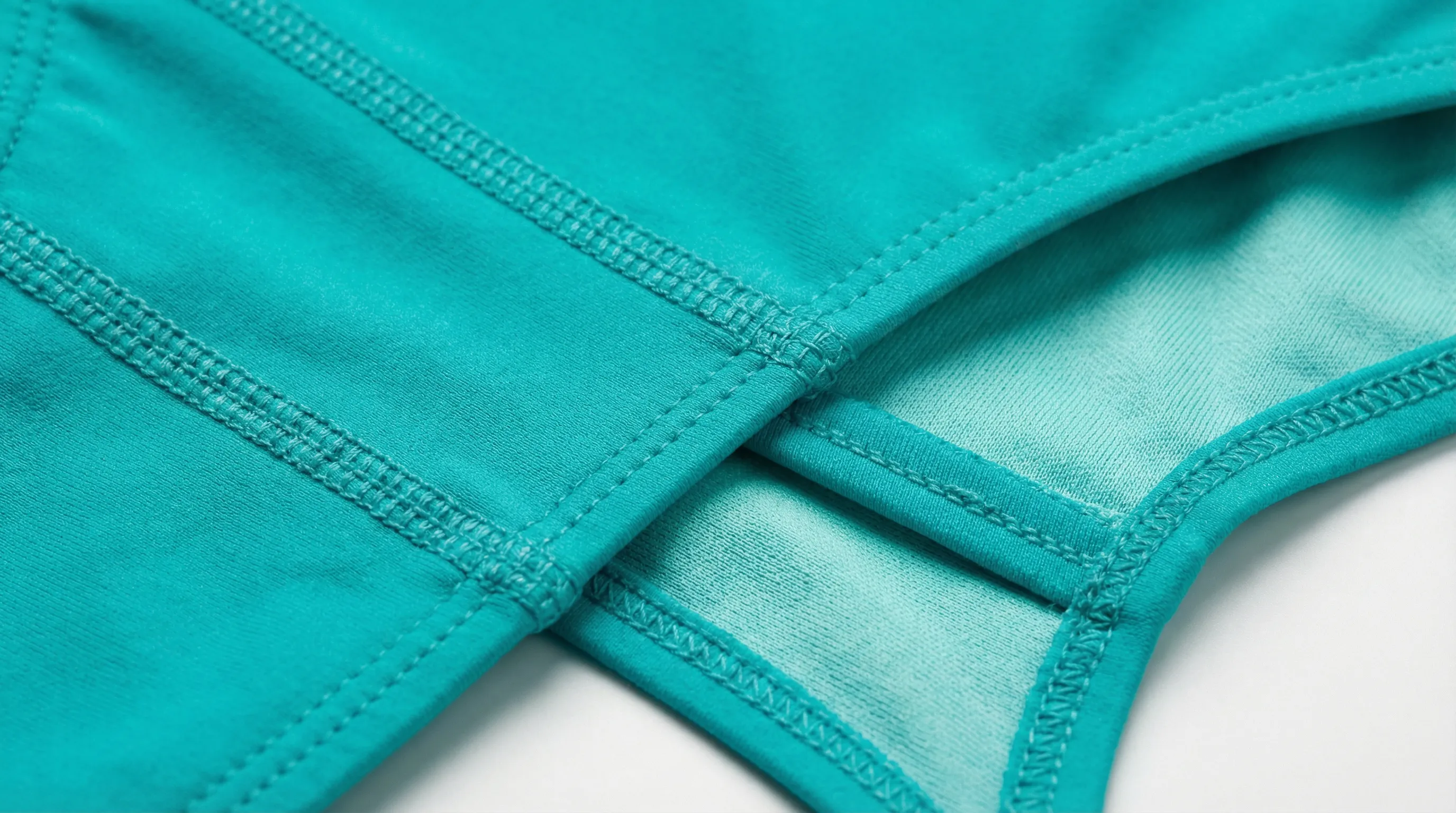 Close-up of swimwear construction showing flatlock seams, fold-over elastic edge finishing, and lining attachment on a bikini bottom
Common Swimwear Tech Pack Mistakes
1. Not specifying lining color for light fabrics White shell + white lining = transparent when wet. Always specify a nude or skin-tone lining for white, pastel, or light-colored swimwear. This is the single most common swimwear production error.
2. Using standard grade rules instead of swimwear-specific grading Swimwear grade increments are smaller than standard apparel due to the stretch factor. A 2-inch grade between sizes on a non-stretch garment translates to roughly 1–1.5 inches for swimwear.
3. Not specifying chlorine resistance level "Chlorine-resistant fabric" is not specific enough. State the exact standard: "Chlorine-resistant per AATCC 162, minimum 100 hours exposure without significant degradation."
4. Forgetting to specify hardware material Factories default to the cheapest option — often zinc alloy or uncoated brass. After 3–5 exposures to chlorinated water, these corrode visibly. Always specify nylon, acetal, stainless steel, or epoxy-coated hardware.
5. Not accounting for sublimation color shift Colors shift 5–15% during the sublimation process (high heat changes dye penetration). Request a strike-off (fabric test swatch) before bulk production to verify colors match your digital artwork.
Create Your Swimwear Tech Pack in Minutes
Traditional swimwear tech packs require Adobe Illustrator for flat sketches and detailed knowledge of stretch fabrics, lining types, and elastic specifications. This process takes 4–8 hours for an experienced technical designer.
With Adstronaut's tech pack generator, you upload a photo of your swimwear design, and the AI generates a complete tech pack including flat sketches, fabric specifications, lining callouts, measurement charts, construction details, and BOM — ready for factory submission. You can then edit any field, replace images, and export a factory-ready PDF.
For indie swimwear brands launching with limited budgets, this eliminates the need for a freelance technical designer ($200–$800 per style for swimwear) and reduces tech pack creation from days to minutes. To see what finished packs look like across categories, browse our tech pack examples, or start from a free tech pack template and fill in the swim-specific fields yourself.
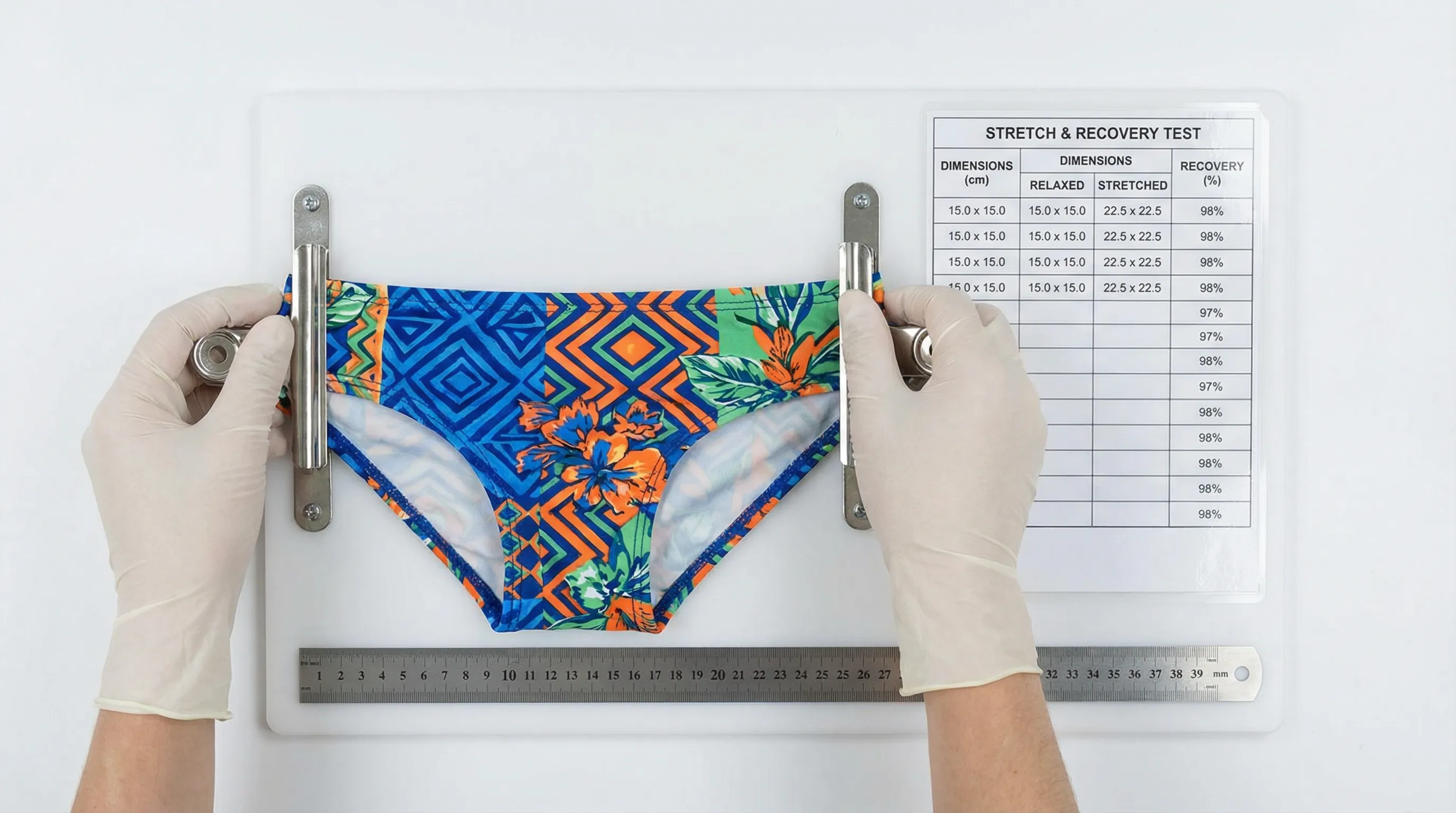 Technical designer stretching swimwear fabric to test recovery while checking against a measurement specification chart
Frequently Asked Questions
What fabric is best for swimwear: nylon/spandex or polyester/spandex?
Nylon/spandex (typically 80/20) is the industry standard for fashion swimwear due to its soft hand feel, vibrant color retention, and excellent stretch recovery. Polyester/spandex (typically 53/47 PBT) is superior for chlorine resistance and is preferred for athletic and competitive swimwear. For a resort or fashion swim brand, nylon/spandex is the better choice.
Does swimwear need to be lined?
Yes, always. Unlined swimwear is transparent when wet and considered a quality defect by any reputable factory. The minimum lining requirement is front crotch panel (bottoms) and front bust panel (tops). Premium swimwear is fully lined, meaning every shell panel has a corresponding lining panel.
What is the minimum order quantity for swimwear production?
Domestic U.S. swimwear factories typically accept MOQs of 50–200 units per style per color. Overseas factories (China, Indonesia, Colombia) usually require 200–500+ units. Sublimated fabric has its own MOQ (typically 50+ yards minimum), which may dictate your overall production minimum.
How do I specify a removable bra cup in my tech pack?
Specify cup type (triangle, molded, or push-up), cup material (polyurethane foam, typical density 3–5 mm), cup size range (S/M/L, corresponding to A/B, B/C, C/D), and insertion method (opening in lining, typically 2–3 inches, positioned at the bottom or side of the cup panel, finished with a small bartack).
How much does it cost to manufacture swimwear?
Unit costs range from $4–$12 for basic bikinis (overseas, 500+ units) to $15–$40 for one-pieces with technical features (molded cups, tummy control). Domestic U.S. production typically costs 2–3x more. Sublimated prints add $1–$3 per unit. For a detailed cost framework, see our guide on how much it costs to start a clothing brand.
What thread should I specify for swimwear construction?
Use 100% textured polyester thread (Woolly Nylon or equivalent) for all seams. Specify Tex 60–90 for construction seams and Tex 40–60 for coverstitching. Cotton thread absorbs water, weakens with chlorine, and should never be used for swimwear. The stitch type should be zigzag (ASTM 304) or 3-thread overlock (ASTM 504) for stretch seams.
How do I spec a reversible swimsuit?
A reversible swimsuit uses self-lining — the same quality fabric on both sides. Your tech pack must specify: both face fabrics (with separate print/color callouts), that all construction seams must be hidden (flatlock or bonded), that hardware must be functional from both sides, and that labels are removable or positioned at side seams. Reversible swimwear requires approximately 2x the fabric of standard lined swimwear.
What certifications should I look for in swimwear fabric?
OEKO-TEX Standard 100 (free from harmful substances), GRS (Global Recycled Standard) if using recycled nylon, and UPF certification from an accredited lab. For the U.S. market, CPSIA compliance is mandatory for children's swimwear (lead and phthalate testing). For EU, REACH compliance is required.
Create your swimwear tech pack in minutes — try free →
Sources and further reading:
- ASTM D6193: Standard Guide for Stitches and Seams in Swimwear (construction standards)
- ASTM D5585: Standard Body Measurements for Adult Female Misses (grading reference)
- AATCC Test Method 162: Chlorine Resistance of Fabrics (chlorine testing standard)
- Grand View Research: Swimwear Market Analysis ($22.5B market, projected $30.7B by 2030)
- Textile Exchange: Preferred Fiber and Materials Report 2025 (41% recycled nylon adoption)
- Complete Guide to Fashion Tech Packs (tech pack fundamentals)
- How to Grade Sizes for a Clothing Line (general grading rules)