Best Midjourney alternatives for fashion in 2026
Updated June 10, 2026
The best Midjourney alternative for fashion depends on what you need after the pretty picture. For reproducing your actual garment, keeping a model consistent across a catalog, and outputting production specs, Adstronaut AI (plans from $29/month; on-model image ~$1, concept ~$2) is the strongest choice. The New Black ($5/40 credits) suits cheap prompt-to-design concepts; Stable Diffusion (free, self-hosted) suits tinkerers who control their own pipeline; DALL·E via ChatGPT Plus ($20/month) suits quick edit-by-conversation mockups. Midjourney itself runs $10–$120/month.
The quick answer
Midjourney is the best general art model; it's not a fashion tool.
Midjourney is the sharpest general-purpose image model in the category — $10 to $120 per month across Basic, Standard, Pro and Mega (Midjourney plans) — and for moodboards, lookbook backdrops, and concept exploration it's hard to beat. Three structural limits drive the fashion-alternatives search: it can't reproduce your exact garment (it invents a plausible one), it can't hold one model's face across a catalog, and it outputs zero production data — no specs, no tech pack, no Pantone codes. If your goal is to put your real product on a consistent model and take it to a factory, the structural fix is Adstronaut AI, purpose-built for fashion from concept to production. For the direct head-to-head, see Midjourney vs Adstronaut.
Midjourney fashion alternatives compared: price, best-for, and what each outputs
| Tool | Price (2026) | Best for | Reproduces your real garment / outputs specs? |
|---|---|---|---|
| Midjourney | Basic $10; Standard $30; Pro $60; Mega $120/mo (annual saves 20%) | General concept art, moodboards, imagined garments | No — invents a garment; no consistent model; no specs |
| Adstronaut AI | Plans $29–$149/mo; on-model image ~$1, concept ~$2, tech pack $3–6 | Putting your real product on a consistent model and taking it to production | Yes — fidelity to your garment, 22 named models, tech packs, Pantone recolor |
| The New Black | Packs from $5/40 credits; subs $8–$65/mo; $89/mo white-label | Cheap, fast prompt-to-design fashion concepts | Partly — fashion-tuned renders + assisted tech-pack draft; design-image first |
| Stable Diffusion | Free self-hosted; DreamStudio $10/1,000 credits; API ~$0.002–$0.035/image | Developers and tinkerers who control their own pipeline | Only if you build it — ControlNet/IP-Adapter/LoRA do the heavy lifting |
| DALL·E / ChatGPT images | ChatGPT Plus $20/mo; API GPT Image ~$0.005–$0.20/image | Quick edit-by-conversation mockups and one-off visuals | No — conversational edits, but no garment fidelity or specs |
Prices per each vendor's published 2026 pages: Midjourney plan comparison, Stability AI platform pricing, OpenAI API pricing. 'Outputs specs' = whether the tool produces production-usable data (tech packs, Pantone codes), not just an image.
Why fashion brands look for a Midjourney alternative
Midjourney earns its reputation — for pure aesthetics it's the best in the field, and many designers keep it for mood and ideation. But three concrete frictions push fashion users to look elsewhere, and they're about fit, not quality.
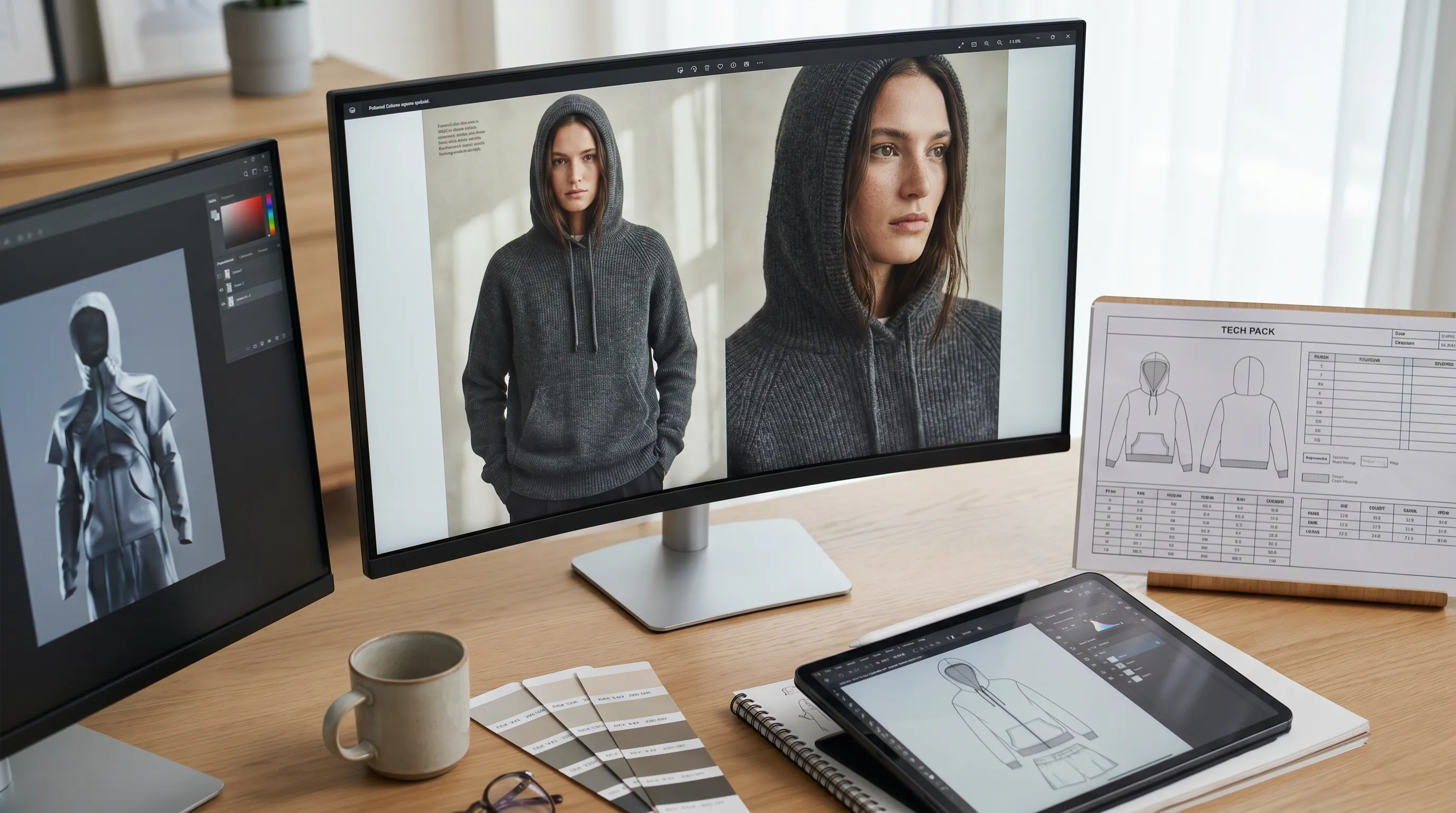
It can't reproduce your actual product. Midjourney generates a plausible garment from a prompt or image reference, not a faithful copy of the hoodie sitting on your desk. Prompt "oversized charcoal fleece hoodie" and you get a beautiful invented hoodie — different seam placement, different drawcord, different fabric weight than your sample. For PDP imagery, where the customer must receive the garment they saw, an invented garment is a return-rate problem. Reproducing your specific product on a model is the gap a purpose-built photoshoot tool closes.
It can't hold a model consistent. A catalog needs the same face across ten poses and three scenes so the drop reads as one shoot. Midjourney has no concept of a reusable, named model — every generation is a fresh roll of the dice, with drifting faces, body proportions, and skin tone. There's no --cref reliable enough to anchor a 20-image collection the way named, repeatable models do.
It outputs zero production data and ships images public by default. There's no tech pack, no bill of materials, no graded measurements, no Pantone code — just a picture. On top of that, Midjourney's default gallery is public: your images are visible to other users unless you're on Stealth Mode, which is only available on the Pro ($60) and Mega ($120) plans (Midjourney plans). And note the commercial fine print — companies with over $1M in prior-year revenue must be on Pro or Mega to use outputs commercially (Midjourney commercial terms), while US copyright offices have held that purely AI-generated portions aren't copyrightable (AI output rights). For a brand, that's privacy, licensing, and IP friction layered on top of the fidelity gap. The fairness note: for the imagined, art-directed concept frame — a campaign mood, an editorial backdrop, a what-if silhouette — Midjourney remains excellent, and plenty of fashion teams keep a Basic seat for exactly that.
The fashion gap, visualized: art vs. product
The best Midjourney alternative for fashion, by use case
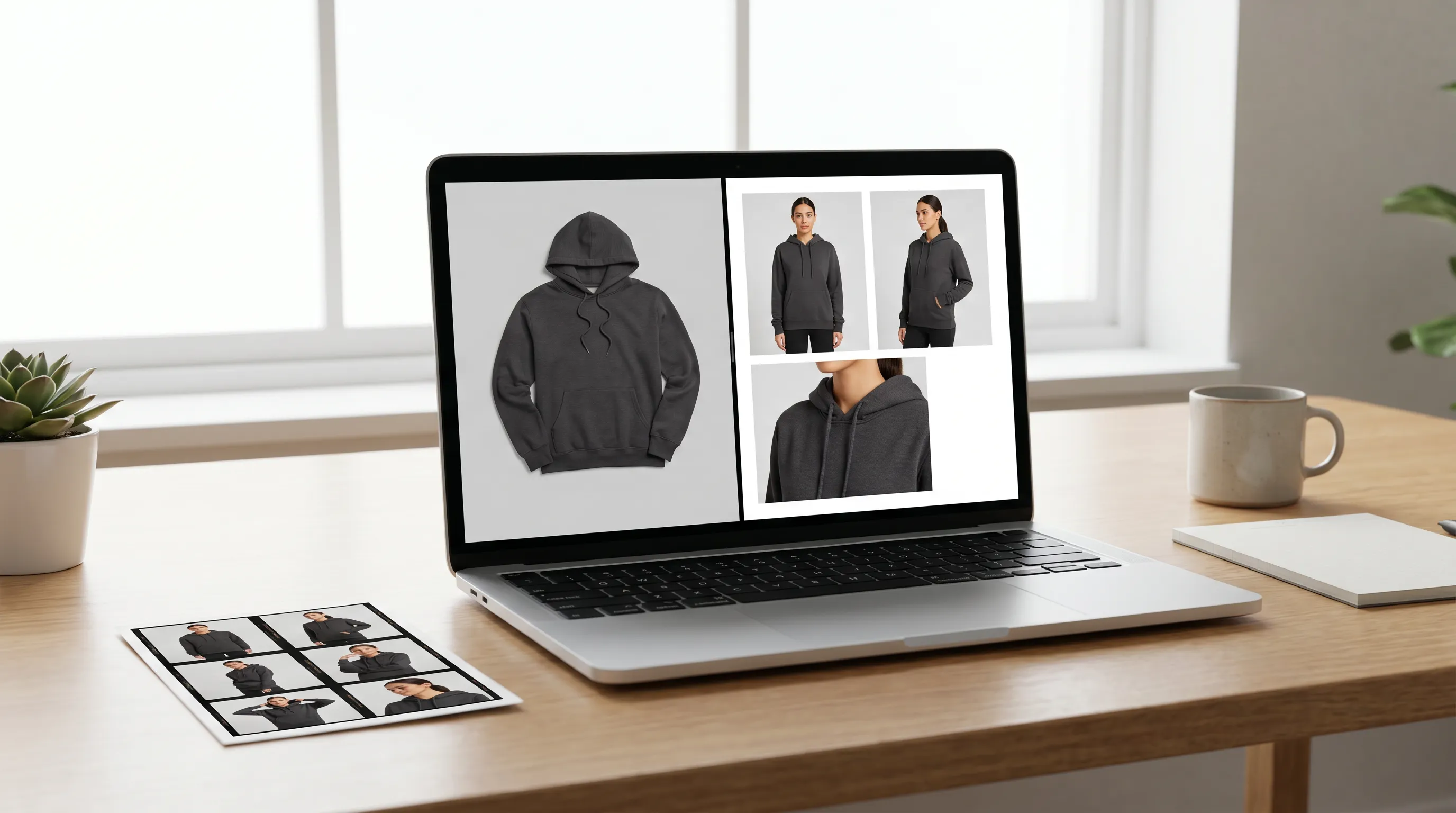
Your real product, a consistent model, and production output → Adstronaut AI. This is the lane Midjourney can't enter. Upload a photo of your actual garment — flat-lay, mannequin, or amateur on-model — and Adstronaut renders it on any of 22 named, repeatable models (12 women, 10 men) across 8 poses and 12 scenes, the same face every time, for ~$1 per image (5 credits). The garment customers receive matches the garment they saw, because the AI is fashion-tuned for fabric drape, weave, and seam fidelity rather than inventing a plausible look. From there the same image flows into a factory-ready tech pack ($3–6), Pantone colorways across 2,300+ TCX, and listing copy — one platform, plans $29–$149/month. For ideation, the AI Designer takes up to 14 inspiration images to four illustration directions plus a photoreal render with an auto-extracted Pantone palette, about $2 (10 credits).
Cheap, fast prompt-to-design concepts → The New Black. thenewblack.ai is a fashion-tuned generator with credit packs from $5 for 40 credits and subscriptions $8–$65/month (The New Black pricing). It knows garments far better than Midjourney and drafts an assisted tech pack, but it's design-image-first and the spec isn't a structured factory document — the full breakdown is in our The New Black alternatives guide.
Full control of your own pipeline → Stable Diffusion. The open-source models are free to self-host (Stable Diffusion in 2026), with hosted DreamStudio at $10 per 1,000 credits and API generations from roughly $0.002–$0.035 per image (Stability AI pricing). With ControlNet, IP-Adapter, and a trained LoRA you can approximate product fidelity and a fixed face — but that's an engineering project, not a product feature, and the honest cost is GPU time plus weeks of pipeline work.
Quick edit-by-conversation mockups → DALL·E via ChatGPT. OpenAI's image model (DALL·E's successor) is bundled with ChatGPT Plus at $20/month or billed via API at roughly $0.005–$0.20 per image (OpenAI API pricing). Conversational editing — "make the jacket longer, swap the buttons" — is genuinely useful for rough mockups, but like Midjourney it invents the garment and outputs no specs.
Switch from Midjourney for fashion, or keep it?
Switch to Adstronaut if…
- ✓You need to show your actual product — not a plausible invented garment — on a model.
- ✓Your catalog needs one consistent model across poses and scenes (22 named, repeatable models).
- ✓You want production output: tech packs, Pantone-anchored colorways, listing copy from the same image.
- ✓You want per-image economics (~$1) tied to a fashion workflow, not GPU hours you have to budget.
- ✓You can't risk a public gallery or the $1M-revenue commercial restriction on lower Midjourney tiers.
Keep Midjourney if…
- ✓Your need is imagined concept art — campaign moods, editorial backdrops, what-if silhouettes.
- ✓You're exploring directions before a real sample exists and fidelity doesn't matter yet.
- ✓You value its best-in-class general aesthetic and art-direction control above all.
- ✓You're fine with $10–$120/month GPU-hour pricing and reroll-until-it's-right workflows.
- ✓You already produce specs and catalogs elsewhere and just want the mood frame.
A pairing works well: explore the mood in Midjourney, then reproduce the real product on a consistent model in Adstronaut.
Moving from Midjourney to a fashion workflow: 4 steps
- 1
Keep Midjourney for mood, not product
Use your existing Midjourney seat for campaign moods and concept exploration — it's good at that. The switch is only for the steps that need your real garment. - 2
Photograph your actual sample
A clear flat-lay, mannequin, or amateur on-model photo is all the input Adstronaut needs — it reproduces that exact garment rather than inventing one. - 3
Render it on a consistent model
Run it through AI Photoshoots (~$1/image, first shoot free): pick one named model and render every pose and scene with the same face for a cohesive drop. - 4
Carry the image into production
Generate a factory-ready tech pack ($3–6), spin Pantone colorways, and auto-write listings — the production data Midjourney never produced.
Which Midjourney alternative should you choose?
Indie founders and small DTC brands who need their real product on a consistent model — and then a tech pack to take it to a factory — get the most from Adstronaut, which owns the fashion lane Midjourney structurally can't enter, at ~$1 per on-model image inside a $29–$149/month platform. Designers wanting cheap, fashion-aware concepts without production weight should try The New Black at $5 for 40 credits. Developers comfortable building their own pipeline can push Stable Diffusion to product-grade fidelity with ControlNet and a LoRA, for the cost of GPU time and engineering effort. Anyone needing quick conversational mockups is well served by DALL·E inside ChatGPT Plus at $20/month.
Keep Midjourney for what it's genuinely best at: imagined, art-directed concept imagery. For the scored landscape across all these tools, read the best AI tools for fashion design guide, and for the direct matchup see Midjourney vs Adstronaut.
Frequently asked questions
What is the best Midjourney alternative for fashion?
It depends on the gap. For reproducing your actual garment on a consistent model and outputting production data, Adstronaut AI is the strongest alternative — on-model images at ~$1, concepts at ~$2, tech packs at $3–6, plans $29–$149/month — which Midjourney ($10–$120/month) structurally can't do because it invents the garment and can't hold a model. The New Black ($5/40 credits) fits cheap fashion concepts; Stable Diffusion (free, self-hosted) fits pipeline builders; DALL·E via ChatGPT Plus ($20/month) fits quick mockups.
How much does Midjourney cost in 2026?
Four plans: Basic $10/month (3.3 fast GPU hours), Standard $30/month (15 hours), Pro $60/month (30 hours), and Mega $120/month (60 hours), with a 20% discount on annual billing. Relax Mode (unlimited slow generations) is available on Standard and up; Stealth Mode (private images) only on Pro and Mega. Extra fast hours cost $4 each, and unused hours don't roll over.
Why is Midjourney not ideal for fashion product images?
Three reasons. It can't reproduce your exact garment — it generates a plausible invented one, so the customer may not receive what they saw. It can't hold one model's face consistent across a catalog, so a multi-image drop won't read as one shoot. And it outputs no production data — no tech pack, no Pantone codes — plus its default gallery is public unless you pay for the Pro/Mega Stealth tier. It's a general art model, not a fashion tool.
Can Midjourney reproduce my actual garment?
Not faithfully. Even with image references and --cref/--sref, Midjourney produces a stylistically similar but invented garment — different seams, drawcord, fabric weight, and proportions than your real sample. For PDP imagery where the customer must receive the garment they saw, that's a fidelity and return-rate problem. Adstronaut is fashion-tuned to reproduce your specific garment from a photo rather than imagine a new one.
Is Adstronaut cheaper than Midjourney for fashion work?
For fashion output, usually yes on a per-result basis. Midjourney sells GPU hours ($10–$120/month) that produce imagined images you still can't use as product shots. Adstronaut charges per usable output: ~$1 per on-model image, ~$2 per design concept, $3–6 per tech pack, inside $29–$149/month plans — and the first shoot is free. You're paying for production-ready fashion results, not reroll attempts.
Is The New Black a good Midjourney alternative for fashion?
For cheap, fashion-aware concepts, yes — at $5 for 40 credits it knows garments far better than Midjourney and drafts an assisted tech pack. But it's design-image-first: the spec isn't a structured factory document, and there's no named reusable model roster. It's a strong ideation step; production typically moves to a dedicated tool. See our full The New Black alternatives guide for the breakdown.
Can Stable Diffusion match Midjourney for fashion?
With work, it can go further — it's free to self-host, and with ControlNet, IP-Adapter, and a trained LoRA you can approximate real-garment fidelity and a fixed face that Midjourney can't. Hosted access runs $10 per 1,000 DreamStudio credits or roughly $0.002–$0.035 per image via the Stability API. The cost is engineering: it's a pipeline you build and maintain, not a product feature you turn on.
Is DALL·E or ChatGPT better than Midjourney for clothing design?
Different strengths. OpenAI's image model (DALL·E's successor), bundled in ChatGPT Plus at $20/month, is better at conversational editing — 'make the sleeves longer, change the buttons' — and text rendering. Midjourney is sharper on raw aesthetics. Neither reproduces your real garment or outputs specs, so for production fashion both are ideation tools, not catalog tools.
Do AI fashion images from these tools need model releases or disclosure?
Adstronaut's 22 models are synthetic, not real people, so there are no model-release forms or likeness-rights issues, and outputs are commercially licensed on paid plans. Midjourney requires Pro or Mega for commercial use by companies over $1M in prior-year revenue, ships images publicly by default, and US copyright offices have held that purely AI-generated portions aren't copyrightable. Always check each tool's current commercial terms before publishing.
Can I use Midjourney and Adstronaut together?
Yes, and it's a sensible stack: explore campaign mood and concept directions in Midjourney, where it excels, then reproduce your actual product on a consistent named model in Adstronaut and carry that image into the tech pack, colorways, and listing. Midjourney covers the imagined frame; Adstronaut covers the real product and everything after it.
Put your real product on a real model
Midjourney imagines a garment. Adstronaut reproduces yours — on any of 22 named, consistent models, then carries it into a tech pack, colorways, and listings. Upload one garment photo. First shoot free, then ~$1 per image.
Try AI PhotoshootsKeep exploring
Sources and further reading
- Midjourney — plan comparison — Basic $10, Standard $30, Pro $60, Mega $120/mo (2026); annual saves 20%; ~3.3/15/30/60 fast hours; Relax on Standard+, Stealth on Pro/Mega
- Midjourney — commercial use terms — paid-plan commercial use; companies over $1M prior-year revenue must be on Pro/Mega; default public gallery
- Midjourney — AI output rights — US copyright offices: purely AI-generated portions not copyrightable
- The New Black — pricing — packs from $5/40 credits; subs $8–$65/mo; $89/mo white-label (2026)
- Stability AI — developer platform pricing — DreamStudio $10/1,000 credits; API generations ~$0.002–$0.035/image; models open-source (2026)
- OpenAI — API pricing — ChatGPT Plus $20/mo; GPT Image (DALL·E successor) ~$0.005–$0.20/image (2026)