AI product photos for Amazon apparel listings that pass the image rules
Updated June 10, 2026
Amazon's main image must sit on a pure white background (RGB 255,255,255), show a single product filling 85% or more of the frame, carry no text, logos, watermarks, or inset graphics, and be at least 1,000px on the longest side — Amazon recommends 1,600px+ so hover-zoom works. Adult apparel mains must be shown on a model or ghost mannequin, and listings can hold up to 9 images. Adstronaut AI generates that compliant set — on-model main, multi-angle and detail frames — from one garment photo for about $1 per image.
Amazon's image requirements for apparel, in plain terms
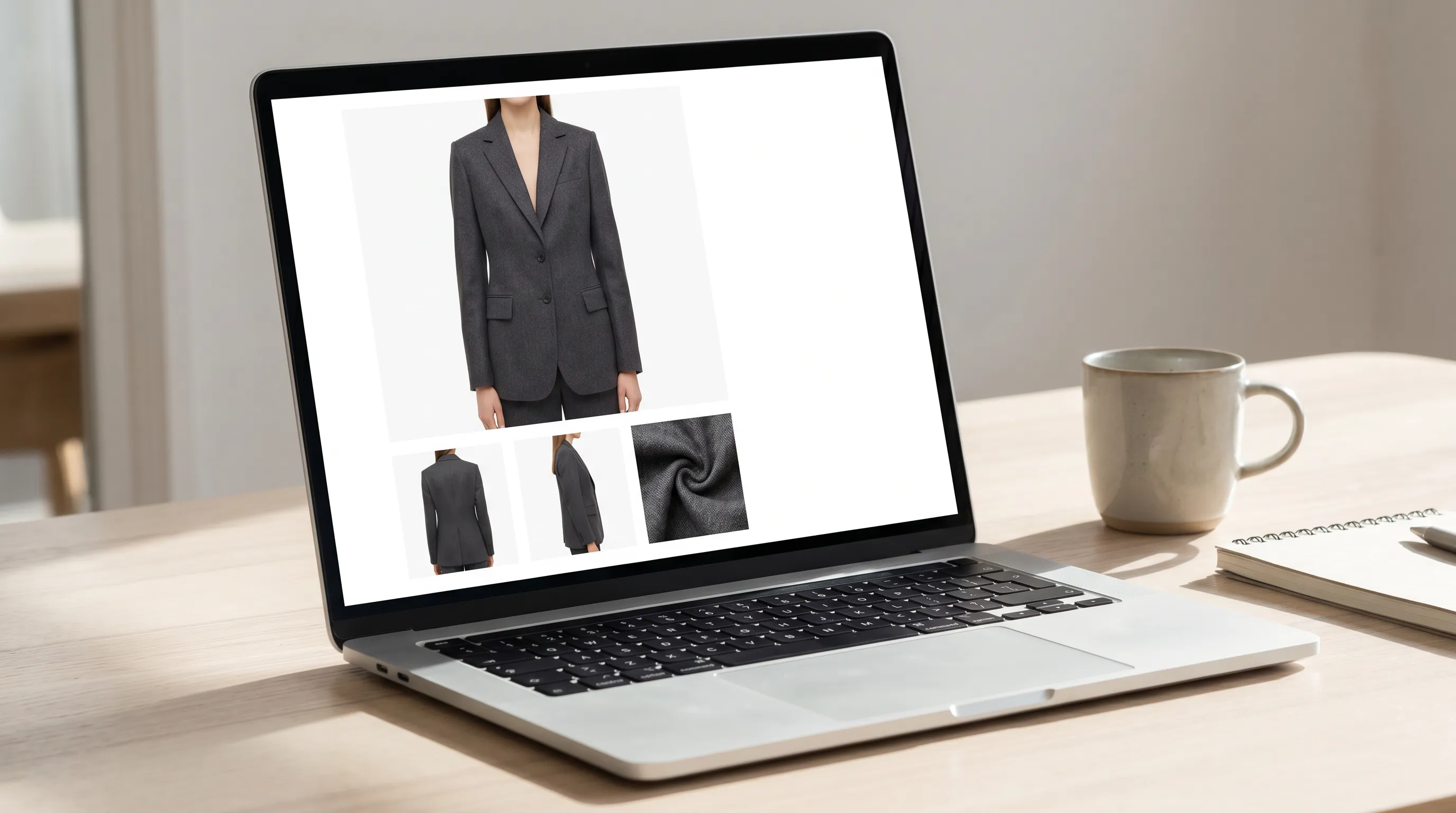
Amazon's product image guidelines set the hardest bar in e-commerce, and the main image carries the strictest rules. It must sit on a pure white background — RGB 255,255,255 exactly — because Amazon's automated checks read the corner pixels; off-white, cream, or light-gray backdrops trigger listing suppression. The product must fill 85% or more of the frame, be a single product (no stacks except multipacks/sets), and show no text, logos, watermarks, borders, or inset images anywhere.
For clothing specifically, Amazon's image guidelines for clothing add a category layer: adult apparel main images must be shot on a live model or with the ghost-mannequin technique — flat-lays and hanger shots don't qualify as a main. Accessories and kids' items go the other way: their mains must not show any part of a mannequin. So the same workflow that's compliant for a women's dress is non-compliant for a belt.
Resolution is where listings quietly lose conversions. Amazon requires at least 1,000 pixels on the longest side for the hover-zoom function to activate, and zoom is a documented conversion lever — so the practical floor is 1,600px, with Amazon recommending 1,600–2,000px for clean display across devices. Accepted formats for the main are JPEG (.jpg) and TIFF (.tif). A listing can hold up to 9 images, and Amazon's own clothing best-practice is a minimum of 5: front and back, additional angles, a detail close-up, and a styled or multi-fit shot. The constraint was never knowing the spec — it was producing a compliant on-model main plus six to eight supporting frames per SKU at a price that scales.
Amazon apparel image spec sheet
| Requirement | Amazon spec (2026) |
|---|---|
| Main image background | Pure white — RGB 255,255,255 exactly; off-white triggers suppression |
| Product fill | Product fills 85% or more of the image frame |
| Resolution | 1,000px minimum on the longest side (zoom requires it); 1,600–2,000px recommended |
| Format | Main image: JPEG (.jpg) or TIFF (.tif) |
| Text / logos / watermarks | Prohibited on the main and supporting images |
| Adult apparel main | Must be on a live model or ghost mannequin — no flat-lay or hanger as main |
| Accessories / kids' main | Must NOT show any part of a mannequin |
| Images per listing | Up to 9; Amazon's clothing best-practice is 5+ (front, back, angles, detail, styled) |
| Single product | One product per image (multipacks/sets excepted); no stacked images |
| AI-generated imagery | Permitted if it accurately represents the shipped product; substantial AI changes require disclosure |
Verified against Amazon Seller Central's product image guide (G1881), the clothing image guidelines (G200498950), and Amazon's 2026 AI-content image policy.
Building a compliant Amazon set from one garment photo
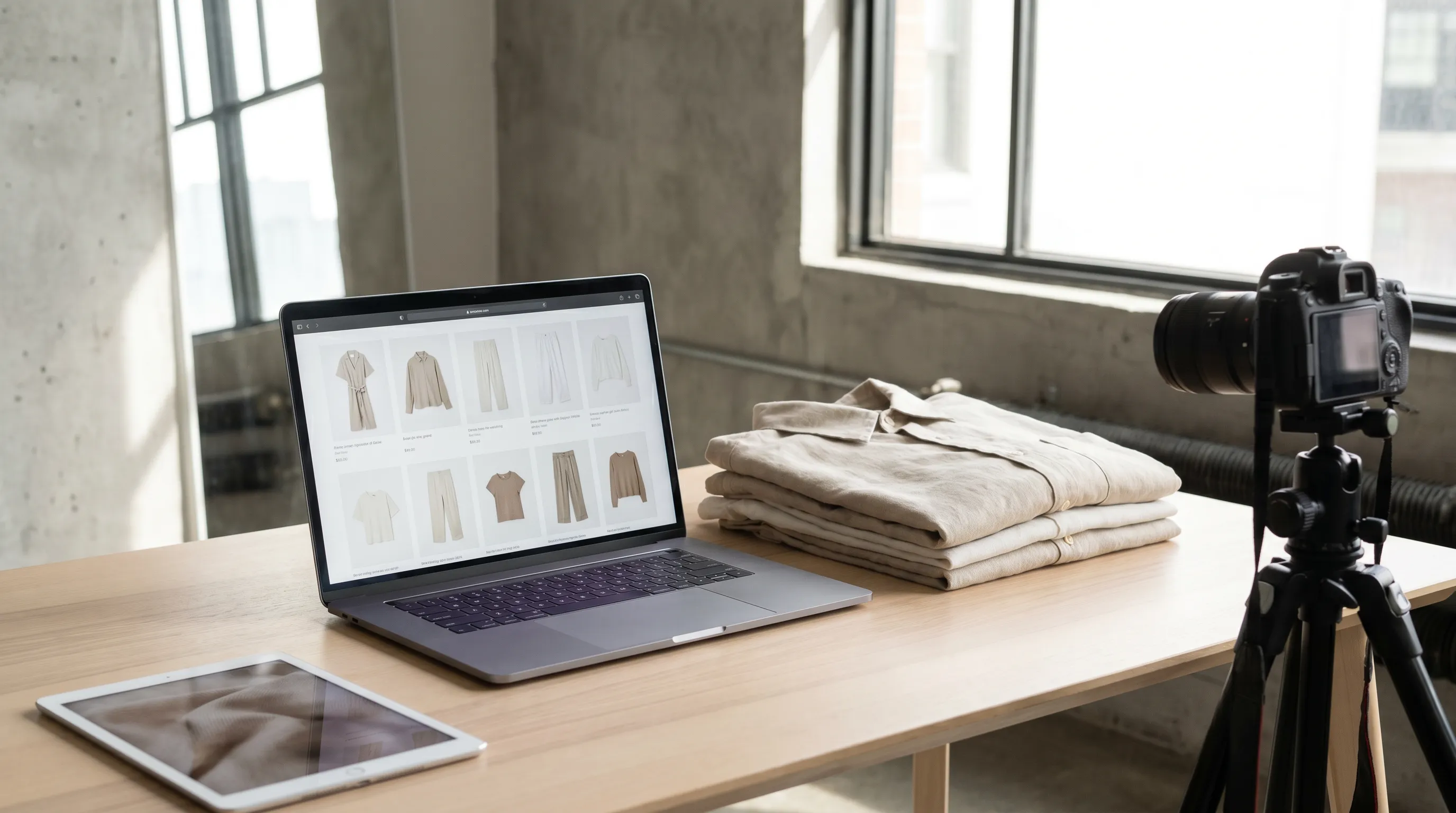
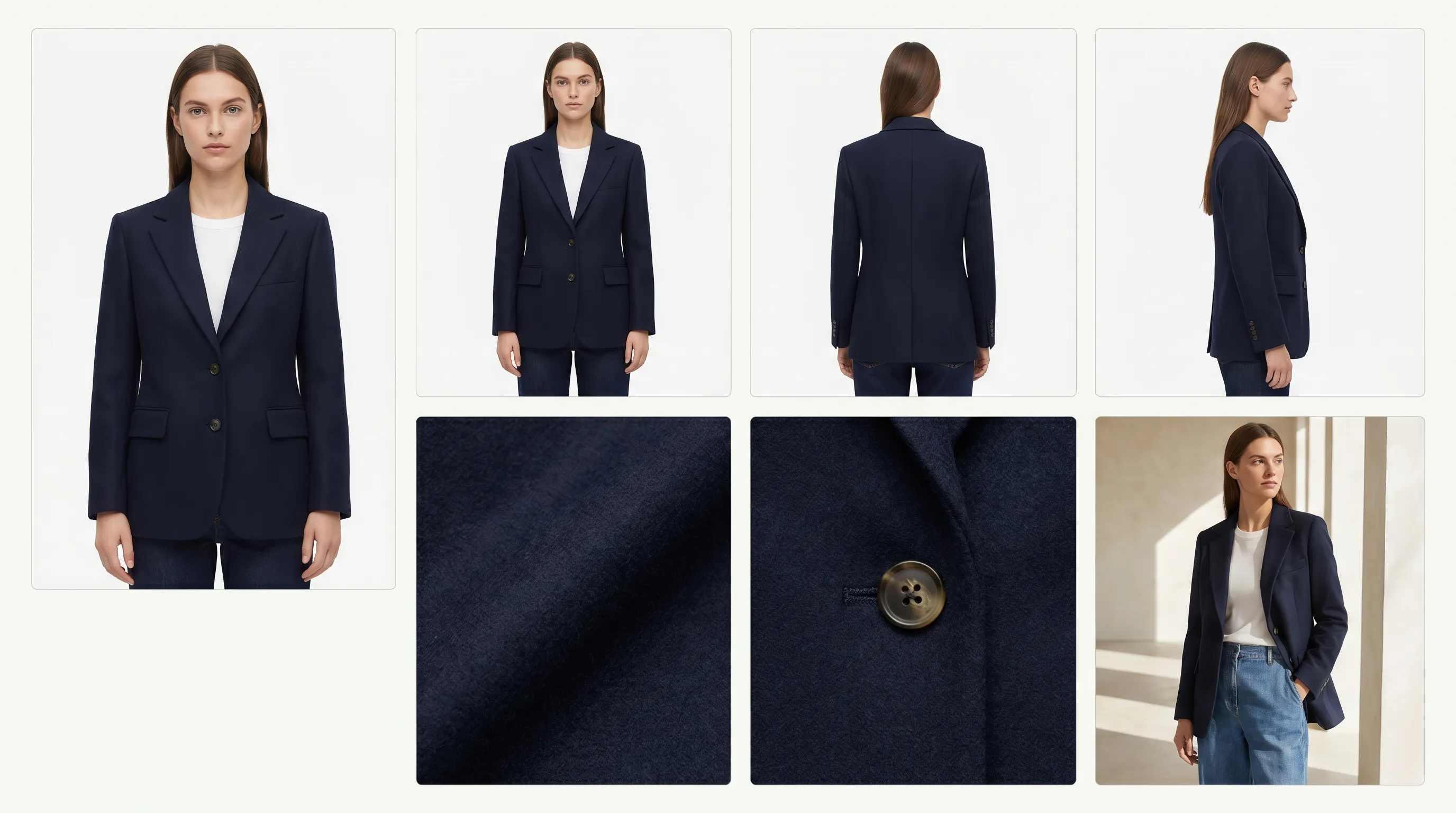
The slot plan that clears the 85%-fill main rule and Amazon's 5+ clothing best-practice:
- 1
Main image — on-model, pure white, 85% fill
Adult apparel needs a model or ghost-mannequin main. AI Photoshoots renders your garment on one of 22 named models against a clean studio scene; crop so the product fills 85%+ on a true-white background. (For belts, bags, and other accessories, swap to a no-mannequin packshot from the Lookbook Creator.) - 2
Front, back, side angles
The Lookbook Creator generates front, back, side, and three-quarter views from the same source — 5 credits (~$1) per view, consistent lighting across the set. Front and back are Amazon's named clothing essentials. - 3
Detail and fabric close-ups
Macro frames of stitching, weave, hardware, and trim — the views that answer fit-and-quality doubts before purchase and cut "not as described" returns. Generated from the same garment, so texture matches what ships. - 4
Styled and multi-fit frames
Amazon's best-practice list calls for a styled inspiration shot and multiple fits. Use a lifestyle scene or a second model to fill the remaining slots up to the 9-image cap. - 5
Colorway variants without a reshoot
Each Amazon child ASIN (per color) wants its own main. The Color Changer renders Pantone-accurate variants (~$0.50), then re-render on the same model so every variant's main is consistent and compliant.
Staying inside Amazon's accuracy and AI-disclosure rules
Amazon's image policy rests on a single principle: every image must accurately represent the physical product the customer receives. The platform's 2026 AI-content rules treat background removal, color correction, and lighting adjustment as permitted minor edits — but prohibit using AI to misrepresent a product's color, size, material, or included contents, or to fabricate features it doesn't have. Generating a lifestyle shot that misrepresents scale, or inventing a pocket or trim the garment lacks, is a violation. Substantial AI modification of product content requires disclosure, and a first violation typically means listing suppression until the image is corrected.
This maps cleanly onto a fidelity-first workflow. Adstronaut is fine-tuned for garment fidelity: your real product's pattern, color, fabric texture, seam placement, and hardware transfer into the render, so the on-model main and the angle frames depict your actual product rather than a fictional one. The discipline is simple — keep the rendered garment true to the sample, never let a frame promise a feature the product doesn't ship with, and disclose AI assistance where Amazon asks. That last rule isn't only policy; it's your return rate.
The honest boundary worth naming: AI does not exempt you from accuracy — it raises the stakes. Because a render is fast and cheap, the temptation is to flatter the garment — deepen a washed-out color, smooth a texture, slim a silhouette. Each of those is exactly what Amazon's policy prohibits, and each widens the gap between the listing and the parcel, which shows up as returns and as the negative reviews that erode placement. Treat the AI like a photographer you brief to capture the sample faithfully, not a retoucher you ask to improve it. The same accuracy standard runs across the sister platforms — the TikTok Shop guide covers a stricter main-image policy, and the Shopify guide the looser one — so a single fidelity-first set syndicates without re-shooting for each marketplace's rulebook.
What a compliant Amazon set costs
Adstronaut prices per output on plans from $29/month: 5 credits — about $1 — per finished image, whether it's a Lookbook angle or an on-model frame. A complete seven-image Amazon set runs roughly $7 in credits; a parent listing with three color variants — each child ASIN needing its own compliant main — lands around $15–$20 including recolors at ~$0.50 each. Output renders well above the 1,000px zoom floor and exports clean, with no baked-in text, borders, or watermarks to strip before upload.
The comparison is stark. A traditional multi-angle apparel shoot covering the same spread runs $3,000–$10,000 for a 10-SKU batch with 1–3 weeks of lead time (Squareshot's 2026 cost guide) — and Amazon's velocity, where new ASINs and seasonal variants launch continuously and a suppressed main image must be re-shot fast, is exactly the cadence a studio calendar can't match. When a listing gets suppressed for an off-white background or a missing on-model main, regenerating the corrected frame costs about a dollar and ships the same hour, not the same fortnight.
Built for Amazon apparel sellers
Indie founders launching FBA apparel who need a compliant on-model main and a 5+ image gallery the week samples arrive — not after a quarterly shoot. Sellers fixing suppressed listings, where Amazon flagged an off-white background or a flat-lay used as the adult-apparel main, and need a corrected on-model frame inside the hour. Multi-variant sellers running the same tee in eight colors, each child ASIN needing its own pure-white main, using recolor-then-re-render so every variant matches. Cross-marketplace operators syndicating one fidelity-first set across Amazon, Shopify, and TikTok Shop, re-cropping to each platform's main-image rule rather than re-booking three shoots.
The pattern across all four: Amazon rewards complete, compliant, zoom-ready galleries and punishes thin or non-compliant ones with suppression and lost placement — on a marketplace whose ASIN cadence outruns any shoot calendar. Generation at ~$1 per frame is how the math closes, and the page stays useful whether you build the set yourself or hand the spec sheet to a photographer.
Frequently asked questions
What are Amazon's main image requirements for apparel?
A pure white background (RGB 255,255,255), the product filling 85% or more of the frame, a single product with no text, logos, watermarks, or inset graphics, and at least 1,000px on the longest side (1,600px+ recommended so zoom works). Adult clothing mains must be shown on a live model or ghost mannequin; flat-lays and hanger shots don't qualify as the main.
Why does Amazon suppress my main image?
The most common trigger is a background that isn't pure white — off-white, cream, or light gray reads as non-compliant to Amazon's automated corner-pixel check. Other triggers: the product filling under 85% of the frame, text or watermarks on the image, a flat-lay used as an adult-apparel main, or resolution under 1,000px. Regenerating a true-white on-model frame fixes most suppressions.
How many images can an Amazon listing have?
Up to 9. Amazon's clothing best-practice is a minimum of 5: front and back, additional angles, a detail close-up, and a styled or multi-fit shot. Filling the gallery matters because more angles reduce pre-purchase doubt and 'not as described' returns — the constraint is production cost, not the platform.
What resolution should Amazon apparel photos be?
At least 1,000 pixels on the longest side, which is the threshold that turns on Amazon's hover-zoom. Because zoom lifts conversion, aim for 1,600px or more — Amazon recommends 1,600–2,000px for clean display across devices. Adstronaut renders well above the floor and exports as JPEG, the accepted main-image format.
Does the apparel main image have to be on a model?
For adult clothing, yes — Amazon requires the main to be on a live model or shot with the ghost-mannequin technique. Accessories and kids' items are the opposite: their mains must not show any part of a mannequin. AI Photoshoots renders the on-model main for adult apparel; the Lookbook Creator produces the no-mannequin packshot for accessories.
Can I use AI-generated photos on Amazon?
Yes, when they accurately represent the product you ship. Amazon permits AI for background removal, color correction, and lighting, but prohibits using AI to misrepresent color, size, material, or contents, or to fabricate features the product lacks. Substantial AI modification requires disclosure. Fidelity-first generation — your garment's real pattern, texture, and hardware preserved — is what keeps the set inside policy.
How much does a compliant Amazon image set cost?
About $7 in credits for a seven-image set — 5 credits (~$1) per finished image, mixing on-model frames and Lookbook angles. A three-variant parent listing with recolored mains lands around $15–$20. The traditional equivalent — a multi-angle studio batch — runs $3,000–$10,000 for ten SKUs with 1–3 weeks of lead time.
Do I need a separate main image for each color variant?
Yes — each Amazon child ASIN (one per color) should carry its own compliant pure-white main showing that exact color. Recolor the source against 2,300+ Pantone TCX codes (~$0.50), then re-render on the same model and scene so every variant's main matches the set. Total cost per colorway is typically under $2 versus a sample-and-reshoot cycle.
Will the AI photos look like my real garment?
That's the priority. Adstronaut is fine-tuned for garment fidelity, so pattern, color, fabric texture, seam placement, and hardware transfer into the render — the on-model main depicts your actual product, not a fictional one. This is both what Amazon's accuracy rules demand and what keeps return rates in line with traditional photography.
Can the same photos work for Amazon, Shopify, and TikTok Shop?
Largely. Generate once at high resolution, then assign to each platform's main-image rule: Amazon needs pure white with 85% fill and an on-model adult-apparel main, Shopify favors 2048×2048 with more lifestyle freedom, and TikTok Shop demands a square pure-white main. The on-model and detail frames are shared across all three; only the crop and main-slot choice change.
Build your Amazon apparel set for ~$1 an image
Skip the studio batch. Upload one garment photo and generate a compliant, on-model, pure-white Amazon main plus the full multi-angle gallery in minutes — free test shots included.
Try AI PhotoshootsKeep going
Sources and further reading
- Amazon Seller Central — product image guide — pure-white RGB 255,255,255 main; product fills 85%; no text/logos/watermarks; 1,000px minimum for zoom
- Amazon Seller Central — image guidelines for clothing — adult apparel main on model or ghost mannequin; accessories main must not show a mannequin
- Seller Labs — Amazon image requirements 2026 — 1,600px+ recommended for zoom; up to 9 images per listing; JPEG/TIFF main
- Amazon AI-generated image policy (2026 summary) — AI must accurately represent the shipped product; no misrepresenting color/size/material; substantial AI changes require disclosure
- Squareshot — clothing photoshoot cost (2026) — $3,000–$10,000 multi-angle batch for ten SKUs; 1–3 weeks lead time