AI product photos for TikTok Shop that meet the image policy
Updated June 10, 2026
TikTok Shop allows up to 9 images per product (max 3 per variant), each at least 600×600px (800×800+ recommended), under 5MB, in JPEG or PNG, with the main image on a pure white background showing the product's front — no text, logos, or watermarks anywhere. Listings need 5+ images to reach the "Good" quality tier. Adstronaut AI generates the compliant set — packshot, multi-angle views, on-model frames — from one garment photo for about $1 per image.
TikTok Shop image requirements, in plain terms
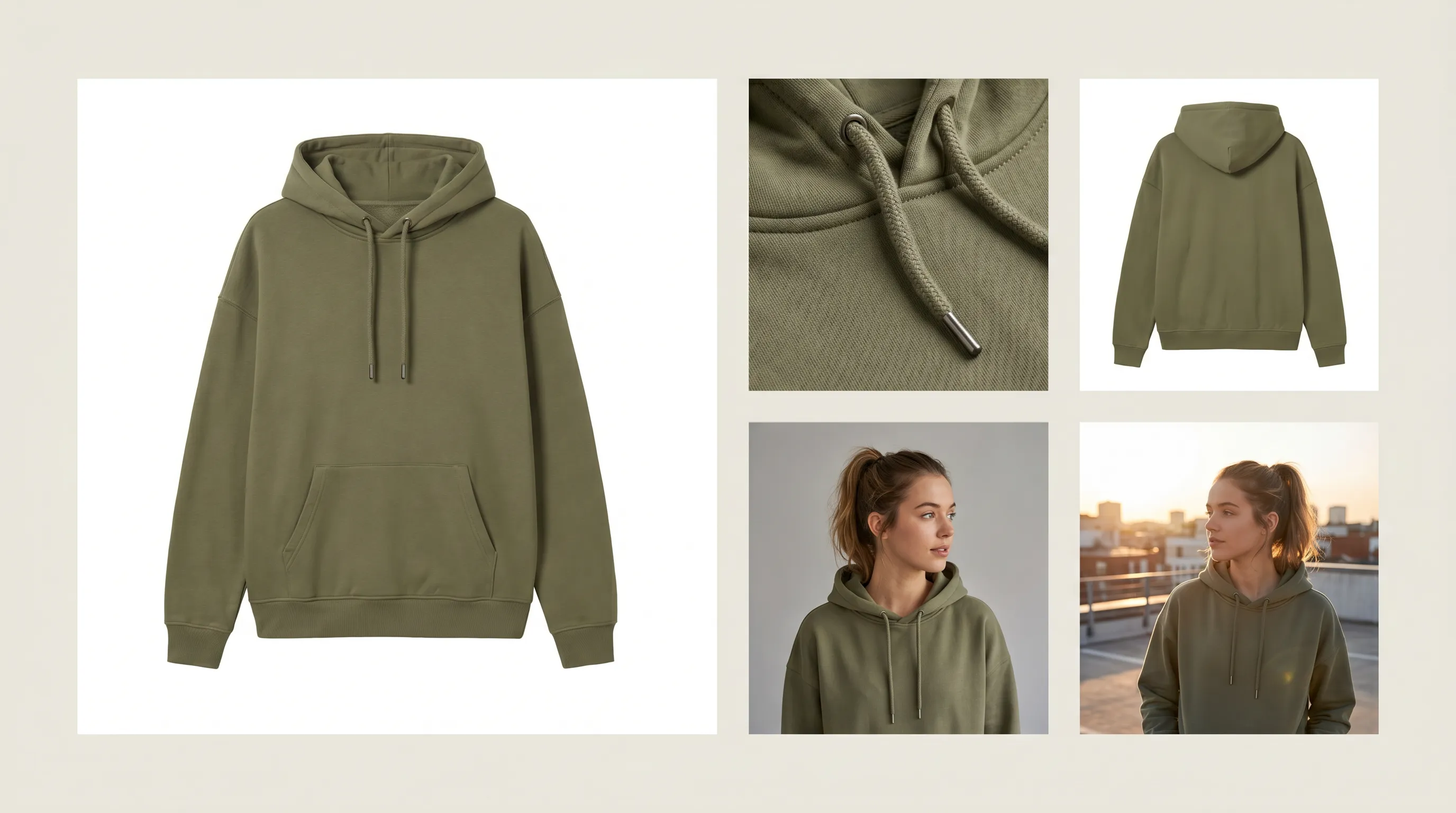
TikTok Shop's Product Listing Policy sets hard limits on every listing. You can upload up to 9 square images per product, with a maximum of 3 per variant (variants share the 9-image total). Each image must be at least 600×600 pixels — TikTok recommends 800×800 or higher, capped at 6000×6000 — under 5MB, saved as JPEG or PNG (WebP isn't accepted).
The main image carries the strictest rules: pure white background, front view of the physical product, no props, and an objective representation of what ships. Across all slots, TikTok prohibits added text, logos, borders, watermarks, or graphics, plus black-and-white images, duplicate angles, and placeholders.
Image count then feeds discovery: the listing-quality guidelines tier every listing, and reaching "Good" requires 5+ images of the main product plus complete attributes — lower tiers get less visibility, and listing quality feeds the Shop Performance Score that gates seller benefits. Filling the back, side, and detail slots isn't cosmetic; it's ranking input.
TikTok Shop image spec sheet
| Requirement | TikTok Shop spec (2026) |
|---|---|
| Images per product | Up to 9 square images |
| Images per variant | Max 3 per variant (count toward the 9 total) |
| Resolution | 600×600px minimum; 800×800+ recommended; 6000×6000 max |
| File size / format | Under 5MB; JPEG or PNG only |
| Main image | Pure white background, front physical view, no props or lifestyle context |
| Text / logos / watermarks | Prohibited on or behind the product, every slot |
| Listing-quality tier | 5+ main-product images required for the "Good" tier |
| Fully synthetic main image | Not allowed — the main image must accurately show the real product |
| Swimwear / sensitive categories | Kids' swim must be flat-lay only; adult swim must not be "revealing" — category rules apply on top |
Verified against TikTok Shop's US Product Listing Policy, listing-quality guidelines, and AI-content rules (2026).
Filling all nine slots from one garment photo
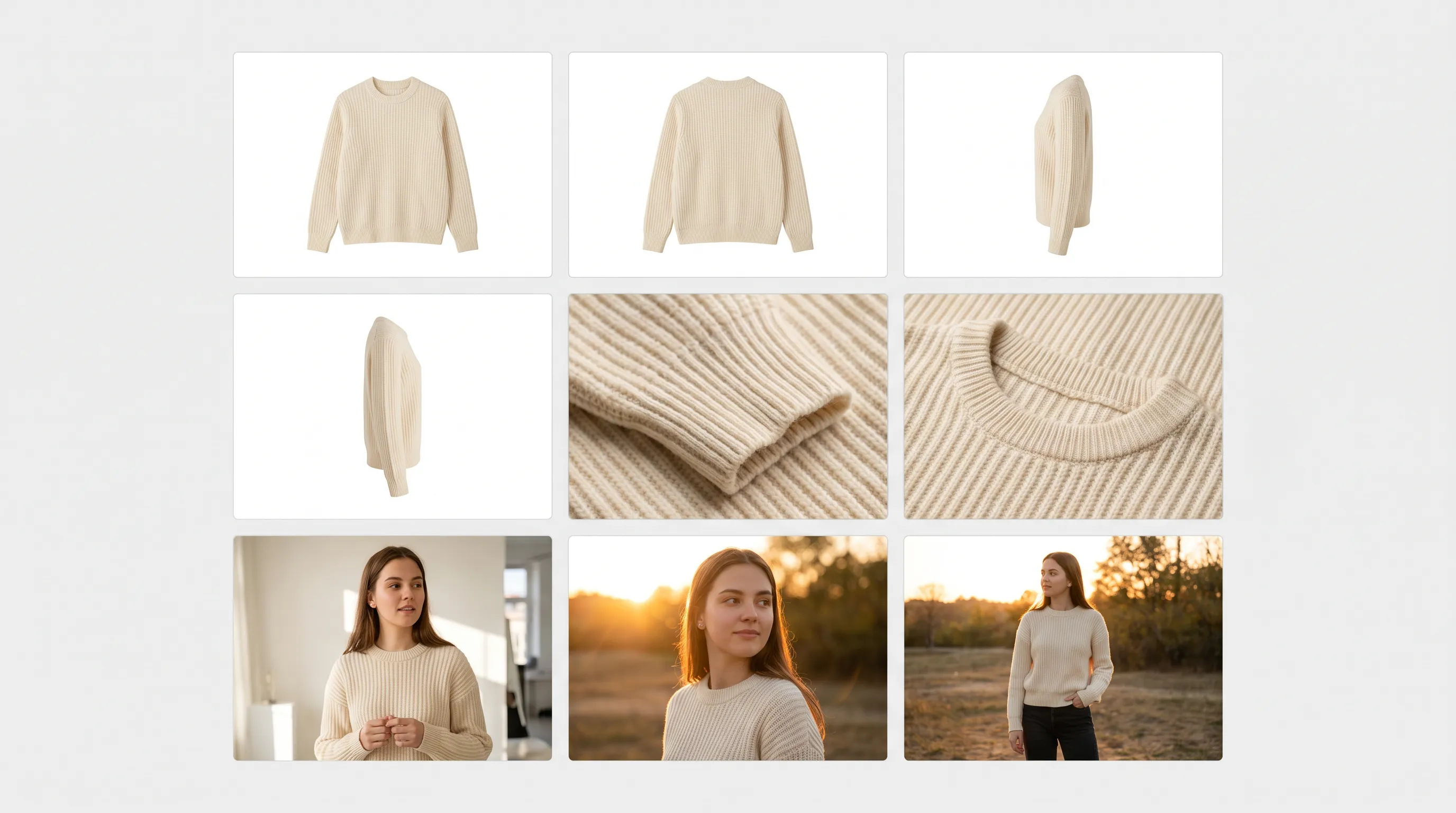
The slot plan that clears the "Good" tier and answers every buyer question:
- 1
Slot 1 — the compliant packshot
Pure white background, front view, product filling the frame. Use a real product photo here (TikTok bars fully synthetic main images); the Lookbook Creator generates clean white-background views when your raw shot needs replacing. - 2
Slots 2–4 — the catalog angles
Back, side, and detail close-up from the Lookbook Creator — 5 credits (~$1) per view, consistent lighting across the set. This is the multi-angle spread the quality tier counts. - 3
Slots 5–7 — on-model frames
AI Photoshoots: pick one of 22 named models, 2–3 poses (full-length, three-quarter, detail), studio or lifestyle scene. Fit and drape answered, feed-native energy included. - 4
Slots 8–9 — variant or styling shots
A colorway from the Color Changer rendered on the same model, or a second scene for context. Remember: max 3 images per variant inside the 9 total.
Staying inside TikTok's accuracy and AI-disclosure rules
TikTok Shop's policy rests on one principle: images must accurately represent the product the customer receives. The main image cannot be a fully synthetic render or placeholder, and the AI-content rules prohibit using AI to change a product's actual size, color, material, or shape — or to show features it doesn't have. Light adjustments, color grading, and background changes count as minor edits; substantial AI changes require disclosure.
This maps cleanly onto a fidelity-first workflow: Adstronaut transfers your real garment's pattern, color, texture, seams, and hardware into the render, so on-model and angle shots depict your actual product rather than a fictional one. Keep a true product photo in the main slot, use generated frames in the supporting slots, label AI-assisted creative where TikTok asks, and never let a render promise a feature the garment doesn't ship with — that last rule isn't just policy, it's your return rate. Swimwear sellers note the extra layer: children's swimwear must be displayed flat (no models or mannequins), and adult swim imagery must avoid "revealing" styling — details in the swimwear photoshoot guide.
What the compliant set costs
Adstronaut prices per output on plans from $29/month: 5 credits — about $1 — per finished image, whether it's a Lookbook angle or an on-model frame. A full nine-slot set runs roughly $8–$9 in credits; a three-variant listing (each variant with its 3-image allowance) lands around $15–$20 including recolors at ~$0.50 each.
The comparison: a traditional multi-angle shoot covering the same spread runs $3,000–$10,000 for a 10-SKU batch plus 1–3 weeks of turnaround (Squareshot's 2026 cost guide) — and TikTok Shop's velocity culture (new products weekly, creator samples, trend-reactive drops) is exactly the cadence studio calendars can't match. Output renders well above the 600×600 floor, exports as JPEG/PNG under 5MB, and ships clean — no baked-in text, borders, or watermarks to strip.
Built for TikTok Shop sellers
Indie streetwear founders launching a Shop the week samples land — nine compliant slots the same afternoon. Shopify sellers syndicating to TikTok who discover their existing 4:5 lifestyle crops fail the square pure-white main-image rule and need a compliant set fast. Social-first brands that A/B ad creative weekly and need a fresh on-model angle per variant without re-booking anything. Multi-variant sellers (the same tee in six colors) using recolor-then-re-render to give every variant its three frames on the same model.
The pattern across all four: TikTok Shop rewards listing completeness and punishes thin galleries, on a platform whose product cycle outruns any shoot calendar. Generation at ~$1 per frame is how the math closes — and the Shopify guide covers the sister platform's specs when you syndicate the other way.
Frequently asked questions
What are TikTok Shop's image requirements?
Up to 9 square images per product (max 3 per variant), each at least 600×600 pixels (800×800+ recommended, 6000×6000 max), under 5MB, in JPEG or PNG. The main image must sit on a pure white background showing the product's front, with no props — and no added text, logos, borders, or watermarks on any image.
How many photos should a TikTok Shop listing have?
Use as many of the 9 slots as you can: TikTok's listing-quality guidelines require five or more main-product images to reach the 'Good' tier, and lower-tier listings get less visibility. A strong fashion set: white-background packshot, back, side, detail close-up, and 2–4 on-model frames.
Does the main image have to be on a white background?
Yes — pure white, front physical view, no props or lifestyle context, per the Product Listing Policy. Lifestyle and on-model shots belong in supporting slots. White-background packshot views can be generated via the Lookbook Creator when your raw photo needs replacing.
Can I use AI-generated photos on TikTok Shop?
In supporting slots, yes — when they accurately show the real product. TikTok prohibits fully synthetic main images and bans AI that changes the product's actual size, color, material, or shape; substantial AI changes require disclosure. Fidelity-first generation (your garment's pattern, texture, and hardware preserved) is what keeps supporting frames inside policy.
How much does a compliant nine-image set cost?
About $8–$9 in credits — 5 credits (~$1) per finished image, mixing Lookbook angles and on-model frames. A three-variant listing with recolors lands around $15–$20. The traditional equivalent — a multi-angle studio batch — runs $3,000–$10,000 for ten SKUs with 1–3 weeks of lead time.
What resolution should I generate at?
Anything above the 600×600 floor passes, but target 800×800+ — TikTok's own recommendation — for the zoom and clarity its quality tiering rewards. Adstronaut renders high-resolution square-croppable output well above the floor, exporting as JPEG/PNG under the 5MB cap.
Are there special rules for swimwear and sensitive categories?
Yes. Children's swimwear and undergarments must be displayed flat — no child models or mannequins. Adult swimwear must avoid 'revealing' styling, and several markets prohibit certain swim styles outright. Category rules stack on top of the base image policy; the swimwear photoshoot guide covers compliant staging in detail.
Can the same images work for Shopify and TikTok Shop?
Partly. Resolution and cleanliness rules overlap, but TikTok demands a square pure-white main image while Shopify favors 2048×2048 with more lifestyle freedom. Generate once at high resolution, then assign: packshot to TikTok's main slot, on-model and lifestyle frames shared across both. The Shopify guide details its sister spec.
Fill all nine TikTok Shop slots from one photo
Upload a single garment photo. Generate the white-background packshot views, multi-angle catalog shots, and on-model frames — TikTok-Shop-ready at about $1 per image.
Start an AI PhotoshootKeep going
Sources and further reading
- TikTok Shop — Product Listing Policy (US) — 9-image max, 3/variant, 600×600 min, 5MB, JPEG/PNG, pure-white main image, no text/logos/watermarks
- TikTok Shop — listing quality guidelines — 5+ images required for the "Good" tier; tier feeds visibility
- TikTok Shop — AI-generated content rules — no fully synthetic main image; disclosure for substantial AI changes
- SKU IQ — TikTok Shop image constraints — 3 images per variant; 600×600–6000×6000 range
- Squareshot — photoshoot cost (2026) — $3,000–$10,000 multi-angle batch baseline