
AI tools for Shopify fashion sellers: the end-to-end stack
Updated June 10, 2026
A Shopify fashion seller's full workflow maps to five Adstronaut tools: on-model photoshoots ($1/image) for the hero PDP shot, multi-angle views for front/back/side/detail, colorway recolors (2 credits) for every variant, product tagging ($0.05/product) for SEO listings, and tech packs ($3–6) for production. One garment photo becomes a complete, conversion-ready listing — no studio, no copywriter, no reshoot.
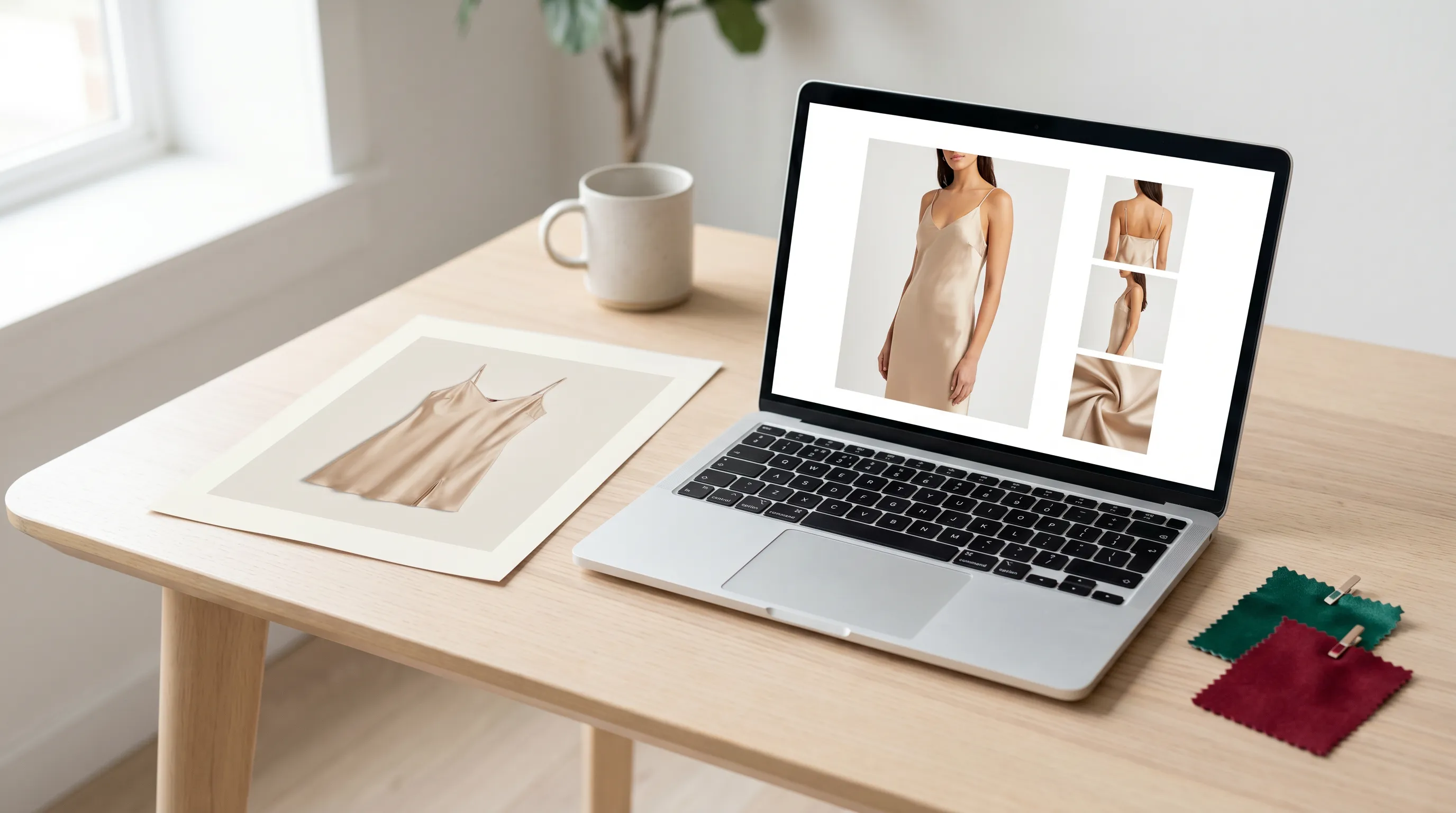
What a Shopify fashion seller actually needs to ship a listing
A Shopify fashion product detail page (PDP) is not one asset — it's a bundle. Shopify's own merchandising guidance asks for a consistent square (1:1) image set, multiple angles, and an on-model shot, recommends 2048×2048px product images, and supports up to 250 media files per product (Shopify image-size guide). On top of the photos, the listing needs structured attributes — title, material, fit, care — so on-site search filters and Google Shopping feeds work. And before any of it exists, the garment has to be produced from a spec a factory can read.
For a small Shopify fashion brand, every one of those needs has historically been a separate vendor: a photographer, a model, a retoucher, a copywriter, a tech designer. A single production day for that imagery runs $2,500–$8,000 once you add the photographer, model, studio, styling, and retouching (Squareshot 2026), with one to three weeks of lead time. That fragmented, slow, expensive stack is exactly what stalls indie launches — the Shopify storefront is ready in an afternoon; the assets take weeks. Adstronaut collapses the stack into one place, where each Shopify need maps to a single tool and a single garment photo feeds all of them.
This page is the cross-feature hub. If you only need one piece — say, just the photo spec — the focused Shopify product photos guide goes deeper on resolution and angles. Here we map the whole journey, from a sample on a hanger to a live, conversion-ready listing.
Every Shopify need mapped to one Adstronaut tool
The same garment photo flows through each step. Costs are per output on plans from $29/month (Standard, 125 credits).
| Shopify seller need | Adstronaut tool | What it does | Cost |
|---|---|---|---|
| Hero on-model shot | AI Photoshoots | Renders your flat-lay or mannequin photo on a named, consistent model — 22 models, 8 poses, 12 scenes | 5 cr (~$1) / image |
| Front / back / side / detail gallery | Lookbook Creator | Generates multi-angle PDP views from one source — 35 view types across 10 product classes | 5 cr (~$1) / view |
| Colorway variants | Color Changer | Pantone-accurate recolor against 2,300+ TCX codes, per-zone, fabric-aware | 2 cr / recolor |
| SEO listing copy + attributes | Product Tagger | Extracts 13 attributes per SKU — title, description, material, fit — exports CSV/Excel for Shopify import | ~$0.05 / product |
| Factory-ready production spec | Tech Pack Generator | Turns one photo into a flat sketch, BOM, graded measurements, and construction notes | 25 cr ($3–6) / pack |
Credit costs and feature counts per Adstronaut's pricing catalog and feature configs; Standard plan $29/month, 125 credits.
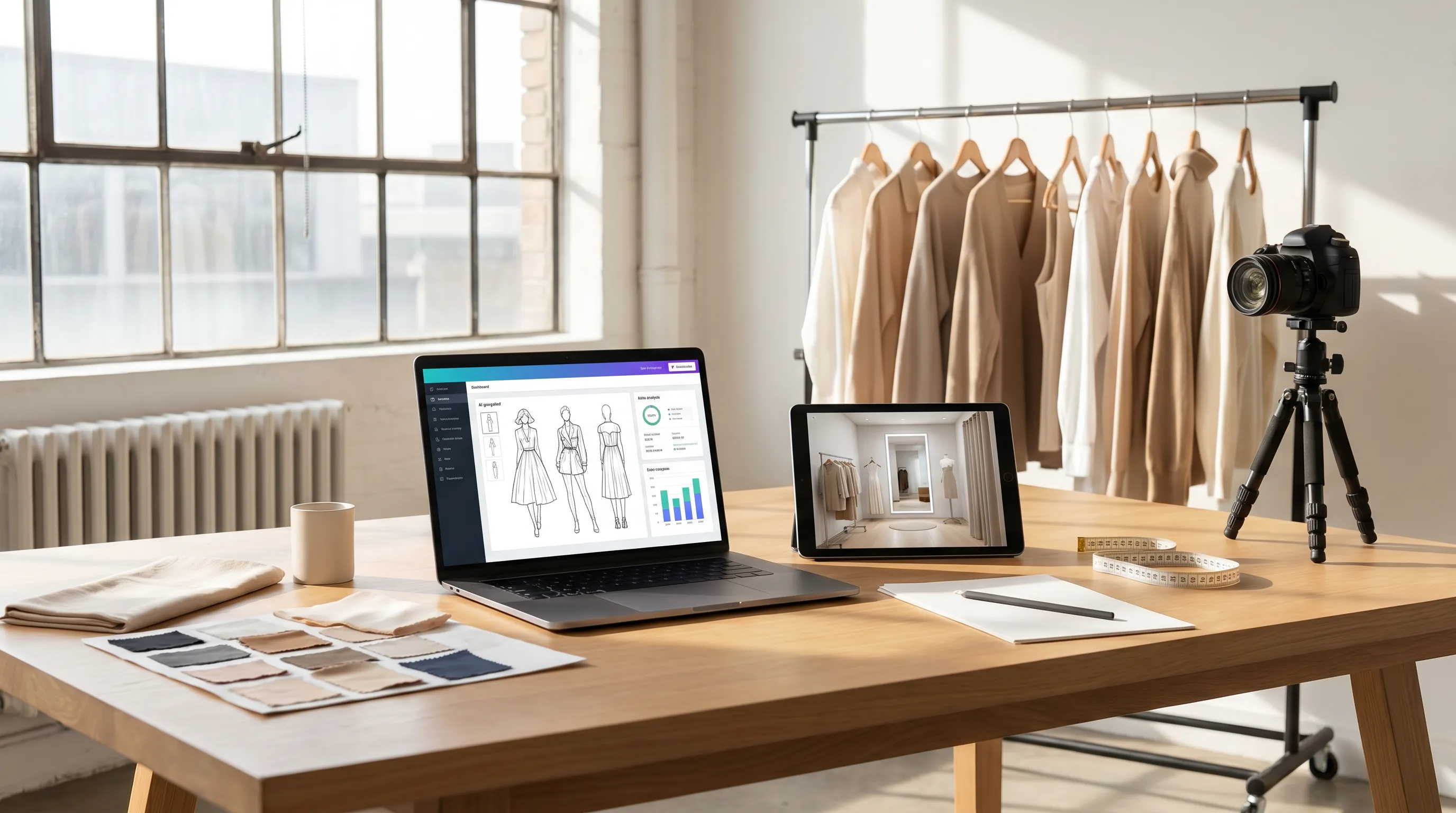
The imagery: on-model hero, then the angle gallery
Apparel buyers resolve doubt visually — how a garment drapes, how it reads on a body, what the back looks like — and Shopify fashion sellers consistently report that complete, multi-angle galleries convert better than a single hanger shot. So the imagery comes in two passes.
First, the hero. AI Photoshoots takes your flat-lay, mannequin, or amateur on-model photo and renders it on one of 22 named, consistent models (12 women, 10 men) across 8 poses and 12 named scenes, at about $1 per image (5 credits). Because the model stays consistent across runs, a whole collection reads as one cohesive shoot — the thing a real studio booking gives you, without the booking.
Second, the angles. The Lookbook Creator generates front, back, side, hero, and detail views from the same source photo, with class-aware sets across 10 product categories (35 view types total) and batches up to 10 products at once. That fills the rest of the square gallery slots Shopify wants — and the detail close-ups are what cut "not as described" returns. The on-model spec, resolution, and angle count for Shopify specifically are covered in the Shopify product photos use case.
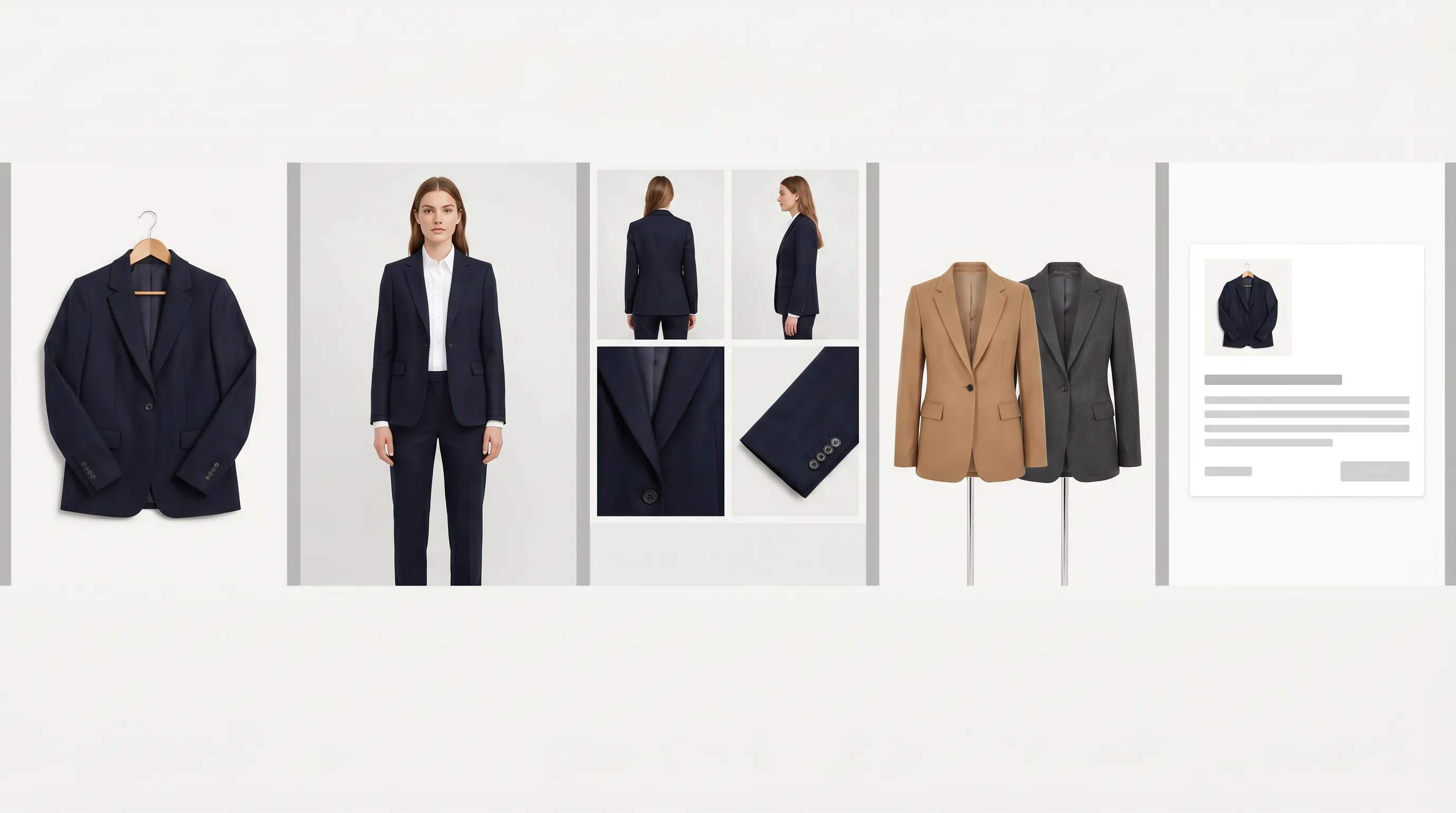
Colorways and the listing: variants without reshoots, copy without a copywriter
Shopify fashion sellers live and die on variants — every new colorway is a new Shopify variant that needs its own matching imagery, and a sample-and-reshoot cycle for each one is exactly the cost that keeps small brands from expanding a line. The Color Changer recolors the source garment against 2,300+ Pantone TCX codes at 2 credits per recolor, per-zone and fabric-aware so texture and shadows survive. Re-render the recolored garment on the same model and scene, and each Shopify variant gets imagery that visually matches the original set.
Then the listing itself. The Product Tagger extracts 13 attributes per SKU — SEO title, 3–4 sentence description, four feature bullets, material, pattern, fit, neckline, closure, care — from a single photo at about $0.05 per product, batching up to 50 at once and exporting CSV or Excel ready for Shopify import. That's the input that makes on-site search filters and Google Shopping feeds actually work — a product feed without structured attributes simply can't be filtered, sorted, or matched to a shopper's query. The taxonomy stays identical across every SKU because one model wrote it, not three freelancers across two seasons. The perfect e-commerce listing guide walks through how the imagery and the attributes assemble into one high-converting PDP.
The end-to-end Shopify workflow, in order
From a sample on a hanger to a live Shopify listing — typically the same day the sample arrives.
- 1
Spec it for production (optional, pre-launch)
If the garment isn't made yet, the Tech Pack Generator turns one photo into a factory-ready pack — flat sketch, BOM, graded measurements, construction notes — for $3–6 (25 credits), so the sample comes back right the first time. - 2
Shoot the hero on-model
Upload the sample photo to AI Photoshoots, pick a model and pose, and render the on-model hero for ~$1. Reuse the same model across the catalog for one-shoot consistency. - 3
Fill the angle gallery
Run the Lookbook Creator on the same photo for front, back, side, and detail views — the square, multi-angle set Shopify's merchandising guidance asks for. - 4
Generate every colorway
Recolor the source with the Color Changer (2 credits each), then re-render on the same model so each Shopify variant has matching imagery — no reshoot. - 5
Write and export the listing
Tag the products with the Product Tagger at ~$0.05 each, then export CSV/Excel and import straight into Shopify. The PDP — images, variants, copy, attributes — is live.
When a traditional studio or freelancer still wins
AI generation is not the right answer for every Shopify seller, and pretending otherwise hurts the brands it doesn't fit.
If your brand identity is built on a specific named muse, art-directed campaign film, or a signature physical-set aesthetic, a real shoot carries intent and provenance that a synthetic model roster won't replicate. Luxury and editorial-led brands often need that. Likewise, for garments with extreme, irregular structure or novel hardware the generator hasn't seen much of, a photographer who can light the actual sample will still beat a render — review every output for fidelity before it goes on a PDP, because the image must match the garment you ship or your return rate (and Shopify's accurate-representation expectation) suffers.
And for the spec side: a tech pack is a strong first draft, not a substitute for a human technical designer on complex, safety-sensitive, or heavily-engineered styles. The honest framing is most listings, not all: for the volume of standard apparel, footwear, bags, and accessories a Shopify fashion brand ships, the AI stack is faster and roughly 95%+ cheaper per asset — and where it isn't the right tool, the page above tells you so.
Who runs the full Shopify stack
Indie founders launching their first store the week samples arrive, replacing a $2,500–$8,000 studio day and a freelance copywriter with one afternoon of generation. Sellers expanding a line who add colorways by recoloring (2 credits) and re-rendering instead of re-booking — variant imagery that matches the original set exactly. Multi-channel operators standardizing front-back-side-detail coverage and consistent attribute taxonomy across hundreds of SKUs, then syndicating the same catalog to other storefronts. Pre-launch brands that spec production with a tech pack first, so the garment they photograph is the garment the factory ships.
The common thread: Shopify rewards complete, consistent, fast-loading listings, and the only thing that ever stood between a small brand and a complete listing was production cost across five separate vendors. Collapsing those five into one garment-photo-in workflow is the change. Browse the full set of use cases to see the same stack mapped to other channels and categories.
Frequently asked questions
What AI tools does a Shopify fashion seller need end to end?
Five, each mapped to one Shopify need: AI Photoshoots for the on-model hero ($1/image), the Lookbook Creator for multi-angle PDP views, the Color Changer for colorway variants (2 credits), the Product Tagger for SEO listing copy and attributes ($0.05/product), and the Tech Pack Generator for factory-ready production specs ($3–6). One garment photo feeds all of them, turning a sample into a complete, conversion-ready listing.
How much does the full Shopify listing stack cost per product?
On plans from $29/month (Standard, 125 credits): a six-view on-model gallery is ~$6, the listing copy and attributes ~$0.05, and each colorway variant about $1.50 (recolor plus re-render). A complete PDP with imagery, variants, and SEO copy typically lands under $10 per product — versus $2,500–$8,000 for a traditional studio day plus a copywriter. Production tech packs, if needed, add $3–6 each.
Can I get on-model photos without hiring a model for my Shopify store?
Yes. AI Photoshoots renders your garment on a roster of 22 named, consistent synthetic models across 8 poses and 12 scenes. No model releases, royalties, or usage windows — paid-plan images are fully licensed for your Shopify store, ads, social, and email. The same model reused across the catalog makes the whole store read as one cohesive shoot.
How do I add a new colorway to Shopify without reshooting?
Recolor the source garment with the Color Changer against 2,300+ Pantone TCX codes (2 credits, per-zone and fabric-aware), then re-render the on-model and angle set on the same model and scene. Each Shopify variant gets imagery that visually matches the original collection — total cost per colorway is typically under $2 versus a $500+ sample-and-reshoot cycle.
How does the Product Tagger help my Shopify listings rank and convert?
It extracts 13 structured attributes per SKU — SEO title, description, four bullets, material, pattern, fit, neckline, closure, care — from a single photo at ~$0.05 each, exporting CSV/Excel for Shopify import. Consistent attribute data is what makes on-site search filters and Google Shopping feeds work, and complete copy reduces the pre-purchase doubt that drives bounce. It batches up to 50 products at once.
Are AI-generated product images allowed on Shopify?
Yes — Shopify has no policy against AI-generated product imagery, provided the photos accurately represent the product you ship. Fidelity-first generation preserves your garment's pattern, color, texture, and hardware, keeping the listing consistent with the delivered product, which is also what keeps your return rate honest. Always review each output before publishing.
Do I need a tech pack if I'm just selling on Shopify?
Only if you're producing the garment yourself. If you're reselling or dropshipping finished goods, skip it. But if you're a brand manufacturing a sample, a tech pack ($3–6) gets the garment made correctly before you photograph it — so the image you put on the PDP matches what the factory ships. It's the pre-launch step, not part of every listing.
How fast can I take a sample to a live Shopify listing?
Typically the same day the sample arrives. The AI generates the on-model gallery in minutes, colorway variants in minutes more, and tags up to 50 products in 2–4 minutes. The traditional path — booking a studio, waiting on retouching, and outsourcing copy — runs one to three weeks. The bottleneck was never the Shopify platform; it was producing the assets.
Will the images and copy match across my whole catalog?
Yes — that's the point of running one stack. Reusing the same model and scene keeps imagery consistent across SKUs and colorways, and the Product Tagger applies the same attribute structure and writing voice to every product. A consistent square ratio, a consistent model, and a consistent taxonomy are exactly what Shopify's merchandising guidance and on-site search both reward.
Is there a subscription, or do I pay per image?
Adstronaut runs on plans (Standard $29/month includes 125 credits; annual is 17% off), and credits price the individual outputs — 5 credits per photo (~$1), 2 per recolor, 0.2 per product tag, 25 per tech pack ($3–6). The free tier includes watermarked previews so you can test the workflow before committing. Commercial licensing on the outputs applies on paid plans.
Turn one garment photo into a complete Shopify listing
Skip the five-vendor stack. Upload one product photo and generate the on-model hero, the multi-angle gallery, every colorway, and the SEO listing copy — free test shots included.
Try AI PhotoshootsKeep going
Sources and further reading
- Shopify — website image size guidelines — 2048×2048 product-image recommendation; 1:1 consistent ratio; multi-angle and on-model guidance
- Shopify Help Center — product media types — up to 250 media files per product; supported formats
- Shopify — product photography guide — multiple angles and on-model shots recommended for apparel PDPs
- Squareshot — clothing photoshoot cost (2026) — $2,500–$8,000 production-day range; $7,450 published full-day model-shoot rate
- The Good — product images and conversion — multi-angle and detail imagery reduce uncertainty and lift conversion