How to Start a Clothing Brand in 2026: 10 Steps from Idea to First Order
To start a clothing brand, choose one product for one customer, set a budget, pick a production model (print-on-demand, private label or cut-and-sew), turn the design into a tech pack, find a manufacturer, approve a sample, price from your real costs, place the first order, and photograph and launch it. A 100-unit small-batch launch of one basic tee costs roughly $2,900 to $15,300 in the US, and an overseas cut-and-sew drop takes about 26 weeks from design to launch.
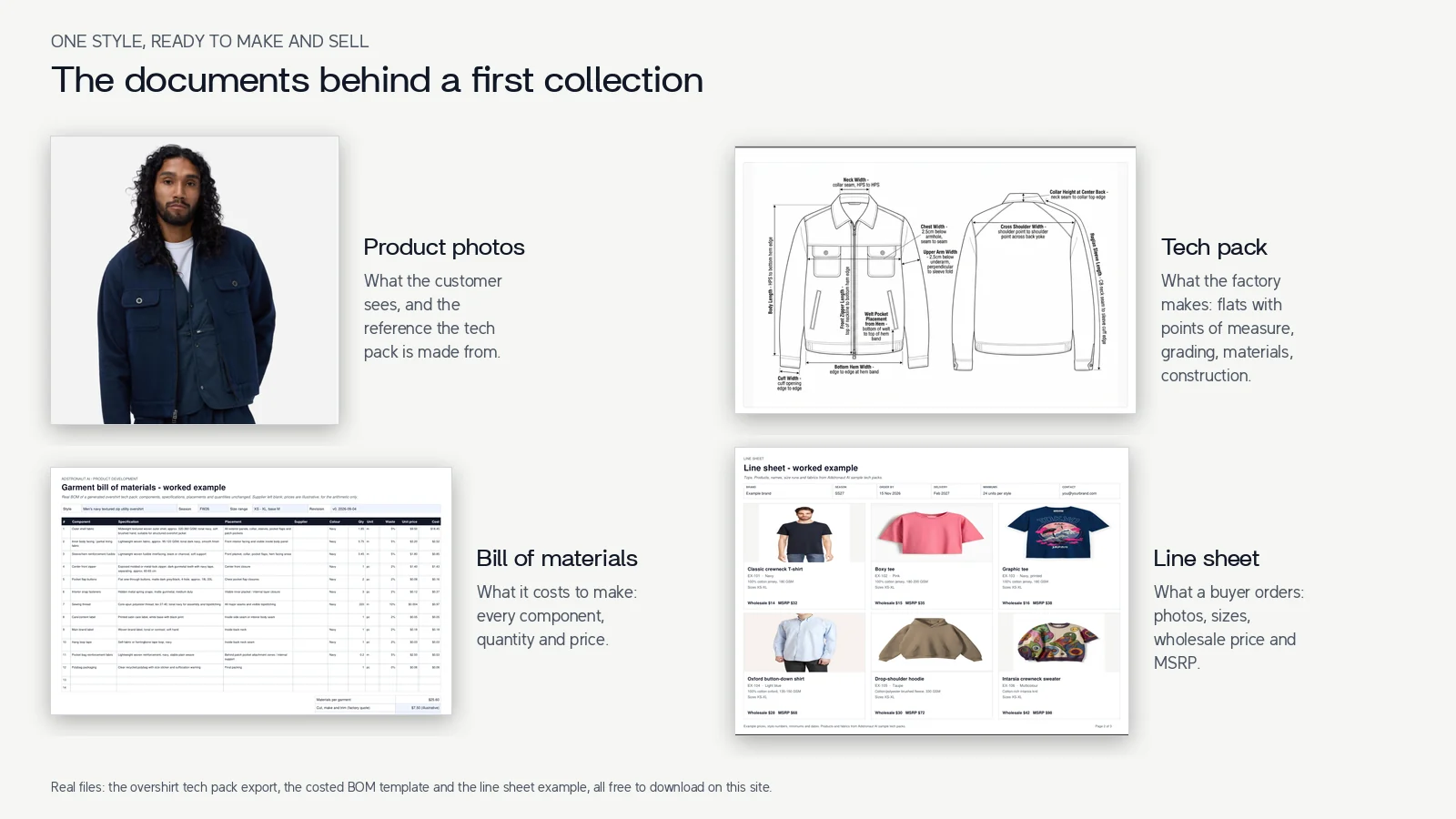
The documents one style needs before it can be made and sold. Every file shown is a real download on this site.
Table of Contents
- 1. Pick one product for one customer
- 2. Set a budget you can actually spend
- 3. Choose how the clothes get made
- 4. Turn the design into a tech pack
- 5. Find a manufacturer and send the right brief
- 6. Approve a sample
- 7. Cost the garment and set your prices
- 8. Plan the first order and the calendar
- 9. Labels, photos and a line sheet
- 10. Launch, then reorder what sells
- Frequently Asked Questions
1. Pick one product for one customer
Start with one to three styles, not a collection. A single hoodie, a tee in two colours or one jacket is enough to learn every step of production, and every extra style multiplies the samples, the minimum order and the inventory you have to sell.
Write the product down in one sentence that names the customer, the garment and the reason to buy: "a heavyweight boxy tee for skaters who wear through cheap blanks". That sentence decides the fabric weight, the fit, the price and where you sell. If you cannot write it, the product is not ready.
Check it against what already exists. Buy two or three competing garments at the price you want to charge, measure them, and note the fabric weight on their labels. You now have a benchmark for your fit, your quality and your price.
2. Set a budget you can actually spend
The budget depends on the production model more than on anything else. The free clothing line startup cost calculator uses 2026 US benchmarks for one basic tee:
| Launch | Units | Typical budget (US, one basic tee) |
|---|---|---|
| Print-on-demand | Made per order | $700 to $6,700 |
| Small batch | 100 | $2,900 to $15,300 |
| Cut-and-sew line | 300 | $5,500 to $22,800 or more |
Hoodies, denim and outerwear cost more per unit. Inventory and marketing are usually the largest lines; samples and tech packs, roughly $220 to $700 per style, are the easiest to reduce. The startup cost breakdown walks through every line.
Keep a reserve. First orders run late, first samples need a second round, and the first marketing push rarely sells through on schedule.
3. Choose how the clothes get made
There are four ways to get clothes made, and each trades control for money and minimums.
| Model | What you do | Minimum order | Control over the product | Best for |
|---|---|---|---|---|
| Print-on-demand | Upload artwork; a supplier prints each order on its blanks | None | Artwork only | Testing designs with no inventory |
| Blanks plus decoration | Buy existing blanks; screen print or embroider them | Small runs | Artwork, labels, some finishing | Graphic tees and hoodies |
| Private label | Choose a factory's existing style; add your label, colour and small changes | Lower than cut-and-sew | Fabric, colour, trims, labels | A fast first product in a proven shape |
| Cut-and-sew | The factory makes your design from your tech pack | Typically 50 to 500 per style, per colour | Everything | An original product |
Cut-and-sew comes in two arrangements. In CMT (cut, make, trim) you buy the fabric and trims and pay the factory for labour; in full package the factory sources everything and quotes one price per unit. First-time founders usually choose full package, because sourcing fabric at small quantities is hard. The CMT glossary and MOQ glossary explain both.
4. Turn the design into a tech pack
A tech pack is the document the factory quotes, samples and produces from: front and back flats with every point of measure, a graded size chart with tolerances, the bill of materials, construction and sewing details, and colourways. Without one, you are asking the factory to guess, and guesses cost sample rounds.
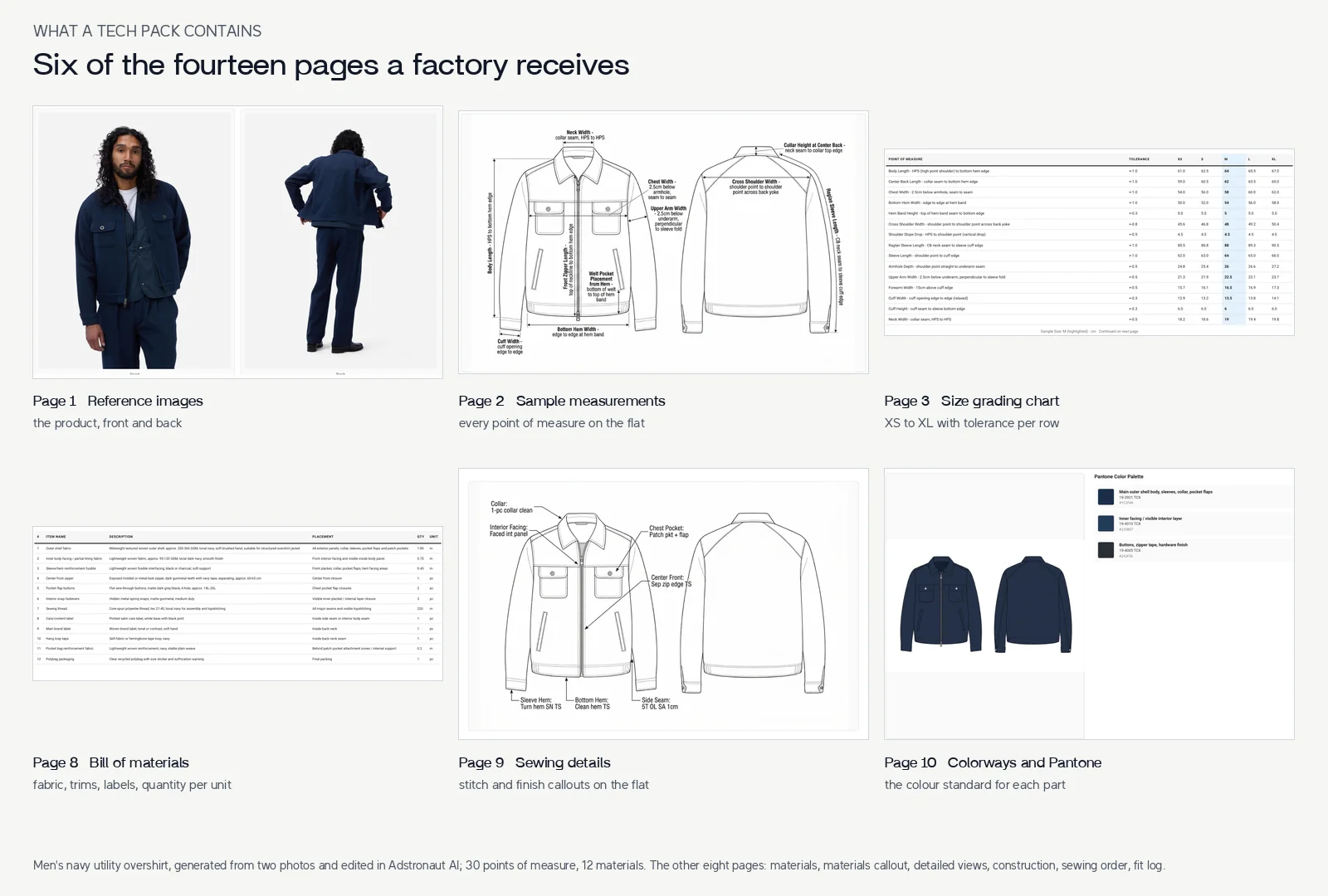
Six of the fourteen pages of a real overshirt tech pack, generated from two photos in Adstronaut AI. Download the full PDF.
There are three ways to get one. A freelance technical designer typically charges about $150 to $500 per style. You can draw the flats yourself in Illustrator and fill a spreadsheet, roughly a working day per style once you are fluent; the free tech pack templates and spec sheet workbook give you the structure. Or the Adstronaut AI tech pack generator writes the whole document from a product photo or sketch in three to five minutes, and you correct the measurements and materials before exporting it.
Whichever route, read what a tech pack is first, and follow how to create a tech pack for a step-by-step example.
5. Find a manufacturer and send the right brief
Look for factories that already make your product category at your quantities: a knitwear factory will not make denim well, and a factory built for 5,000-unit runs will not prioritise 100. Directories, trade shows, referrals from other founders and sourcing agents are the usual routes; how to find a clothing manufacturer compares them.
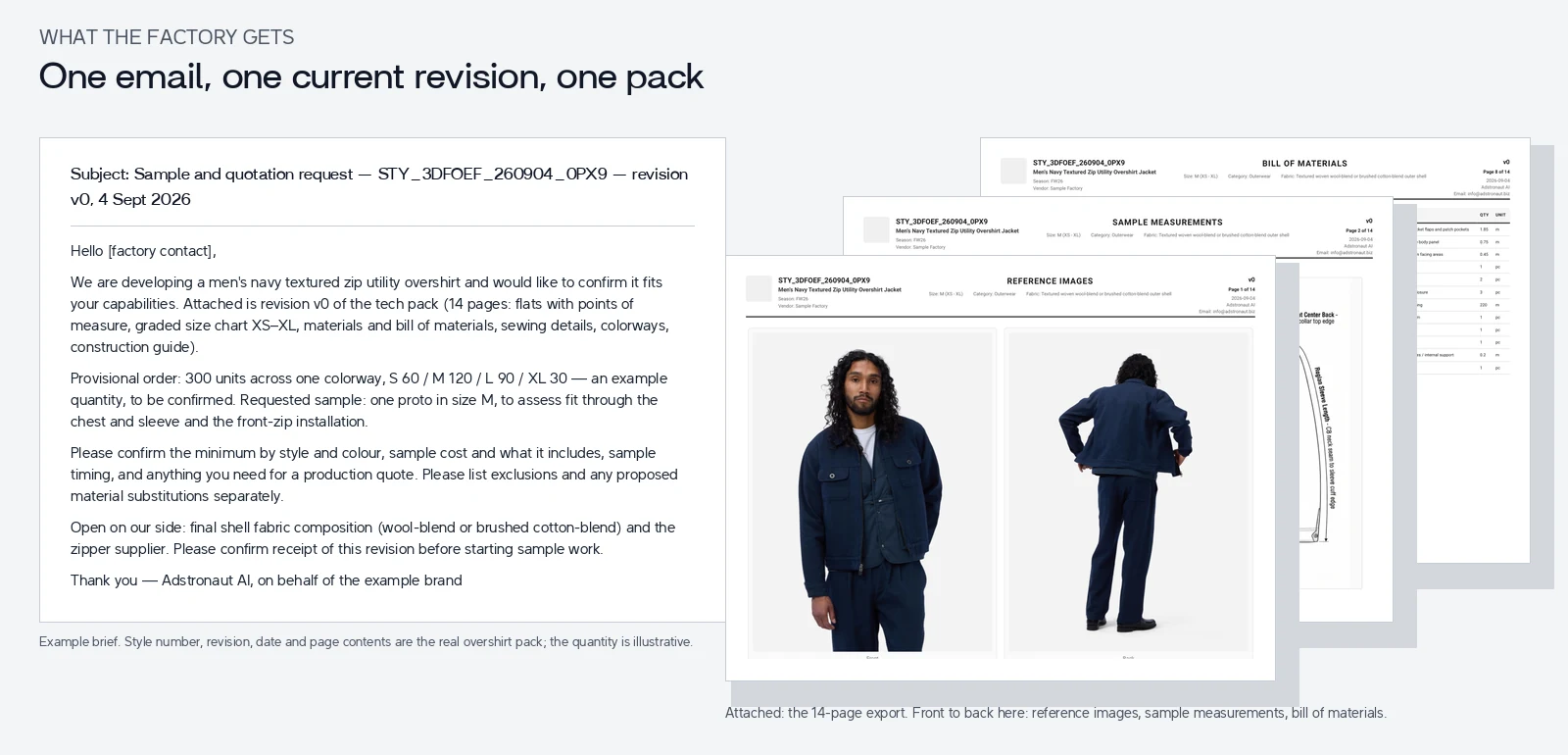
What a complete first message to a factory contains, for the same overshirt. The brief and email template are free to download.
Send each shortlisted factory the same package: the tech pack, the quantity per style and colour, your target price, the delivery date you need, and your questions about minimums, sample cost and lead time. A complete brief gets a real quote; a photo and "how much?" gets a guess. The manufacturer handoff guide has the brief, the email and a worked example.
6. Approve a sample
The first sample (the proto) shows whether the factory understood the tech pack. Measure it against the size chart, point of measure by point of measure, and check every row against its tolerance. Try it on a fit model or on the people you are designing for, not only on a hanger.
Write your corrections into the tech pack, not into an email, and send a new revision. Most small brands need one to three rounds before the pre-production sample, and each round typically costs a few weeks and a sample fee; the sampling costs guide breaks down the numbers. Approve the pre-production sample in writing before bulk production starts.
7. Cost the garment and set your prices
Build the cost from the bill of materials: every fabric, trim, label and piece of packaging, with its quantity per garment and price, plus the factory's cut, make and trim charge, freight and duty. The free bill of materials template totals it as you type, using a real 12-line BOM as its example.
Price from that landed cost. The standard starting point is keystone pricing: wholesale at about 2 to 2.5 times landed cost, and retail at about 2 to 2.5 times wholesale. A garment that costs $12 landed wholesales near $26 and retails near $58. The clothing pricing calculator shows both the markup and the margin, which are not the same thing: a 2× markup is a 50% margin, not 100%.
If you sell only on your own site, you can price between the two, but keep enough margin to fund marketing, returns and the next order.
8. Plan the first order and the calendar
Plan the drop backwards from the launch date. The free fashion drop planner subtracts each stage's lead time; its typical overseas cut-and-sew drop looks like this:
| Stage | Typical time |
|---|---|
| Design and tech pack | About 5 weeks |
| Sourcing a factory and materials | About 4 weeks |
| Sampling | About 5 weeks |
| Bulk production | 6 to 7 weeks |
| Sea freight | 3 to 6 weeks |
| Photoshoot and pre-launch | 2 to 4 weeks |
| End to end | About 26 weeks |
A domestic small batch runs about 19 weeks, and print-on-demand under 4. Order sizes to your customers, not evenly: most brands order more of the middle sizes, and your competitor research from step 1 tells you where to start.
9. Labels, photos and a line sheet
Labels. In the US, the FTC's Textile and Wool Acts rules require most garments to carry the fibre content, the country of origin and the identity of the manufacturer or seller (often an RN number), and the Care Labeling Rule requires permanent care instructions. The free care label generator lays out the fibre content and care symbols; check the rules for every country you sell in.
Product photos. You need clean, consistent product photos for your site and marketplaces, ideally before the stock arrives so you can take pre-orders. Adstronaut AI's photoshoots put your garment on a model from a flat-lay or sample photo, and the lookbook tool generates front, back and side product views on a consistent background.
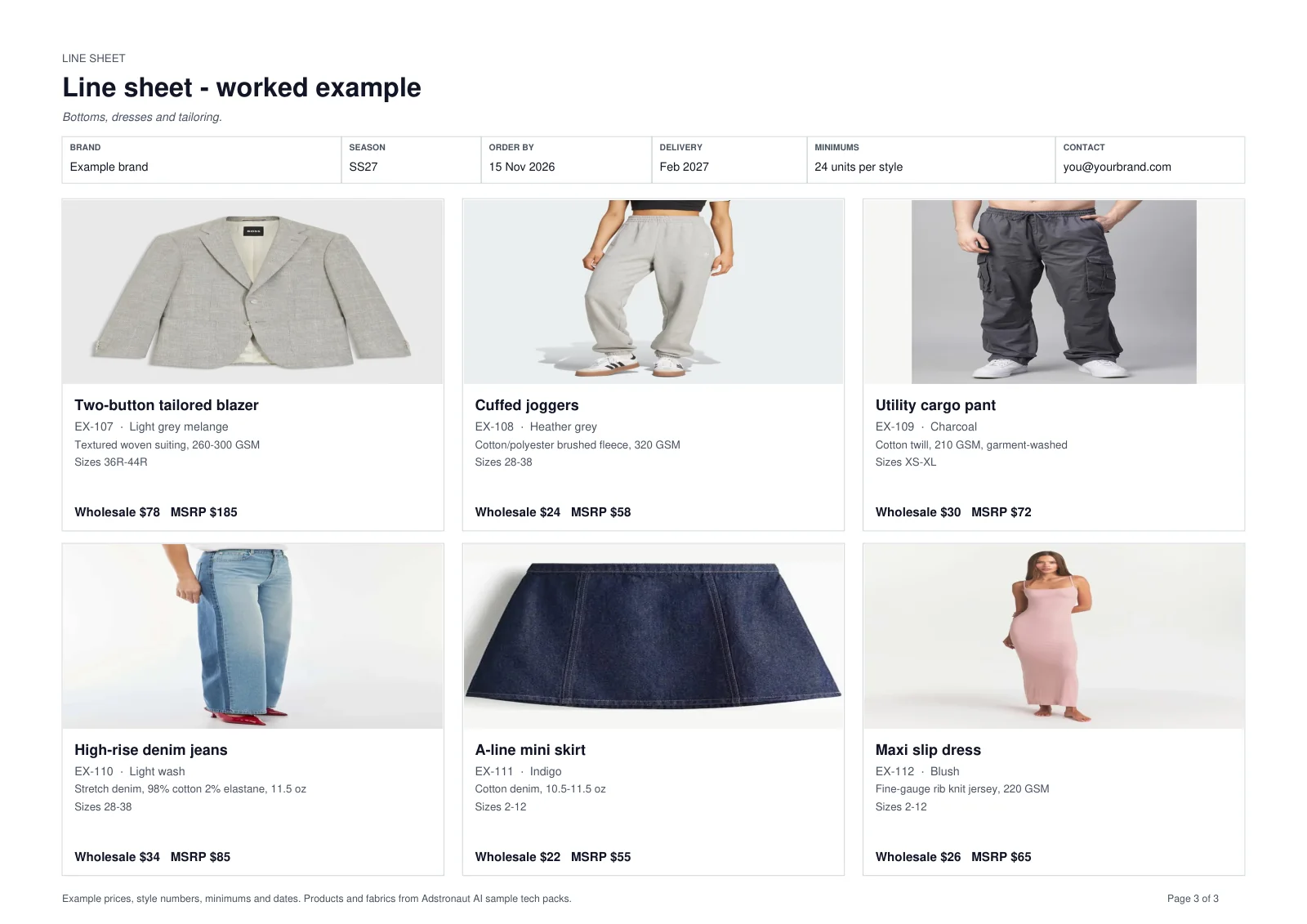
A page of the free wholesale line sheet template's worked example. Prices and style numbers are examples.
A line sheet, if you sell wholesale. Buyers order from a line sheet: product photos with style numbers, colours, fabrics, sizes, wholesale price and MSRP, under a header with the order deadline, delivery window and minimums. The free line sheet template has the layout in Excel and PDF.
10. Launch, then reorder what sells
Launch where your customer already is. Most new brands start direct to consumer on their own online store, then add marketplaces, pop-ups or wholesale. Tell people before the stock lands: pre-orders and a waiting list tell you which sizes and colours to reorder.
After the first sell-through, look at three numbers: which sizes sold out first, the return reasons, and the margin after marketing. Correct the size ratio and the tech pack, then reorder the winners before adding new styles. A second order of a proven product is cheaper and safer than a new collection.
Frequently Asked Questions
How much does it cost to start a clothing brand?
For one basic tee in the US, roughly $700 to $6,700 with print-on-demand, $2,900 to $15,300 for a 100-unit small batch, and $5,500 to $22,800 or more for a 300-unit cut-and-sew line, according to the free startup cost calculator. Hoodies, denim and outerwear cost more.
How long does it take to start a clothing brand?
An overseas cut-and-sew drop takes about 26 weeks from design to launch: roughly 5 weeks for design and the tech pack, 4 for sourcing, 5 for sampling, 6 to 7 for production, 3 to 6 for freight and 2 to 4 for photos and pre-launch. A domestic small batch takes about 19 weeks, and print-on-demand under 4.
Can I start a clothing brand with no design experience?
Yes. You need a clear idea of the product, reference photos and the willingness to measure and check samples. A tech pack generator such as Adstronaut AI turns a product photo into the technical document a factory needs, and a freelance technical designer or the factory can resolve the construction decisions.
Do I need a tech pack to start a clothing brand?
For cut-and-sew and most private-label production, yes. The tech pack is what the factory quotes and samples from; without one you pay for extra sample rounds while the factory guesses. Print-on-demand and blanks with decoration only need your artwork and placement.
What is the minimum order for a clothing brand?
Cut-and-sew factories typically ask for 50 to 500 units per style, usually per colour, because setup costs and fabric rolls are fixed. Private label is often lower, and print-on-demand has no minimum.
Should I start a clothing brand with print-on-demand?
Print-on-demand is the cheapest way to test designs and demand, with no inventory. Its per-unit cost is higher and you are limited to the supplier's blanks, so brands that want their own fit, fabric or construction move to private label or cut-and-sew once a design sells.
What legal steps do I need to start a clothing brand?
Register the business where you operate, check that your brand name is available as a trademark and a domain, and label every garment as your market requires. In the US that means fibre content, country of origin, the seller's identity and permanent care instructions, under the FTC's textile and care labeling rules. The SBA's guide covers business plans and structures.
Turn your first design into a factory-ready tech pack →
Sources and further reading:
- FTC: Threading your way through the labeling requirements under the Textile and Wool Acts — fibre content, country of origin and seller identity
- FTC: Clothes captioning, complying with the Care Labeling Rule — permanent care instructions
- U.S. Small Business Administration: write your business plan — planning and structure
- Shopify: how to start a clothing line — selling direct to consumer
- Clothing line startup cost calculator and fashion drop planner — the budget and calendar benchmarks used above
- How much does it cost to start a clothing brand? — every cost line in detail