
Free wholesale line sheet template
Updated September 22, 2026
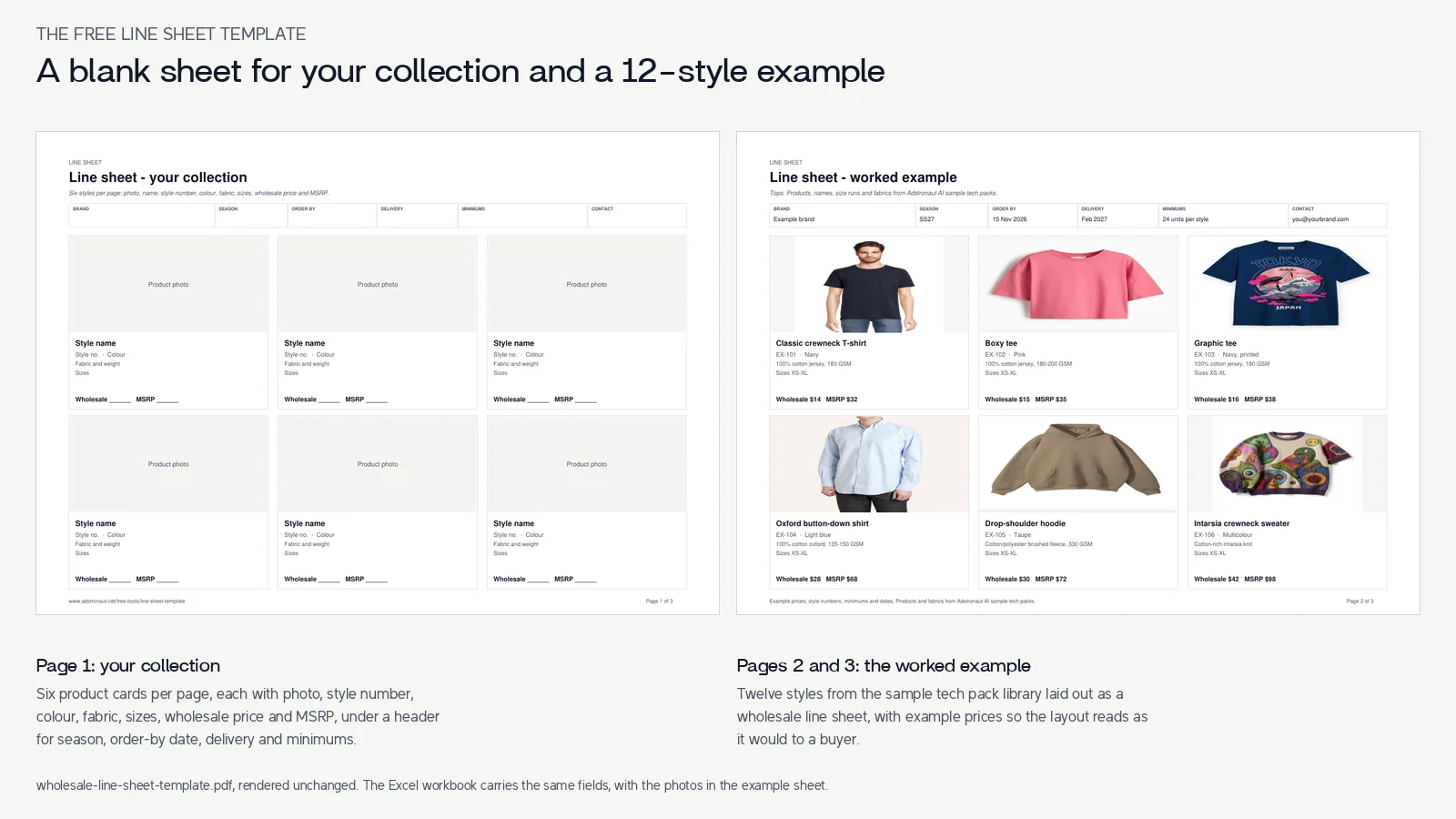
A line sheet is the document a wholesale buyer orders from: one card per style with a product photo, style number, colour, fabric, size range, wholesale price and suggested retail price (MSRP), under a header that states the season, order deadline, delivery window and minimums. This free template gives you the layout in Excel and as a printable PDF, with six product cards per page, and a 12-style worked example built from real sample products. Download both without signing up.
What is in the download
The Excel workbook has two sheets. Your line sheet has the header fields a buyer looks for first (brand, season, order-by date, delivery window, minimums, payment terms, contact and currency) and twenty style rows with an image column, style name, style number, colour, fabric, sizes, wholesale price, MSRP, minimum per style, delivery and notes. Worked example fills twelve rows, with the product photos placed in the image column.
The printable PDF is the version a buyer actually receives: three landscape pages with six product cards each. Page 1 is blank for your collection; pages 2 and 3 are the worked example. Neither file needs an account.
What a buyer looks for on each card
| Field | Why it is there | In the example |
|---|---|---|
| Product photo | Buyers scan photos first. Use the same background and framing for every style. | Each sample pack's reference photo |
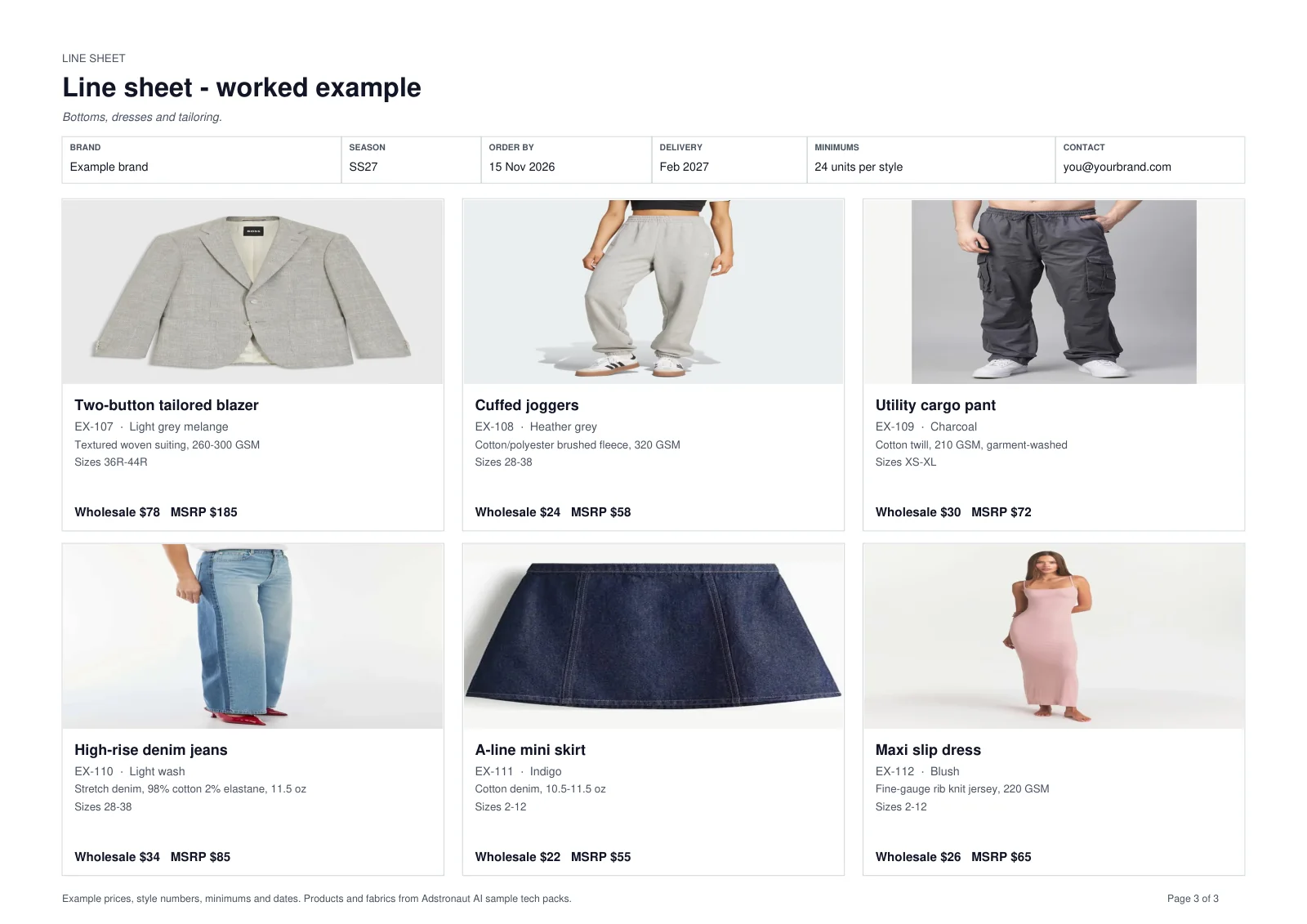
| Style name and number | The number is what goes on the purchase order; the name is how the buyer remembers it. | Two-button tailored blazer, EX-107 |
| Colour | Every colourway you are offering, in words a buyer understands. | Light grey melange |
| Fabric | Composition and weight, the first quality question a buyer asks. | Textured woven suiting, 260-300 GSM |
| Sizes | The size run you will actually produce. | 36R-44R |
| Wholesale and MSRP | What the buyer pays you, and the retail price you suggest. The gap is the buyer's margin. | $78 wholesale, $185 MSRP |
| Header: order by, delivery, minimums, terms | Tells the buyer when to order, when stock arrives and the smallest order you accept. | Order by 15 Nov 2026, delivery Feb 2027, 24 units per style |
Example values are illustrative. Set wholesale from your landed cost, and MSRP from your retail strategy.
How to fill in the line sheet
- 1
Fix the header first
Season, the order-by date, the delivery window, minimums per style and per order, payment terms and who to contact. A buyer who cannot see when stock arrives will not place the order. - 2
Use one kind of photo for every style
All flat-lays, or all on the same model and background. Mixed photography makes a collection look unfinished. If you only have mixed reference photos, generate consistent product views before you build the sheet. - 3
Number every style, and every colourway
One style number per style, with colourways as a suffix or a separate line. The number must match your purchase orders, your tech packs and your invoices. - 4
Price from your costs, not from your competitors
Start from the landed cost per unit, which the bill of materials and your factory quote give you, then set wholesale at roughly 2 to 2.5 times cost and MSRP at roughly 2 to 2.5 times wholesale. The pricing calculator does the arithmetic. - 5
Keep it to what is actually for sale
Only styles you can produce at the stated minimums, in the stated sizes, by the stated delivery date. A line sheet is a commitment, not a mood board.
Line sheet, lookbook and tech pack
A line sheet sells the collection to a buyer: facts, prices and dates. A lookbook sells the mood, with styled photography and few numbers. A tech pack tells the factory how to make each style. The three share the same style numbers, colours and fabrics, which is why it pays to write them down once: the fabric on your line sheet should be the fabric on line 1 of your bill of materials, and the size run should be the one in your tech pack.
For the full walkthrough, with digital and printed formats and the most common mistakes, read how to create a line sheet.
Consistent product photos for every style
The part of a line sheet that takes longest is the photography: every style shot the same way, often before production samples exist. Adstronaut AI's lookbook tool generates front, back and side views of a product from one photo, on a consistent background, so every card on the sheet matches. For on-model images, AI photoshoots put the same garment on a model in a chosen setting.
Line sheet questions
Is the line sheet template free?
Yes. The Excel workbook and the printable PDF download without an account. Adstronaut AI's image tools are separate and credit-based.
What should a wholesale line sheet include?
A header with your brand, season, order-by date, delivery window, minimums, payment terms and contact, then one entry per style with a product photo, style name and number, colours, fabric, size range, wholesale price and MSRP.
How many styles go on one page?
Four to eight is typical. The template uses six product cards per landscape page, which keeps photos large enough to judge and fits a small collection on two or three pages.
Are the prices in the example real?
No. The products, names, size runs and fabrics come from Adstronaut AI's public sample tech packs; the style numbers, wholesale prices, MSRPs, minimums and dates are examples so the layout reads as it would to a buyer. Set yours from your own costs.
What is the difference between a line sheet and a lookbook?
A line sheet is a sales document for buyers, with prices, sizes, minimums and delivery dates. A lookbook is a styled presentation of the collection with few or no numbers. Most brands send both, with matching style numbers.
Matching product photos for every style
Upload one photo per product and generate consistent front, back and side views for your line sheet, before production samples exist.
Create product viewsRelated resources
Sources and further reading
- Adstronaut AI sample tech pack library — Source of the twelve example products, their names, size runs and fabrics.