
Fix: too many sampling rounds
Updated June 10, 2026
Most brands run 3–4 physical sample rounds at $200–$1,500 each because tech packs are ambiguous and fabric and color get tested by cutting real samples. The fix: send a precise tech pack so the factory stops guessing, and settle fabric and color digitally before sampling — brands with clear, structured specs average 1.8 rounds instead of 3.2, a 44% reduction.
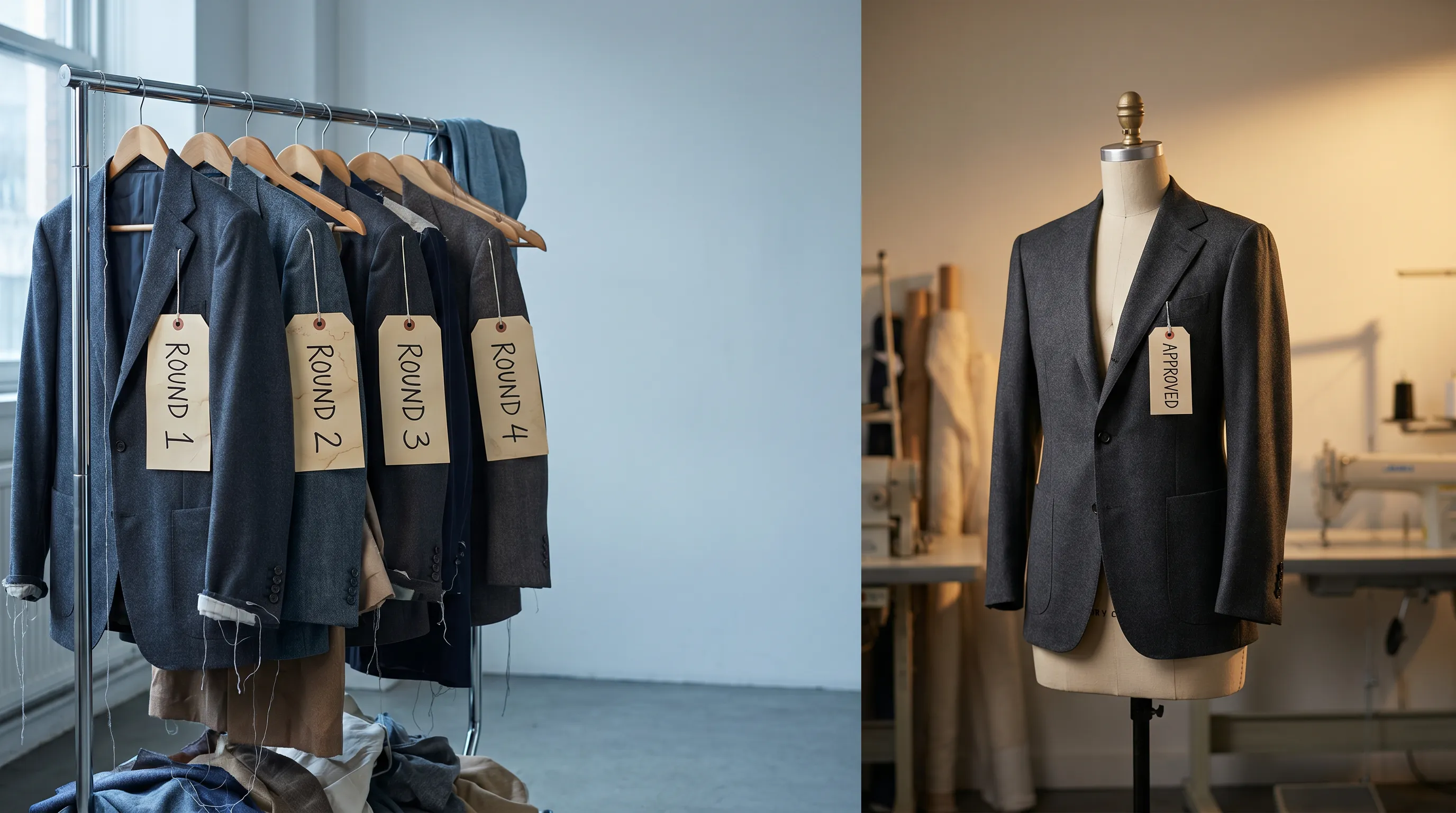
Why you're stuck in sampling rounds
Each physical sample round costs $200–$1,500 per style and most styles need 2–4 rounds before approval, so the true sampling bill per style reaches $900–$5,000+ (sampling cost breakdown). Each round also burns 1–2 weeks of lead time for cutting, sewing, shipping, and review — which is how a 10-style range quietly loses a season.
Two causes drive the extra rounds. Ambiguous tech packs: missing tolerances, vague construction callouts, or absent color codes force the factory to guess, and unclear specifications are the leading cause of first-sample failure (WFX Tech Pack 101). Physical iteration on fabric and color: ordering a sample to see how a fabric drapes or a Pantone reads, deciding it's wrong, and ordering another. Every "let me just see it" loop is a paid round you could have run on screen. Brands working from clear, structured specs average 1.8 rounds versus 3.2 without — a 44% reduction (WFX).
The sampling math
Sampling is the budget line where spec quality converts directly into cash.
The fix: settle spec, fabric, and color before the first cut
You don't cut rounds by sampling faster — you cut them by removing the discovery questions before the first sample exists.
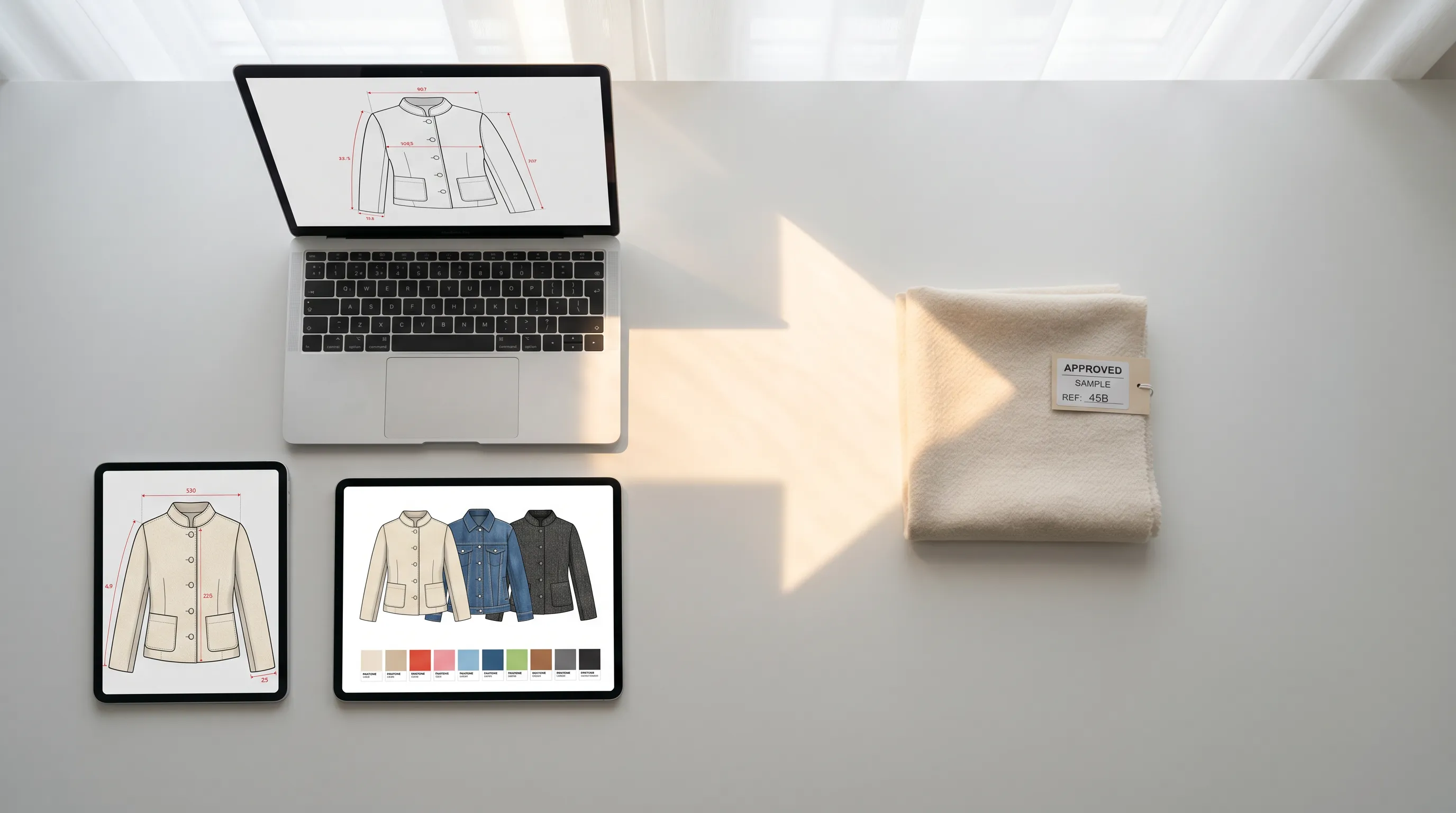
Settle the spec. The AI Tech Pack Generator turns one garment photo into a factory-ready pack — annotated flat with points of measure, structured BOM with supplier fields, graded measurements with tolerances, construction notes — for $3–6 per pack. Ambiguity is what the factory samples against; a complete pack removes the guesswork that triggers round two.
Settle fabric on screen. The AI Fabric Swapper renders your garment in any of 21 curated fabrics — or any swatch you upload from your own mill, with no preset limit — with real drape, sheen, and per-region control, at 2 credits (~$0.50) per swap. Compare five candidates digitally instead of ordering five $50–$200 physical swatches that ship in 1–3 weeks.
Settle color on screen. The AI Color Changer renders Pantone-accurate colorways per garment zone against 2,300+ TCX codes (~$0.50 each), so the colorway locks before any dye lot is cut — not after a sample returns the wrong shade.
What causes extra rounds — and how to remove each one
| Cause of extra rounds | The fix |
|---|---|
| Ambiguous measurements or missing tolerances — factory guesses the fit | Send graded points of measure with tolerances so the first sample targets the right spec |
| Vague construction callouts (seams, stitch types, trims) | Generate construction notes and an annotated flat the factory can build from without assumptions |
| Color tested physically — sample returns the wrong shade | Lock the Pantone TCX colorway digitally (~$0.50) before the dye lot is cut |
| Fabric tested physically — "let me see it in linen first" | Swap fabrics on screen (~$0.50) — including your own mill swatches — and sample only the finalist |
| No structured BOM — factory sources the wrong trim | Ship a line-itemized bill of materials so components are sourced right the first time |
| Fit confirmation on a real body | Keep this one — it's the round you should still pay for |
Five of the six causes are removable before sampling. The sixth is the legitimate purpose of a sample.
The 1–2 round process, step by step
- 1
Generate the complete pack first
One photo into the Tech Pack Generator; review tolerances, stitch callouts, and the BOM for 10–15 minutes. This is the document the factory samples against — make it unambiguous. - 2
Run the fabric shortlist digitally
Five candidates through the Fabric Swapper (presets or your own mill swatches — uploads aren't limited) ≈ $2.50, versus $250–$1,000 of physical swatches and three weeks. - 3
Lock colorways against TCX codes
Render each colorway per zone in the Color Changer and put the winning codes in the pack — the factory dyes to a number, not a vibe. - 4
Spend your sample budget on the finalist
Order one physical sample to confirm fit and hand-feel on a real body. That's the round that earns its $200–$1,500 — the discovery rounds never did.
Realistic expectations: AI reduces sampling, it doesn't eliminate it
You will still make a physical sample — and you should. Fit on a real body, hand-feel, and final fabric performance are confirmed in cloth; no render replaces that. What digital pre-visualization removes is the discovery rounds: sampling to learn what a fabric or color looks like, then paying again when it's wrong. A realistic target is moving from 3–4 rounds to 1–2 — the 3.2-to-1.8 shift brands report with structured specs. At $200–$1,500 per round, two avoided rounds return $400–$3,000 and 2–4 weeks per style.
Digital fidelity also has honest limits: heavy structured tailoring, technical stretch, and bias-cut drape still benefit from an early physical proto. The principle stands regardless: use the screen to kill the obviously-wrong options cheaply, and spend the sample budget confirming the finalist — not auditioning the rejects. The wider strategy is covered in what is digital sampling.
Who this fix is for
Indie and first-time founders feel sampling hardest — at $900–$5,000+ per style, a 10-style range can burn $9,000–$50,000 before a single unit sells; settling spec, fabric, and color digitally is often the difference between launching and stalling. Production leads use precise packs to make the factory in Tiruppur, Vietnam, or Porto sample against the right target the first time — teams report first-sample revisions falling from about three per style to one. Sustainability leads compare material substitutions (virgin to recycled poly, conventional to organic cotton) across a collection digitally instead of triggering a re-sampling round per swap.
If the spec itself is your bottleneck, start at tech pack takes too long; if you're choosing tooling, the tech pack cost guide prices every route.
Frequently asked questions
How many sample rounds does a garment usually take?
Most styles need 2–4 physical rounds before production approval — simple tees at the low end, structured outerwear at the high end. Brands working from clear, structured tech packs average about 1.8 rounds versus 3.2 without them, a roughly 44% reduction, because the factory's first attempt targets an unambiguous spec.
How much does one sample round cost?
$200–$1,500 per style per round depending on complexity and factory region, plus 1–2 weeks of lead time for cutting, sewing, shipping, and review. Across 2–4 rounds, a single style's true sampling cost reaches $900–$5,000+ — for a 30-style collection, $27,000–$150,000 before anything ships.
Can AI actually reduce my sampling rounds?
Yes — by removing discovery rounds, not the confirmation sample. A precise generated tech pack stops the factory guessing, and digital fabric and color tests settle those decisions before cutting. The realistic move is from 3–4 rounds to 1–2; you still order one physical sample for fit and hand-feel, which is the round worth paying for.
Why does an unclear tech pack cause extra rounds?
Missing tolerances, vague construction callouts, or absent color codes force the factory to fill gaps with assumptions that rarely match your intent — so the first sample comes back wrong and you pay for another round plus 1–2 weeks. Unclear specifications are the leading documented cause of first-sample failure.
How does digital fabric swapping cut a round?
Instead of ordering five physical swatches at $50–$200 each with 1–3 weeks of shipping, the Fabric Swapper renders your garment in each candidate — 21 curated presets or any swatch you upload from your own mill, with no preset cap — showing drape, sheen, and per-region placement for about $0.50 per swap. The physical sample then tests the winner, not the rejects.
How does digital color testing cut a round?
Wrong color is one of the most common reasons a sample is rejected and re-cut. The Color Changer renders zone-accurate colorways against 2,300+ Pantone TCX codes (~$0.50 each), so the colorway is locked to a code in the tech pack before any dye lot exists — and the factory dyes to that number.
Will my factory still need a physical sample?
Yes, and you want one: fit on a real body, hand-feel, and fabric performance must be confirmed in cloth. The goal of this fix is one confirmation sample instead of three or four discovery rounds — digital tools reduce sampling; they don't eliminate it. Structured tailoring and bias-cut pieces may still warrant an early proto.
How much time and money does cutting two rounds save?
At $200–$1,500 per round, two avoided rounds save $400–$3,000 in direct cost per style — and because each round adds 1–2 weeks, you also reclaim 2–4 weeks of development calendar, often the difference between hitting a drop date and missing the season.
Settle the spec before you cut the first sample
Upload one garment photo and get a factory-ready tech pack — flats, BOM, graded measurements, construction notes — so your factory samples against the right target the first time. First pack free, then $3–6.
Generate a Tech PackKeep going
Sources and further reading
- Adstronaut — fashion sampling costs — $200–$1,500 per round; 2–4 rounds; $900–$5,000+ per style
- World Fashion Exchange — Tech Pack 101 — 3.2 → 1.8 rounds with structured specs; unclear specs as leading failure cause
- Apparel.wiki — standard lead times — 1–2 weeks per additional sample round
- Fabrikn — clothing sampling costs — per-round ranges by garment complexity