
Tech pack takes too long? Here's how to cut it from hours to minutes
Updated June 10, 2026
A manual tech pack takes 6–10 hours per style because flat sketches are drawn by hand in Illustrator (2–4 hours alone) and the BOM and graded points of measure are typed into a separate Excel sheet. The fastest fix: generate a factory-ready pack from one product photo in 3–5 minutes for $3–6 with Adstronaut AI — with templates (4–8 hrs) and freelancers ($100–$1,200, 3–7 days) as the honest alternatives.
Why tech packs take so long
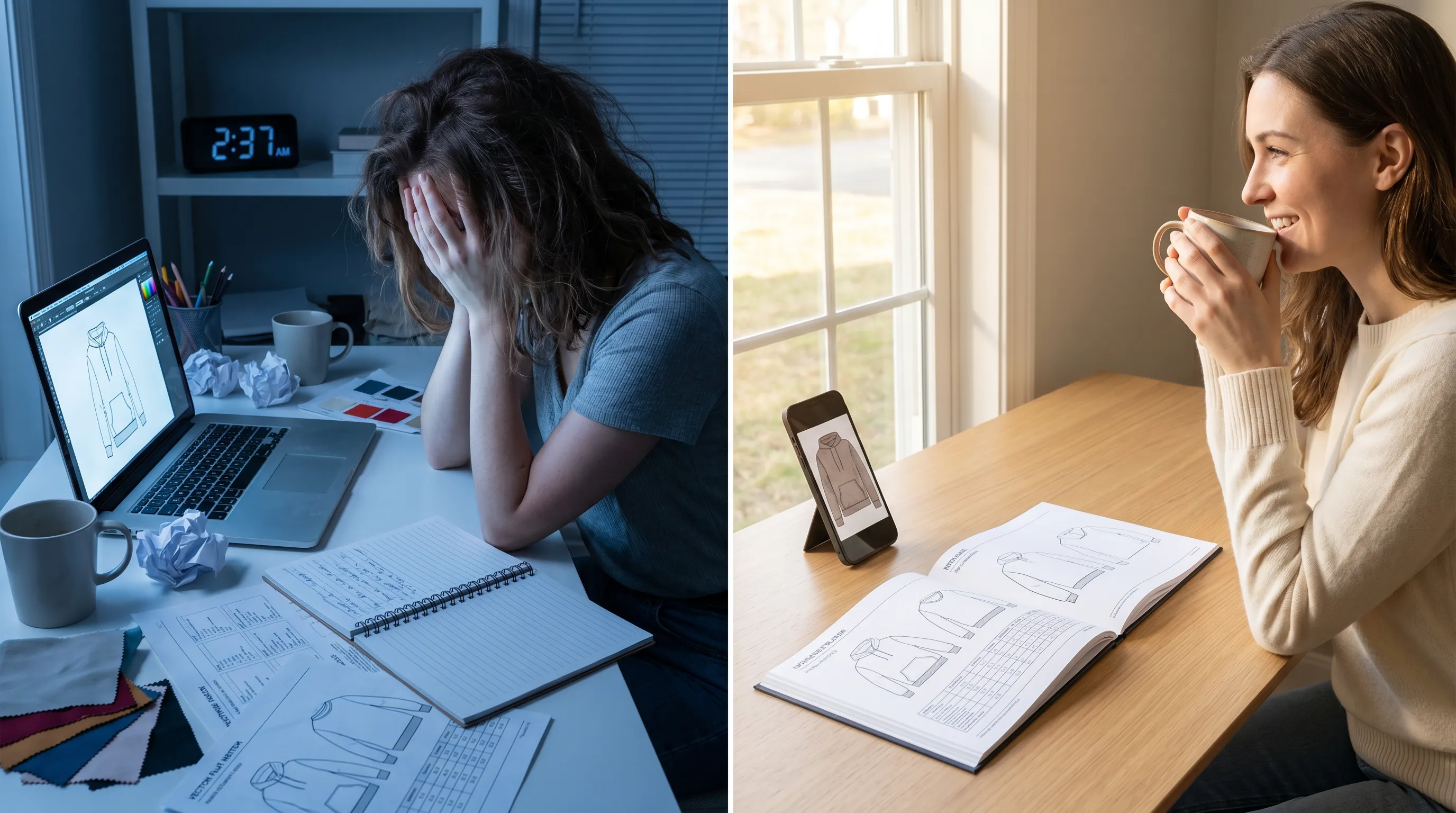
You opened Illustrator to draw a flat at 9pm and it's now midnight — with the bill of materials and measurement chart still to go. That's the normal experience: a complete tech pack takes 6–10 hours per style (Tech Pack Wizard's timed benchmark), and almost none of it is creative.
The time goes to three manual jobs. Flat sketches eat 2–4 hours per style — front and back drawn by hand, seams and proportions matched. The bill of materials follows: 18–25 line items for a hoodie, 55+ for a lined blazer, typed into Excel. Then points of measure — labeling reference points on the sketch and grading every measurement across the size run with tolerances. A basic tee runs 3–4 hours end to end; a lined blazer can pass 12. And it's all per style, from scratch: a 20-style collection is 120–200 hours of tracing and typing before a single sample ships — the silent bottleneck that pushes drops weeks late.
Where the hours actually go
The fastest fix: generate the pack from a photo
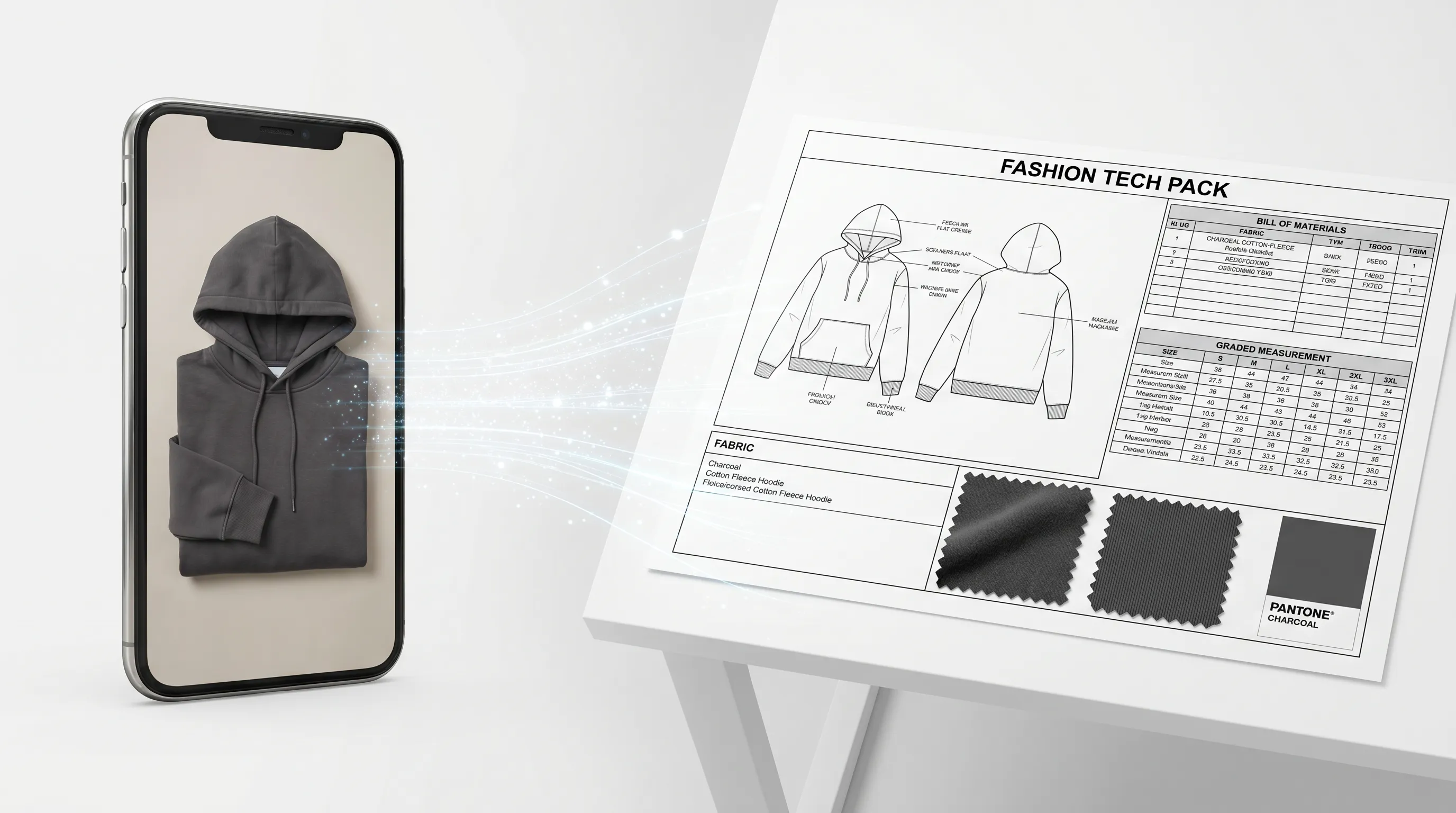
The 2–4 hour flat sketch is the step every other method still leaves to you — Techpacker organizes packs but you draw the flat; templates structure specs but you draw the flat; even plugin-accelerated Illustrator is you, drawing the flat. Adstronaut's AI Tech Pack Generator removes it: upload one photo of your sample — flat-lay, mannequin, mockup, or clean sketch — and it returns the annotated flat, structured BOM, graded measurements with tolerances, construction notes, and Pantone colorways in 3–5 minutes.
The remaining work is review, not creation: 10–15 minutes typing real supplier names, refining measurements off your sample, adding custom artwork. End to end: under 30 minutes per style for $3–6 (25 credits; plans from $29/month; first pack free as a watermarked preview). A 20-style collection's spec work shrinks from 120–200 hours to an afternoon — and class coverage spans apparel, footwear, leather goods, knitwear, and bodywear with the correct sections for each.
Every method, timed and priced
| Method | Time per pack | Cost | The catch |
|---|---|---|---|
| Illustrator + Excel (manual) | 6–10 hrs (3–4 for a tee, 12+ for a blazer) | $22.99–$34.49/mo + your hours | CAD skill assumed; restarts from zero every style |
| Templates (Sheets/Excel/Canva) | 4–8 hrs — flats still drawn or sourced | $0–$15/mo | Halves the spec time, never touches the 2–4 hr flat |
| Freelance technical designer | 3–7 business days turnaround | $100–$300 simple, $300–$600 mid, $600–$1,200+ complex | Queue time; $2,000–$12,000 across a 20-style drop |
| Techpacker (collaboration platform) | Faster assembly once flats exist | $35–$125/user/mo + onboarding | Doesn't draw flats — Illustrator stays in the loop |
| Adstronaut AI (generation) | 3–5 min draft + 10–15 min review | $3–6 per pack; first free | Bespoke placement art still wants a manual pass |
Manual and plugin timings per Tech Pack Wizard; freelance rates per Successful Fashion Designer's published survey; Techpacker per its pricing page.
The honest alternatives: templates and freelancers
Generation isn't the only lever. Templates and a BOM library genuinely help if you have Illustrator skills: one master spec template plus saved component rows (your usual fleece, your standard YKK zipper) can halve the spec time on every style after the first. The ceiling: templates never touch the flat sketch, so template-based packs still run 4–8 hours (five methods compared).
A freelance technical designer removes your hours entirely: a complete pack in 3–7 business days at $100–$300 for simple styles, $300–$600 mid-complexity, $600–$1,200+ for structured outerwear (published rate survey). Right for a one-off hero piece you can't spec yourself; painful across a drop — 20 styles is $2,000–$12,000 and weeks of back-and-forth. The honest mapping: templates win if you're CAD-fluent with a stable component set; a freelancer wins for a single complex style; generation wins when the flat itself is the bottleneck and you ship volume. Many brands combine them — generate the draft, hand-tune one tricky flat.
Reclaim your evenings this week: 4 steps
- 1
Time your current method once
Track one style honestly — flat, BOM, POMs, assembly. Most founders measure 6–10 hours and stop arguing with the data. - 2
Generate the same style
Upload its photo to the Tech Pack Generator (first pack free) and compare the draft against your manual version section by section. - 3
Build your review habit
Keep a 10–15 minute checklist: suppliers into the BOM, sample measurements into the POMs, custom artwork attached. That's the human layer that stays. - 4
Batch the backlog
Run the rest of the drop in one session — 10 styles ≈ an afternoon and $30–$60 in credits. Put the reclaimed week into selling the collection.
Who feels this most
Indie and first-time founders lose entire weekends to a single pack because the 2–4 hour flat is a skill they never learned. Small brands and DTC labels shipping 10–50 styles feel it as a collection-wide bottleneck — 120–200 hours that push every drop late. Production leads feel it downstream, in revision rounds: rushed manual packs are ambiguous, and unclear specs are the leading cause of first-sample failure (WFX Tech Pack 101) — teams that switched report first-sample revisions dropping from about three per style to one.
If your specific slowness is the Illustrator step itself, the dedicated Illustrator-too-slow fix goes deeper on in-app speedups; if extra sampling rounds are the downstream symptom, see too many sampling rounds.
Frequently asked questions
How long does it take to make a tech pack manually?
6–10 hours per style in Illustrator plus Excel: 2–4 hours on the front-and-back flat sketches, 1–2 hours on the bill of materials (18–25 rows for a hoodie, 55+ for a lined blazer), 2–3 hours on points of measure graded with tolerances, and about an hour assembling the PDF. A basic tee runs 3–4 hours; complex outerwear can pass 12.
Why do tech packs take so long?
Three manual jobs with zero carryover: hand-drawn flats, a typed BOM, and per-size graded measurements — each restarted from scratch for every style. Nothing links the sketch to the spec, so changes don't propagate. The structure of the work, not designer skill, is what makes a 20-style collection cost 120–200 hours.
What is the fastest way to make a tech pack?
Generation from a photo: Adstronaut returns the flat sketch, structured BOM, graded measurements, construction notes, and Pantone colorways in 3–5 minutes for $3–6 per pack. With a 10–15 minute review you export a factory-ready PDF in under 30 minutes — roughly 12–20× less hands-on time than the manual route.
Do templates actually save time?
Partly. A reusable spec template with a saved BOM-component library can halve the materials-and-measurements time on every style after the first. But templates never touch the flat sketch — the single largest line at 2–4 hours — so template-based packs still run 4–8 hours per style.
How long does a freelancer take, and what does it cost?
3–7 business days for standard garments (7–14 for complex styles) at $100–$300 simple, $300–$600 mid-complexity, and $600–$1,200+ for structured outerwear, per published rate surveys — plus 25–50% rush premiums. It removes your hours but adds queue time; across a 20-style drop it's $2,000–$12,000 and weeks of coordination.
Can I make a tech pack fast without Illustrator skills?
Yes — that's exactly what generation changes. Upload a front-facing garment photo and the AI produces the flat, BOM, and graded measurements with no CAD involved. Templates and collaboration platforms, by contrast, still assume someone draws the flat in vector software.
Does a faster tech pack mean lower quality?
Not if the document is complete — and completeness is what factories actually judge. Unclear specs are the leading cause of first-sample failure, and rushed manual packs are where ambiguity creeps in. Teams that moved to generation plus a focused human review report first-sample revisions dropping from about three per style to one.
How much does the AI route cost across a collection?
A tech pack is 25 credits — $5.80 on the $29/month Standard plan down to about $3.10 on annual Studio, so call it $3–6. A 20-style collection runs $60–$120 in credits, versus $2,000–$12,000 freelance or 120–200 in-house hours. The first pack is free as a watermarked preview.
Stop losing weekends to tech packs
Skip the 6–10 hours per style. Upload one garment photo and get a complete factory-ready tech pack — flats, BOM, graded measurements, construction notes — in minutes. First one free.
Try the AI Tech Pack GeneratorKeep going
Sources and further reading
- Tech Pack Wizard — timed benchmark — 6–10 hour per-pack manual baseline
- Successful Fashion Designer — freelance rates — $100–$1,200+ per style by complexity; 3–7 day turnaround
- Techpacker — Illustrator tech-pack workflow — manual flat-sketch process and time
- World Fashion Exchange — Tech Pack 101 — unclear specs as leading cause of first-sample failure