Factory keeps misunderstanding my tech pack? Here's why — and how to fix it
Updated June 10, 2026
When a factory ships the wrong sample, the spec is almost always the culprit, not the factory. Unclear technical documentation is the leading cause of first-sample failure, because factories don't guess by choice — they guess when a callout, tolerance, or point of measure is ambiguous. Fix it for free first: tighten callouts, write a how-to-measure guide, attach reference images, send written feedback. Then close the gaps for good with a structured pack that ships every section — generated in 3–5 minutes for $3–6 with Adstronaut.

Why your factory keeps getting it wrong
The sample arrives, and it's wrong: the wrong neckline, a hem two inches off, the wrong shade of navy. It's tempting to blame the factory. The data says otherwise — unclear technical documentation is the leading cause of sample delays and production rework (World Fashion Exchange; Ninghow Apparel's tech-pack mistakes guide).
Here's the mechanism that matters: factories don't guess because they want to — they guess because they have to. When a callout reads "color: blue" or "neckline: standard," or a point of measure says "chest" without specifying where it's measured, the factory fills the gap with its own judgment (Tech Pack Genius). Their judgment and yours rarely match, so the sample comes back to their interpretation, not your intent.
Four ambiguity types cause most wrong samples: vague callouts ("standard," "normal," "as shown"), missing tolerances (no ± band, so the factory sets its own), ambiguous points of measure ("chest" with no landmark, so you and the factory measure different spots), and lost-in-translation feedback (verbal or unannotated notes a sewing line reads three ways). If extra rounds are your real symptom, the sibling fix on too many sampling rounds goes deeper on the cost math.
What the ambiguity costs
Fix it for free first: four communication upgrades
Before changing tools, close the four ambiguity gaps by hand. These cost nothing and resolve most repeat misunderstandings.
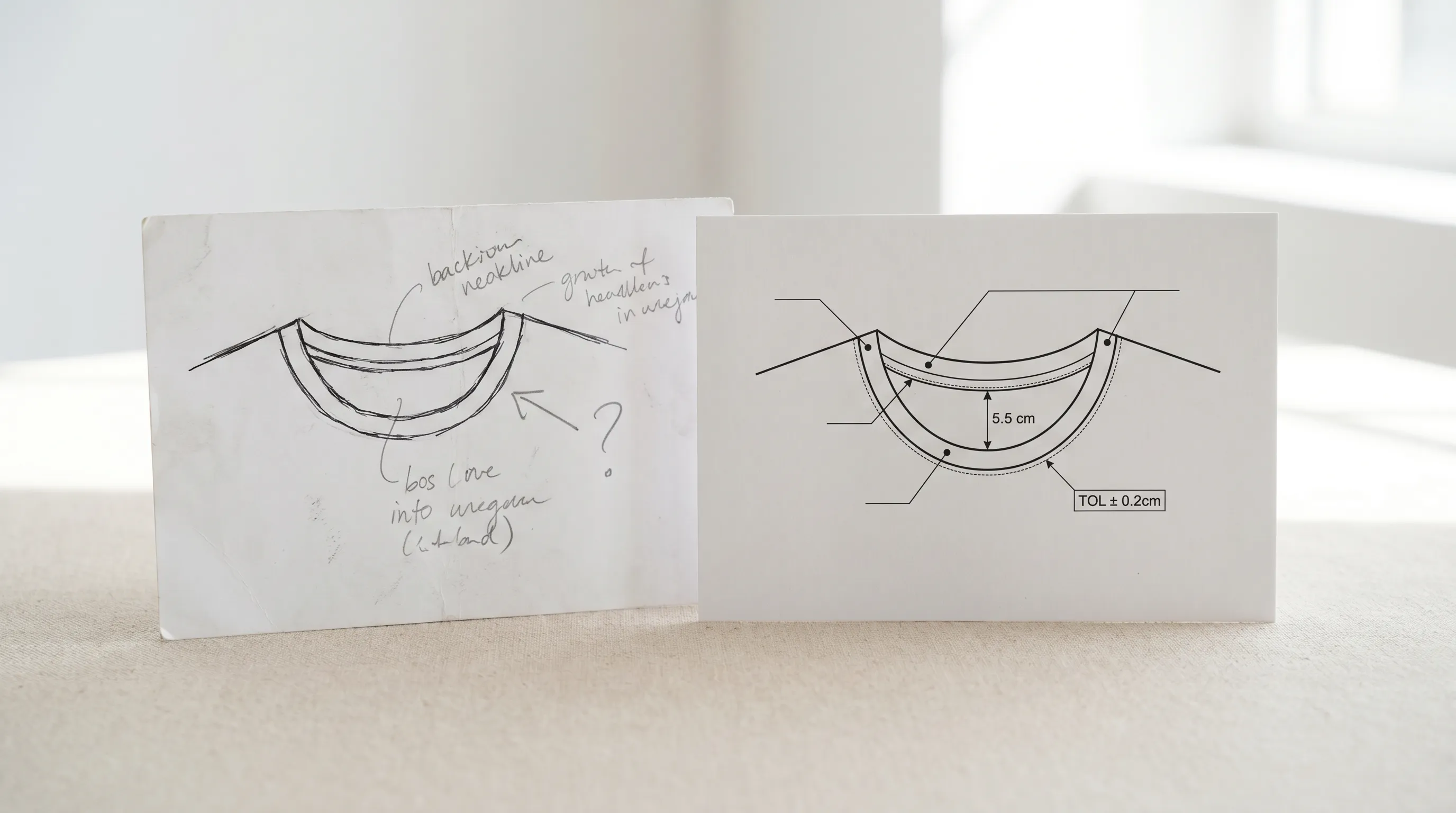
1. Kill every vague word in your callouts. Search your pack for "standard," "normal," "as shown," and "approx." Replace each with a number or a named reference: not "crew neckline" but "crew neckline, 7" finished width, 1" rib." Ambiguous instructions are the ones that cost the most, because they quietly invite the factory to decide for you (Fashinza).
2. Add a tolerance to every measurement. If a point of measure has no ± band, the factory will set its own — and a garment built to their tolerance is technically correct and still wrong. State the band in writing before sampling (Techpacks.co). The glossary entry on points of measure explains how to landmark each one so "chest" can't be measured in two places.
3. Build a one-page how-to-measure (HTM) guide. Most sample-to-bulk variance comes from the factory and the brand measuring the same point in different places. A shared HTM guide — a sketch or photo showing exactly where each measurement is taken — forces one method, and you ask the factory to confirm they'll follow it (Points of Measure).
4. Communicate in writing, with annotated images. Verbal comments get lost on the floor. Attach labeled front/back/side reference photos to the pack, and when a sample comes back, mark up photos with arrows and exact instructions — "add 1" to the armhole straight measurement," not "armhole is tight" (Uphance's tech-pack guide). Our blog on how to communicate with a manufacturer turns this into a repeatable cadence.
The 6-point ambiguity audit before you send
Run this on any pack before it reaches the factory. Each item closes one of the gaps that produces a wrong sample.
- 1
No vague words survive
Zero instances of "standard," "normal," "approx," or "as shown." Every one becomes a number, a Pantone code, or a named landmark. - 2
Every POM has a landmark and a tolerance
Each measurement names exactly where it's taken and carries a±band. See what a point of measure is if any are still labeled by name alone. - 3
Colors are coded, not described
Replace "navy" with a Pantone TCX code. "Blue" is the single most-cited ambiguity in the mistake guides above. - 4
A how-to-measure guide is attached
One page, one method, shared and confirmed — so you and the factory never measure the same point in two places. - 5
Reference images are labeled
Front, back, side, plus close-ups of any tricky construction, with arrows on the problem areas. - 6
One version, dated
Send a single dated PDF. Multiple untracked versions are a classic way for a factory to build from the wrong instructions.

The structural fix: a pack that can't be vague
The free fixes work — but they depend on you catching every gap, every time, across every style. The deeper problem is that a hand-built pack starts blank, so omissions are the default and completeness is the exception. A structured generator flips that: it ships every section the product class needs, pre-populated, so there's nothing to forget.
Adstronaut's AI Tech Pack Generator takes one photo of your sample — flat-lay, mannequin, mockup, or clean sketch — and returns an annotated flat with landmarked points of measure, a graded measurement table with tolerances, a structured bill of materials with supplier fields, construction notes with stitch callouts, and Pantone-coded colorways instead of color words, in 3–5 minutes for $3–6 (25 credits; plans from $29/month; first pack free as a watermarked preview). The four ambiguity types are designed out: measurements carry landmarks and bands, colors are TCX codes, and the sections a factory expects are all present rather than half-remembered.
It covers apparel, footwear, leather goods, knitwear, and bodywear, each with the correct sections for that class — a footwear pack specs the upper, sole unit, and closure rather than sleeves and necklines. The result reads cleanly to a sewing line in Tiruppur, Porto, or Guangzhou without translation. Production teams who switched report first-sample revision rounds dropping from roughly three per style to about one. The factory-grade breakdown shows exactly which gaps the structure closes.
Each fix, what it closes, and the catch
The free communication fixes and the structural fix aren't either/or — most brands layer them. Here's how they compare.
| Fix | What it closes | Cost | The catch |
|---|---|---|---|
| Tighten callouts + add tolerances | Vague words, missing ± bands | $0 + your hours | Manual; you must catch every gap on every style |
| How-to-measure guide | Same POM measured in two places | $0 + setup time | Only works if the factory confirms and follows it |
| Annotated reference images + written feedback | Lost-in-translation verbal notes | $0 + your hours | Adds per-round effort; doesn't fix the source pack |
| Freelance technical designer | Most ambiguity, if briefed well | $100–$1,200+ per style | Queue time; a vague brief still yields a vague pack |
| Adstronaut AI (structured generation) | All four gaps by default — landmarks, bands, TCX, full sections | $3–6 per pack; first free | Bespoke placement art still wants a manual review pass |
Free-fix effectiveness per the cited tech-pack mistake guides; freelance rates per Successful Fashion Designer's published survey; generated route per Adstronaut's workflow and verified credit pricing.
Where the misunderstanding enters
When the manual approach is still right
A generator doesn't make the communication fixes obsolete, and it isn't always the answer. If you already write tight, landmarked, tolerance-banded packs and your wrong samples trace to one fiddly construction detail, you don't need new tooling — you need a sharper annotated photo and a five-minute call with your factory. If the misunderstanding is relational — a new factory still learning your standards, or a language barrier no document fully bridges — the highest-leverage move is the how-to-measure guide plus a sealed, dual-approved pre-production sample, not a different pack format.
And for a single bespoke hero piece with unusual construction, a freelance technical designer who can sit with the pattern may catch nuances a photo-driven draft won't ($100–$1,200+ per style depending on complexity, per published rates). The structured pack wins when the problem is systemic ambiguity across many styles — when omissions and vague callouts keep slipping through because every pack starts from a blank page. That's the failure mode it's built to remove.
Who hits this hardest
First-time founders hit it because they don't yet know which fields a factory needs, so the gaps are invisible until the wrong sample arrives — and they read the wrong sample as their own failure rather than a documentation gap. Small brands shipping 10–50 styles hit it as a recurring tax: one ambiguous callout per style, multiplied across a drop, becomes weeks of avoidable revision rounds. Production leads hit it downstream, where the cost is measured in sample iterations and shifted ship dates — and where tightening the source document pays back fastest.
The through-line for all three is the same: the factory isn't the problem, and neither are you. The blank-page document is. Close the four ambiguity gaps — by hand with the audit above, or by default with a structured generated pack — and the "factory keeps misunderstanding me" problem mostly disappears, because there's nothing left to misunderstand.
Frequently asked questions
Why does my factory keep making the wrong sample?
Almost always because the spec is ambiguous, not because the factory is careless. Unclear technical documentation is the leading cause of first-sample failure: when a callout says "standard," a measurement has no tolerance, or a point of measure isn't landmarked, the factory has to fill the gap with its own judgment — and their interpretation rarely matches your intent. Tighten the document and the wrong samples mostly stop.
Is it the factory's fault or my tech pack's fault?
Usually the tech pack's. Factories don't guess because they want to — they guess because a vague callout, a missing tolerance, or an unlandmarked measurement leaves them no choice. Before switching factories, run an ambiguity audit on your pack: kill every vague word, add a tolerance band to every point of measure, and code your colors as Pantone TCX rather than words.
What makes a point of measure ambiguous?
A point of measure is ambiguous when it names a measurement without specifying exactly where it's taken — "chest" instead of "chest, 1 inch below armhole, edge to edge." You and the factory then measure different spots and the sample reads as off-spec even when both of you measured correctly. The fix is to landmark every measurement and share a how-to-measure guide so there's one method. See our glossary entry on what a point of measure is.
How do I stop the factory from guessing on color?
Replace color words with codes. "Blue" or "navy" is the single most-cited ambiguity in tech-pack mistake guides because dozens of shades qualify. Specify a Pantone TCX code instead, and the factory matches a physical standard rather than an adjective. Adstronaut's generated packs output Pantone-coded colorways by default for exactly this reason.
What is a how-to-measure guide and do I need one?
It's a one-page reference — a sketch or photo — showing exactly where each measurement on your garment is taken. You share it with the factory and ask them to confirm they'll follow it. It's the single highest-leverage fix for sample-to-bulk variance, because most variance comes from the brand and the factory measuring the same point in two different places. Yes, you need one, especially with a new factory.
Will an AI-generated tech pack actually reduce misunderstandings?
It removes the most common source — omissions and vague defaults — because a structured generator ships every section pre-populated: landmarked points of measure, tolerance bands, a structured BOM, construction notes, and Pantone-coded colors. There's nothing to forget. Production teams who switched to Adstronaut report first-sample revision rounds dropping from roughly three per style to about one. It doesn't replace clear feedback on a returned sample — that human layer stays.
How much does a clearer tech pack cost with Adstronaut?
A tech pack is 25 credits — about $3–6 depending on plan (plans start at $29/month for 125 credits, and the first pack is free as a watermarked preview). You upload one garment photo and get a complete, factory-ready pack in 3–5 minutes, then spend 10–15 minutes reviewing supplier names and measurements. The structure is what closes the ambiguity gaps, not the speed.
How many sampling rounds should a clear tech pack take?
One to two, versus three to five with vague specs — and complete tech packs cut sampling rounds by up to 40% in published analyses. The biggest driver of extra rounds is ambiguity the factory had to resolve on its own. If revision rounds are your core symptom rather than wrong samples specifically, see the dedicated fix on too many sampling rounds.
Does a faster or AI-built pack mean lower quality for the factory?
No — factories judge completeness and clarity, not how the document was produced. A pack is rejected when it's vague, not when it's fast. A structured pack that carries every section, with landmarks, tolerances, and coded colors, reads more cleanly to a sewing line than a rushed manual one with gaps. The format is what the factory cares about, and the format is exactly what generation standardizes.
What if the misunderstanding is a language barrier, not the document?
Lean harder on the visual layers. A landmarked flat sketch, a how-to-measure guide with photos, Pantone codes, and annotated sample feedback all communicate without translation — which is why a complete, structured pack reads cleanly across Tiruppur, Porto, Istanbul, and Guangzhou. For relational gaps with a new factory, add a sealed pre-production sample that both you and the factory measure and approve before bulk.
Stop the wrong samples at the source
Close the four ambiguity gaps for good. Upload one garment photo and get a structured, factory-ready tech pack — landmarked measurements with tolerances, a clear BOM, construction notes, and Pantone-coded colorways — in minutes. First one free.
Try the AI Tech Pack GeneratorKeep going
Sources and further reading
- World Fashion Exchange — Tech Pack 101 — unclear technical documentation as the leading cause of first-sample failure and rework
- Ninghow Apparel — top tech-pack mistakes — factories fill ambiguous gaps with their own judgment; vague specs cause delays
- Points of Measure — POMs — ambiguous points of measure cause sample-to-bulk variance; how-to-measure guide as the fix
- Techpacks.co — damaging tech-pack mistakes — missing tolerances force the factory to manufacture to its own band
- Uphance — garment spec sheets — complete tech packs cut sampling rounds by up to 40%
- Successful Fashion Designer — freelance rates — $100–$1,200+ per style by complexity for a freelance technical designer