
What is a POM (point of measure)?
Updated September 22, 2026
A point of measure (POM) is a specific, named location on a garment where a single dimension is taken — for example, across chest, measured 1" below the armhole, edge to edge. Each POM is written on the spec sheet as a standardized instruction with a target value, a tolerance (typically ±¼–½"), and a graded value for every size, so designer and factory measure the identical spot the identical way.
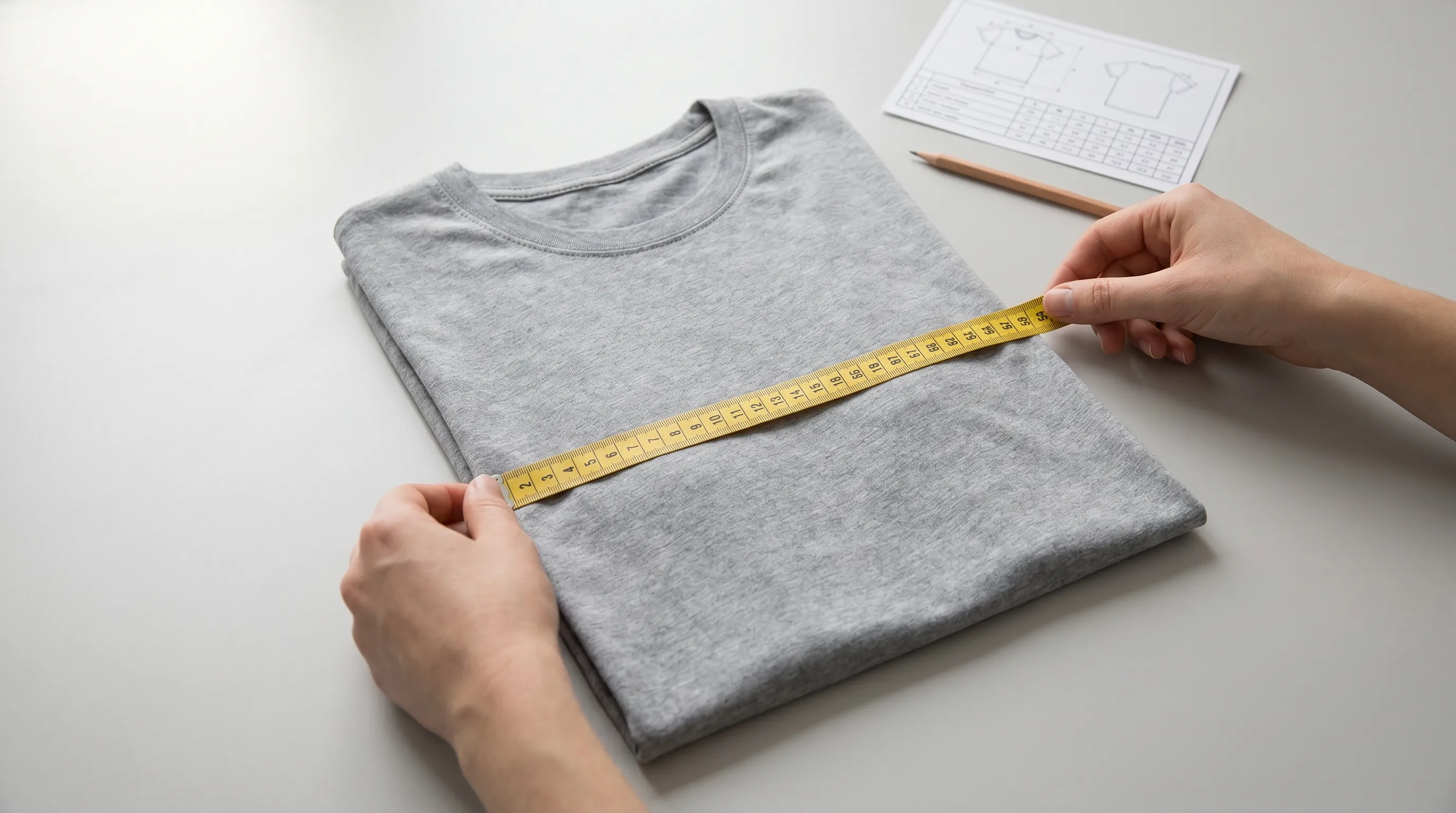
What is a POM, and how is one written?
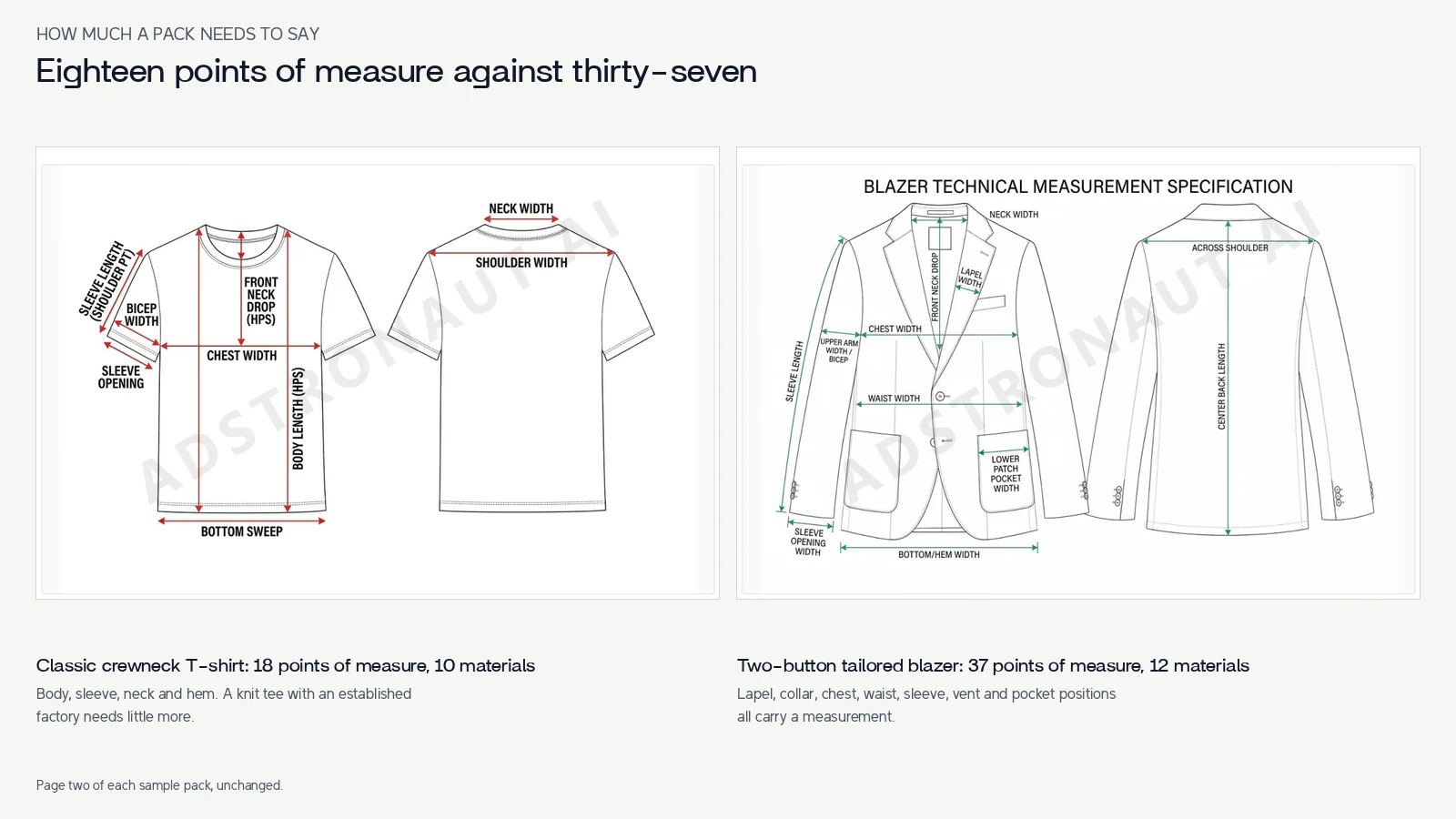
A point of measure (POM) is a single named location on a garment where one dimension is recorded — "across chest," "HPS to hem," "sleeve length," "bottom sweep." A garment spec sheet is essentially a numbered list of POMs, each pairing a how-to-measure description with a target value, a tolerance, and a graded value per size. A basic tee carries about a dozen; a tailored jacket or jeans can exceed thirty.
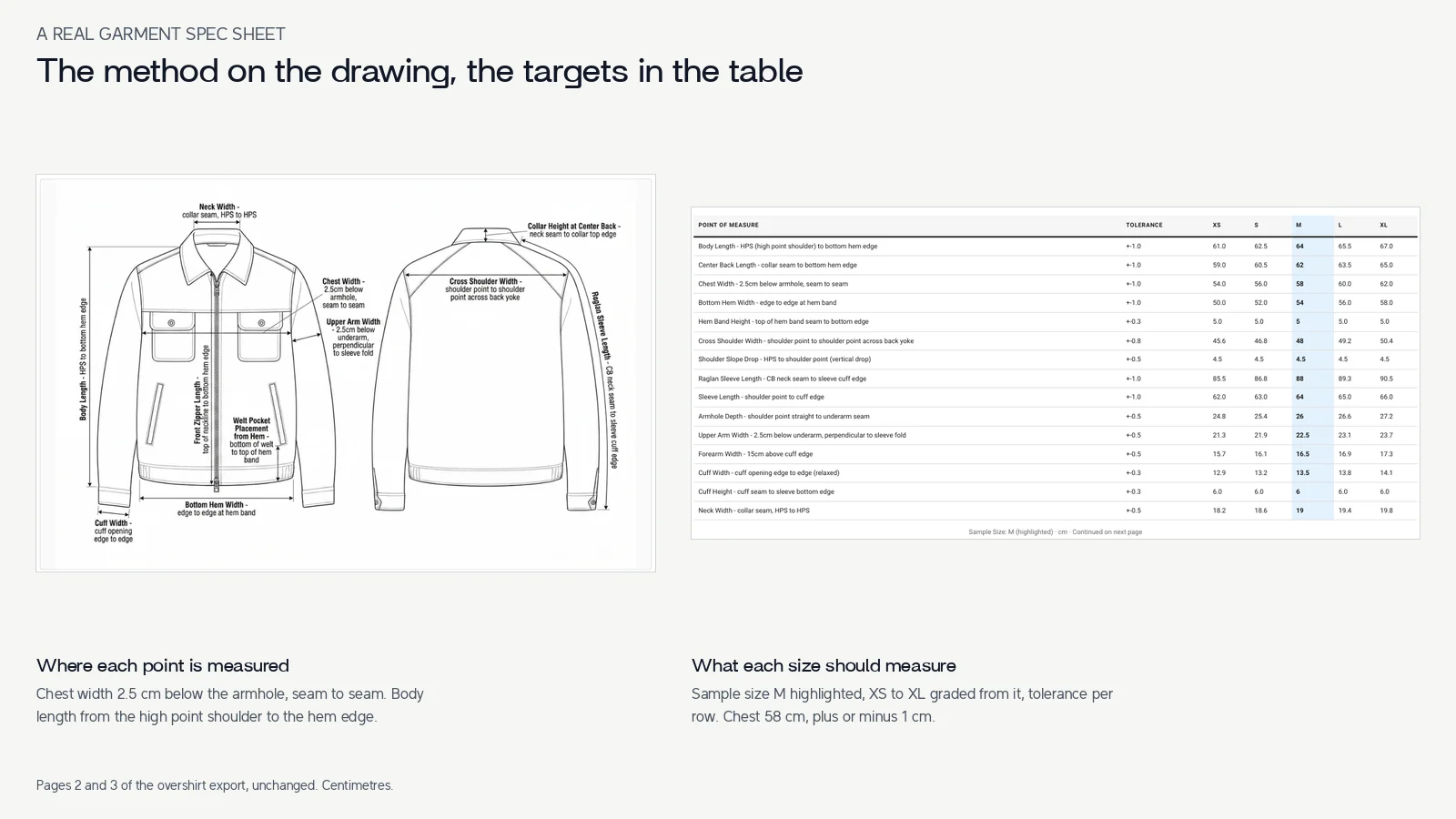
A POM only works if it's unambiguous — a designer in one country and a factory QC team in another must land on the same number. So each POM is written as a precise instruction, not a word: "across chest" alone is too vague; the sheet says "Across chest — measured 1" below armhole, garment flat, edge to edge" (Designers Nexus' POM conventions). Most spec sheets pair the chart with a how-to-measure diagram — a flat sketch with numbered arrows matching each row (Delogue's spec guide) — so the factory measures where the arrow points, not where habit suggests.
The standard POMs on a tee, mapped
Worked example
One row of a real spec sheet
POM #4 on a tee spec might read: "Across chest, 1" below armhole, edge to edge — Size M target: 21", tolerance ±½"" with graded values S 19.5" / M 21" / L 22.5" (a 1.5" grade rule). At QC, the factory lays the garment flat and measures: 21.3" passes (within 20.5–21.5"); 21.8" fails and the piece is flagged. Multiply that decision across 30 POMs and a full size run, and you see why the sheet's precision — not the sewing — is usually what separates an accepted shipment from a dispute.
Common POMs and where each is measured
| POM | Where measured |
|---|---|
| Body length (HPS to hem) | From the high-point shoulder (where shoulder seam meets neckline) straight down to the hem edge |
| Across chest | Horizontally 1" below the armhole, garment flat, edge to edge |
| Across shoulder | Straight across the back, outer shoulder seam to outer shoulder seam |
| Neck width | Neck seam to neck seam at the HPS |
| Sleeve length | Top of sleeve at shoulder seam to sleeve opening |
| Bicep | 1" below the armhole, perpendicular to sleeve length |
| Bottom sweep (hem) | Across the bottom edge, edge to edge |
| Waist (bottoms) | Across the top of the waistband — relaxed AND extended for elastic waists |
| Front / back rise | Crotch seam to top of waistband, front and back respectively |
| Thigh | 1" below the crotch seam, perpendicular to the leg |
| Inseam | Along the inner leg seam, crotch to leg opening |
Standard apparel conventions per Designers Nexus and Delogue. Knit garments with stretch record key POMs both relaxed and extended.
Tolerance, grading — and the trap between them
Every POM carries two more numbers. Tolerance is acceptable variance within a size, written ± — chest 21" ±½" means 20.5–21.5" passes QC. Critical fit POMs (chest, waist, hip) typically run ±¼–½"; less critical points get looser values, and woven garments hold tighter tolerances than knits (Alison Hoenes' tolerance guide). The grade rule is the step between sizes — commonly 1.5–2" per size at the chest.
The trap: if a POM's tolerance is wider than half its grade step, sizes can legally overlap — a finished Large can measure smaller than a passing Medium. Numeric sizing (6/8/10), which grades in smaller steps than alpha sizing (S/M/L), demands proportionally tighter tolerances. It's the single most common spec-sheet engineering error, and it produces the maddening customer review: "I ordered up and it fit smaller."
How POM charts get built today
Manually, a POM chart means typing every landmark, tolerance, and graded value across the size run into a spreadsheet — slow, and easy to break the tolerance-vs-grade relationship silently. Adstronaut's Tech Pack Generator writes the chart from a single garment photo: it detects the garment class, places the standard POMs that class needs (chest 1" below armhole, HPS-to-hem, rise and inseam for bottoms), and returns them graded across the size range with tolerances applied, referencing standard body-measurement tables (ASTM D5585 for women's missy sizing, D6240 for men's) where applicable.
Every value stays editable — you tune POMs to your sample's real measurements in review, then export the print-ready PDF. For the document the chart lives in, see what is a spec sheet; for the sizing math underneath it, how to grade sizes.
Frequently asked questions
What does POM stand for in fashion?
Point of measure — a single named location on a garment where one dimension is taken, such as across chest, sleeve length, or HPS to hem. A spec sheet lists 12–30+ POMs, each with a how-to-measure instruction, a target value, a tolerance, and a graded value for every size.
How is the chest POM measured?
Across chest is measured horizontally 1 inch below the armhole with the garment flat, edge to edge. The 1"-below-armhole landmark exists for repeatability: measuring at the underarm seam itself varies with how the armhole sits, while the offset point gives designer and factory the same number every time.
What is HPS in a point of measure?
HPS is the high-point shoulder — where the shoulder seam meets the neckline, the highest stable landmark on a garment. Length POMs anchor to it: body length is 'HPS to hem,' measured straight down. It appears constantly on spec sheets because it survives styling changes that move other reference points.
What is a tolerance on a POM?
The acceptable variance from target, written with ± — chest 21" ±½" passes QC anywhere from 20.5" to 21.5". Critical fit POMs (chest, waist, hip) typically carry ±¼–½"; minor points get looser values; wovens hold tighter than knits. Tolerances are what make a spec enforceable rather than aspirational.
How are POMs different from grading?
A POM is a location plus target within one size; the grade rule is the step between sizes for that POM — e.g. chest grading +1.5" per size while body length grades +0.5". Tolerance is variance within a size; grade is change across sizes. The two interact: tolerance must stay below half the grade step or sizes overlap.
How many POMs does a garment need?
A basic tee: about a dozen (chest, length, shoulder, neck, sleeve, bicep, sweep). Jeans: 15–20 including waist, hip, rises, thigh, knee, inseam, leg opening. Tailored jackets exceed thirty. The rule: enough POMs that the factory never has to guess a dimension that matters to fit.
Why does a tolerance wider than the grade rule cause problems?
Because sizes can legally overlap at QC: with a 1" grade and a ±¾" tolerance, a Large at the low end (smaller) passes while a Medium at the high end (larger) also passes — and the customer who sized up receives a smaller garment. Keep each POM's tolerance under half its grade step, and tighten further for numeric sizing.
Can POM charts be generated automatically?
Yes. Adstronaut's Tech Pack Generator detects the garment class from one photo and writes the class-standard POMs — already graded across the size range with tolerances applied, referencing ASTM body-measurement tables where relevant. Every value remains editable before the PDF export, so your sample's real measurements get the final say.
Get graded POMs without the spreadsheet
Upload one garment photo and get a complete, graded points-of-measure chart — tolerances applied, every value editable — inside a factory-ready tech pack. First pack free, then $3–6.
Try the AI Tech Pack GeneratorRelated reading
Sources and further reading
- Designers Nexus — basic points of measure — how-to-measure conventions for tops and bottoms
- Delogue PLM — speccing with POMs — POM definition and how-to-measure diagrams
- Alison Hoenes — writing POM tolerances — tolerance ranges and the tolerance-vs-grade relationship
- ASTM D5585-21 — body measurement tables (women's missy) — standard body-measurement basis for grading (paid standard)