
What is a grade rule in fashion?
Updated September 22, 2026
A grade rule is the set of measurement increments applied to each point of measure (POM) to scale a garment up or down between sizes. It defines exactly how much each dimension grows or shrinks per size — typically 1–2 inches at girth points (chest, waist, hip) and 0.25–1 inch at smaller points (shoulder, neck, sleeve) — keeping fit and proportion consistent across the size range.
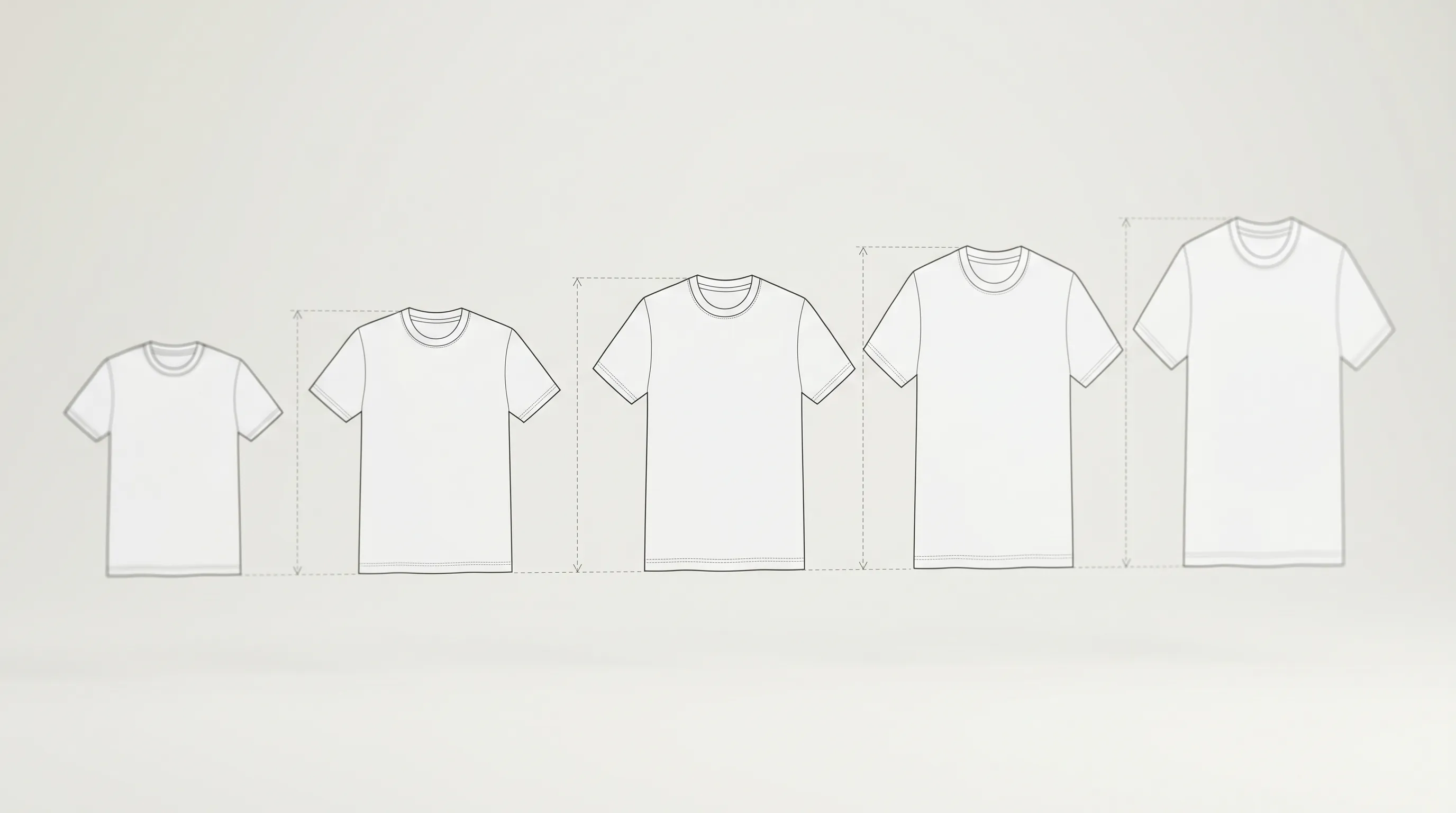
What is a grade rule?
A grade rule is the set of measurement increments — the fixed amount each point of measure grows or shrinks — used to scale a garment from one size to the next. Patternmakers describe it as "the incremental jumps between sizes for specific points of measure" (Garmenta Apparel), and it's what a grader applies at every step from XS to 3XL.
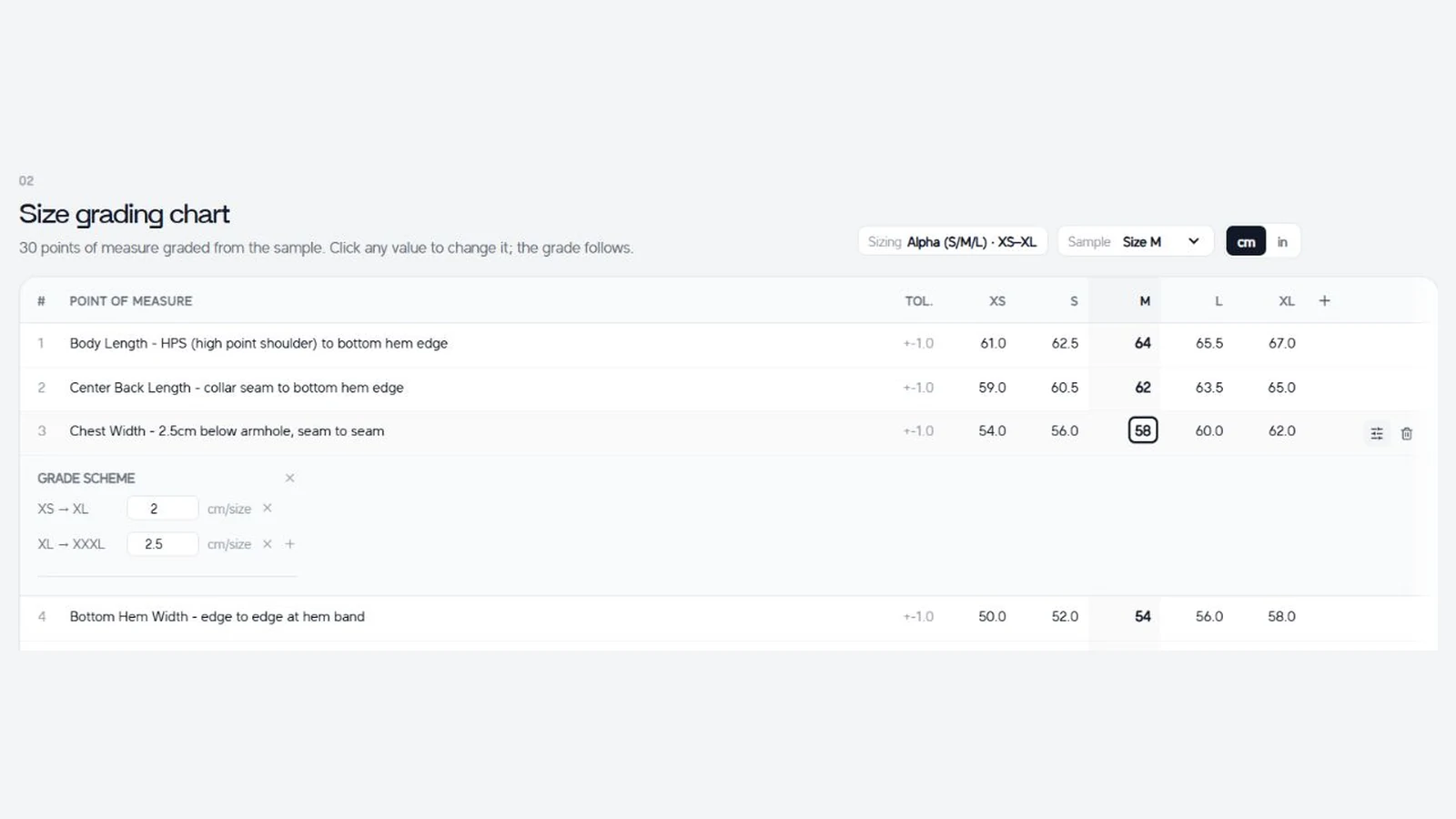
Each POM carries its own increment: a chest might grade 2 inches per size, body length 1 inch, sleeve 0.5 inch (Top Notch Pattern). Girth points (chest, waist, hip) grade in 1–2" steps; smaller points (neck, shoulder) in 0.25–0.5" steps. On the pattern itself, those increments distribute across grade points — corners and notches — along the X axis (width, parallel to girth lines) and Y axis (length, parallel to center front/back), so the armhole, shoulder slope, and dart placement shift in proportion rather than stretching from one corner.
Critically, a grade rule does not redesign the garment. It scales the existing shape so an XL fits like the sample size enlarged — recorded once, applied uniformly, which is what keeps every size reading as the same style.
Worked example
Grading a tee's chest from a size M base
Your sample-size M measures 21" across the chest, and the chest grade rule is +1.5" per size. The run becomes: S 19.5" → M 21" → L 22.5" → XL 24". Above XL the increment widens to +2" (larger bodies need proportionally more room), so 2XL = 26", 3XL = 28". Meanwhile body length grades +0.5": M 28" → L 28.5" → XL 29". Each POM steps by its own rule simultaneously — that full set of per-POM increments is the garment's grade, and it's what fills every column of the graded spec sheet.
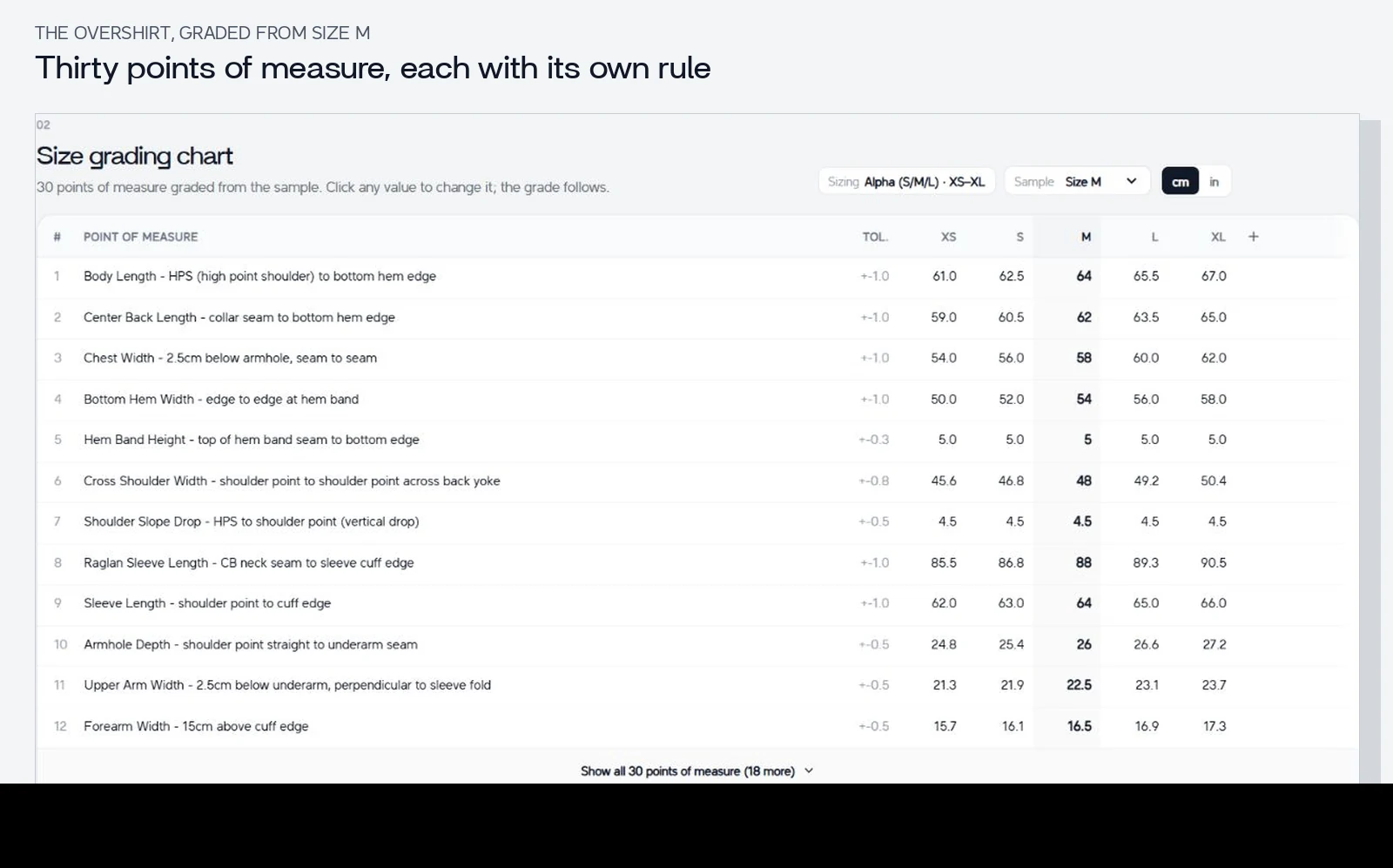
Example grade rules by point of measure
| Point of measure (POM) | Typical increment per size |
|---|---|
| Chest / bust | 1–2" (1.5" common for tops in the core range) |
| Waist | 1–2" |
| Hip / seat | 1–2" |
| Body length (HPS to hem) | 0.5–1" |
| Across shoulder | 0.25–0.5" |
| Neck width | 0.125–0.25" |
| Sleeve length | 0.25–0.5" |
| Armhole depth | 0.25–0.5" |
| Leg opening / hem | 0.25–0.5" |
Representative increments for a knit top. Exact values are set per brand and fit block; girth increments commonly widen to 2" above size 16 / XL. Per Top Notch Pattern and standard grading practice.
The grade rule, visualized as a nest
How grade rules work across a range — and where they bend
Grade rules are cumulative: with a 2" chest rule and a 40" base, the run walks 38 → 40 → 42 → 44. But increments aren't uniform across the whole range. Standard women's grading commonly runs 1" per size through the small numerics, 1.5" through the mid range, and 2" at 18+ (Successful Fashion Designer's grading guide), because bodies don't scale linearly.
Fit categories bend the rules further. Petite keeps girth increments but shortens length steps (sleeve, rise, body length each reduced ~½–1" per step). Plus is not a scaled-up missy block — it's a separate base pattern with its own proportions and typically +2" girth steps; grading a missy block upward past 1X is the classic cause of plus sizes that fit nowhere. The body-measurement baselines behind all of this live in the ASTM tables — D5585 for women's missy sizing, D6240 for men's — which brands use as the starting reference for their own blocks.
Grade rule vs pattern making vs grading
Three terms, one pipeline. Pattern making creates the base pattern — the garment's shape in one sample size, with its ease, darts, and silhouette. The grade rule is the specification for how that base scales: the per-POM increments. Pattern grading is the process of applying those rules to produce every other size. The patternmaker designs the shape; the rule says how much each point moves; grading executes it.
Confusing them is a real fit risk: a beautifully drafted base with an inconsistent rule fits perfectly at the sample size and badly at the extremes — and because returns concentrate at range ends, broken grading shows up in your returns data before it shows up in your studio. The full sizing method is in how to grade sizes for a clothing line.
Where grade rules live in a tech pack
Grade rules surface as the graded measurement chart in the tech pack — the spec page listing every POM across all sizes, the increment visible column to column, each row carrying its tolerance. The factory cuts and QCs every size against this chart; without it, your pattern can't be graded correctly and fit drifts at the extremes.
Adstronaut's Tech Pack Generator builds this chart from one garment photo: it detects the class, assigns class-appropriate POMs, and applies standard increments across the run — with every increment editable, so your fit block's specifics override the defaults before export. The interaction between the rule and each POM's tolerance (tolerance must stay under half the grade step, or sizes overlap) is covered on the POM page.
Frequently asked questions
What is a grade rule in simple terms?
The fixed amount each garment measurement changes from one size to the next. A chest grade rule of 1.5" means every size up adds 1.5" at the chest. Every point of measure — chest, waist, length, sleeve — has its own rule, and applying them all together scales the garment evenly across the range.
What is a typical grade rule for a t-shirt?
Roughly: chest 1–1.5" per size, body length 0.5–1", sleeve 0.25–0.5", neck width 0.125–0.25", shoulder 0.25–0.5". Exact values are brand- and fit-block-specific, and girth increments commonly widen to 2" above XL / size 16 to hold proportion on larger bodies.
What's the difference between a grade rule and pattern grading?
The rule is the specification — the per-POM increment between sizes. Grading is the execution — applying those rules to the base pattern to produce the run. Pattern making, upstream of both, creates the base shape itself. Instruction, process, and design respectively.
How much does the chest grade between sizes?
Typically 1–2" per size, with 1.5" the common figure for tops in the core range. Women's numeric sizing often steps 1" through small sizes, 1.5" mid-range, and 2" at 18+, because body girth doesn't scale linearly with size label.
What are X and Y grade points?
The pattern corners and notches where a grade rule's increment is physically applied. X-axis points control width (parallel to bust/hip lines); Y-axis points control length (parallel to center front/back). Distributing the increment across multiple points keeps armholes, slopes, and darts proportional instead of stretching the pattern from one corner.
Does a grade rule change the design of a garment?
No — it scales the existing shape proportionally. An XL graded from a sample M should look like the M enlarged: same proportions, seam placement, and fit intent. If sizes read as different designs, the grade is inconsistent, not the pattern. The grade nest overlay is the standard visual audit.
Are petite and plus sizes graded with the same rules?
No. Petite keeps girth increments but shortens length steps (~½–1" less at sleeve, rise, and body length per step). Plus requires its own base block with different proportions and typically +2" girth steps — scaling a missy block upward past 1X is the classic source of plus ranges that fit no one.
Where is the grade rule recorded in a tech pack?
In the graded measurement chart — the spec page listing every POM across all sizes with the increment visible column to column and a tolerance per row. Factories grade, cut, and QC against it. Adstronaut's generator builds this chart automatically from one photo, with every increment editable before export.
Get graded measurements automatically
Skip building grade rules by hand. Upload one garment photo and get a graded measurement chart — every POM, every size, tolerances applied, fully editable. First pack free, then $3–6.
Try the AI Tech Pack GeneratorRelated reading
Sources and further reading
- Garmenta Apparel — what is a grade rule — grade rule as incremental jumps per point of measure
- Top Notch Pattern — decoding grade rules — per-POM increments and size-range steps
- Successful Fashion Designer — garment grading guide — 1"/1.5"/2" increments by size range; rule vs process
- ASTM D5585-21 — women's missy body measurement tables — body-measurement baseline brands grade against (paid standard)
- Garmenta Apparel — grading up to plus sizes — why plus needs its own block, not a scaled missy block