Your product photoshoot is too expensive — here's how to cut cost per image
Updated June 10, 2026
A fashion product shoot stacks separately-billed line items — photographer $1,000–$3,500/day, model $500–$3,000, studio $300–$1,500, styling and HMUA, then $25–$150 per image retouching — landing at $2,500–$8,000 per day, or $45–$200+ per finished image. The fix is two-sided: cut the real shoot's line items, and move catalog volume (PDP sets, colorways, ad variants) to AI on-model imagery at about $1 per image.
Why your shoots cost so much: the stack, not the day rate
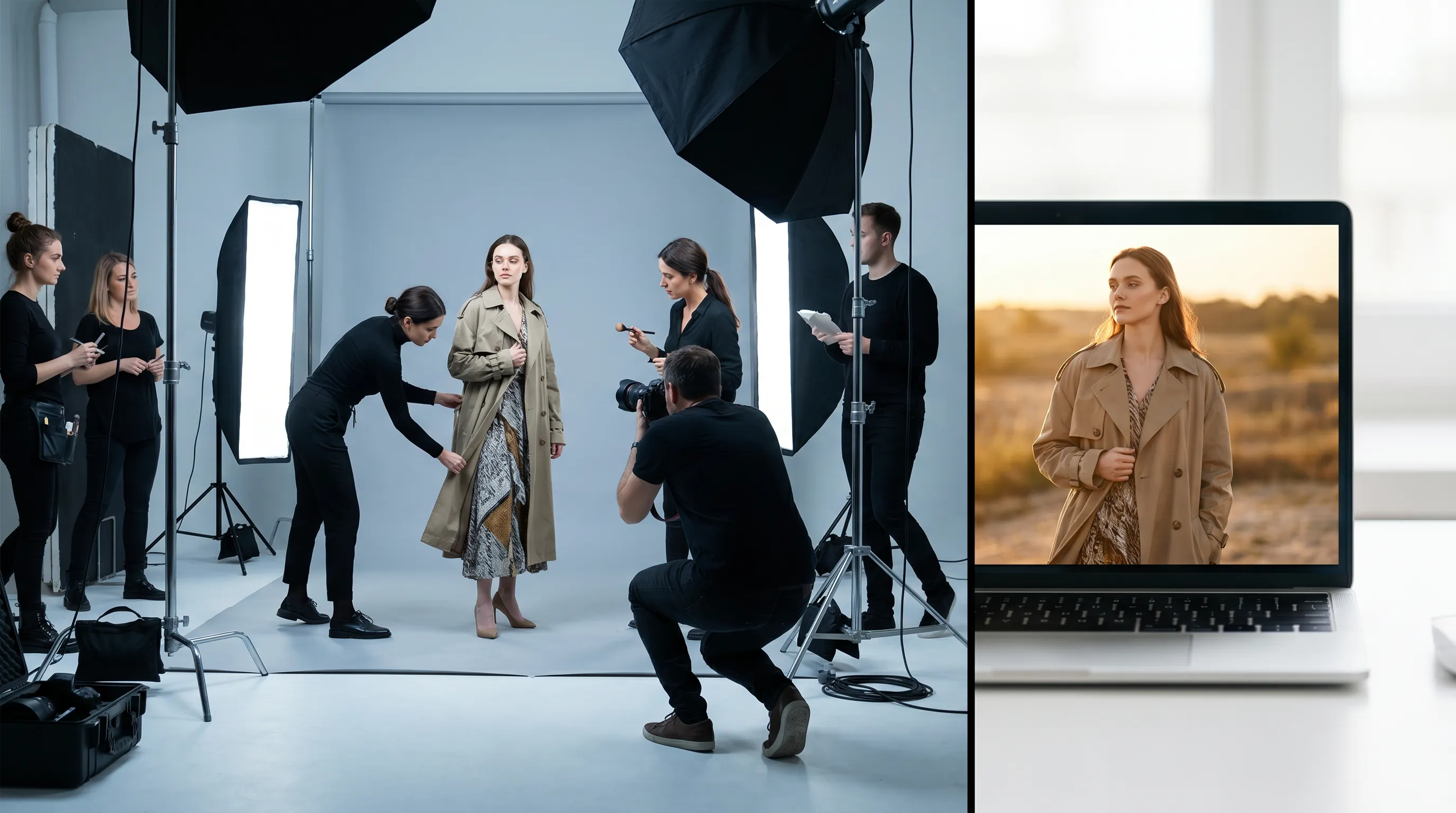
The day rate is never the real number. A fashion shoot is a stack of separately-billed line items: photographer at $1,000–$3,500/day (more in NYC/LA), an agency model at $500–$3,000/day, studio at $300–$1,500/day, stylist at $400–$1,800, hair and makeup at $250–$1,200, then $25–$150 per image for retouching (Wearview's 2026 breakdown). Squareshot publishes a representative all-in figure: $7,450 for a full 8-hour model shoot day, producing roughly 12–48 finished images (Squareshot 2026).
Spread across a day's output, that's $45–$200+ per finished image — and the effective number runs higher still, because hidden costs (sample shipping, rush retouching, model-usage renewals, the inevitable small reshoot) add 30–50% to initial budgets (Nightjar's cost analysis). Worst of all, it's a recurring tax: every colorway, restock, and season re-books the entire production. (Launching with no budget at all? The zero-budget playbook is the page for you — this one is for brands already shooting.)
Where the money goes on a shoot day
Fix one: cut the real shoot's line items
If a live shoot is non-negotiable, the stack is still compressible. Drop on-model where it isn't earning: flat-lay and ghost-mannequin frames cost $25–$75 each versus $100–$500+ for on-model, and removing the model + HMUA lines saves $750–$4,200/day (Nightjar). Book half-days and batch aggressively — the crew cost is fixed, so per-image cost falls as frame count rises; brands that batch a quarter's SKUs into one day routinely halve their effective rate. Swap agency for freelance talent on catalog work ($500–$1,200 vs $1,500–$3,000+) where a recognizable face adds nothing. Keep retouching basic ($25–$50/image) for white-background PDP frames. Use a daylight studio and skip the lighting-rig rental.
Run all five tactics well and a lean day still lands around $2,000–$2,600. That's the floor of the live-shoot model — the crew has to eat. Getting below it requires changing the model, not the vendor.
Fix two: move catalog volume to ~$1 AI images
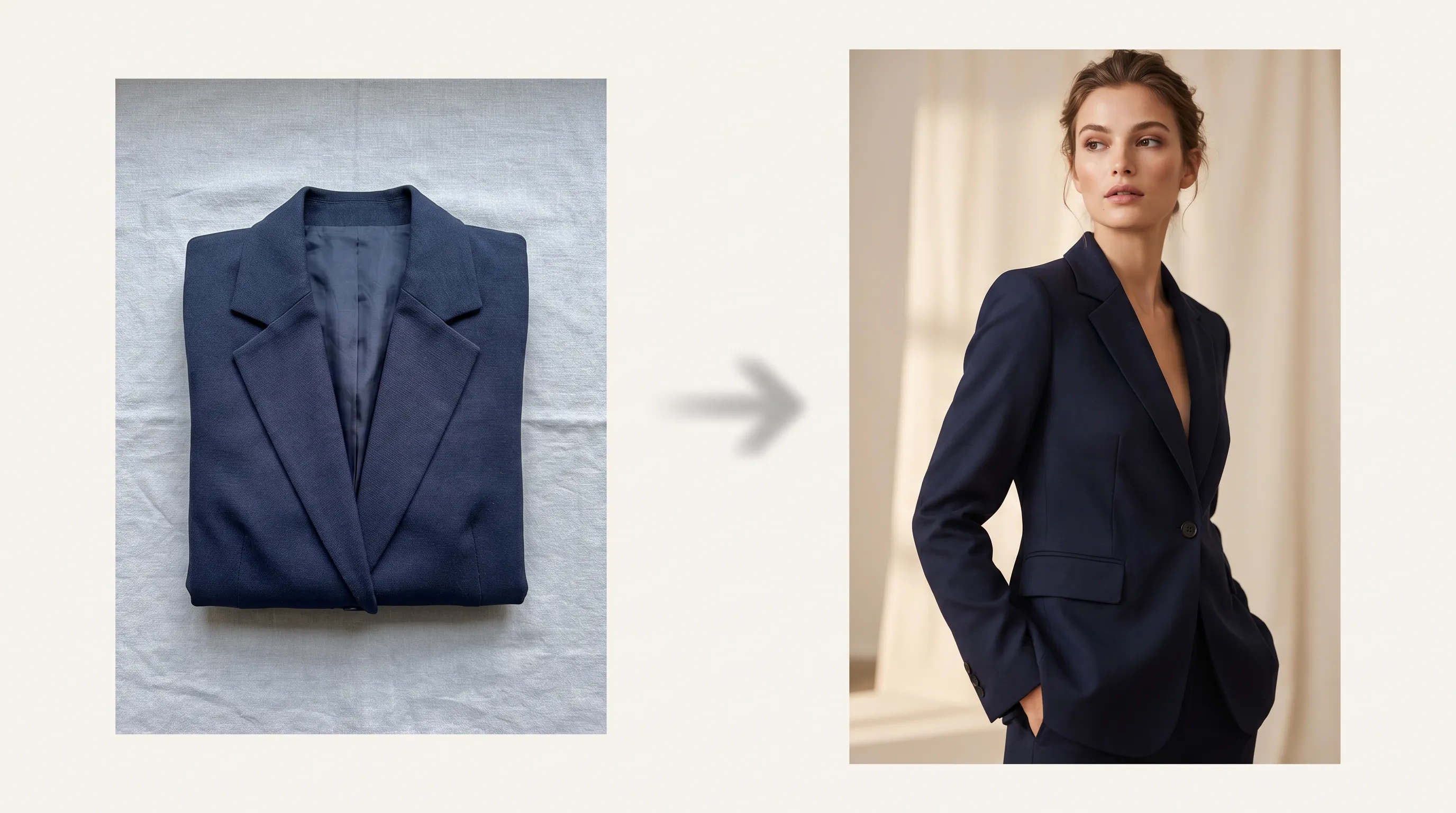
Adstronaut AI Photoshoots renders editorial on-model imagery from a single garment photo — flat-lay, mannequin, or an existing shoot frame — at 5 credits per pose, about $1 per finished image, in minutes. You direct it like a shoot: 22 named, consistent models (the same face across your whole catalog), 8 poses, 12 studio and location scenes plus 36 lifestyle presets, and full-outfit assembly from separate garment uploads. Output on paid plans is commercially licensed with no model releases — the models are synthetic — and there's no retouching invoice because the render is the final.
The jobs that should move first are the ones where the live stack is most wasteful: PDP pose sets (a 6-frame set: ~$6), colorway variants (recolor at ~$0.50, re-render on the same model and scene — no new sample, no re-book), ad-creative A/B variants (four model/scene tests for under $20 against a five-figure live test), and marketplace angle requirements via the Lookbook Creator. A 10-SKU drop's complete on-model catalog lands around $60–$100 in credits — against $2,500+ for the equivalent day.
Traditional shoot vs Adstronaut, line by line
| Line item | Traditional shoot | Adstronaut AI |
|---|---|---|
| Photographer | $1,000–$3,500/day | $0 — generation replaces the crew |
| Model | $500–$3,000/day + usage renewals | $0 — 22 synthetic named models included |
| Studio + styling + HMUA | $950–$4,500/day combined | $0 — 12 scenes and 8 poses selected in-app |
| Retouching | $25–$150 per image | $0 — output is final |
| Lead time | 1–3 weeks scheduling + post | Minutes per generation |
| Model releases | Required, with usage windows | None — synthetic models, licensed on paid plans |
| Cost per finished image | $45–$200+ (hidden costs add 30–50%) | ~$1 (5 credits per pose) |
| 10-SKU drop, full on-model catalog | $2,500–$8,000+, re-billed each season | ~$60–$100 in credits, regenerate any time |
Line-item ranges per Wearview, Squareshot, and Nightjar (2026); Adstronaut per its plan credits (plans from $29/month).
When the live shoot is still worth it (the honest split)
AI doesn't replace every shoot, and pretending otherwise would cost this page its usefulness. Keep the crew when the campaign is the product: a luxury hero frame, named-talent collaboration, or motion-heavy work where real fabric in real wind carries the story. Keep it when fit-on-a-real-body is the purchase driver — bridal, tailoring, technical performance wear under scrutiny. And keep it for the one defining editorial concept a year that sets the brand's visual language.
The pattern profitable brands converge on is a hybrid budget: one or two live shoot days a year for hero frames (budgeted properly — full cost anatomy here), with the recurring catalog volume — PDP sets, colorways, restocks, ad variants, marketplace angles — running on AI at ~$1 per image. That converts photography from a per-drop tax into a fixed annual line plus near-zero marginal cost.
Cut your cost per image this quarter: 4 steps
- 1
Compute your real cost per finished image
Last shoot's all-in spend (crew, studio, retouch, shipping, reshoots) divided by usable frames. Most brands land at $45–$200+ — write the number down; it's your benchmark. - 2
Tag your imagery by job
Split the catalog into hero frames (brand-defining, keep live) and volume frames (PDP sets, colorways, angles, ad variants — candidates to move). - 3
Pilot one SKU's volume set on AI
Run a current product through AI Photoshoots — same model across 4–6 poses, ~$5 in credits (free plan covers the first test shots). Compare against your benchmark image quality and cost. - 4
Rebuild the budget around the split
Book the crew for the hero days only; route colorways, restocks, and variants through generation. Track the per-image number quarterly — that's the metric this whole fix moves.
Who this fix is built for
Shopify and Amazon sellers adding colorways and seasonal SKUs without re-booking the production. Performance marketers spinning model and scene variants for ad testing at credits instead of crew rates. Multi-market brands localizing the model per audience — North American campaign, Southeast Asian PDP, European editorial — from one source photo. Production-stage brands whose shoot calendar, not their factory, is what delays the drop.
If that's you, the per-image math is the whole argument: $45–$200 versus ~$1, with the hero frames still shot the way they deserve. For platform-specific specs once the volume moves, see AI product photos for Shopify and the TikTok Shop image guide.
Frequently asked questions
How much does a product photoshoot cost in 2026?
A typical fashion production day stacks to $2,500–$8,000 — photographer ($1,000–$3,500), model ($500–$3,000), studio ($300–$1,500), stylist, hair and makeup, plus $25–$150 per image retouching. Squareshot's published full-day model-shoot rate is $7,450. Per finished image that's $45–$200+, with hidden costs (sample shipping, rush fees, reshoots) adding 30–50%.
Why is fashion photography so expensive?
Because it's a stack of separately-billed specialists, not one fee — six invoices per day before retouching. The fixed crew cost also makes small batches brutal: shooting 12 frames costs nearly the same as shooting 48, and every colorway or restock re-books the entire production. The structure, not any single vendor, is the expense.
How can I make a traditional shoot cheaper?
Five levers: shoot flat-lay/ghost-mannequin where on-model isn't earning (saves $750–$4,200/day in model + HMUA); book half-days and batch a quarter's SKUs into one session; use freelance over agency talent for catalog work; keep retouching basic ($25–$50/image) on white-background frames; choose a daylight studio. A tightly-run day still floors around $2,000–$2,600 — below that you change the model, not the vendor.
How much cheaper is an AI photoshoot really?
About $1 per finished on-model image (5 credits per pose) versus $45–$200+ from a live day — a 10-SKU drop's complete catalog runs $60–$100 in credits against $2,500–$8,000. There's no retouching line (renders are final), no scheduling lead time, and no usage renewals. Hero-campaign frames are the exception worth keeping live.
Will AI images match my real product?
Garment fidelity is the design priority: pattern, color, fabric texture, seam placement, and hardware carry from your input photo to the render. Brands report return rates in line with traditional photography because the product shown matches the product shipped. Test it on your own SKU — the free plan's credits cover about five watermarked trial shots.
Can I A/B test ad creative without re-shooting?
Yes — this is one of the highest-ROI moves. Generate the same garment on four different models or scenes for under $20 in credits and let the ad platform pick the winner, versus a five-figure live test. Winning variants can then be extended across the catalog with the same model for consistency.
How do colorways work without a reshoot?
Recolor the source image against 2,300+ Pantone TCX codes in the Color Changer ($0.50), then re-render on the same model, pose, and scene in AI Photoshoots ($1). The new variant drops into the catalog visually consistent with the original shoot — no new sample, no booking, same afternoon.
When is a real photoshoot still worth the money?
When the frame's job is brand-defining rather than catalog: luxury hero imagery, named-talent collaborations, motion work where real fabric movement carries the story, and fit-scrutiny categories like bridal and tailoring. The efficient structure is hybrid — one or two live days a year for those, AI for the recurring volume.
Cut your cost per image to about $1
Keep the hero shoot. Move the catalog volume. Upload one garment photo, pick a model, pose, and scene — finished on-model imagery in minutes, free test shots included.
Try AI PhotoshootsKeep going
Sources and further reading
- Wearview — the real cost of a fashion photoshoot (2026) — line-item day rates per role
- Squareshot — clothing photoshoot cost (2026) — published $7,450 full-day model shoot; $2,500–$8,000 typical day range
- Nightjar — product photography cost breakdown — per-image ranges by type; hidden costs add 30–50%; 2–3× effective multiplier
- Soona — model hiring costs (2026) — agency vs freelance model day rates