
Can't afford a tech pack designer? Here's how to spec your collection on a pre-launch budget
Updated June 10, 2026
Freelance technical designers charge $100–$300 for a simple tee, $300–$600 for a dress, and $600–$1,200+ for structured outerwear — roughly $1,500–$5,000 to spec a first 8–12 style collection (Successful Fashion Designer survey). If that's out of reach pre-launch, the honest cheaper routes are free templates, learning the basics yourself, and starting with one simple style — or generating a factory-ready pack from a photo for $3–6 with Adstronaut AI, first pack free as a watermarked preview.

Why tech pack designers feel out of reach pre-launch
You found a sample maker, you have a garment you believe in, and the factory asks for a tech pack. So you message a freelance technical designer — and the quote lands somewhere you weren't ready for. A simple tee runs $100–$300, a dress or mid-complexity style $300–$600, and structured outerwear $600–$1,200+ (Successful Fashion Designer's published rate survey). Hourly, that's $25–$50 for a junior freelancer and $72–$95 for an experienced one (per the same survey and ZipRecruiter's freelance technical-designer data).
The per-style number isn't the whole bill. Most freelancers include only 1–2 revisions and charge $50–$150 for each round after (cost breakdowns from clothing producers), and a vague brief typically needs 2–4 rounds. Rush work adds 25–50%. Stack it across a collection and a first 8–12 style drop is $1,500–$5,000 before you've sold a single unit. That's the cruelty of the pre-launch math: the spec is gatekeeping the sample, the sample is gatekeeping the sale, and the cash to pay for the spec only exists after the sale.
This page is about the cheaper routes that actually work. If your problem isn't cost but the calendar — the pack itself taking days you don't have — the sibling fix tech pack takes too long covers the speed angle directly.
What designers actually charge
Cheaper route 1: a free template plus a reusable component library
Before you pay anyone, get a free tech pack template. A good one structures every section a factory expects — flat-sketch placeholders, bill of materials (BOM), points of measure (POMs), construction notes, colorways — so you're filling in blanks instead of inventing a document. Google Sheets, Excel, and Canva templates cost $0, and Adstronaut publishes free sample packs across common garment types (graphic tee, hoodie, slip dress, denim, sneaker) you can study as worked examples.
The lever that compounds is a reusable component library. Save your standard rows once — the fleece you always use, your usual YKK zipper, your default rib trim — and every style after the first reuses them instead of being typed from scratch. That alone can halve the materials-and-measurements time on each subsequent style.
The honest ceiling: a template gives you the structure, not the hardest content. It still leaves you to draw the flat sketch and decide every measurement — which is exactly where most first-time founders stall. And the failure mode is costly: vague specs are the leading cause of first-sample rejection, and a template makes it easy to ship a half-empty BOM or unmeasured POMs without realizing it. Five no-Illustrator methods compared walks the template route in depth, including which sections factories actually reject when they're left vague.
Cheaper route 2: learn the basics and spec one simple style first
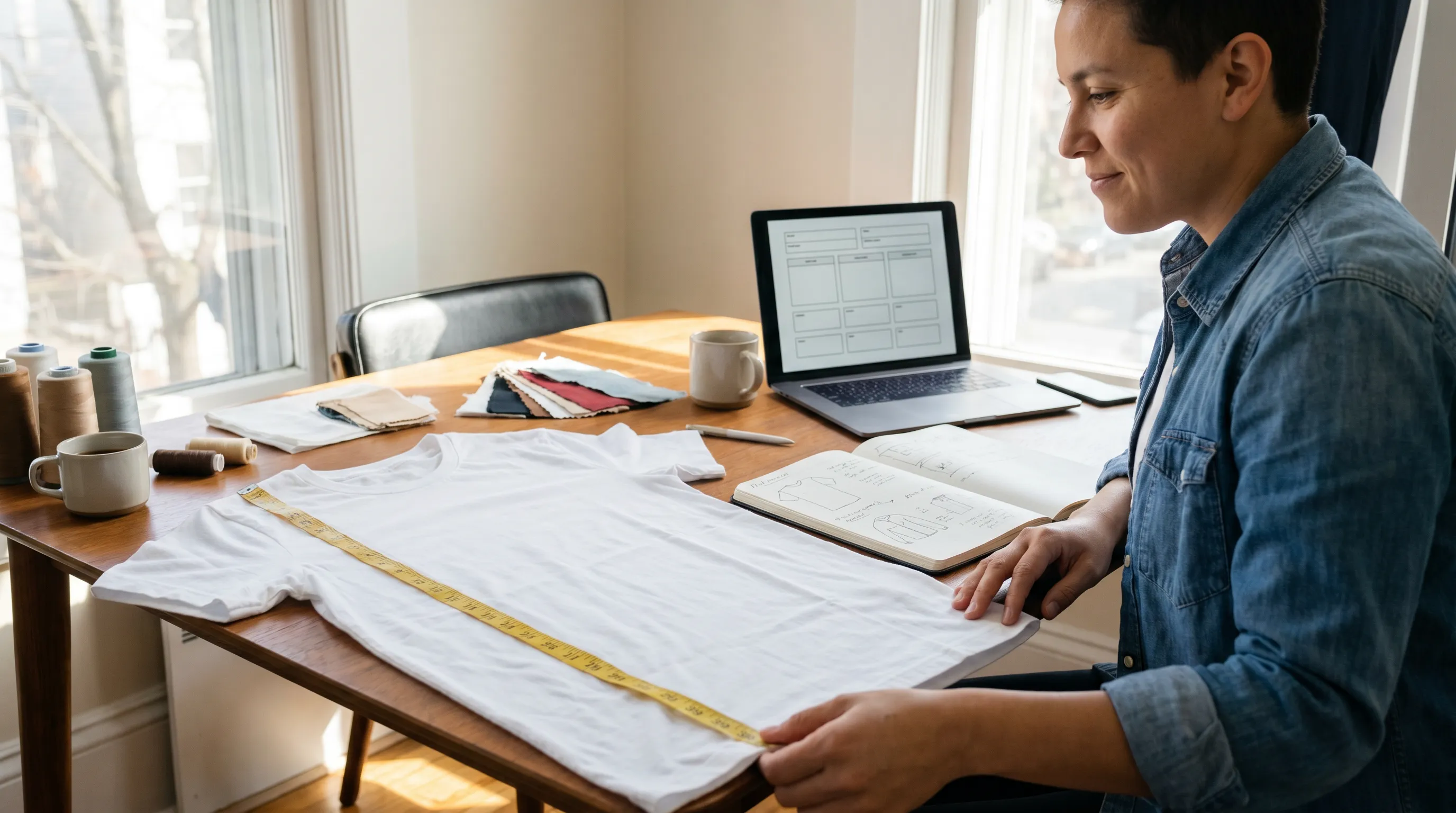
You do not need a fashion degree to produce a usable tech pack — you need to understand five things: the flat sketch (front and back line drawing), the BOM (every material and trim with supplier and quantity), the points of measure (where the garment is measured), grading (how those measurements change across sizes), and construction notes (seam and stitch callouts). A weekend of reading covers the vocabulary; what is a tech pack and how to create a tech pack are free starting points, and studying a finished sample pack teaches the format faster than any tutorial.
Then start with your simplest style. A boxy tee or a basic crewneck is a far gentler first tech pack than a lined jacket, and the skills transfer. Spec the easy piece yourself, send it to the factory, and use the first-sample feedback as your real-world tutorial — the factory will tell you exactly what was unclear, which is the fastest way to learn what a complete pack needs. Borrow the measuring points and BOM categories from a sample pack in your garment class so you're adapting a known-good structure rather than guessing.
The honest trade-off: this route costs time instead of money. Drawing the flat by hand without CAD experience is slow and frustrating, and a self-taught first pack often needs an extra sample round while you learn — and that extra round has a real cost in both sampling fees and weeks of calendar. It's the right call when your runway is long and your budget is near zero, and it pairs naturally with generation: let the AI handle the flat and the first-draft specs, and spend your learning time on the review instead of the blank page.
The structural fix: generate the pack from a photo for $3–6
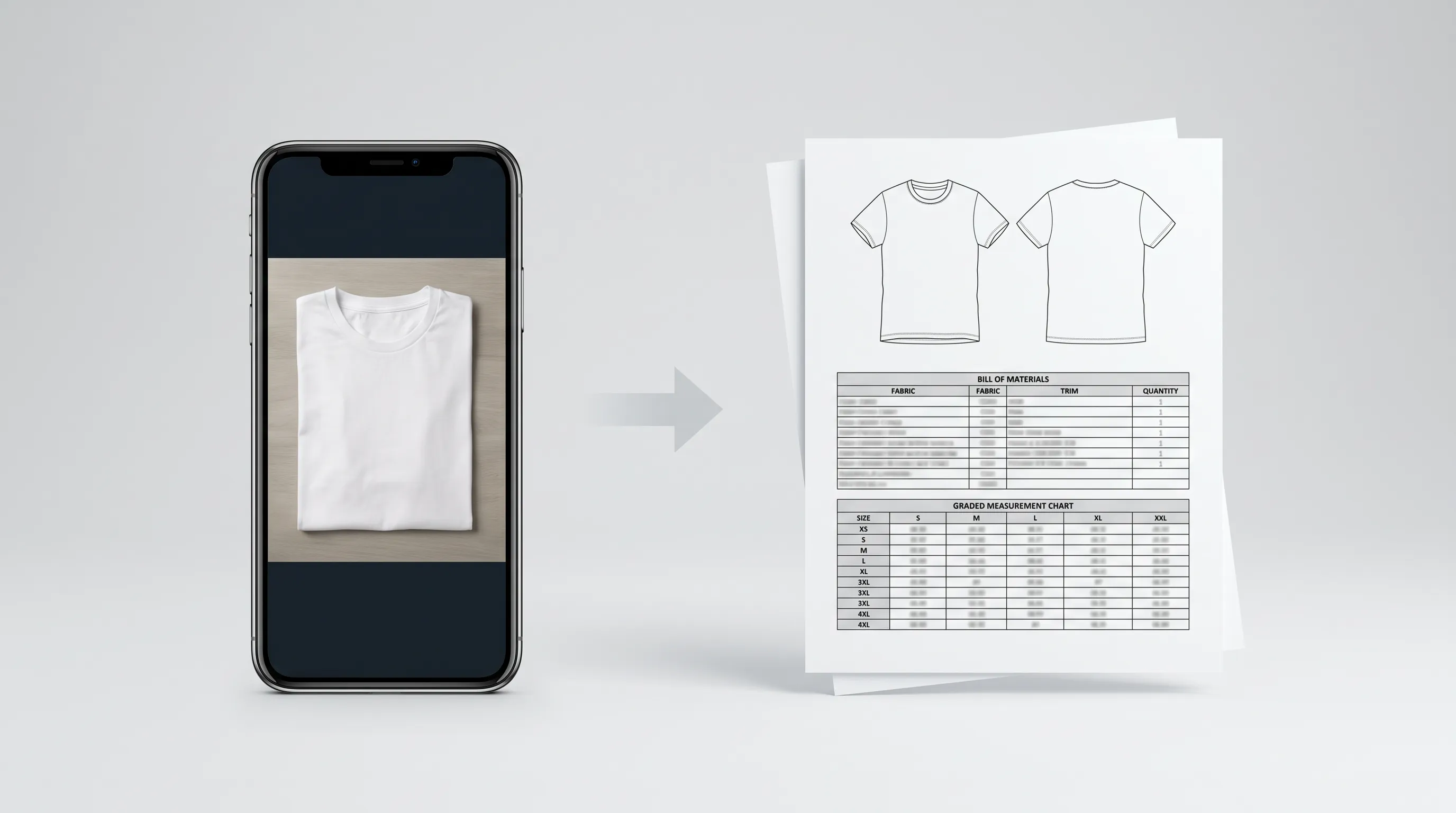
Templates and self-teaching both leave the two hardest jobs on your desk — drawing the flat and deciding every spec. Generation removes them. Adstronaut's AI Tech Pack Generator takes one photo of your sample — flat-lay, mannequin shot, mockup, or clean sketch — and returns the annotated flat sketch, a structured BOM, graded measurements with tolerances, construction notes, and Pantone colorways in 3–5 minutes.
The cost is the part that changes the pre-launch math: a tech pack is 25 credits, which works out to $3–6 depending on plan (plans start at $29/month), and the first pack is free as a watermarked preview so you can judge the output before spending anything. That's not a discount on the freelance route — it's a different order of magnitude. A 10-style collection that quotes at $1,500–$5,000 from freelancers runs roughly $30–$60 in credits, and class coverage spans apparel, footwear, leather goods, knitwear, and bodywear with the correct sections for each.
What stays human is review, not creation: 10–15 minutes typing your real supplier names into the BOM, refining measurements off the sample you're holding, and attaching any custom artwork. You keep the judgment a freelancer would charge for; you skip the part you couldn't afford.
This is also why generation beats the two free routes on speed and risk, not just price. A template hands you a blank flat to draw and a blank spec to fill; self-teaching hands you both plus a learning curve. Generation hands you a complete first draft you correct — which is the difference between staring at an empty document at 11pm and editing one that's already 90% right. End to end you're at a factory-ready PDF in under 30 minutes per style, versus the 3–7 business days a freelancer quotes per pack.
Every budget route, priced honestly
Four ways to get a factory-ready spec when a designer's quote is out of reach — with the real catch on each.
| Route | Out-of-pocket cost | What it costs you instead | The catch |
|---|---|---|---|
| Free template + component library | $0 | Your hours; CAD skill for the flat | Structures the doc but you still draw the flat and decide every spec |
| Learn the basics, spec it yourself | $0 | A weekend of study + slow first packs | Self-taught first pack often needs an extra sample round |
| Freelance technical designer | $100–$1,200+ per style; $1,500–$5,000 a collection | Queue time, revision fees ($50–$150/round) | The route you can't afford pre-launch; that's why you're here |
| Adstronaut AI (generate from a photo) | $3–6 per pack; first free | 10–15 min review per style | Bespoke placement artwork still wants a manual pass |
Freelance rates per Successful Fashion Designer's published survey and clothingproducer.com; Adstronaut pricing per its credit catalog (25 credits per pack, plans from $29/mo).
The pre-launch math, side by side
Spec your first style this week on near-zero budget: 4 steps
A concrete plan that gets a factory-ready pack to your sample maker without paying a designer.
- 1
Pick your simplest style first
Choose the boxy tee or basic crew, not the lined jacket. The skills transfer up, and a simple first pack is the cheapest possible way to learn what a factory needs. - 2
Generate it free and judge the output
Upload the sample photo to the Tech Pack Generator — the first pack is free as a watermarked preview, so you risk nothing comparing it against a blank template. - 3
Do the 10–15 minute human review
Type your real supplier names into the BOM, correct each measurement against the sample in your hands, and attach any artwork. That's the judgment a freelancer would have billed you for. - 4
Send it, then batch the rest
Ship the pack, learn from the first sample, then run the remaining styles in one session — 10 packs is roughly $30–$60 in credits versus $1,500–$5,000 freelance.
When paying a designer is still the right call
Generation isn't always the answer, and the honest cases matter. A genuinely complex hero piece — a tailored, fully-lined jacket with intricate internal construction, or a structured bag with hardware engineering — can warrant a freelance technical designer or pattern maker who will physically interrogate the seam allowances and grade rules. If that one garment is the entire bet, $600–$1,200 to get it unambiguously right is cheap insurance against repeated sample failures.
A designer also buys accountability and a relationship. A good freelancer will catch a manufacturability problem you'd never see, push back on an impossible spec, and stand behind revisions. If you're raising on the collection, or the construction is the product, that human judgment is worth paying for — pair it with generation: draft every style from a photo, then spend your freelance budget on a focused review of only the trickiest one or two. Many funded brands run exactly this hybrid, and it's far cheaper than handing the whole collection over.
The deeper cost breakdown — freelancer versus AI versus in-house, with the math on each — lives in how much does a tech pack cost.
Who this is for
Pre-launch and first-time founders feel this hardest: the spec is the gate to the sample, but the cash for the spec only exists after the sale, so a $400-per-style quote stalls the whole launch. Generation breaks the deadlock because $3–6 a pack fits a pre-revenue budget.
Bootstrapped indie and DTC brands shipping 10–50 styles feel it as a collection-wide tax — $1,500–$5,000 per drop, every drop. Batching generated packs turns that into tens of dollars and an afternoon.
Designers without CAD skills are stuck twice over: they can't draw the flat themselves and can't afford to hire it out. Generation is the only route that removes both the skill barrier and the cost barrier at once. If the speed of production is your real bottleneck rather than the price, start with tech pack takes too long; if drawing flats in Illustrator is the specific pain, see Illustrator too slow for tech packs.
Frequently asked questions
How much does a freelance tech pack designer charge?
Roughly $100–$300 for a simple tee, $300–$600 for a mid-complexity style like a dress, and $600–$1,200+ for structured outerwear, per Successful Fashion Designer's published rate survey. Hourly, juniors run $25–$50 and experienced designers $72–$95. Most include only 1–2 revisions and bill $50–$150 for each round after, with 25–50% rush premiums.
What's the cheapest way to make a tech pack?
If your budget is near zero, a free template plus learning the basics costs $0 out of pocket — but takes a weekend of study and your hours drawing the flat. The cheapest route that still removes the hard work is generating the pack from a photo: about $3–6 per pack (25 credits) with Adstronaut, and the first one is free as a watermarked preview so you can judge it before paying.
Can I make a tech pack without hiring a designer?
Yes. Free templates structure the document, and AI generation produces the flat sketch, BOM, graded measurements, and construction notes from a single photo — no CAD skill and no freelancer required. You still do a 10–15 minute review to add real supplier names and correct measurements against your sample, which is the judgment a designer would otherwise charge for.
Are free tech pack templates good enough for a factory?
A template gives you the right structure, but not the hardest content — it still leaves you to draw the flat sketch and decide every measurement, which is where most first-time founders stall and where factories most often reject vague packs. Templates are a solid free starting point; pair them with generation if drawing the flat or deciding the specs is your real blocker.
How much does it cost to spec a whole first collection?
A typical first 8–12 style collection runs $1,500–$5,000 with freelance designers, before extra revision rounds. Generating the same packs from photos runs roughly $30–$60 in credits for a 10-style drop — a different order of magnitude, not a discount. The first pack is free as a watermarked preview.
Do I need Illustrator or design skills to make a tech pack on a budget?
No. The flat sketch is the part that normally demands Illustrator skills, and generation draws it from your photo, so no CAD or design degree is needed. If you can upload an image, you can produce a factory-ready pack. Templates, by contrast, still assume someone draws the flat in vector software.
Is a cheap or AI-generated tech pack lower quality?
Quality is about completeness, not price — factories judge whether the flat, BOM, graded measurements, and construction notes are clear and unambiguous, not how the document was produced. A complete generated pack reviewed for 10–15 minutes is typically clearer than a rushed self-taught one. The risk with any budget route is leaving sections vague, which causes extra sample rounds.
Should I ever still pay a freelance designer?
Yes — for a genuinely complex hero piece (a fully-lined tailored jacket, a structured bag with hardware) where one garment is the whole bet, or when you need a human to catch manufacturability problems and stand behind revisions. The cheapest version of that is a hybrid: generate every style from a photo, then spend a small freelance budget reviewing only the one or two trickiest packs.
What does the first free tech pack include?
The first pack is free as a watermarked preview, so you get the full generated output — flat sketch, BOM, graded measurements with tolerances, construction notes, and Pantone colorways — to judge against your needs before paying. Paid plans (from $29/month) remove the watermark and unlock the print-ready export at $3–6 per pack.
How fast is generating a pack compared to hiring out?
Generation returns a complete draft in 3–5 minutes, plus a 10–15 minute human review — under 30 minutes per style. A freelance technical designer averages 3–7 business days per pack, longer for complex styles, with each revision adding 2–5 business days. So the budget route is also the fast route.
Spec your collection without the designer fee
Skip the $100–$1,200 per style. Upload one photo of your sample and get a complete factory-ready tech pack — flat sketch, BOM, graded measurements, construction notes, Pantone colorways — in minutes. First pack free as a watermarked preview.
Try the AI Tech Pack GeneratorKeep going
Sources and further reading
- Successful Fashion Designer — freelance technical design rates — $100–$300 tee, $300–$600 mid, $600–$1,200+ outerwear; $25–$95/hr by experience
- AKCN / clothingproducer.com — tech pack cost guide — 1–2 revisions included, $50–$150 per extra round; vague briefs need 2–4 rounds
- ZipRecruiter — freelance technical designer hourly rate — US freelance technical-designer hourly benchmark
- Ninghow Apparel — freelancer vs factory tech pack cost — per-style and collection-level freelance cost ranges
- World Fashion Exchange — Tech Pack 101 — tech pack components and why vague specs cause sample failures