
What is a cost sheet in fashion?
Updated June 10, 2026
A cost sheet (or costing sheet) is the line-by-line build-up of what one garment costs to produce: fabric + trims + CMT labor + factory overhead + margin. It rolls those lines into the factory's FOB price, then adds freight and duty to reach landed cost. Fabric alone is typically 60–70% of a basic garment's cost, and apparel landed cost usually runs 15–30% above FOB.
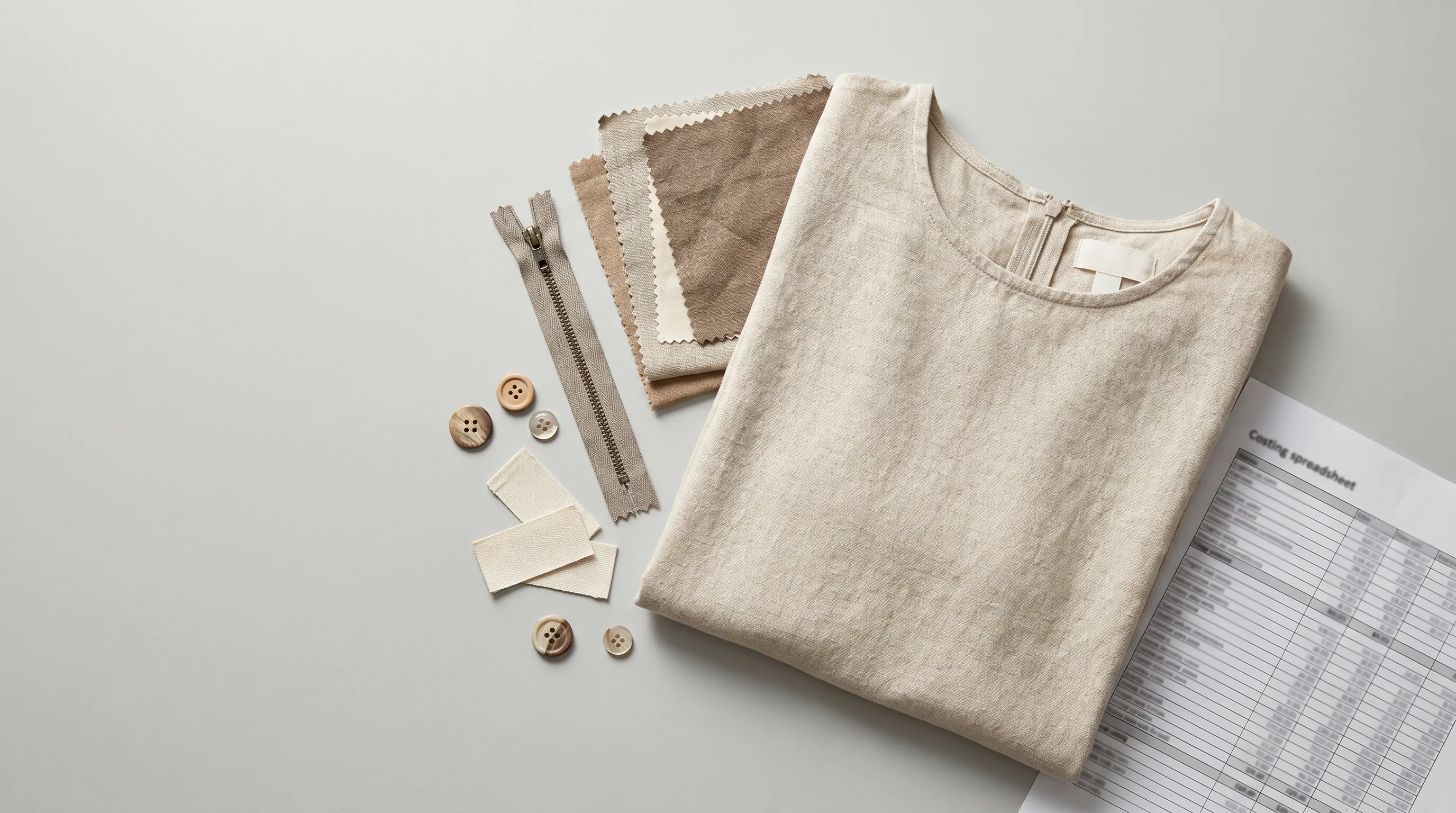
What is a cost sheet?
A cost sheet (also called a costing sheet or garment cost breakdown) is a structured document that adds up every input needed to make a single garment and rolls them into one per-unit cost. It is the bridge between what a garment is made of and what it should sell for — the tool a factory uses to quote a price and a brand uses to check whether a style can hit its margin target (Uphance).
What it captures: the cost sheet is organized into a handful of cost categories — fabric, trims and accessories, CMT (cut, make, trim) labor, factory overhead, packaging and freight, and finally the factory's profit margin. Add the first set of lines and you get the production cost; add margin and you get the price the factory quotes (Weft Apparel).
The key nuance: a cost sheet is not the same as a price. It is a build-up of true cost that a margin is then applied to. Two factories can return very different cost sheets for the same garment because labor rates, fabric sourcing, and overhead differ by country and order size — which is exactly why brands ask for the sheet, not just the final number. A transparent, itemized cost sheet lets a brand negotiate line by line (challenge a high fabric price, or a thread allowance that looks inflated) instead of haggling over a single opaque figure. It also makes the sheet a planning tool: change the order quantity and you can watch overhead-per-unit fall, or swap a $4.50/m fabric for a $3.80/m one and see the FOB drop before you commit.
The components of a garment cost sheet
Every cost sheet is built from the same categories, even if the formatting differs by factory:
Fabric is almost always the largest single line. It is calculated as consumption (meters or yards per garment, including a cutting-waste allowance) multiplied by the fabric price. Fabric typically accounts for 60–70% of the cost of a basic-style garment, and can range from 40% to 70% depending on the style (Weft Apparel). Because it dominates the sheet, a small error in either consumption or price — a few cents per meter, or forgetting cutting waste — moves the whole per-unit cost more than any other line.
Trims and accessories are everything that isn't the main fabric: sewing thread, zippers, buttons, rivets, elastic, interlining, plus the brand, care, and size labels and the hangtags. Each gets its own quantity and unit cost, and on a heavily-trimmed style — a structured jacket, say — these lines can rival the fabric in total.
CMT — cut, make, trim — is the factory's labor and operating cost to actually cut the fabric, sew the garment, and finish it. CMT is quoted per unit and varies sharply with garment complexity and country (Jinfeng Apparel). A simple tee carries a low CMT; a lined coat with welt pockets carries a high one because it takes many more machine operations.
Overhead is the indirect cost of running the factory — supervision, utilities, equipment depreciation, quality control — spread across the order. It is why small production runs cost more per unit: the same fixed overhead divides across fewer garments.
Packaging and freight cover polybags, cartons, hangers, and the cost of moving goods to the port. Margin is the factory's profit, applied as a percentage on top of all the above to reach the quoted price.
Worked example: building a $19 FOB cost
From fabric line to FOB price, one garment
Take a simple cotton dress. Fabric consumption is 2.1 m at $4.50/m = $9.45. Trims — thread, a zipper, buttons, plus woven and care labels — total $2.55. CMT labor and finishing is $4.00. That is a production cost of $16.00 per unit. The factory applies an 18% margin (≈ $2.88) to reach an FOB price of ≈ $18.90.
That $18.90 is the number on the factory's purchase order — but it is not what the garment costs you. Add freight, duty, and inbound handling at ~22% (≈ $4.15) and the landed cost is ≈ $23.05. If you then wholesale at 2× landed you quote ≈ $46, and a 2× keystone retail markup lands the dress near $92 (AIMS360). Change only the fabric price and every downstream number moves — which is why the cost sheet starts with fabric.
Cost sheet line items at a glance
A standard apparel cost sheet groups inputs into these categories. Shares are indicative for a basic woven/knit style; complex or heavily-trimmed garments shift the mix.
| Cost category | What's in it | Typical share of cost |
|---|---|---|
| Fabric | Consumption (m/yd + waste) × fabric price | 40–70% (60–70% on basics) |
| Trims & accessories | Thread, zippers, buttons, elastic, interlining, labels, hangtags | 5–15% |
| CMT (cut, make, trim) | Factory labor to cut, sew, finish — per unit | 15–30% |
| Overhead | Supervision, utilities, QC, equipment depreciation | 5–15% |
| Packaging & freight | Polybags, cartons, inbound movement to port | 2–8% |
| Factory margin | Factory profit, applied on the cost build-up | 12–35% |
Fabric + trims + CMT + overhead + packaging = production cost; add margin to reach FOB. Shares per Weft Apparel and Uphance costing references — actuals vary by style, country, and order size.
How cost builds from fabric to retail
FOB cost vs landed cost
Two numbers get confused constantly, and the difference decides whether a style is actually profitable.
FOB (free on board) is the price on the factory's purchase order: FOB = BOM cost + CMT + factory margin. It is the cost of the goods loaded onto the ship at the origin port — everything the factory is responsible for, and nothing more (Uphance).
Landed cost is what it actually costs to get that unit into your warehouse: landed = FOB + freight + duty + inbound handling. For apparel imports, landed cost typically runs 15–30% above FOB (Leeline Apparel). The exact uplift depends on the duty rate for the garment's category and country of origin, the shipping mode (sea freight is cheaper per unit than air but slower), and how full the container is. Brands that set wholesale and retail prices off FOB alone systematically overstate their margins by that same 15–30%, which is how a style that looked profitable on the cost sheet loses money on the P&L. Always price off landed cost, never off FOB. For the full FOB-versus-CMT sourcing picture — including when you supply the fabric yourself — see what is CMT.

Cost sheet vs BOM: what's the difference?
A cost sheet and a bill of materials (BOM) are related but not the same document, and using them interchangeably causes pricing errors.
The BOM is the materials list: every fabric, trim, and label with its quantity, supplier reference, and per-unit cost — typically 8 to 25 line items for an apparel garment (Uphance). It answers what the garment is made of and what those materials cost.
The cost sheet takes that material total and adds the things the BOM doesn't carry — CMT labor, factory overhead, packaging, and margin — to produce the FOB or wholesale price. In short: the BOM is an input to the cost sheet. A priced BOM feeds the fabric-and-trims block; the cost sheet wraps labor, overhead, and margin around it. This is where a complete bill of materials earns its keep — if the BOM is missing a fabric weight or a trim, the cost sheet inherits the gap. Adstronaut's tech pack generator produces a structured BOM with per-material price fields, so the materials half of the cost sheet is populated straight from the spec rather than re-keyed by hand.
Common cost sheet mistakes
Pricing off FOB instead of landed cost. The single most expensive error — it hides freight and duty, overstating margin by 15–30% on imports. Always carry the sheet through to landed before you set a wholesale price.
Confusing markup with margin. A 50% markup on cost is only a 33% margin on the selling price. Calculating markup when you meant margin systematically under-prices the garment (AIMS360). Decide which you mean and label it on the sheet.
Forgetting fabric waste. Fabric consumption must include the cutting-waste allowance, not just the net pattern area. Under-stating consumption understates the biggest line on the sheet — the one that's already 60–70% of cost.
Leaving trims off. A thread, an interlining, or a care label omitted from the BOM never reaches the cost sheet, so the quoted cost is low and the first invoice is a surprise. A complete, priced bill of materials is the only reliable defense.
Treating one factory's sheet as the truth. CMT and margin vary by country and order size; a single quote isn't a benchmark. Get two or three cost sheets for the same tech pack and compare them line by line — the differences usually live in CMT and fabric sourcing, not in the trims.
Building the sheet before the spec is final. A cost sheet priced against an incomplete tech pack will be re-quoted the moment a real BOM lands. Lock the spec, then cost it.
Frequently asked questions
What is a cost sheet in the garment industry?
A cost sheet (or costing sheet) is a structured document that adds up every input needed to make one garment — fabric, trims, CMT labor, factory overhead, packaging — and applies a margin to reach the quoted price. It's the bridge between what a garment is made of and what it should sell for.
What are the components of a garment cost sheet?
Fabric (consumption × price), trims and accessories (thread, zippers, buttons, labels), CMT labor to cut/make/finish, factory overhead, packaging and freight, and the factory's margin. Fabric is usually the largest line — 60–70% of a basic garment's cost.
What is the difference between a cost sheet and a BOM?
A BOM (bill of materials) is the materials list — every fabric, trim, and label with quantity and per-unit cost, typically 8–25 lines. A cost sheet takes that material total and adds CMT labor, overhead, packaging, and margin to reach FOB or wholesale price. The BOM is an input to the cost sheet.
What is FOB cost in apparel?
FOB (free on board) is the price on the factory's purchase order: FOB = BOM cost + CMT + factory margin. It's the cost of goods loaded onto the ship at the origin port — everything the factory is responsible for, but not freight, duty, or inbound handling.
What is the difference between FOB and landed cost?
FOB is the price at the origin port. Landed cost adds freight, duty, and inbound handling to get the unit into your warehouse: landed = FOB + freight + duty + handling. Apparel landed cost typically runs 15–30% above FOB, so always price off landed, not FOB.
How is garment cost calculated?
Add fabric (consumption × price, including waste) + trims + CMT labor + overhead + packaging to get production cost, then apply the factory's margin for FOB. Add freight and duty for landed cost. Example: $9.45 fabric + $2.55 trims + $4.00 CMT = $16.00, +18% margin ≈ $18.90 FOB.
What percentage of garment cost is fabric?
Fabric typically accounts for 60–70% of the cost of a basic-style garment, and ranges from about 40% to 70% depending on the style and how much trim and labor the garment requires. It's almost always the single largest line on the cost sheet.
What is the difference between markup and margin on a cost sheet?
Markup is added on top of cost; margin is a share of the selling price. A 50% markup on cost is only a 33% margin on the sale price. Confusing the two is a common costing error that under-prices the garment — decide which you mean and label it on the sheet.
How do brands price a garment from the cost sheet?
They carry the cost sheet through to landed cost, then apply a markup. A common pattern is keystone pricing — roughly 2× landed cost for wholesale and 2× wholesale for retail — though multiples of 1.8×–2.5× are used depending on brand positioning and volume.
Feed your cost sheet straight from the spec
Upload one garment photo and get a factory-ready tech pack with a structured BOM — per-material price fields included — so the materials half of your cost sheet is populated from the spec, not re-keyed by hand. First pack free, then $3–6.
Try the AI Tech Pack GeneratorRelated reading
Sources and further reading
- Weft Apparel — garment costing sheet — cost categories; fabric 60–70% of basic-garment cost
- Uphance — garment costing & pricing — FOB = BOM + CMT + margin; BOM 8–25 lines; landed = FOB + freight + duty
- Leeline Apparel — manufacturing cost breakdown — landed cost runs 15–30% above FOB for apparel imports
- Jinfeng Apparel — costing a garment for CMT — CMT = factory labor/overhead per unit, varies by complexity and country
- AIMS360 — fashion profit margin & pricing — keystone 2× wholesale/retail; markup vs margin distinction