
Canva vs Adstronaut AI for fashion tech packs
Updated June 10, 2026
Canva is a general design platform — 265M+ monthly users, free or $15/month Pro — that lays out spec-sheet templates but cannot draw a flat sketch, build a structured BOM, or grade measurements. Adstronaut AI generates the factory-ready technical content itself — flats, BOM, graded points of measure — from one garment photo in minutes for $3–6 per pack. Canva formats the document; Adstronaut writes what goes in it.
Canva vs Adstronaut AI: the quick verdict
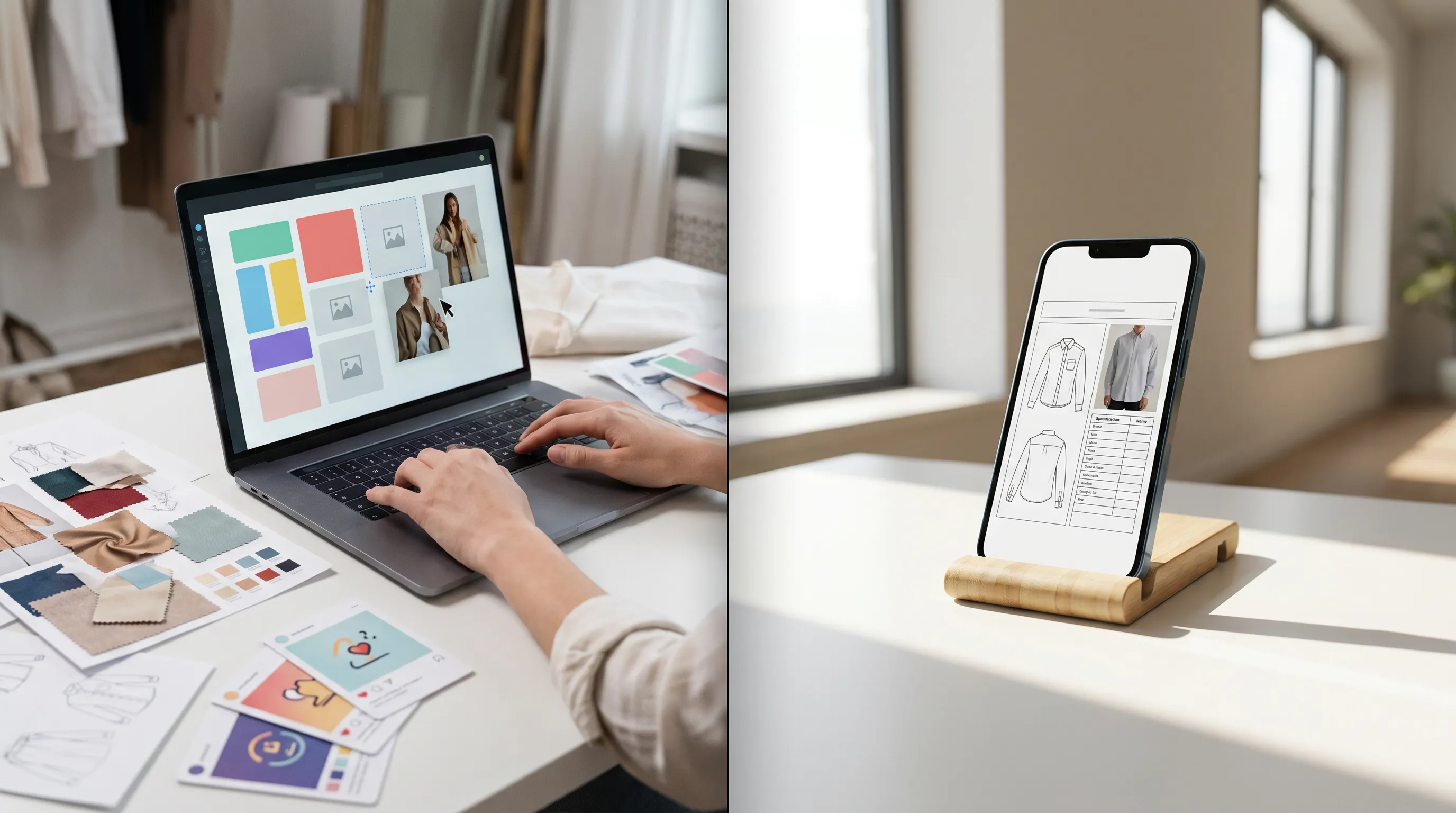
Canva and Adstronaut AI both produce a document that looks like a fashion tech pack — but they're built for opposite jobs. Canva is the world's default drag-and-drop design platform: 265 million+ monthly active users and $4B in annual recurring revenue as of its last reported year (TechCrunch, Feb 2026). It excels at layout — mockups, line sheets, lookbooks, marketing graphics. What it cannot do is the technical core: it draws no flat sketches, structures no bill of materials, and its tables are static — they display numbers you type, with no grading and no tolerances.
Adstronaut AI inverts that: you upload one product photo and the AI Tech Pack Generator returns the flat sketches, a structured BOM, graded points of measure, and construction notes in minutes. Choose Canva for everything around the tech pack — line sheets, lookbooks, launch graphics. Choose Adstronaut for the factory-ready technical content itself. Most brands that try to do both in Canva end up paying a freelancer for the parts Canva can't produce.
Canva vs Adstronaut AI, side by side
| Factor | Canva | Adstronaut AI |
|---|---|---|
| Price | Free; Pro $15/mo ($120/yr); Teams $10/seat/mo annual, 3-seat minimum (~$300/yr) | Plans from $29/mo (125 credits); a tech pack is 25 credits — $3–6 per pack |
| What it is | General-purpose design platform (265M+ MAU) | Purpose-built AI tech-pack generator for fashion |
| Flat sketches | None — import flats drawn elsewhere | Generated automatically from your photo, front and back |
| Bill of materials | Hand-built static table, no structure | Structured BOM with supplier, quantity, and per-unit price fields |
| Graded measurements (POMs) | Static table — no grade rules, no tolerances | Auto-generated and graded across the size run with tolerances |
| Garment-class intelligence | Generic templates with fixed fields | Class-specific sections: apparel, footwear, leather goods, knitwear, bodywear |
| Time per tech pack | 2–4 hours assembling a template — flats and specs sourced separately | 3–5 minutes to generate, 10–15 minutes to review |
| Mockups & marketing | Excellent — mockup generator, templates, brand kits | Not the focus — pairs with AI Photoshoots for on-model imagery |
| Skills required | Layout sense; you supply all technical content | None — upload a photo |
| Best for | Line sheets, lookbooks, decks, social graphics | Factory-ready specs for indie founders and small brands |
Canva pricing per Canva.com (2026); scale per TechCrunch's February 2026 reporting. Tech-pack capability assessed against the sections factories require.
Choose Adstronaut if… / Choose Canva if…
Choose Adstronaut AI if…
- ✓You need the technical content generated — flats, BOM, graded POMs — not just arranged on a page.
- ✓You can't draw a flat sketch and don't want to pay a freelancer $100–$600 per style for one.
- ✓Your factory keeps asking for tolerances, stitch specs, and graded charts a Canva table can't produce.
- ✓You make footwear, knitwear, or leather goods and need class-correct sections without learning the conventions.
- ✓You want the pack in minutes for $3–6, not an evening of template-wrangling plus outsourced specs.
Choose Canva if…
- ✓You need marketing assets: line sheets, lookbooks, buyer decks, social graphics — Canva is the best tool on this list for them.
- ✓You want quick print mockups — artwork on a blank tee or hoodie for a pre-sale test.
- ✓You already have flats and specs from a designer and only need them arranged cleanly for a flexible local maker.
- ✓Your team already lives in Canva and brand-kit consistency across marketing matters more than technical depth.
- ✓Budget is zero and the garment is genuinely simple — a basic tote or tee with a forgiving manufacturer.
These aren't rivals so much as neighbors: many brands run Canva for the launch assets and Adstronaut for the factory pack.
What a factory needs vs what each tool produces
How much does each actually cost?
Canva's pricing is per seat: Free for basic layout, Pro at $15/month ($120/year), and Teams at $10 per seat/month billed annually with a 3-seat minimum — roughly a $300/year floor (Canva pricing; note Canva's 2024 move to per-seat Teams pricing raised costs sharply for small teams). None of that buys technical content: you still draw flats in Illustrator, buy them from a freelancer at $100–$600 per style (Successful Fashion Designer rates), or skip them and accept the factory's guesswork.
Adstronaut prices the output: a tech pack is 25 credits — $5.80 on Standard ($29/month), $4.60 on Pro, about $3.10 on annual Studio. Call it $3–6 per pack, first one free as a watermarked preview. For a 20-style collection, a Canva-plus-freelancer workflow runs $2,000–$12,000 once the outsourced flats and specs are counted; the same collection generates for $60–$120 in Adstronaut — with the full cost breakdown here.
Why a Canva template isn't a factory-ready tech pack
A Canva tech-pack template gives you the frame of a tech pack — labeled sections, a tidy grid, room for a measurement chart — but none of the infrastructure that makes the document functional at a factory. There are no measurement-annotation tools, no grade-rule logic, no BOM structure; tables are static displays (Style3D's analysis of Canva tech packs reaches the same conclusion). Most critically, Canva cannot generate a flat sketch — the one page a factory reads first — so you import it from somewhere else or send a pack without it.
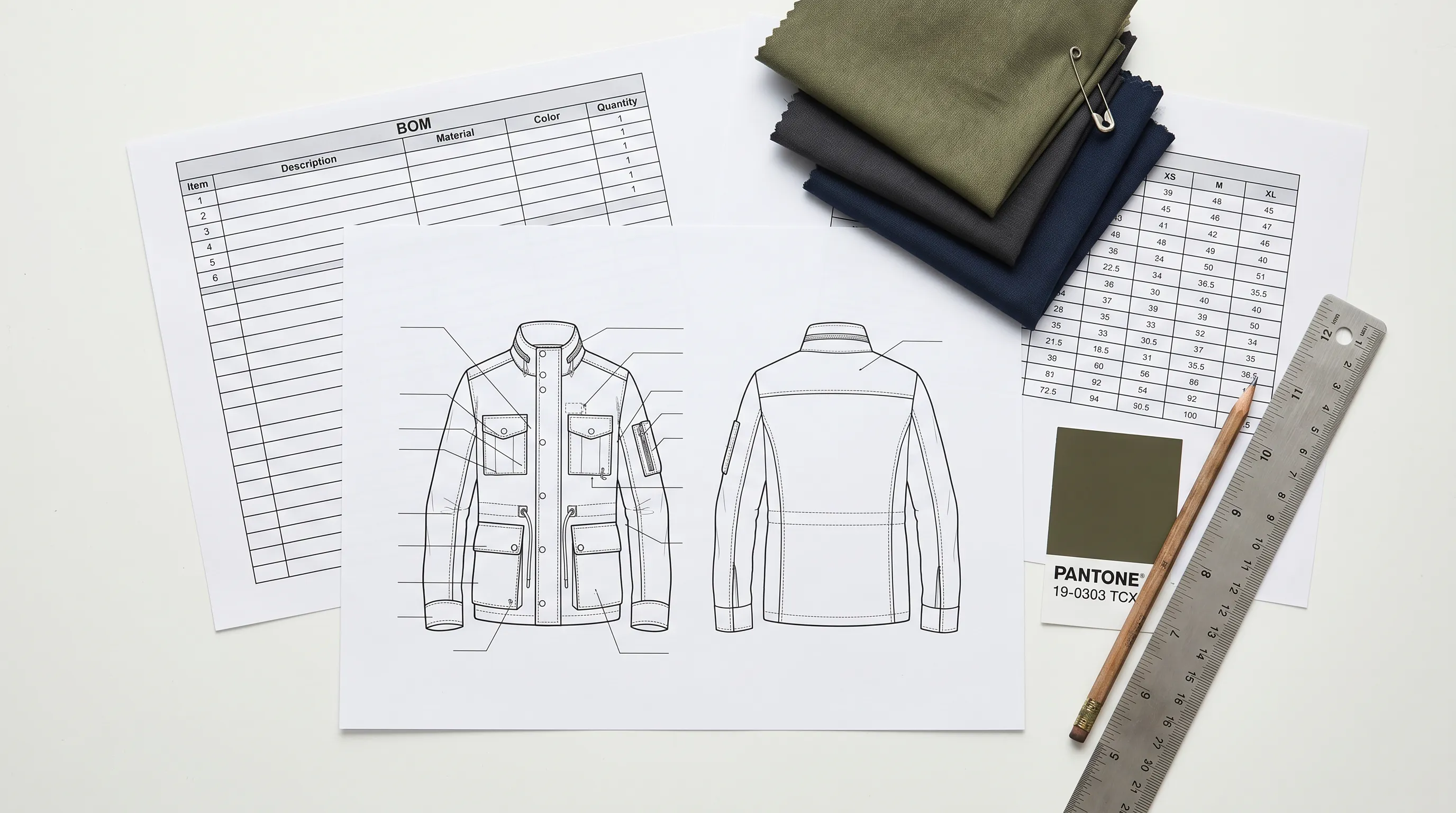
That gap has a price: incomplete or ambiguous specs are the leading cause of first-sample failure, and every failed sample round costs $200–$1,500 and 1–2 weeks (WFX Tech Pack 101; sampling cost data). Adstronaut generates the technical content as structured data — annotated flats from your photo, a BOM with supplier and per-unit price fields, POMs graded with tolerances against the relevant ASTM tables (D5585 for women's apparel), class-specific sections for footwear, knitwear, and leather goods — and exports a print-ready PDF. The difference is the one our factory-grade criteria guide tests: can a manufacturer cut a sample from it without calling you?
When Canva is the better choice
Canva genuinely wins for everything around the tech pack. For product mockups — dropping a print onto a blank tee to preview a design for social or a pre-sale — Canva's mockup generator is fast and free. For line sheets, lookbooks, buyer decks, and launch graphics, its template library and brand kits are the best in class at the price, and your team probably already uses it. It's also defensible for a very simple spec layout — a basic tote going to a flexible local maker — when you already own the flats and measurements and just need them arranged.
The honest framing: if your bottleneck is making things look presentable, Canva is the right tool. If your bottleneck is producing the flats, BOM, and graded measurements in the first place, Canva can't help — that's the job Adstronaut was built for. Many brands run both, and for the imagery inside those Canva line sheets, AI Photoshoots generates the on-model shots for about $1 each.
The clean two-tool workflow
If you already use Canva, don't abandon it — split the jobs:
- 1
Generate the factory pack in Adstronaut
Upload one garment photo to the Tech Pack Generator; review the BOM and measurements; export the PDF for your manufacturer. $3–6, under 30 minutes. - 2
Generate the imagery
Run the same garment through AI Photoshoots for on-model shots (~$1 each) and the Lookbook Creator for multi-angle views. - 3
Assemble marketing assets in Canva
Drop the generated imagery into Canva's line-sheet, lookbook, and social templates — the layout work it's genuinely best at. - 4
Keep the two documents separate
The factory gets the Adstronaut PDF; buyers and customers get the Canva-built assets. One technical source of truth, one brand layer.
Which should you choose?
Indie founders and first-time designers without flats or CAD skills get the most from Adstronaut — it produces the technical content Canva assumes you already have, with the first pack free. Small brands and DTC labels producing 10–50 styles a year skip both the freelance flat-sketch fee and the spec-table grind. Production leads send factories complete, graded packs a manufacturer can quote from directly.
Canva stays the pick for marketing-led teams, wholesale sellers building line sheets, and anyone formatting content they already own. For the full tool landscape, see the best tech pack software roundup, the Illustrator-alternatives comparison — where Canva appears as the budget option among five methods — and how to create a tech pack without Illustrator.
Frequently asked questions
Can you make a tech pack in Canva?
You can make a document that looks like a tech pack using Canva's templates, but Canva generates none of the technical content: no flat sketches, no structured BOM, and static measurement tables with no grading or tolerances. You must import flats drawn elsewhere and type every spec by hand. For simple garments with flexible makers it can pass; for production at a real factory it usually triggers questions and revision rounds.
Is Adstronaut better than Canva for tech packs?
For factory-ready tech packs, yes — it generates the flats, structured BOM, and graded measurements from one photo in minutes for $3–6 per pack, which Canva structurally cannot do. For mockups, line sheets, and marketing graphics, Canva remains the stronger tool. They solve different problems, and many brands deliberately run both.
Does Canva have a flat sketch generator?
No. Canva cannot draw a technical flat — the most important page in a tech pack. Your options are drawing it in Illustrator (2–4 hours with CAD skills), buying it from a freelancer ($100–$600 per style), or generating it: Adstronaut produces annotated front and back flats automatically from a garment photo.
How much does Canva cost in 2026?
Canva Free is genuinely free. Canva Pro is $15/month or $120/year. Canva Teams is $10 per seat per month billed annually with a 3-seat minimum — roughly $300/year at the floor, after Canva's 2024 shift to per-seat Teams pricing. None of the plans include tech-pack tooling like grading, tolerances, or BOM structure.
Can Canva grade measurements across sizes?
No. Canva tables are static — they display whatever numbers you type and cannot apply grade rules, calculate a size run, or carry tolerances. You'd grade manually in a spreadsheet and paste values in. Adstronaut auto-generates the graded points-of-measure chart across the full size range, with tolerances, from one photo — and every value stays editable.
Do factories accept tech packs made in Canva?
Factories care about completeness, not software. A Canva-assembled pack can work if it contains real flats, a complete BOM, and graded measurements — but Canva makes you source all three elsewhere. Incomplete specs are the leading cause of first-sample failure, and each failed round costs $200–$1,500 and 1–2 weeks, which is why purpose-built generation tends to pay for itself on the first style.
Why do founders switch from Canva templates to Adstronaut?
The pattern is consistent: they assemble a beautiful Canva pack, send it to a manufacturer, and get back a list of questions — where are the tolerances, the stitch specs, the graded chart, the flat's construction callouts? Answering those means hiring a technical designer anyway. Switching to generation removes the gap: the factory-facing sections arrive complete, and Canva goes back to doing marketing.
Is Canva good for fashion mockups and marketing?
Yes — this is where Canva excels and where Adstronaut doesn't compete. Its mockup generator previews prints on blanks, and its template library covers line sheets, lookbooks, buyer decks, and social formats backed by 265M+ users' worth of polish. The strongest stack pairs Canva's layout with Adstronaut's generated imagery and specs.
What does Adstronaut generate that Canva can't?
The technical core: annotated front-and-back flat sketches from a photo, a structured bill of materials with supplier and per-unit price fields, graded points of measure with tolerances, construction and stitch callouts, and Pantone TCX colorways — with class-specific sections for footwear, knitwear, leather goods, and bodywear. Canva arranges content; it doesn't create any of these.
Can I use both together?
Yes — it's the recommended setup. Generate the factory pack and product imagery in Adstronaut (tech pack $3–6; on-model images ~$1), then drop the imagery into Canva for line sheets, lookbooks, and launch graphics. The factory gets the technical PDF; buyers get the brand-layer assets. One source of truth each.
Generate your first tech pack free
Canva lays out the page — Adstronaut writes the flats, BOM, and graded specs that go on it. Upload one garment photo and get a factory-ready tech pack in minutes. First pack free, then $3–6 each.
Try the AI Tech Pack GeneratorKeep comparing
Sources and further reading
- Canva — pricing (Free, Pro, Teams) — Pro $15/mo or $120/yr; Teams $10/seat/mo annual, 3-seat minimum (2026)
- TechCrunch — Canva scale reporting (Feb 2026) — 265M+ monthly active users, 31M+ paid, $4B ARR
- Style3D — using Canva for tech-pack templates — static tables, no grading, no BOM structure, no flat generation
- Canva — mockups — print-on-blank mockup capability for marketing
- Successful Fashion Designer — freelance rates — $100–$600 per style for flats/specs Canva can't produce
- World Fashion Exchange — Tech Pack 101 — incomplete specs as the leading cause of first-sample failure