
How to make a factory-ready tech pack for bomber jackets
Updated June 10, 2026
A bomber jacket tech pack must specify the shell fabric (nylon or polyester at 70–200 denier, or satin/leather), the ribbed-knit collar, cuffs and hem with rib ratio (1x1 or 2x2) and gauge, a quilted or padded lining with fill weight, a two-way head-to-head zipper with gauge, snap and utility pockets, and bartacks at stress points. Adstronaut AI drafts all of it — flat sketch, BOM, graded measurements, construction notes — from a single garment photo in minutes for $3–6 per pack.
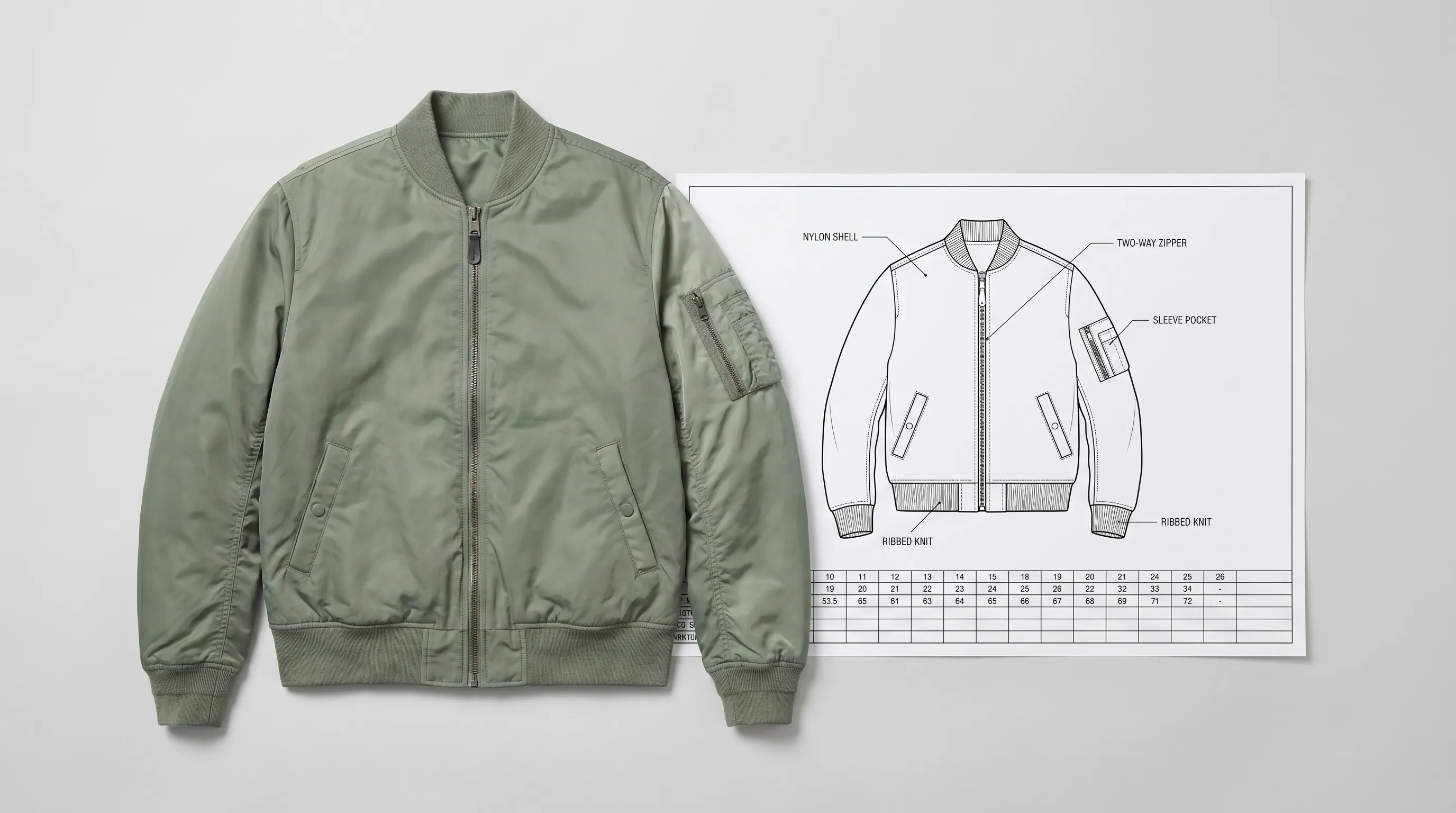
What goes in a bomber jacket tech pack
A bomber jacket tech pack is the manufacturing blueprint for a short, waist-length jacket built on the MA-1 flight-jacket lineage — a bloused nylon or poly shell finished with ribbed-knit collar, cuffs and hem. It carries the standard outerwear backbone (flat sketch, BOM, graded points of measure, construction notes, colorways), but the sections that decide whether your sample reads as a real bomber are the trims, the lining, and the zipper.
The shell line names a wind-resistant face fabric — most commonly nylon or polyester at 70–200 denier (flight-spec bombers run a coated 200–380T weave), or a satin, twill, or leather variant for fashion styles. The ribbed-knit section is what a generic jacket tech pack never gets right: it states the rib ratio (1x1 or 2x2), the knit gauge, the trim height and the relaxed-vs-stretched widths for the stand collar, the cuffs and the waist hem so the trim grips and recovers instead of bagging out. Then comes the quilted or padded lining with a stated fill weight (commonly 3–6.6 oz/yd² polyester), the two-way head-to-head zipper with its gauge and slider direction, the snap-flap and utility (sleeve-pocket) callouts, and bartacks at the pocket mouths and zipper base. Get any of these wrong and the factory sews trim that won't recover, picks a one-way zipper, or skips the bartacks — and you pay for another sample round at $200–$1,500.
Bomber jacket tech pack: what each section needs
Every row below is a section a real outerwear factory expects to see on a bomber — and the column on the right is what a generic apparel template leaves blank.
| Section | What a bomber jacket demands |
|---|---|
| Shell fabric | Nylon or polyester 70–200 denier (flight-spec: coated 200–380T ripstop), or satin/twill/leather for fashion bombers; wind-resistance, coating and water-repellent finish noted |
| Ribbed-knit trims | Stand collar, cuffs and waist hem: rib ratio (1x1 or 2x2), knit gauge, fiber (poly/cotton or wool-blend), trim height, and relaxed vs stretched width for grip and recovery |
| Lining & fill | Quilted or padded lining (diamond/channel quilt), insulation type and fill weight (commonly 3–6.6 oz/yd² polyester), quilt-line spacing, and inner welt pocket callout |
| Front closure | Two-way head-to-head zipper (e.g. molded #5 or coil), gauge, slider count and direction, tape color, top/bottom stops, optional storm flap and zip garage |
| Pockets | Slash hand pockets, snap-flap chest/welt pockets, and the signature utility pocket on the left sleeve with pen slots; closure type (snap, zip, hook-and-loop) per pocket |
| Stitch & seam class | Lockstitch (ISO 4915 class 301) topstitch at ~8–10 SPI, overlock (ISO 514) seam finishing, bartacks (ISO 4915 class 304) at pocket mouths, sleeve-pocket and zipper base |
| Measurements & POMs | Body length, chest, across-shoulder, sleeve length, bicep, cuff opening, collar height, hem-band height and stretched/relaxed trim widths — graded per size |
| BOM | Shell, lining, insulation, rib-knit trim, two-way zipper, snaps, thread, labels, drawcord/snaps, interlining — 15–30 line items with supplier and per-unit fields |
| Colorways | Pantone TCX per shell, rib trim and lining; flag the classic reversible orange lining and any contrast-trim colorway |
Stitch and bartack classes per ISO 4915 (301/304) and ISO 514; shell denier and fill-weight ranges per Alpha Industries / Cockpit USA published MA-1 specs and quilted-bomber product pages.
Worked example
One rib-trim line and one zipper line, written correctly
Weak spec: "ribbed cuffs and a zipper." Factory-ready trim spec: "Collar, cuffs, waist hem: 2x2 rib, 14-gauge, 95% polyester / 5% spandex, hem-band height 2 in. (5 cm), relaxed width 18 in. / stretched to 24 in., recovery ≥90%; Pantone 19-0414 TCX." Factory-ready closure spec: "CF zip: YKK two-way head-to-head molded #5, gunmetal, two sliders meeting at center, 24 in. tape, autolock pulls, bartack at top and bottom stops." Two lines, a dozen decisions the factory no longer guesses — and the difference between a first sample that grips at the wrist and a $200–$1,500 discovery round. That's the level of specificity the generator drafts and your review confirms.
Why bomber packs differ from a generic jacket spec
A generic jacket template assumes a flat woven hem, a one-way center-front zip, and no knit trim — which is exactly the three things a bomber overturns. The rib knit is structural, not decorative. The original MA-1 used a 100% wool knit collar, cuffs and waistband; modern bombers use a poly or poly-spandex rib in 1x1 or 2x2, and the pack has to state the rib ratio, gauge and stretched-vs-relaxed widths the same way an activewear pack states elastane and recovery. Spec it loosely and the cuffs bag out after a week; spec it too tight and the wearer can't get a hand through.
The zipper is two-way, not one-way. Bombers sit at the hip, so the front zip is a head-to-head two-way unit that lets the wearer open the hem while sitting or riding — a different part number, slider count and stop configuration than a standard jacket, and a line the factory will substitute incorrectly if the pack stays silent. The lining carries a fill. Flight and quilted bombers specify an insulation type and fill weight (the classic reversible style runs a contrast orange lining for ground-rescue visibility), so the BOM needs an insulation line and a quilt-spacing callout a shirt-grade template has no field for. And stress points need bartacks — pocket mouths, the utility-pocket bartack on the sleeve, and the base of the zipper take repeated load, so ISO 4915 class 304 bartacks are real construction callouts, not an afterthought. A class-aware generator fills every one of those fields; a one-size apparel template leaves them blank.
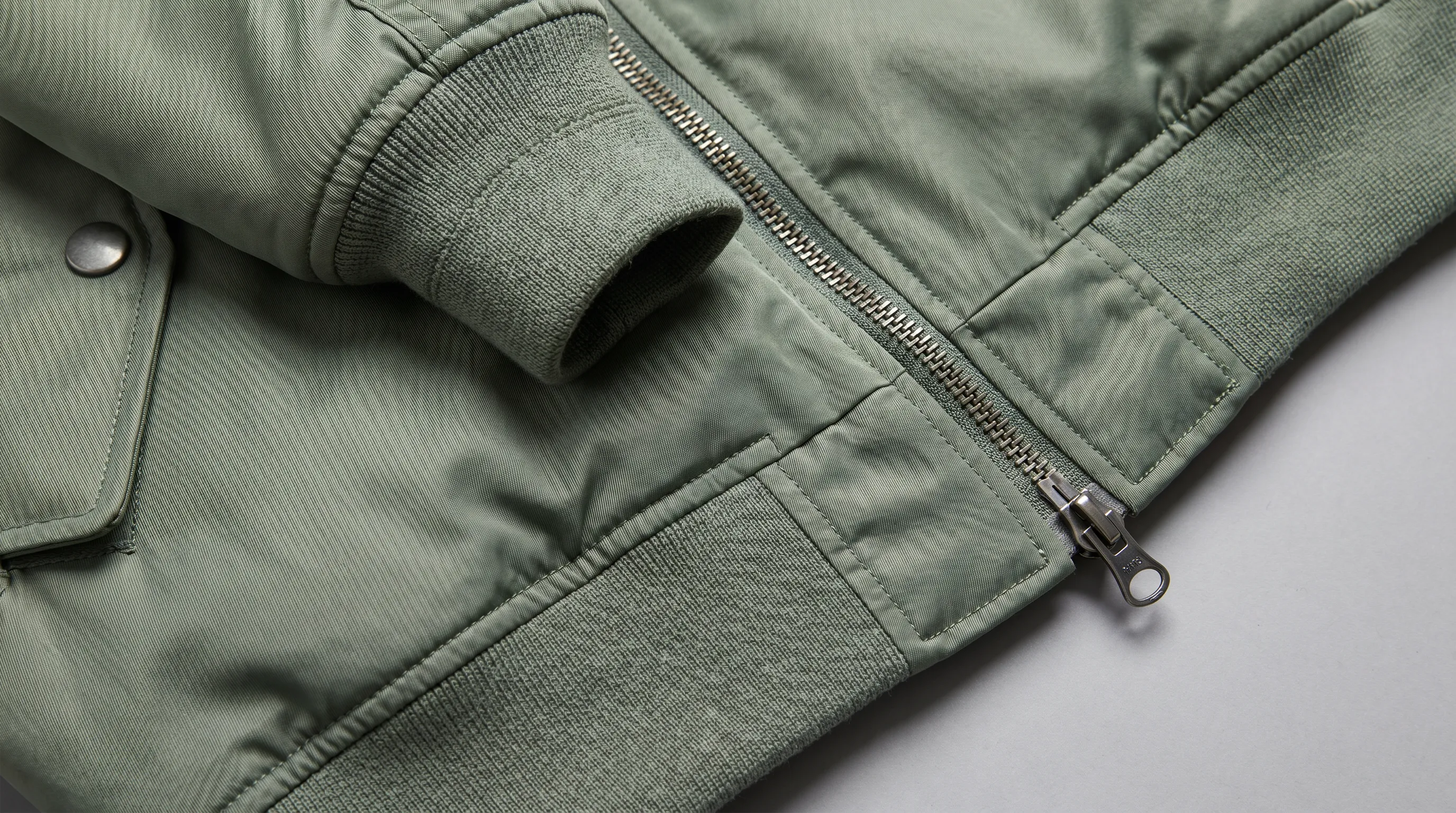
Generate a bomber jacket pack in 3 steps
The AI writes the document; you confirm the details only you know — your mill's exact rib, fill and zipper part numbers.
- 1
Upload one photo
Flat-lay of your sample bomber, a mannequin shot, or a clean mockup. The AI detects the jacket as a bomber silhouette — bloused shell, ribbed stand collar, knit cuffs and hem — and the construction that implies. - 2
Review the bomber-specific draft
In 3–5 minutes you get the flat sketch, BOM pre-populated with shell, rib-knit trim, insulation and two-way-zipper component lines, graded POMs including trim widths, and bartack and stitch callouts. Spend 10–15 minutes entering your mill's exact rib ratio and gauge, shell denier, fill weight, and zipper part number off your sample. - 3
Export and send
Print-ready PDF (Excel/CSV on Pro) to your factory. Total cost $3–6 — versus $150–$500 and 3–7 days for a freelance technical designer, per published rate surveys.
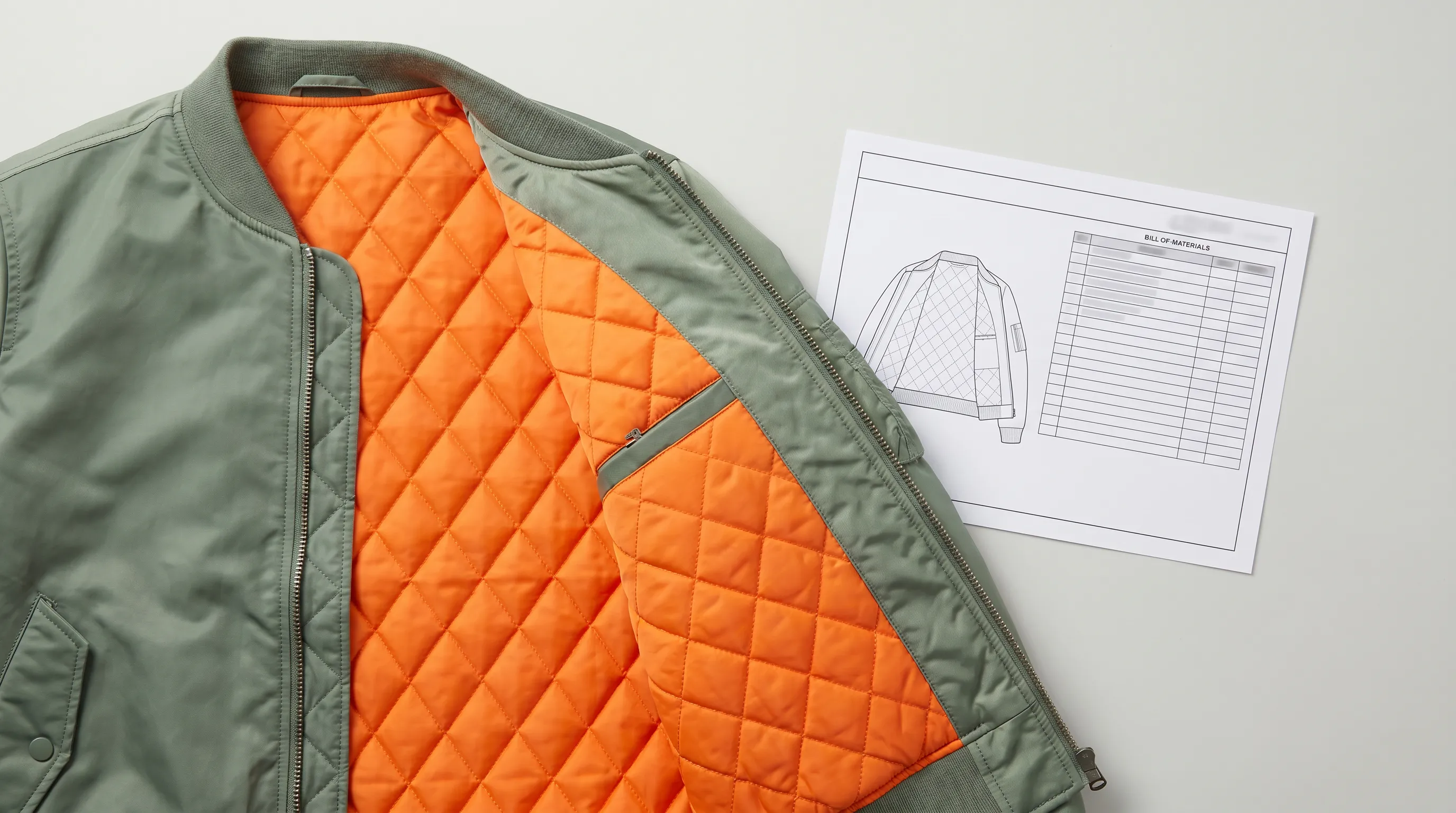
Built for streetwear and outerwear founders
This is for the founder launching a bomber, flight jacket, or varsity-bomber line without an in-house technical designer: you've sourced a nylon or satin shell, found a rib-knit trim supplier, sewn a sample, and need a document a factory will quote from — without $150–$500 per style in freelance fees or the 6–10 hour Illustrator grind. It fits streetwear brands dropping seasonal bombers, production leads cutting first-sample revision rounds on trim-heavy outerwear, and Shopify outerwear stores graduating from blank-and-print to true cut-and-sew (where MOQ math and trim sourcing suddenly matter).
Adstronaut writes the shell-fabric composition, the ribbed-knit collar/cuff/hem callouts with rib ratio and gauge, the quilted-lining and fill spec, the two-way-zipper line, and the bartack placements — so your factory in Guangzhou, Tiruppur, or Istanbul receives a bomber-grade pack, in minutes. When the samples come back, the AI Photoshoots side of the platform handles the on-model imagery the same week, and the color changer lets you preview every shell-and-trim colorway before you commit a dye lot.
Frequently asked questions
What shell fabric should a bomber jacket tech pack specify?
Most bombers use a wind-resistant nylon or polyester shell in the 70–200 denier range; flight-spec MA-1 styles run a coated 200–380T ripstop nylon, while fashion bombers use satin, twill, cotton, or leather. The pack states the exact fiber, denier or thread count, weave, coating, and any water-repellent finish, plus the lining and insulation behind it.
How does the pack spec the ribbed knit collar, cuffs and hem?
The rib-knit section names the rib ratio (1x1 or 2x2), the knit gauge, the fiber (poly, poly-spandex, cotton, or a wool blend on heritage styles), the trim height, and the relaxed vs stretched widths for the stand collar, cuffs, and waist hem. Stating stretched-vs-relaxed width and recovery is what makes the trim grip at the wrist and waist instead of bagging out.
Why does a bomber need a two-way zipper in the tech pack?
A bomber sits at the hip, so the center-front closure is a two-way head-to-head zipper: two sliders meet at the center and can open from the bottom up, letting the wearer vent or sit comfortably. The pack calls out the zipper type (molded or coil), gauge (e.g. #5), tape color and length, slider count and direction, top and bottom stops, and any storm flap or zip garage.
What lining and insulation does a bomber jacket tech pack call out?
Most bombers carry a quilted or padded lining — diamond or channel quilt — with a stated insulation type and fill weight, commonly 3 to 6.6 oz/yd² of polyester fill. The classic flight bomber uses a reversible contrast lining (often orange for ground-rescue visibility). The pack states the quilt pattern, quilt-line spacing, fill weight, and inner welt-pocket placement.
Where do bartacks go on a bomber jacket?
Bartacks (ISO 4915 stitch class 304) reinforce the highest-load points: the mouths of the slash hand pockets and snap-flap pockets, the signature utility pocket on the left sleeve, and the top and bottom of the center-front zipper. Calling them out by location and stitch count tells the factory exactly where to reinforce so the pockets and zip base don't tear under repeated load.
What is the utility pocket on a bomber jacket?
The utility pocket is the small zip or snap pocket on the upper left sleeve of an MA-1 style bomber, originally a pen-and-cigarette pocket on flight jackets. The pack specifies its size, closure (zip or snap), any internal pen slots, the bartacks at its mouth, and its exact placement relative to the shoulder and bicep seam.
How long does generating a bomber jacket pack take?
3–5 minutes for the draft — flat sketch, BOM, graded measurements with trim widths, and construction callouts — then 10–15 minutes of review to enter your mill's exact rib ratio and gauge, shell denier, fill weight, and zipper part number. Under 30 minutes end to end, versus 3–7 days for a freelance technical designer.
How much does a bomber jacket tech pack cost?
$3–6 with Adstronaut (25 credits; plans from $29/month; first pack free as a watermarked preview). Freelance technical designers charge $150–$500 per outerwear style at 3–7 day turnarounds, so a 20-style collection runs $60–$120 in credits versus $3,000–$10,000 freelance.
Can it handle leather, satin, and varsity bombers too?
Yes — the silhouette drives the sections, and the shell line adapts. A leather bomber adds panel callouts, hide and hardware specs, and lining; a satin bomber notes the lighter face fabric and seam finish; a varsity bomber swaps the nylon shell for melton wool body and leather sleeves with snap-front and chenille-patch callouts. Each keeps the ribbed-knit trim, two-way or snap closure, and bartack treatment appropriate to the style rather than a one-size template.
Generate your bomber jacket tech pack
Upload one photo of your bomber. Get the shell-fabric spec, ribbed-knit collar/cuff/hem callouts, quilted-lining and fill details, the two-way-zipper line, and bartacked pocket placements in minutes. First pack free, then $3–6.
Try the AI Tech Pack GeneratorKeep going
Sources and further reading
- MA-1 bomber jacket — Wikipedia — knit collar/cuff/waistband construction; original 100% wool knit trim; brass zipper and storm flap
- Alpha Industries — MA-1 Bomber Jacket (Heritage) — shell, knit rib collar/cuff/waistband and reversible lining spec from the originating brand
- Cockpit USA — Diamond Quilted Flight Jacket — diamond-quilt lining, polyester fill weight and ripstop nylon shell construction
- YKK Vislon molded zipper — molded #5 zipper and two-way head-to-head closure used for bomber center-front
- Seamwork — guide to rib knit fabrics — 1x1 vs 2x2 rib ratio, stretch and recovery for cuffs, collars and hem bands
- Successful Fashion Designer — freelance rates — $150–$500 per style; 3–7 day turnaround for freelance technical design