
How to make a factory-ready tech pack for activewear
Updated June 10, 2026
An activewear tech pack must specify performance-fabric composition (typically 75–92% polyester or nylon with 8–22% elastane, 160–320 GSM), flatlock and coverstitch seam classes, elastic waistband construction, gusset panels, and stretch-aware points of measure recorded relaxed and extended. Adstronaut AI generates all of it — flat sketch, BOM, graded measurements, construction notes — from a single garment photo in minutes for $3–6 per pack.
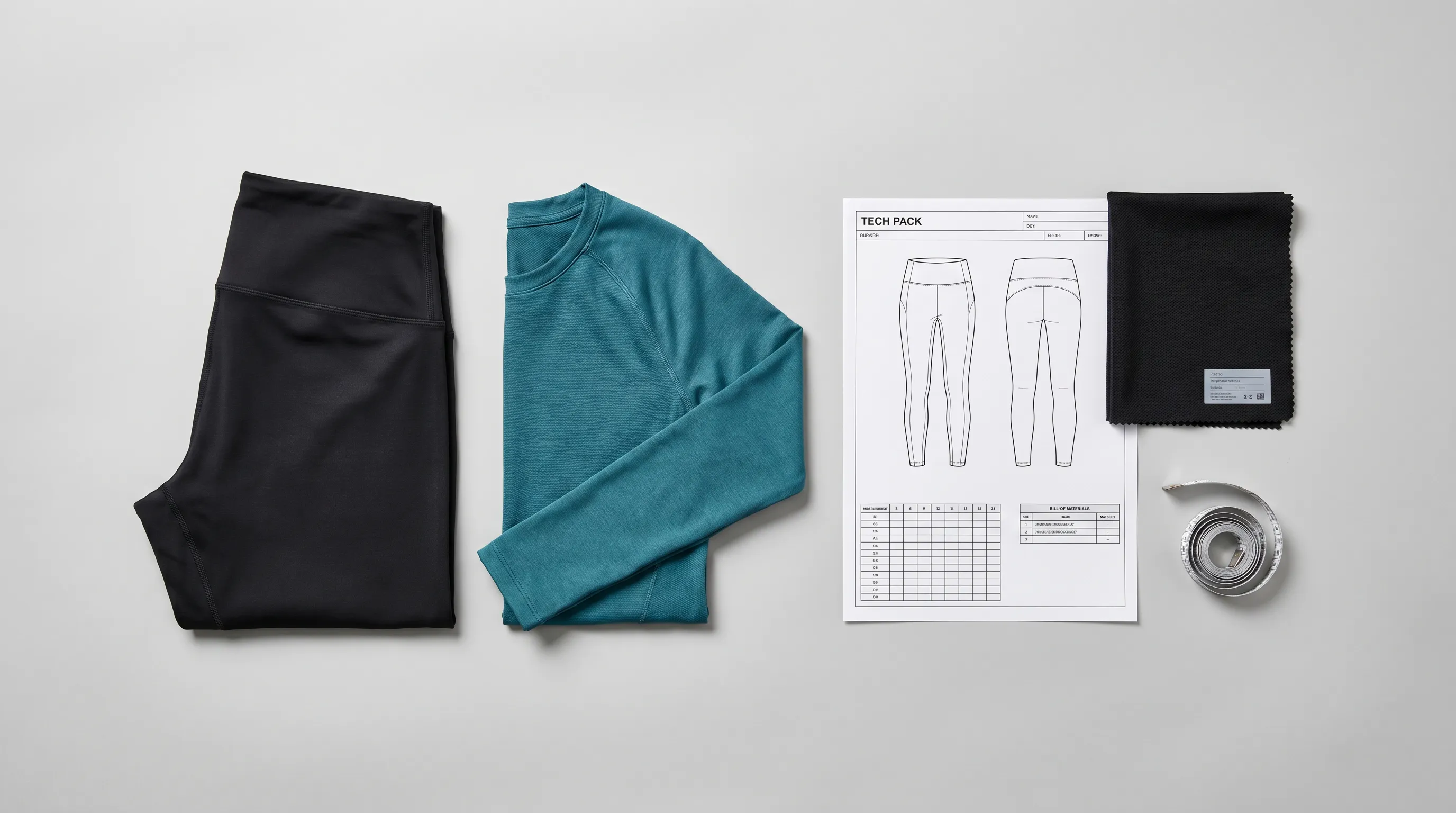
What goes in an activewear tech pack
An activewear tech pack is the manufacturing blueprint for a stretch performance garment — leggings, sports bras, compression tops, training shorts. It carries the standard backbone (flat sketch, BOM, graded points of measure, construction notes, colorways), but every section is rewritten for stretch and performance.
The fabric line specifies a performance knit — most commonly 75–92% polyester or nylon with 8–22% elastane, in the 160–320 GSM range, with four-way stretch and moisture-wicking behavior called out. The seam section names stitch classes a woven pack never mentions: flatlock (ISO 4915 stitch class 607) to kill chafe, coverstitch for hems and waistbands. Elastic specs, gusset panels, and stretch-recovery figures round it out. Get any of these wrong and the factory cuts the wrong seam allowance, picks a stitch that pops under load, or grades the garment like a woven — and you pay for another sample round at $200–$1,500.
Activewear tech pack: what each section needs
| Section | What activewear demands |
|---|---|
| Fabric & composition | Performance knit: 75–92% poly or nylon + 8–22% elastane, 160–320 GSM; four-way stretch, moisture-wicking, quick-dry behavior noted per fabric |
| Stitch & seam class | Flatlock (ISO 4915 class 607, butt-joined, zero overlap) at ~12–16 SPI for body seams; overlock (ISO 514) for closing; classes per ASTM D6193 |
| Coverstitch & finishing | Coverstitch (ISO 602/605) on hems, cuffs, necklines at ~10–14 SPI; texturized (bulked) thread and ballpoint needles to avoid skipped stitches |
| Elastic & waistband | Elastic type (exposed/jacquard/encased), width, tension, gripper and drawcord specs, stretch-to-fit ratio for the waist opening |
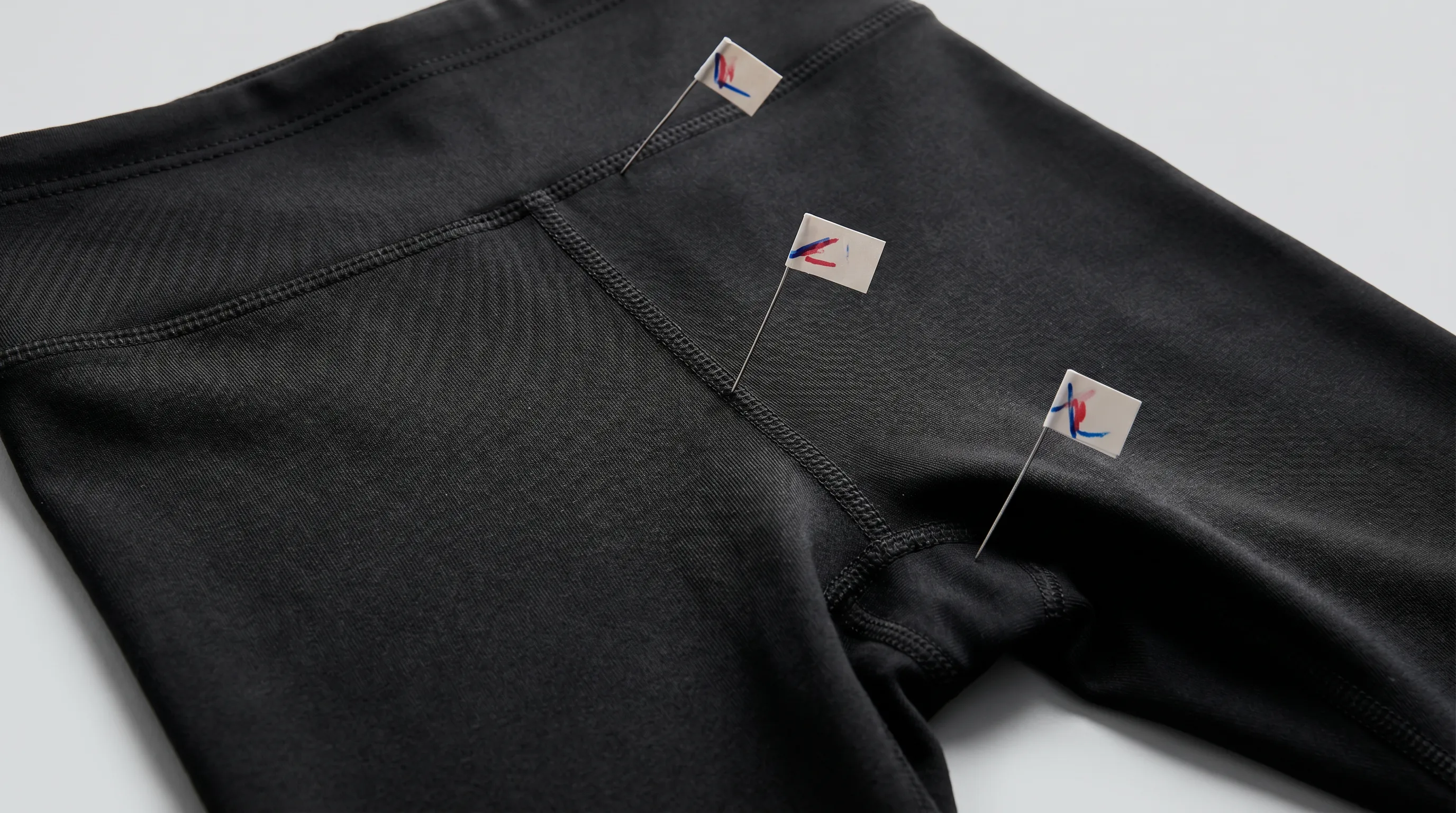
| Panels & gusset | Cut-and-sew panel callouts, contour seams, crotch or center-back-rise gusset on leggings for range of motion and seam-stress relief |
| Measurements & POMs | Stretch-aware: waist relaxed AND extended, hip, front/back rise, inseam, thigh, leg opening — plus stretch and recovery percentages |
| Performance testing | Stretch & growth (ASTM D2594/D3107), moisture management (AATCC 195), air permeability (ASTM D737), colorfastness to perspiration (AATCC 15) |
| BOM | Shell knit, power-mesh panels, elastics, drawcord, gripper tape, labels, heat transfers, stretch thread — 12–25+ line items |
| Colorways | Pantone TCX per panel and trim; flag sublimation vs piece-dye and dye-migration risk on poly blends |
Stitch classes per ISO 4915/514/602 and ASTM D6193; performance tests per ASTM D2594/D3107, AATCC 195/15, ASTM D737.
Worked example
One legging fabric line, written correctly
Weak spec: "black stretch fabric." Factory-ready spec: "Body: 78% recycled polyester / 22% elastane circular knit, 240 GSM, four-way stretch ≥150% extension, ≥90% recovery (ASTM D2594), wicking finish (AATCC 195 Grade ≥3), squat-proof opacity at full stretch; Pantone 19-4007 TCX." One line, eight decisions the factory no longer guesses — and the difference between a first sample that fits and a $200–$1,500 discovery round. That's the level of specificity the generator drafts and your review confirms.
Why activewear packs differ from woven apparel
Stretch changes everything downstream of the fabric line. Negative ease: compression styles are cut smaller than the body and rely on recovery to fit, so POMs are recorded both relaxed and at full stretch, with stretch-and-growth figures (typically ≥90% recovery) tested under ASTM D2594/D3107. Grade a legging like a woven and the entire size run fits wrong — the grade-rule logic still applies, but against stretched dimensions.
Seams take dynamic load: a standard overlock pressed against skin during a run chafes and can pop under repeated stretch; flatlock's butt-joined profile lies flat and retains over 90% of the fabric's elasticity, which is why it owns activewear body seams. And performance is spec, not marketing: wicking (AATCC 195), breathability (ASTM D737), and perspiration colorfastness (AATCC 15) are real test lines a sportswear factory and lab expect to see referenced. A generic apparel template has none of these fields — which is exactly the gap a class-aware generator closes.
Generate an activewear pack in 3 steps
- 1
Upload one photo
Flat-lay of your sample leggings or training top, mannequin shot, or clean mockup. The AI detects the activewear sub-class — leggings, sports bra, compression top, shorts — and the construction it implies. - 2
Review the stretch-specific draft
In 3–5 minutes you get the flat sketch, BOM pre-populated with performance-knit and elastic component classes, stretch-aware graded POMs, and flatlock/coverstitch callouts. Spend 10–15 minutes entering your mill's exact elastane %, GSM, and the relaxed-vs-stretched measurements off your sample. - 3
Export and send
Print-ready PDF (Excel/CSV on Pro) to your factory. Total cost $3–6 — versus $150–$500 and 3–7 days for a freelance technical designer, per published rate surveys.
Built for activewear and athleisure founders
This is for the founder launching a leggings, sports-bra, or training-short line without an in-house technical designer: you've sourced a performance knit, sewn a sample, and need a document a factory will quote from — without $150–$500 per style in freelance fees or the 6–10 hour Illustrator grind. It fits athleisure brands scaling 10–30 SKU drops, production leads cutting first-sample revision rounds, and Shopify activewear stores graduating from print-on-demand to cut-and-sew (where MOQ math suddenly matters).
Adstronaut writes the stretch-fabric composition, flatlock and coverstitch callouts, elastic and gusset specs, and relaxed-vs-stretched measurements — so your factory in Tiruppur, Vietnam, or Sialkot receives an activewear-grade pack, in minutes. When the samples come back, the AI Photoshoots side of the platform handles the on-model imagery the same week.
Frequently asked questions
What fabric composition should an activewear tech pack specify?
Most activewear uses a performance knit of 75–92% polyester or nylon blended with 8–22% elastane, in the 160–320 GSM range. The pack states the exact percentage split, GSM, four-way-stretch behavior, and moisture-wicking properties per fabric. Compression styles trend toward 18–22% elastane; lighter athleisure tops run 8–12%.
What seam and stitch types does activewear need?
Flatlock (ISO 4915 class 607) is the body-seam standard — its butt-joined, zero-overlap profile lies flat against skin, prevents chafe, and retains over 90% of fabric stretch at roughly 12–16 SPI. Coverstitch (ISO 602/605, ~10–14 SPI) finishes hems, cuffs, and waistbands; overlock closes seams. Spec texturized thread and ballpoint needles for knits.
How are activewear measurements different from regular clothing?
Compression garments are cut with negative ease — smaller than the body — so points of measure are recorded both relaxed and at full stretch, with stretch and recovery percentages (ASTM D2594/D3107) alongside. Key legging POMs: waist relaxed and extended, hip, front and back rise, inseam, thigh, leg opening.
Why do leggings need a gusset in the tech pack?
A diamond or triangular crotch gusset relieves seam stress at the highest-strain point, improving range of motion and preventing blowouts during squats and lunges. The pack calls out the gusset's panel shape, seam class (usually flatlock), and how it joins front, back, and inseam panels.
What ASTM and AATCC tests should the pack reference?
Stretch and recovery: ASTM D2594 (knits) and D3107. Stitch classification: ASTM D6193 / ISO 4915. Performance claims: AATCC 195 (moisture management), ASTM D737 (air permeability), AATCC 15 (colorfastness to perspiration). Referencing the standards tells factory and lab exactly what the garment must pass.
How long does generating an activewear pack take?
3–5 minutes for the draft — flat sketch, BOM, stretch-aware graded measurements, construction callouts — then 10–15 minutes of review to enter your mill's exact elastane percentage and GSM, elastic widths, and sample measurements. Under 30 minutes end to end, versus 3–7 days freelance turnaround.
How much does an activewear tech pack cost?
$3–6 with Adstronaut (25 credits; plans from $29/month; first pack free as a watermarked preview). Freelance technical designers charge $150–$500 per activewear style at 3–7 day turnarounds, so a 20-style collection runs $60–$120 in credits versus $3,000–$10,000 freelance.
Does it handle sports bras and compression tops too?
Yes — the sub-class drives the sections. Sports-bra packs add band elastic, cup or shelf-liner, and strap construction; compression tops emphasize panel seaming and negative ease; training shorts add liner, drawcord, and gusset specs. Each gets the appropriate flatlock, coverstitch, and stretch-aware measurement treatment rather than a one-size template.
Generate your activewear tech pack
Upload one photo of your leggings, sports bra, or training top. Get the performance-fabric spec, flatlock and coverstitch callouts, elastic and gusset details, and stretch-aware measurements in minutes. First pack free, then $3–6.
Try the AI Tech Pack GeneratorKeep going
Sources and further reading
- ASTM D2594 — stretch properties of knitted fabrics — stretch and growth test method for activewear knits
- ASTM D3107 — stretch properties of woven stretch fabrics — stretch, growth, recovery calculations
- ISO 4915 — stitch types classification — flatlock class 607 and related stitch classes
- AATCC test methods — TM195 moisture management; TM15 colorfastness to perspiration
- Successful Fashion Designer — freelance rates — $150–$500 per activewear style; 3–7 day turnaround