
How to create a tech pack for lingerie
Updated June 10, 2026
A lingerie tech pack specifies stretch fabrics (typically 75–82% nylon / 18–25% spandex powermesh and lace), elastics by type, width, and finish (picot, plush-back, fold-over, strap), hardware (hook-and-eye closures sized 19–57mm by cup depth, rings, sliders, underwire channeling), cup and gore construction, and band/cup/gore points of measure at tight tolerance. Adstronaut AI generates this most component-dense of fashion documents from one photo in minutes for $3–6.
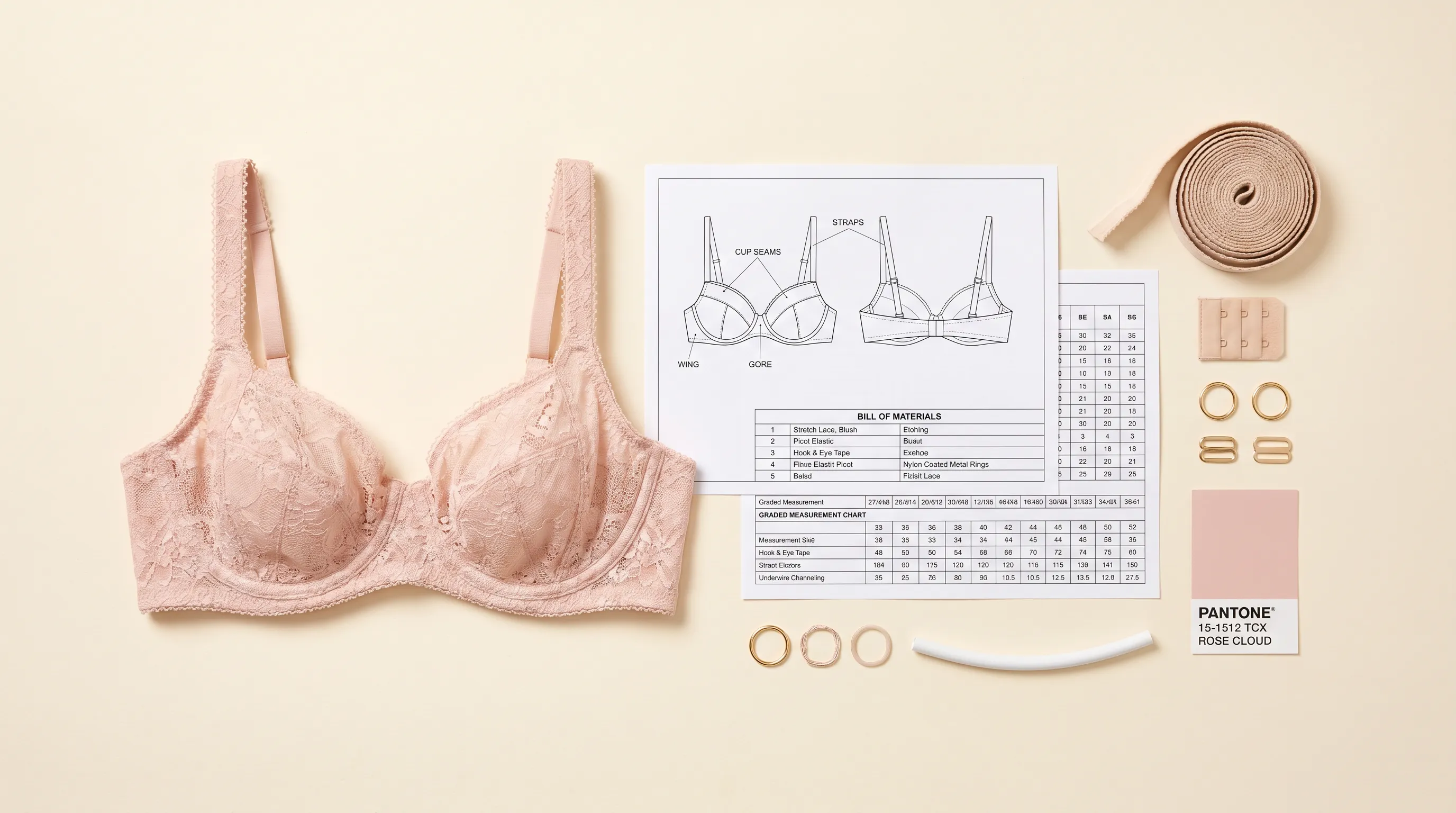
What goes in a lingerie tech pack
A lingerie tech pack is the manufacturing blueprint for an intimates style — bra, brief, bralette, bodysuit — and it is the most component-dense document in fashion. A single underwire bra assembles from roughly 12 fabric pieces, 2 cups, 2 underwires, 2 rings, 2 sliders, and a hook-and-eye set (Bra-Makers Supply's findings list) — and every part is its own BOM line with supplier, size, and finish.
What separates it from a tee pack: almost nothing is a single woven fabric. Stretch fabrics — powermesh, stretch lace, tricot — are specced by fiber composition and stretch direction. Elastics are specced by type, width, and finish (the body side must be plush). Hardware is specced by size, plating, and quantity. And the fit-critical measurements — band, cup, gore — are graded at tight tolerance, because on parts this small a 0.75cm seam-allowance error can move a finished bra a full size (Merckwaerdigh's seam-allowance analysis).
What a lingerie tech pack must specify
| Section | What lingerie demands |
|---|---|
| Fabric & stretch | Shell, cup, wing fabrics by fiber and stretch: powermesh wings ~75–80% nylon / 20–25% spandex (150–240 GSM), stretch lace, tricot lining; stretch direction (2- vs 4-way) and recovery per piece |
| Elastics | Each by type, width, finish: picot edge (often 3/8"), plush-back band and underarm elastic (plush to body), fold-over (FOE) for edges, firm strap elastic (~50% stretch, wider on larger cups) |
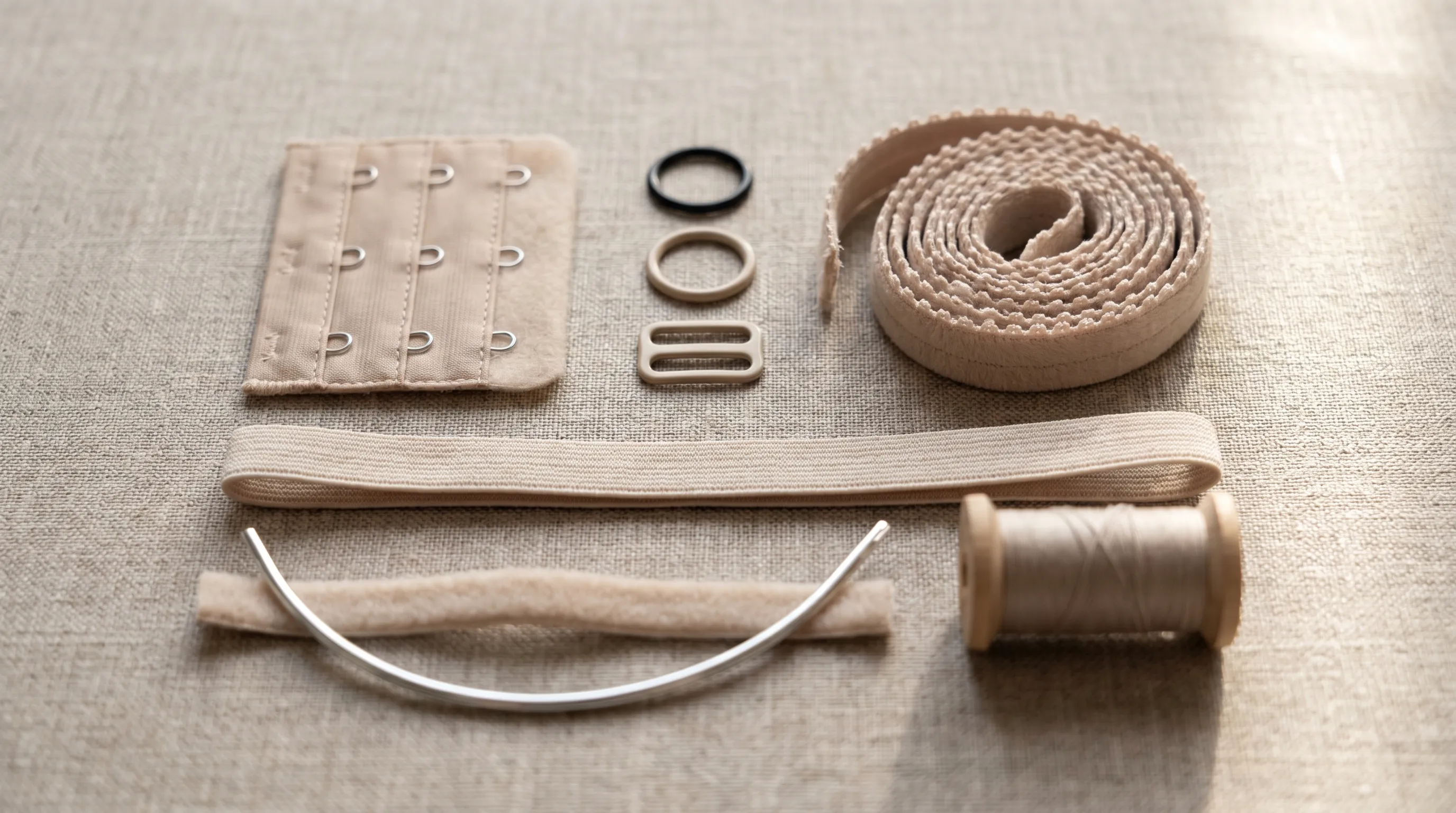
| Hardware | Hook-and-eye rows × columns sized by cup depth (19mm for A/B up to 57mm for F+), 2 rings + 2 sliders sized to strap width, nickel-free or nylon-coated plating, any front clasp or G-hook |
| Cup & underwire | Cup construction (molded foam, cut-and-sew, unlined), underwire diameter and length per size, plush channeling with ~3/8" wire play, center-gore height and width |
| Seams & stitch | Narrow seam allowances (~0.75cm / 3/8"), zigzag and three-step zigzag for elastic application, bartacks at strap and ring stress points (ASTM D6193 classes) |
| Measurements / POMs | Band relaxed AND stretched, cup depth and width, gore width/height, strap range, wing height — graded at tight tolerance because the parts are small |
| BOM | 20–40+ line items: fabrics, elastics, rings, sliders, hooks, wires, channeling, labels, thread, bow — each with supplier, quantity, unit, price fields |
| Care & compliance | Hand-wash/delicate care, nickel-free hardware notes, fiber-content labeling for skin-contact garments |
| Colorways | Pantone TCX per component — shell, lace, elastic, and bow dye-match separately |
Composition and component specs per Bra-Makers Supply, Orange Lingerie, and Porcelynne supply references.
Worked example
Why cup grading isn't scaling — sister sizes in practice
A 34B, a 32C, and a 36A share the same cup volume but different bands — that's sister sizing, and it's why bra grading is multi-axis. Moving 34B → 34C keeps the underband but enlarges the cradle and shrinks the wing; moving 34B → 36B keeps the cup but lengthens the band and its elastic cut lengths, and the hook-and-eye may step from 19mm toward 38mm as depth grows. A full 28A–44H run can demand 80+ distinct wire, cup, and strap component SKUs. This is why the pack grades band, cup, and gore as independent axes — and why a generic apparel grading table fails intimates.
Generate a lingerie pack in 3 steps
- 1
Upload one photo of your sample
Flat-lay of the bra or brief, mannequin shot, or clean mockup — the AI detects the intimates construction rather than treating it as generic apparel. - 2
Review the intimates-specific draft
3–5 minutes returns the flat sketch (cups, gore, wing, strap routing), a BOM pre-populated with intimates component classes, band/cup/gore graded POMs, and elastic-application callouts. Your 10–15 minutes: exact elastic widths, underwire diameter and channeling, Pantone TCX per component, your sample's measurements. - 3
Export the factory PDF
Print-ready PDF (Excel/CSV on Pro) for your intimates factory in Sri Lanka, Vietnam, or Portugal. $3–6 total versus $150–$500 and 3–7 days for an intimates-specialist freelancer.
Why lingerie packs are uniquely unforgiving
A bra is a small load-bearing structure: the band carries most of the support, the gore anchors between the cups, and wire, channeling, and bartacks manage that load. One wrong component and the garment fails on the body, not just on the rack.
The parts are small and numerous, so the BOM runs long and the seams unforgiving — 0.75cm allowances mean small cutting errors shift finished sizes, and cup grading is a multi-piece adjustment (LilypaDesigns on cup grading), not a uniform scale. Because elastics, channeling, and hardware each carry plush-side and stretch specs, ambiguity in any single field triggers a re-sample — and intimates already has the highest fit-iteration rate of any apparel category, with 2–4 fit rounds standard before approval. That's exactly the small-component density where a complete structured pack pays for itself (and where the sampling-rounds fix compounds it).
Built for intimates and lingerie founders
Built for intimates founders launching a first bra, brief, or bralette range without a technical designer — the people for whom a $150–$500-per-style freelance pack and a 3–7 day turnaround is a real cash-flow bottleneck. It fits the indie lingerie label speccing a capsule, the swim-and-intimates brand shipping stretch styles every season (the swimwear photoshoot guide covers that line's imagery), and the production lead tired of rebuilding the same band-cup-gore table per colorway.
You don't need to know what plush-back elastic or a three-column hook-and-eye is going in — the AI drafts the intimates construction and the document explains itself in the editor, with every field editable. If you can photograph your sample, you can produce a lingerie tech pack. The pricing logic of the whole category lives in the tech pack cost guide.
Frequently asked questions
What does a lingerie tech pack need that a regular apparel pack doesn't?
Components woven garments never carry: stretch fabrics specced by fiber and stretch direction (powermesh wings at ~75–80% nylon / 20–25% spandex), elastics by type, width, and plush finish (picot, plush-back, fold-over, strap), hardware (hook-and-eye sized 19–57mm by cup, rings, sliders), underwire diameter with plush channeling, and band/cup/gore POMs graded at tight tolerance on independent axes.
Can Adstronaut generate a bra tech pack from a photo?
Yes — upload a flat-lay or mannequin shot and it detects the intimates construction, generating the flat sketch (cups, gore, wing, straps), a component-level BOM (fabrics, elastics, rings, sliders, hooks, wire, channeling), graded band-cup-gore measurements, and elastic-application callouts in 3–5 minutes for $3–6.
How much does a lingerie tech pack cost?
$3–6 generated (25 credits; first pack free as a watermarked preview), versus $150–$500 per style from an intimates-specialist freelancer at 3–7 business days. A 10-style lingerie capsule: roughly $30–$60 in credits against $1,500–$5,000 freelance.
Which elastics and hardware should a bra BOM list?
Typically 20–40+ line items: shell, cup, and wing fabrics; picot edge elastic (often 3/8"); plush-back band and underarm elastic; firm strap elastic; fold-over elastic; two rings and two sliders sized to strap width; the hook-and-eye closure (taller on larger cups); underwires by diameter and length; plush channeling; plus thread, labels, and bow — each with supplier, size, finish, and quantity.
Why is grading lingerie harder than grading a t-shirt?
Because band and cup grade on independent axes. Moving 34B→34C keeps the underband but enlarges the cradle and shrinks the wing; sister sizes (30D/32C/34B/36A) share cup volume across different bands. Combined with 0.75cm seam allowances on small parts, errors compound fast — a full size run can need 80+ distinct component SKUs.
What is plush-back elastic and why does the spec call it out?
Elastic with a brushed, soft face on the body side — mandatory comfort spec for band and underarm elastics worn against skin. The pack states which side faces the body, because applying it inverted is a classic factory error that passes visual QC and fails the first wear test.
Do intimates factories accept AI-generated tech packs?
Yes — factories evaluate the document, not the tool: component-level BOM, graded band-cup-gore POMs with tolerances, stitch and elastic-application callouts, exported as a standard print-ready PDF. Completeness is what cuts revision rounds in the category with fashion's highest fit-iteration rate.
Can I edit the generated lingerie pack?
Every field: BOM rows (supplier, quantity, unit, price), exact picot and strap elastic widths, underwire diameter and channeling spec, band/cup/gore measurements with your own tolerances, and Pantone TCX per component. Generate, refine for 10–15 minutes, export.
Generate your lingerie tech pack from one photo
Skip the hours in Illustrator and Excel. Upload a photo of your bra or brief and get the component BOM, graded band-cup-gore measurements, and construction notes in minutes. First pack free, then $3–6.
Try the AI Tech Pack GeneratorKeep going
Sources and further reading
- Bra-Makers Supply — bra findings kit — 12 fabric pieces, 2 cups, 2 wires, 2 rings, 2 sliders, hook-and-eye per bra
- Orange Lingerie — bra-making notions — elastic types, plush finish, hardware, channeling
- Porcelynne — powermesh 240 GSM — powermesh composition and weight reference
- LilypaDesigns — grading between cup sizes — cradle/wing multi-piece grading mechanics
- Merckwaerdigh — bra seam allowances — 0.75cm / 3/8" allowances on small parts
- Van Jonsson Design — hook-and-eye sizing — 19mm (A/B) to 57mm (F+) closure widths by cup