How Long Does Fashion Production Actually Take? Timeline Benchmarks by Garment (2026)
Fashion production takes 3 to 9 months from first sketch to delivered product, and 20 to 32 weeks is typical for a first run. The clock breaks into four phases: design and tech-pack documentation (2 to 6 weeks), sampling across proto, fit, and pre-production rounds (4 to 8 weeks), bulk manufacturing (6 to 16 weeks), and shipping (3 days by air to 8 weeks by sea). A repeat order with an approved sample and a proven factory moves far faster — often 8 to 14 weeks total. The single biggest lever a founder controls is the front of the timeline: the documentation and sampling-prep phase, where a complete tech pack cuts sample rounds roughly in half.
This is the definitive reference on where every week goes — stage by stage, garment by garment, region by region — with sourced benchmarks throughout. Where a figure is directional rather than a hard industry standard, it is labeled.
Compress the documentation phase — generate a factory-ready tech pack in minutes →
Table of Contents
- The full timeline at a glance
- Stage by stage: where every week actually goes
- How long production takes by garment type
- Domestic vs overseas: speed against cost
- What actually compresses the timeline (and what can't)
- First run vs repeat: why your second order ships faster
- Frequently Asked Questions
The full timeline at a glance {#the-full-timeline-at-a-glance}
 The distance between an idea and a finished garment is measured in months, not weeks — most of it invisible before the first cut is ever made.
A realistic end-to-end timeline for a new garment runs 3 to 9 months. The wide range is not vagueness — it reflects real variables: garment complexity, how many sampling rounds you need, whether your fabric is in stock or milled to order, and whether the finished goods travel by container ship or by plane.
Industry sources converge on a consistent picture. Maker's Row places the full apparel product-development process at 6 to 9 months when counted from concept. Measured more narrowly — from the point a factory has an approved sample in hand — end-to-end lead times generally run 12 to 20 weeks, with Asian manufacturers clustering around 10 to 16 weeks and US and EU producers finishing in 8 to 14 weeks.
The gap between those two framings is the part first-time founders systematically forget. The "6 to 9 months" figure includes the development front — design, tech packs, fabric sourcing, and two to three rounds of sampling — that happens before a factory will quote you a bulk lead time. Ask a manufacturer "how long does production take?" and a good answer sounds like "6 to 8 weeks after design approval." That is true, and it is also only the back half of your actual calendar.
Here is the shape of a typical first run, phase by phase:
| Phase | Typical duration | Share of a ~28-week timeline |
|---|---|---|
| Concept and design | 2–4 weeks | ~10% |
| Technical design (tech pack) | 1–3 weeks | ~7% |
| Sampling (2–3 rounds) | 4–8 weeks | ~22% |
| Material procurement | 1–4 weeks (often overlaps) | — |
| Bulk production | 6–16 weeks | ~40% |
| Shipping and delivery | 3 days–8 weeks | ~15% |
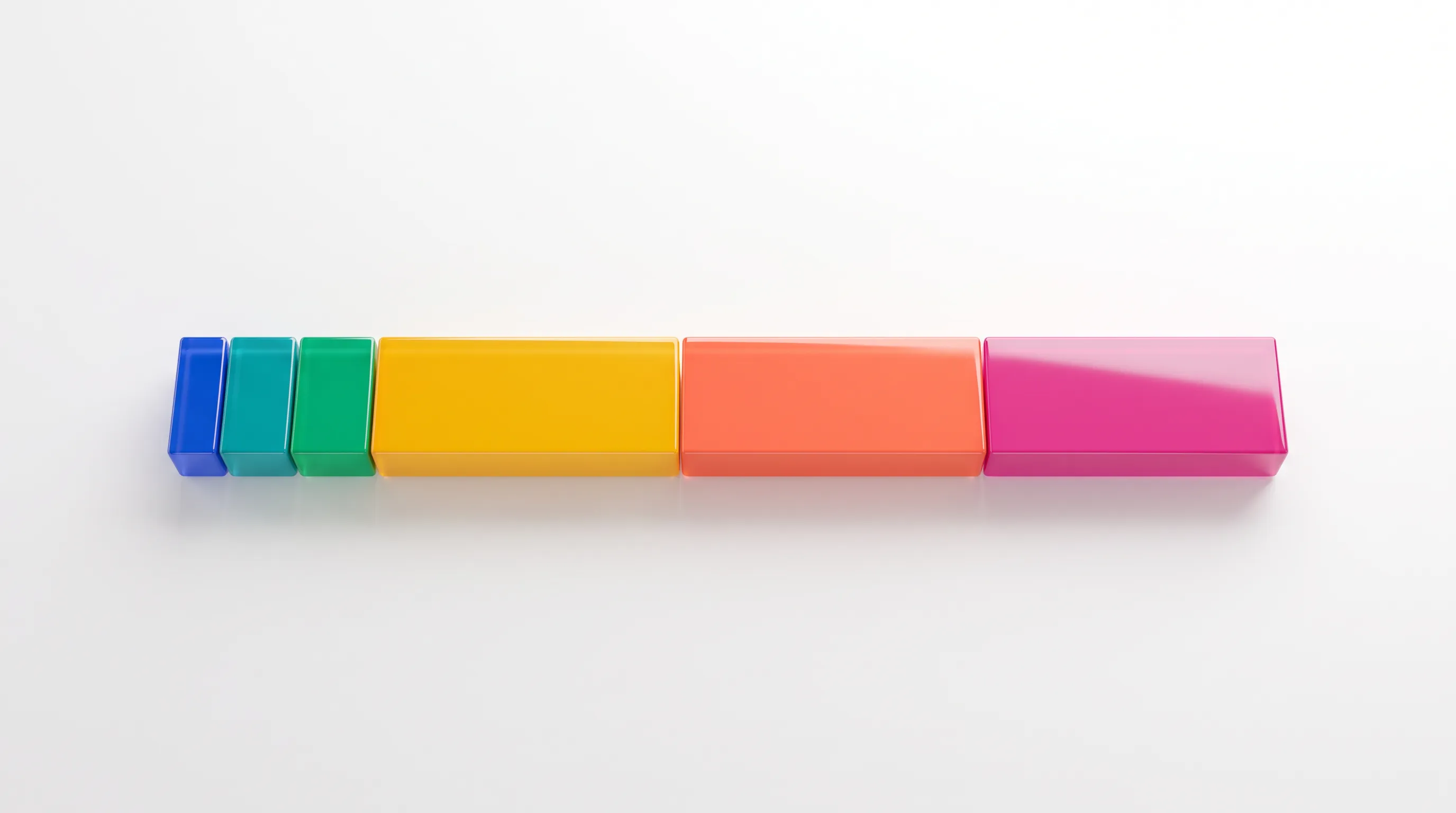 A ~28-week first-run calendar, drawn to scale: manufacturing and shipping dominate the back half, while the compressible documentation phase is a thin sliver at the front.
Two structural facts fall out of this table. First, manufacturing and shipping — the physical, irreducible part — dominate the back half and cannot be meaningfully compressed by better paperwork. A container does not cross the Pacific faster because your tech pack is excellent. Second, the front half is where founders lose the most time to avoidable rework, and it is the only part software touches. Hold that distinction; the rest of this guide returns to it.
Stage by stage: where every week actually goes {#stage-by-stage}
The production calendar is not one process but six, chained end to end. Maker's Row breaks the clothing-production process into pre-production and design, sampling, material procurement, bulk production, quality control, and shipping. Each stage has its own clock, and each fails in its own way.
Concept and design: 2 to 4 weeks
The opening phase covers sketches, mood boards, silhouette decisions, and concept refinement. For an established brand iterating on a known block, this can collapse to days. For a first collection, 2 to 4 weeks is realistic once you account for the decisions that get remade: colorways, fabric weight, trim direction. Design rarely blocks the calendar on its own — but design indecision leaks into every later stage, because a change of mind after sampling costs a full round.
Technical design and the tech pack: 1 to 3 weeks
The tech pack is the document that translates a sketch into instructions a factory can build from — flat sketches, a bill of materials, points of measure, construction and stitch details, and graded specs. Prepared manually, this phase takes 1 to 3 weeks, and a freelance technical designer typically charges $150 to $500 per style for it. This is the stage that determines the length of the next stage. Unclear specifications are the leading cause of first-sample failure, and each additional sampling round typically adds 2 to 4 weeks to the calendar. A tech pack is cheap insurance against expensive weeks.
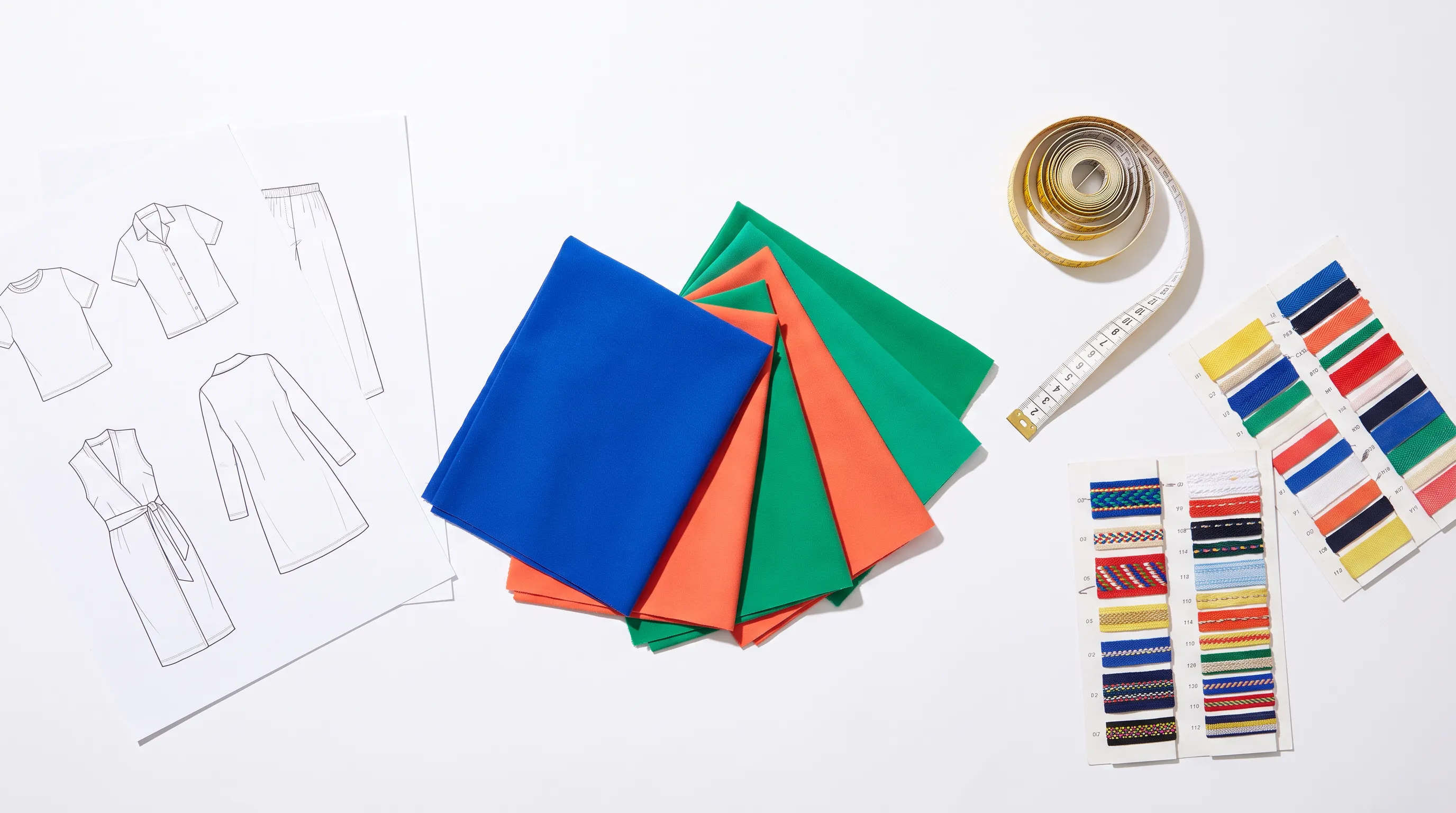 The tech pack is the shortest stage on the calendar and the one that most determines how long every stage after it takes.
Sampling: 4 to 8 weeks across proto, fit, PP, and TOP
Sampling is the back-and-forth heart of development, and it is where timelines most often slip. Most new styles move through four sample types: the proto (first physical version — does the silhouette and construction work in three dimensions?), the fit sample (confirms measurements and drape), the PP or pre-production sample (final approval using actual bulk materials), and the TOP or top-of-production sample (the first unit off the real line).
Each round has its own turnaround. A fit-revision cycle typically runs 7 to 10 days; a PP sample needs 7 to 14 days, longer if bulk materials have not arrived. Most styles need 2 to 3 rounds — a proto to validate design, a fit to confirm measurements, a PP as final sign-off. Stacked with shipping samples back and forth internationally, that is where the 4-to-8-week sampling window comes from. Complex garments push to the top of the range: a simple style with a complete tech pack samples in 4 to 6 weeks, mid-complexity in 5 to 8, and complex outerwear in 7 to 12.
Material procurement: 1 to 4 weeks, often the hidden bottleneck
Fabric is the stage founders forget because it usually runs in parallel — until it doesn't. In-stock jersey or fleece ships in days. But milled-to-order fabric, custom knits, or specialty denim can carry lead times of several weeks on their own, and a PP sample cannot be finished in the correct fabric until the roll arrives. When a timeline blows out for no obvious reason, unquoted fabric lead time is the usual culprit.
Bulk production: 6 to 16 weeks
This is the physical manufacturing run — cut, sew, finish, and quality-control inspection at volume. Counted from final sample approval, most bulk orders take 6 to 12 weeks, with Asian factories around 10 to 16 weeks and US or EU producers finishing in 8 to 14. Order size and garment complexity move the number: a small run of simple tees clears faster than 2,000 units of multi-panel outerwear. Bulk production is the largest single block on the calendar and the least compressible — it is limited by machines, labor, and finishing capacity, not by information.
Shipping and delivery: 3 days to 8 weeks
The final leg depends entirely on air versus sea. Air freight from China to the US runs 3 to 5 days airport-to-airport and 5 to 10 days door-to-door — fast, and several times more expensive per kilo. Ocean freight is the default for volume: China to the US West Coast clusters around 20 to 30 days of transit, the East Coast 30 to 40-plus days, and China to Northern Europe roughly 55 to 58 days port-to-port. Add customs clearance and last-mile delivery, and sea freight realistically consumes 6 to 8 weeks of your calendar. This stage, like manufacturing, is physics — no software shortens the Pacific.
Here is the whole chain in one view, with the honest answer to the question every founder actually wants answered: which of these can I speed up?
| Stage | Typical duration | What happens | Can AI / better docs compress it? |
|---|---|---|---|
| Concept and design | 2–4 weeks | Sketches, mood boards, silhouette and colorway decisions | Partially — visualization and variation tools speed iteration |
| Technical design (tech pack) | 1–3 weeks | Flats, BOM, points of measure, construction specs | Yes, substantially — minutes vs 1–3 weeks |
| Sampling (proto → fit → PP → TOP) | 4–8 weeks | 2–3 physical rounds to confirm fit, fabric, construction | Indirectly — a complete tech pack cuts rounds ~in half |
| Material procurement | 1–4 weeks | Sourcing and receiving fabric and trims | No — mill lead times are fixed |
| Bulk production | 6–16 weeks | Cut, sew, finish, QC at volume | No — limited by machines and labor |
| Shipping and delivery | 3 days–8 weeks | Air or ocean freight, customs, last mile | No — freight transit is fixed |
The pattern is unambiguous. Software compresses the front of the timeline — the documentation and the sampling-prep that feeds it — and leaves the physical back half untouched. Any tool that claims to speed up manufacturing or shipping is selling something that does not exist.
See what a factory-ready tech pack looks like in minutes →
How long production takes by garment type {#by-garment-type}
Not all garments run on the same clock. A blank-body tee and a tailored blazer share almost none of the same construction risk, and their timelines reflect it. The variables that stretch a garment's calendar are the number of pattern pieces, the number of fit-sensitive seams, whether it needs washing or finishing (denim), and whether it depends on a specialized component with its own lead time (a shoe last, an underwire, a custom knit).
Below are directional total timelines by category, drawn from manufacturer benchmarks. These count development plus sampling plus bulk production for a first run — before shipping — and assume overseas manufacturing. Treat them as planning ranges, not guarantees.
| Garment | Development + sampling | Bulk production | Total (pre-shipping) |
|---|---|---|---|
| Basic t-shirt | 3–5 weeks | 4–6 weeks | 8–12 weeks |
| Hoodie / fleece | 4–6 weeks | 6–8 weeks | 10–14 weeks |
| Denim jeans | 5–7 weeks | 7–11 weeks | 12–18 weeks |
| Knitwear (sweater) | 5–8 weeks | 6–10 weeks | 11–18 weeks |
| Tailored jacket / blazer | 6–10 weeks | 8–12 weeks | 14–20 weeks |
| Swimwear | 5–8 weeks | 6–9 weeks | 11–17 weeks |
| Footwear | 8–16 weeks | 5–7 weeks | 13–24 weeks |
Sources: garment ranges synthesized from published apparel-manufacturing and footwear-production timeline references. Directional planning ranges, overseas manufacturing assumed.
T-shirts and basic knits: the fast lane
A simple t-shirt order using readily available fabric typically takes 8 to 12 weeks end to end, and a straightforward run from design approval can clear in 4 to 8 weeks: fabric sourcing (1 to 2 weeks), pattern and sampling (1 to 2 weeks), cutting and sewing (1 to 2 weeks), and finishing and QC (1 week). Blanks are forgiving because there is little fit risk and the fabric is almost always in stock.
Hoodies and fleece: one step up
Hoodies run 10 to 14 weeks. The added time comes from heavier fabric, more panels, and construction details — drawcords, kangaroo pockets, ribbing — that each carry their own sampling risk. Still a relatively fast category, and a common first product for exactly that reason.
Denim: washing is a whole second process
Jeans run 12 to 18 weeks because denim is really two products in one: the sewn garment and the wash. Custom denim production lands at 8 to 12 weeks for most orders, with mass runs of 20 to 45 days once the wash and finish are locked. Fit iterations on denim are especially slow — the fabric's rigidity and stretch recovery mean each fit round teaches you something the last one hid.
Tailored jackets and blazers: the long pole
Tailoring sits at the top: 14 to 20 weeks. A blazer can carry dozens of pattern pieces, internal canvas and fusibles, structured shoulders, and multiple linings — every one a fit-sensitive decision. Sampling alone on jackets and structured outerwear can consume 4 to 6 weeks. This is the category where an incomplete tech pack does the most damage, because there is the most to specify and the most to get wrong.
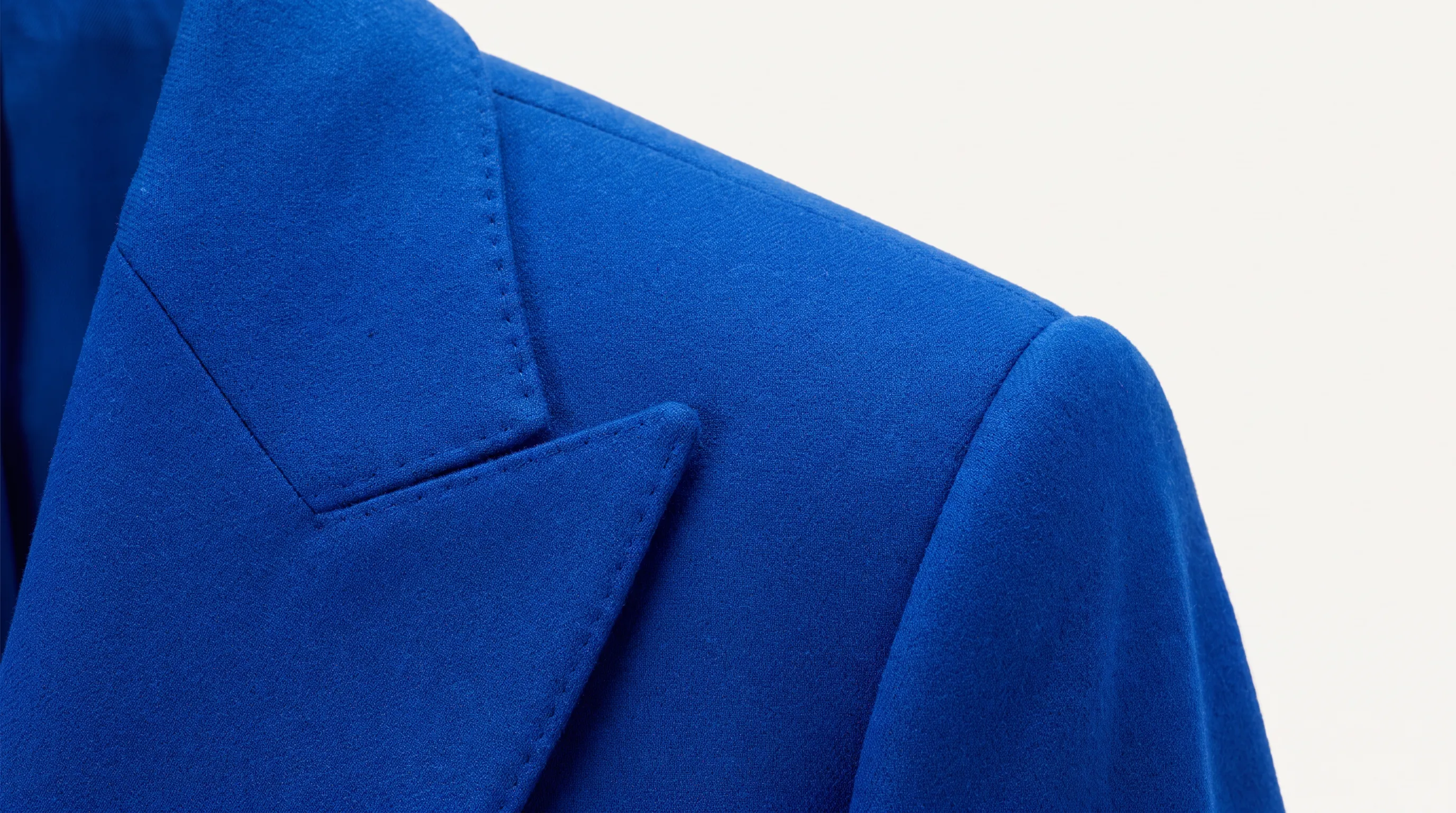 A tailored jacket carries the most construction risk of any common garment — and the longest, most sampling-heavy timeline.
Knitwear: the yarn is the clock
Sweater knitwear runs 11 to 18 weeks, and its bottleneck is upstream: yarn sourcing and the knitting program. Whole-garment and intarsia knits add programming time before a single sample exists. If the yarn is not in stock, the yarn lead time — not the factory — sets your calendar.
Swimwear: seasonal and unforgiving
Swimwear itself is a fast make, but the season is brutal. Makers advise starting a summer collection 6 to 9 months in advance to absorb sampling, fit revisions on stretch fabric, and shipping. Miss the window and the product is dead weight until next year — swimwear's real timeline risk is the calendar, not the make.
Footwear: a category of its own
Footwear is the slowest common category, 3 to 6 months of development because of the last — the foot-shaped mold every shoe is built on. A new last plus 3 to 5 sample rounds (prototype, development, confirmation, pre-production) dominates the front of the schedule; bulk production is a comparatively fast 35 to 45 days once confirmed. For footwear especially, the documentation and prototyping phase is the timeline.
Domestic vs overseas: speed against cost {#domestic-vs-overseas}
Where you manufacture trades unit cost against lead time and minimum order quantities, and the trade is real in both directions. Overseas factories in Asia offer the lowest per-unit costs at the price of longer lead times and weeks of ocean freight. Nearshore and domestic producers cost more per unit but collapse the shipping leg and make small reorders viable.
The lead-time spread by region is wide. Portugal — Europe's nearshoring hub, home to the mills and factories around Porto — offers 2-week road freight into the EU. Turkey can turn small orders in 3 to 4 weeks. Mexico, duty-free into the US under USMCA for qualifying goods, runs 15-to-25-day lead times and can replenish US inventory in 2 to 3 weeks. Vietnam runs 45 to 60 days. Bangladesh, the low-cost volume leader, carries a longer 90-to-120-day lead time.
| Sourcing region | Production lead time | Shipping to primary market | Relative unit cost | MOQ | Best for |
|---|---|---|---|---|---|
| China | 30–60 days | Sea 3–6 wk / Air 3–5 days to US | Low–medium | 200–500+ | Complex builds, deep supply chain |
| Vietnam | 45–60 days | Sea 3–5 wk to US | Low | 300–500+ | Volume, activewear, denim |
| Bangladesh | 90–120 days | Sea 5–8 wk to US/EU | Lowest | 500–1,000+ | High-volume basics |
| Portugal | 3–6 weeks | 2 wk road to EU | Medium–high | 50–200 | EU brands, fast reorders, knitwear |
| Turkey | 3–4 weeks | 1–2 wk to EU | Medium | 100–300 | EU-facing denim and knits |
| Mexico | 15–25 days | 2–3 wk to US | Medium | 100–300 | US nearshoring, fast replenishment |
| USA domestic | 4–8 weeks | Days (no freight) | Highest | 50–200 | Premium positioning, speed to market |
Sources: country lead-time figures synthesized from published apparel-sourcing country guides. Lead times exclude development and sampling.
The strategic read: for a first run and for reorders where speed matters, the total landed timeline — production plus freight — often favors nearshoring even when the unit cost is higher. A Portuguese knit at a higher per-unit price that lands in Europe in five weeks can beat a Bangladeshi equivalent that is cheaper per unit but four months out — because the faster maker supports higher full-price sell-through. McKinsey's work on shortening the apparel calendar is blunt on this point: faster turnaround supports higher full-price sell-through and limits markdown risk. Time on the calendar is money off the margin.
What actually compresses the timeline (and what can't) {#what-compresses-the-timeline}
Here is the honest map of where time is recoverable — because most of the "speed up your production" advice online quietly ignores that manufacturing and shipping are fixed.
What cannot be compressed: bulk production and freight. A factory sews at a rate set by its machines and its people; a container crosses the ocean at the speed of a ship. No document, no software, and no amount of urgency changes those two blocks, which together are the majority of a 28-week calendar. Any tool promising to make manufacturing faster is misrepresenting what it does.
What can be compressed: the front of the timeline — design iteration, technical documentation, and the number of sampling rounds that documentation determines. This is not a marginal slice. Sampling is 4 to 8 weeks, and its length is driven almost entirely by how complete and unambiguous your tech pack is. The data here is direct: unclear specifications are the leading cause of first-sample failure, and clients using thorough tech packs reduce sampling rounds from 4.5 to as low as 1.8, saving $300 to $750 per design. Since each avoided round is 2 to 4 weeks, cutting from four rounds to two can pull a full month off your calendar without touching the factory floor.
 The recoverable weeks live at the front of the timeline — in documentation clear enough that the factory gets the first sample right.
This is precisely the phase Adstronaut compresses, and it is worth being exact about the boundary. Adstronaut does not make your factory sew faster or your container arrive sooner. What it does is collapse the documentation stage — the 1-to-3-week, $150-to-$500 tech-pack step — into minutes. Adstronaut generates a complete, factory-ready tech pack from a single product photo: flat sketches, a bill of materials, points of measure, and construction callouts, in the format a manufacturer expects. The tech pack itself is a small line item on the calendar; its value is in what it prevents downstream.
Because the tech pack determines sample-round count, compressing and sharpening the documentation phase is the highest-leverage move a founder has. A brand that spends three weeks and $400 producing an incomplete tech pack, then burns two extra sample rounds — four to eight extra weeks — fixing what the document should have specified, has lost more time to paperwork than to the factory. Getting the specification right the first time is where Adstronaut turns weeks of avoidable rework into a first-pass sample that is closer to correct. That is the entire, honest claim: AI compresses the documentation and sampling-prep phase; it does not touch the physical manufacturing or shipping that make up the rest of the calendar.
McKinsey notes the same principle at the industrial scale: some manufacturers use digital tools and AI to reduce sampling lead time from weeks to days. The mechanism is identical whether you are a global brand or a founder with one style — better information upstream buys back weeks downstream.
First run vs repeat: why your second order ships faster {#first-run-vs-repeat}
The timelines above describe a first run — the expensive, slow one where everything is being figured out for the first time. A repeat order of an already-approved style is a different animal, and understanding the gap is essential to planning a business rather than a single drop.
On a reorder, most of the front of the timeline disappears. Design is done. The tech pack exists. The pattern is graded and on file. The fit and PP samples are already approved, so the sampling stage — the 4-to-8-week back-and-forth — collapses to a single confirmation sample or is skipped entirely. What remains is fabric procurement (if not already in stock), bulk production, and shipping. That is why repeat runs with an established manufacturer and approved samples typically move in 8 to 14 weeks, roughly half a cold-start timeline.
The implication for planning is direct: the first run is where you buy down all the future timelines. Every week invested in getting the documentation, fit, and factory relationship right on run one is a week you never spend again on runs two through twenty. This is also why the tech pack compounds — it is authored once and reused every season, and a complete one keeps every reorder on the fast track. The founders who scale are the ones who treat the slow, painful first run as the fixed cost of a fast pipeline, not as the normal speed of their business.
One planning note that costs brands entire seasons: seasonal collections must start 9 to 12 months before launch to safely absorb development, sampling, production, and shipping. That is not because any single stage is that long — it is because the stages chain, buffers are needed, and a missed sampling round can push a summer drop into autumn. Plan backward from the on-shelf date, not forward from today.
Start your first run with a complete tech pack — generate one in minutes →
 Plan the calendar backward from the on-shelf date. The first run is slow so that every run after it can be fast.
Frequently Asked Questions {#frequently-asked-questions}
How long does it take to manufacture clothing from start to finish? From first sketch to delivered product, 3 to 9 months is realistic, with 20 to 32 weeks typical for a first run. Design and tech packs take 2 to 6 weeks, sampling 4 to 8 weeks, bulk production 6 to 16 weeks, and shipping 3 days by air to 8 weeks by sea. A repeat order of an approved style moves in 8 to 14 weeks.
How long does bulk production take after sample approval? Counted from final sample approval, most bulk orders take 6 to 12 weeks. Asian factories cluster around 10 to 16 weeks and US or EU producers finish in 8 to 14 weeks, depending on order size and garment complexity. This is the manufacturing stage only — it excludes the development and sampling that come before it.
How many sample rounds does a new garment need? Most new styles need 2 to 3 rounds: a proto to validate design and construction, a fit sample to confirm measurements, and a pre-production (PP) sample as final sign-off in bulk materials. Each fit-revision cycle runs 7 to 10 days and each PP sample 7 to 14 days. Complete tech packs cut the average round count from roughly 4.5 to under 2.
How long does sea freight take versus air freight? Ocean freight from China to the US West Coast runs about 20 to 30 days of transit (longer to the East Coast) and 55 to 58 days to Northern Europe, before customs and last-mile — realistically 6 to 8 weeks total. Air freight is 3 to 5 days airport-to-airport and 5 to 10 days door-to-door, at several times the per-kilo cost.
Which garment type has the longest production timeline? Footwear is the slowest common category at 3 to 6 months, because a new shoe last plus 3 to 5 sample rounds dominates development. Among apparel, tailored jackets and blazers are longest at 14 to 20 weeks, driven by dozens of pattern pieces and internal structure. Basic t-shirts are fastest at 8 to 12 weeks.
Is domestic manufacturing faster than overseas? Usually, on total landed time. US domestic runs take 4 to 8 weeks of production with no ocean freight; Portugal reaches EU markets in about 5 weeks door to door; Mexico replenishes the US in 2 to 3 weeks. Overseas producers in Vietnam (45–60 days) or Bangladesh (90–120 days) cost less per unit but add weeks of production lead time and sea freight.
Can AI or software make clothing production faster? Only the front of the timeline. AI tools like Adstronaut compress the documentation and sampling-prep phase — generating a factory-ready tech pack in minutes instead of the 1-to-3-week, $150-to-$500 manual step, and reducing the sample rounds that unclear specs cause. AI does not and cannot speed up physical bulk manufacturing or ocean freight, which are the majority of the calendar.
How far ahead should I start a seasonal collection? Start 9 to 12 months before your on-shelf date. That horizon absorbs design, tech packs, 2 to 3 sampling rounds, fabric lead times, bulk production, and shipping, with buffer for a missed sample round. Swimwear and other tightly seasonal categories should begin at least 6 to 9 months out to avoid missing the selling window entirely.
Sources and further reading: