Stable Diffusion vs Adstronaut AI for fashion brands
Updated June 10, 2026
Stable Diffusion is a free, open-source AI image generator you run yourself — but it needs a 12–24GB GPU, software like ComfyUI or Automatic1111, and ControlNet plus custom-trained LoRAs you assemble by hand, with no built-in fashion pipeline, product fidelity, or tech packs. Adstronaut AI is purpose-built for fashion: it renders your real garment on a consistent model from ~$1 per image and drafts factory specs, with zero setup, on plans from $29/month.
Stable Diffusion vs Adstronaut AI: the quick verdict
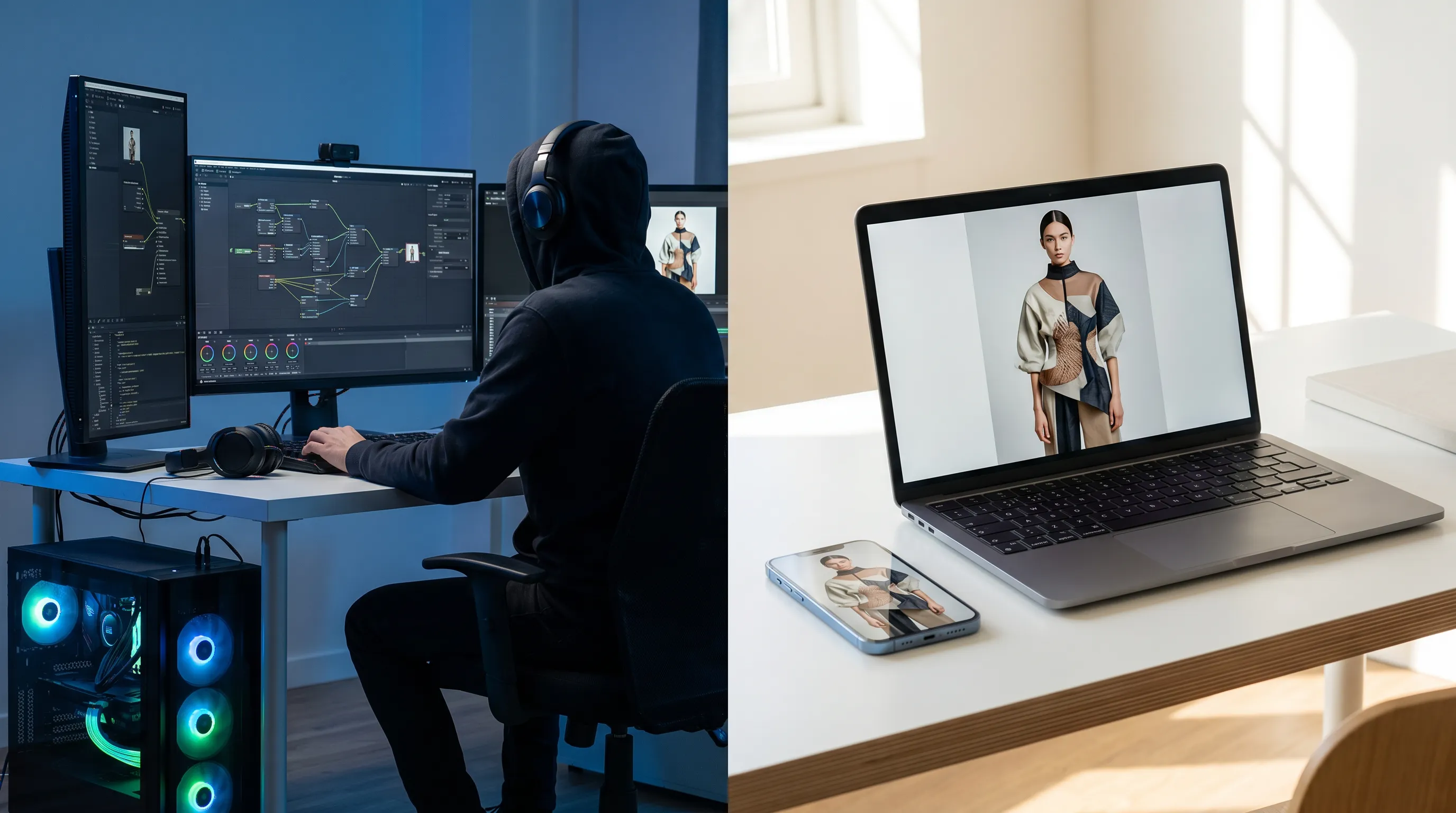
Stable Diffusion and Adstronaut AI both generate fashion imagery, but they sit at opposite ends of the control-versus-convenience trade-off. Stable Diffusion is open-source and free to run — Stability AI's models are downloadable and, under the Community License, free for commercial use while your business is under $1M in annual revenue (Stability AI license). In exchange for that freedom you supply everything else: a GPU with 12–24GB of VRAM (Aiarty GPU requirements), software like ComfyUI or Automatic1111, and the ControlNet, inpainting, and custom-LoRA scaffolding that fashion work actually requires. There is no out-of-the-box garment fidelity, no repeatable model identity, and no tech packs — you build the pipeline.
Adstronaut AI is built the other way around. You upload the photo of the product you sell, and the AI Photoshoots tool renders that garment on one of 22 named, consistent models for about $1 per image, while the AI Designer takes a moodboard to a production-ready concept — no GPU, no node graph, no training runs. Choose Stable Diffusion if you want maximum control, free compute, and you have the technical chops (or the time) to assemble a workflow. Choose Adstronaut if you want fashion-specific output and a path to production without becoming an ML engineer. The rest of this page is the evidence.
Stable Diffusion vs Adstronaut AI, side by side
| Factor | Stable Diffusion (self-hosted) | Adstronaut AI |
|---|---|---|
| Price | Models free (open-source); you pay for GPU — a $300–$1,000 card or ~$0.34/hr cloud | Plans from $29/mo (125 credits); a photoshoot image is 5 credits — ~$1 each; a designer concept is 10 credits — ~$2 |
| Setup required | Install Python, ComfyUI/A1111, drivers, models, ControlNet, extensions; hours to days | None — sign in and upload a photo in the browser |
| Hardware | GPU with 12–24GB VRAM recommended (RTX 3060 12GB minimum for SDXL) | None — runs on Adstronaut's servers from any device |
| Built for | General-purpose, fully customizable image generation | Fashion production — real-product imagery, concepts, specs |
| Your actual product | Possible, but you must build a clothing-transfer workflow (ControlNet + inpainting + reference) | Renders the exact garment from your uploaded photo — pattern, color, seams transfer |
| Model consistency | Requires training a custom face LoRA on 50–100 images yourself | 22 named models with the same face across every pose and scene, built in |
| Tech packs / specs | None — image generation only | Separate tech pack tool: flats, BOM, graded measurements (25 credits, $3–6) |
| Pantone / colorways | None native; assemble it yourself | Auto-extracted 5-color Pantone palette; per-zone Color Changer |
| Skills required | Comfortable with Python, Docker, node graphs, prompt + model tuning | None — point and click |
| Commercial license | Free under $1M revenue (SD 3.5 Community License); Enterprise license above | Commercial license on paid plans |
| Best for | Technical builders, researchers, brands needing bespoke custom pipelines | Indie founders and brands shipping catalogs and specs without a GPU |
Hardware and license facts per Stability AI's license and published GPU-requirement guides; cloud-GPU rate per RunPod's 2026 pricing. Adstronaut pricing and feature counts per its plans page and feature configs.
Choose Adstronaut if… / Choose Stable Diffusion if…
Choose Adstronaut AI if…
- ✓You want fashion-specific output today — your real garment on a model — without installing software, downloading models, or owning a GPU.
- ✓You need the same model across a whole catalog and don't want to train a custom face LoRA on 50–100 photos to get it.
- ✓You want the imagery to flow into production — Pantone palettes, tech packs, line sheets — not just stop at a picture.
- ✓You'd rather pay ~$1 per finished on-model image than spend hours wiring a ControlNet-plus-LoRA pipeline that may still drift from your sample.
- ✓You're a founder or marketer, not an ML engineer, and your time is better spent on product than on node graphs.
Choose Stable Diffusion if…
- ✓You want maximum control and free compute — open weights you can fine-tune, modify, and run offline with no per-image cost.
- ✓You're technically comfortable with Python, ComfyUI or Automatic1111, ControlNet, and training your own LoRAs.
- ✓You already own a capable GPU (12GB+ VRAM) or are happy renting one at roughly $0.34/hour.
- ✓You need a bespoke pipeline a SaaS won't give you — a custom model, an unusual workflow, full data privacy on your own machine.
- ✓You're a researcher, hobbyist, or studio with engineering time and the DIY build is a feature, not a cost.
Some teams run both: Stable Diffusion for experimental, fully custom work, Adstronaut for the catalog they actually have to ship on a deadline.
Free software, real costs — the setup math
How much does each actually cost?
Stable Diffusion's headline is unbeatable: the software and the model weights are free. Stability AI distributes SD 3.5 and earlier models openly, and under the Community License they're free for commercial use as long as your organization's annual revenue stays under $1M — above that, you need an Enterprise license (Stability AI license). The cost lives downstream. To run a modern model you want 12–24GB of VRAM: an RTX 3060 (12GB) is the practical SDXL minimum at roughly $300 used, while flagship models like Flux and SD 3.5 push toward 16–24GB and a card in the $1,000+ range (Aiarty GPU requirements). Don't own one? Cloud GPUs rent from about $0.34/hour for an RTX 4090 on RunPod — roughly $2–3 of compute per 1,000 images (RunPod pricing). On a per-image basis, that's astonishingly cheap.
Adstronaut prices per finished output instead. A photoshoot image is 5 credits — about $1 ($0.62–$1.16 depending on plan); a designer concept is 10 credits, roughly $2. Plans run Standard $29/mo (125 credits), Pro $69/mo (375), and Studio $149/mo (1,000), with annual billing 17% off, and the free plan includes 25 credits so your first shoot is free as a watermarked preview. The honest framing: Stable Diffusion wins the raw per-image compute cost decisively. Adstronaut's per-image price buys you the absence of everything else — no hardware, no setup, no LoRA training, and a fashion-tuned result on the first try.
The setup tax: what 'free' actually requires
Free-to-run is not the same as free-to-use, and the gap is the entire point of this comparison. Getting Stable Diffusion producing usable fashion imagery means installing a runtime — ComfyUI (a node-graph editor) or Automatic1111 (a web UI) — plus Python, the right GPU drivers, base model checkpoints, and usually ControlNet for pose and structure control (AI Tool Discovery — run Stable Diffusion locally). Cloud hosts like RunPod ship templates that cut the install time, but they assume you're comfortable with Docker and GPU environments, and Community-Cloud machines can drop offline mid-job (RunPod review 2026). None of that touches the fashion-specific layer yet.
For a brand, that layer is where the hours go. To put your actual garment on a model, practitioners chain a clothing-transfer workflow — a garment reference, ControlNet normal maps for fabric surface, and inpainting to preserve the pose (Stable Diffusion Art — change clothes with AI). To keep one model's face across a catalog, you train a custom face LoRA on 50–100 images of that model (Punya AI — custom fashion LoRA guide). Each of those is a project. Adstronaut ships all of it as a default: upload a photo, pick a model, render. The trade is real — you give up the open-ended control of a node graph in exchange for never having to build one.
Fashion fidelity: out of the box vs assembled by hand
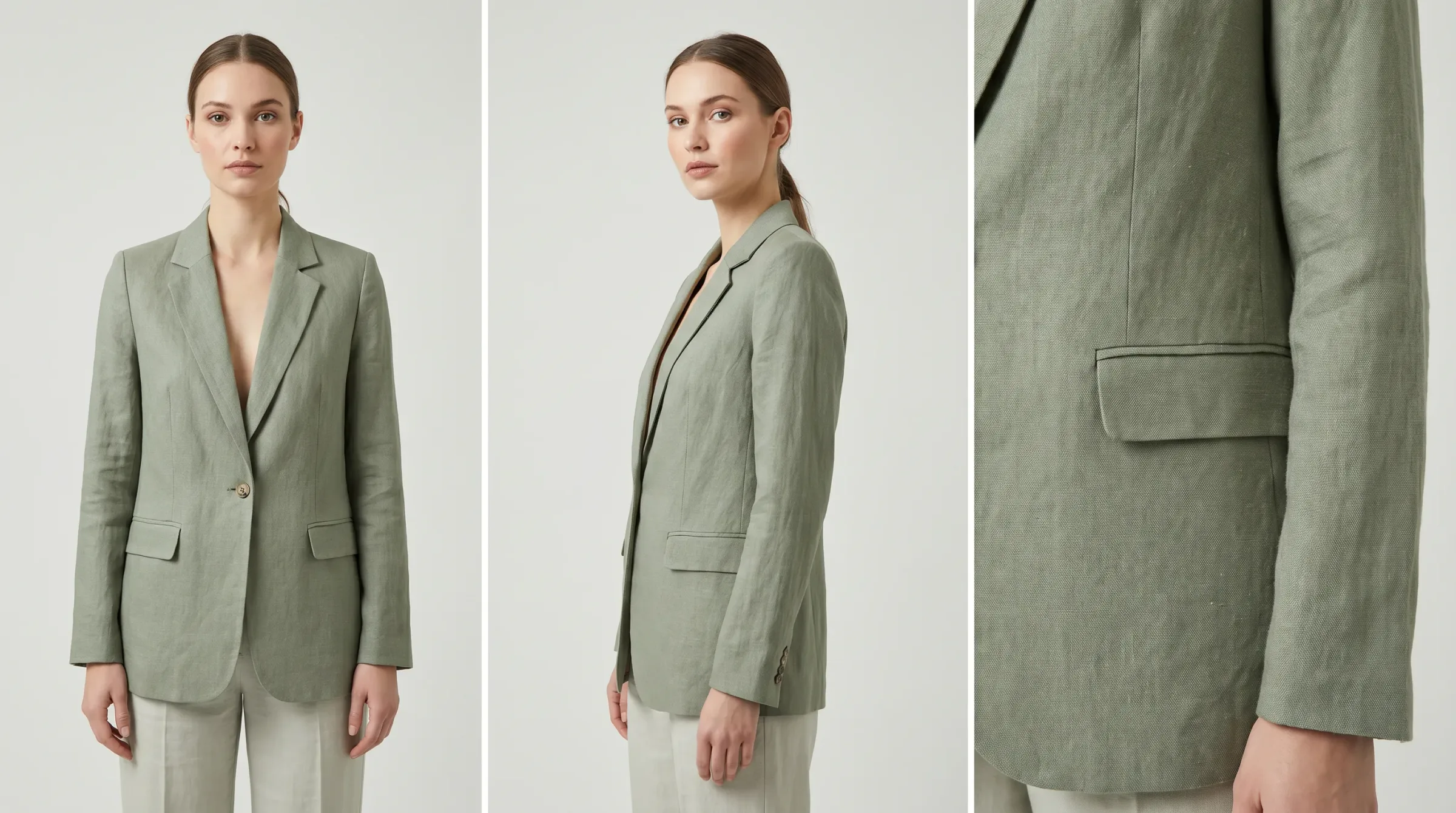
A base Stable Diffusion model knows what a jacket looks like in general; it does not know what your jacket looks like. Out of the box it generates a plausible garment from a text prompt, which is interpretation, not reproduction — the print drifts, a pocket appears, the collar reshapes. The open-source ecosystem absolutely can close that gap: with the right ControlNet stack, a garment reference, and MagicClothing-style workflows, skilled users match professional photography for many fabric types. But that fidelity is something you engineer, tune, and maintain — it is not a guarantee the model ships with.
Adstronaut's AI Photoshoots model is fine-tuned for fashion fidelity by default. You upload the actual garment photo — flat-lay, mannequin, or amateur on-model — and the pattern, color, fabric texture, seam placement, and hardware transfer to the rendered image. You can assemble a full look across four outfit slots (top, bottom, full-body, footwear) from separate uploads, and test alternate colorways per-zone in the Color Changer against 2,300+ Pantone TCX shades. The distinction is consistency of outcome: with Stable Diffusion, fidelity is a function of how good your pipeline is; with Adstronaut, it's the baseline you start from. For a head-to-head against the tools brands shortlist most, the best AI photoshoot tools roundup scores each on exactly this.
From image to production: specs Stable Diffusion never touches
Imagery is one third of getting a garment made; the other two — a concept you can iterate and a spec sheet a factory can build from — are completely outside an image generator's scope. Stable Diffusion is, by design, an image model. There is no Pantone extraction, no bill of materials, no graded measurement chart, and no plugin that turns a render into a factory document. The open-source community builds remarkable extensions, but a tech pack is a structured production artifact, not an image-generation task.
Adstronaut closes that loop natively. The AI Designer turns a moodboard into four illustration variations and a photoreal render, each shipping with an auto-extracted 5-color Pantone palette ready for your dye house. From there the separate AI Tech Pack Generator drafts flat sketches, a structured bill of materials, and graded measurements for apparel, footwear, leather goods, knitwear, and bodywear in 3–5 minutes, at 25 credits (about $3–6) per pack. The same product DNA carries from concept to catalog to factory — a pipeline a raw image model was never meant to enter. The same structural gap applies to other general image tools, which the Midjourney comparison covers from the closed-source, prompt-driven side.
When Stable Diffusion is the better choice
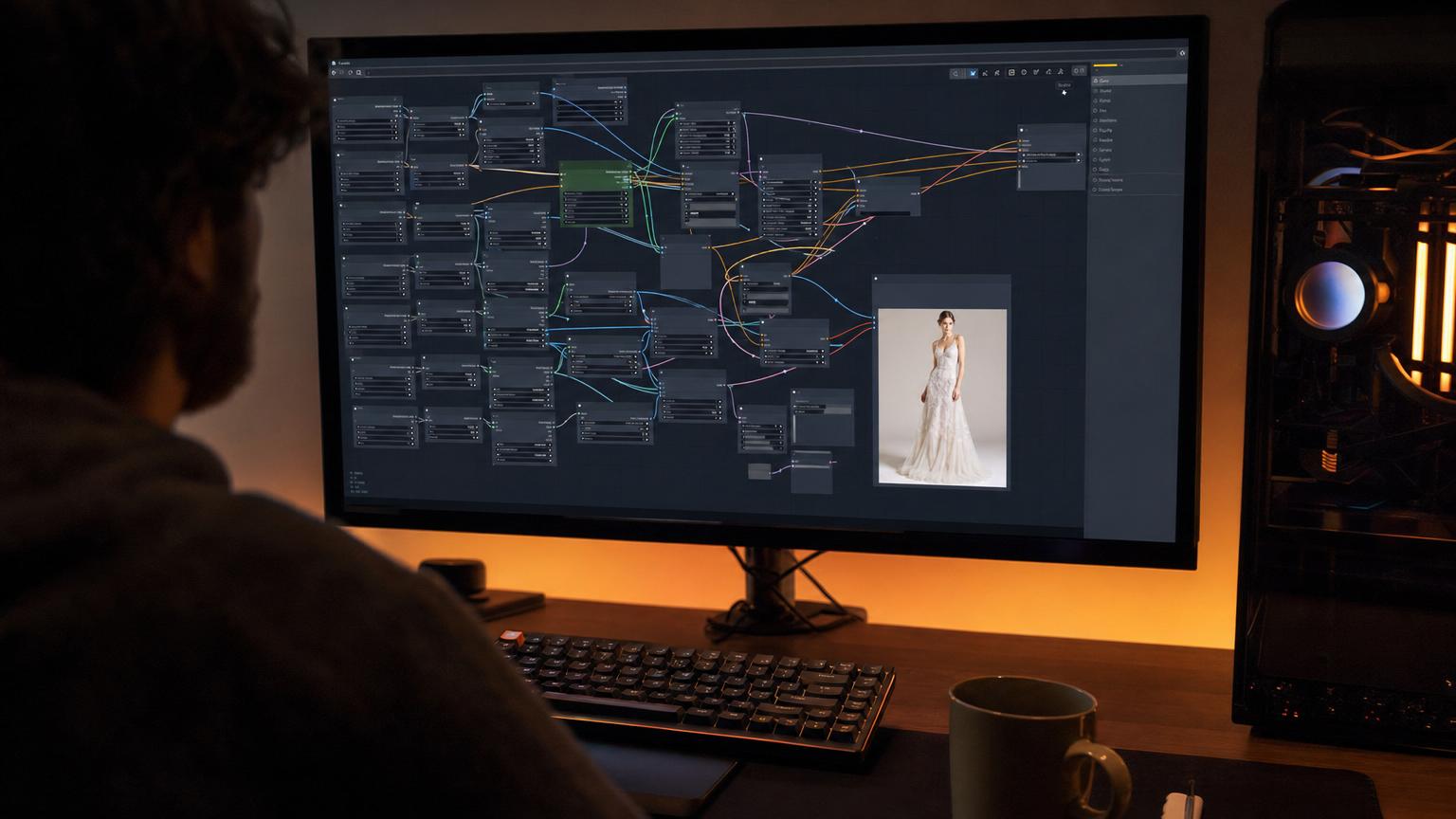
Adstronaut does not replace Stable Diffusion, and pretending otherwise would cost this page its credibility. For maximum control, free compute, and full ownership of the pipeline, Stable Diffusion is unmatched — open weights you can fine-tune on your own data, run entirely offline for data privacy, and modify at any layer. If you're a technical founder, a researcher, or a studio with engineering time, that DIY ceiling is exactly the freedom you want, and a fixed SaaS workflow would only get in the way. The per-image compute cost — roughly free once you've built the rig — is genuinely lower than any per-credit price.
Stable Diffusion is also the right call when your need is truly bespoke: a custom model trained on a proprietary aesthetic, an unusual generative workflow no product exposes, or a hard requirement to keep every image on hardware you control. The pattern some teams land on is hybrid — experiment and build custom pipelines in Stable Diffusion, and lean on Adstronaut for the deadline-driven catalog where setup time is the enemy. If you're scoping the whole tool stack rather than just these two, the best AI tools for fashion design and the comparison hub line each option up on the same criteria.
Moving fashion work off a Stable Diffusion build: the 4-step workflow
Keep your Stable Diffusion rig for custom and experimental work — this is the per-product workflow when you just need the real garment on a model without the setup.
- 1
Skip the install entirely
No GPU, no ComfyUI, no model downloads, no ControlNet graph. Sign in to AI Photoshoots in the browser — the fashion pipeline is already assembled. - 2
Upload the real garment photo
A flat-lay, mannequin shot, or amateur on-model photo works (JPG/PNG/WEBP). This replaces the clothing-transfer workflow you'd otherwise wire together by hand. - 3
Pick a model, pose, and scene
Choose one of 22 named models so your catalog stays consistent — no custom face LoRA to train — then a pose and scene, and render at ~$1 per image. - 4
Carry it into production
Extract the Pantone palette in AI Designer, test colorways in the Color Changer, and draft a tech pack when you're ready for the factory.
Which should you choose?
Indie founders and DTC brands shipping real product, with no GPU and no ML background, get the most from Adstronaut — it renders the exact garment on a consistent model from ~$1 an image, no install, no training runs, and the first shoot is free to preview. Catalog and e-commerce teams save the most on consistency and speed: one model across forty SKUs without a custom LoRA, plus a path to tech packs in the same workflow. Design and merchandising leads use the AI Designer plus tech packs to run concept-to-factory in one pipeline.
Technical builders, researchers, and studios with engineering time should keep Stable Diffusion — for control, free compute, and bespoke pipelines it's the open-source standard, and many teams run both. For the wider field, see the best AI photoshoot tools and the best AI tools for fashion design roundups, which place each tool in its real lane — the free-but-DIY one, and the paid-but-purpose-built one.
Frequently asked questions
Is Stable Diffusion free, and is it cheaper than Adstronaut?
The Stable Diffusion software and model weights are free and open-source, and under the SD 3.5 Community License they're free for commercial use while your business is under $1M in annual revenue. But you supply the hardware: a 12–24GB GPU costing roughly $300–$1,000, or a cloud GPU from about $0.34/hour. Per image, Stable Diffusion's compute is far cheaper than Adstronaut's ~$1. The cost Adstronaut removes is everything else — no setup, no GPU, no LoRA training, and fashion-tuned output on the first try.
Why do people switch from Stable Diffusion to a purpose-built fashion tool?
Three reasons recur: setup (installing ComfyUI or Automatic1111, models, ControlNet, and training custom LoRAs takes hours to days before the first usable fashion image), hardware (a capable 12–24GB GPU isn't free), and the missing fashion layer (no built-in garment fidelity, no consistent model identity, no tech packs). Stable Diffusion stays in the workflow for custom and experimental work; the deadline-driven catalog moves to a fashion-specific tool like Adstronaut.
What hardware do I need to run Stable Diffusion for fashion?
For modern models, plan on a GPU with 12–24GB of VRAM. An RTX 3060 (12GB) is the practical minimum for SDXL at 1024px; flagship models like Flux and SD 3.5 push toward 16–24GB. A capable card runs $300 used to $1,000+ new, or you can rent a cloud RTX 4090 from about $0.34/hour. Adstronaut needs no hardware at all — it runs on its own servers and you work in the browser from any device.
Can Stable Diffusion put my actual garment on a model?
Yes, but not out of the box. You build a clothing-transfer workflow: a garment reference image, ControlNet (often normal maps for fabric surface), and inpainting to preserve the pose. To keep the same model face across a catalog you also train a custom face LoRA on 50–100 images. It's powerful and fully controllable, but it's an engineering project. Adstronaut ships that pipeline as a default — upload a garment photo, pick one of 22 consistent models, and render.
Does Stable Diffusion create tech packs or production specs?
No. Stable Diffusion is an image generator — it stops at the picture, with no bill of materials, graded measurements, or Pantone extraction, and no extension turns a render into a factory document. Adstronaut's AI Designer auto-extracts a 5-color Pantone palette from each render, and the separate AI Tech Pack Generator drafts flats, a BOM, and graded measurements in 3–5 minutes for 25 credits ($3–6) per pack across apparel, footwear, leather goods, knitwear, and bodywear.
Do I need technical skills to use Stable Diffusion?
For real fashion work, yes. You need to be comfortable installing software, managing GPU drivers and model files, wiring node graphs in ComfyUI or panels in Automatic1111, and assembling ControlNet plus LoRA workflows — cloud hosts add Docker familiarity on top. Adstronaut is point-and-click: upload a garment photo, pick a model, pose, and scene, and render. No code, no models to download, no GPU to manage.
Can I use Stable Diffusion images commercially for my brand?
Under the SD 3.5 Community License, yes, for free while your organization's annual revenue is under $1M; above that threshold Stability AI requires an Enterprise license. License terms differ by model version, so check the specific model's license. Adstronaut grants a commercial license on paid plans, and because its photoshoot models are synthetic there are no model releases or likeness issues to manage.
Will the garment in an Adstronaut image match my real product?
Yes — that's the priority. Adstronaut's photoshoot model is fine-tuned for fashion fidelity, so pattern, color, fabric texture, seam placement, and hardware transfer from your uploaded photo to the rendered image. With raw Stable Diffusion, that level of fidelity depends entirely on how well you've built your ControlNet-and-reference pipeline; with Adstronaut it's the baseline you start from.
Can I run both Stable Diffusion and Adstronaut together?
Yes, and some teams do. Use a Stable Diffusion rig for experimental, fully custom, or privacy-sensitive work where the open node graph and free compute are the point; use Adstronaut for the catalog you have to ship on a deadline, where setup time is the enemy. One is maximum control you build; the other is fashion-specific output that's ready immediately.
Is the per-image cost really lower with Stable Diffusion?
On raw compute, yes — once the rig is built, generating images is nearly free, and a cloud RTX 4090 runs roughly $2–3 of compute per 1,000 images. The honest catch is that the figure ignores the hours of setup, the hardware, and the LoRA-training time before that first batch, plus the absence of fashion fidelity, model consistency, and tech packs. Adstronaut's ~$1 per image prices in all of that as a finished, fashion-tuned output.
Skip the GPU and the node graph
Stable Diffusion is free to run if you bring the hardware, the setup, and the engineering time. Upload one garment photo and Adstronaut renders it on a consistent model in minutes — fashion-tuned, no install. First shoot free as a watermarked preview, then about $1 per image in credits.
Try AI PhotoshootsKeep comparing
Sources and further reading
- Stability AI — license — SD 3.5 Community License: free commercial use under $1M annual revenue; Enterprise license required above
- Aiarty — Stable Diffusion GPU requirements 2026 — RTX 3060 12GB minimum for SDXL; 16–24GB+ for Flux/SD 3.5 flagship models
- RunPod — GPU cloud pricing — RTX 4090 from ~$0.34/hr; ~$2–3 compute per 1,000 SDXL images
- AI Tool Discovery — run Stable Diffusion locally (ComfyUI + A1111) — install runtime, Python, drivers, model checkpoints, ControlNet to get started
- Stable Diffusion Art — change clothes with AI — clothing transfer requires inpainting + ControlNet to preserve pose
- Punya AI — custom fashion LoRA training guide — training a custom clothing/face LoRA requires 50–100 reference images
- Adstronaut pricing and plans — photoshoot 5 cr ~$1, designer 10 cr ~$2, tech pack 25 cr $3–6; plans from $29/mo