How to make a factory-ready tech pack for kidswear
Updated June 10, 2026
A kidswear tech pack carries every standard section — flat sketch, BOM, graded measurements, construction notes — plus a safety-compliance layer no adult garment needs: no neck or hood drawstrings (ASTM F1816, sizes 2T–12), snaps and trims that pass a 15 lbf (≈70 N) pull test, Class 1 flammability (16 CFR 1610), and CPSIA lead (≤100 ppm) and phthalate (≤0.1%) limits with a tracking label. Adstronaut AI drafts the document from one garment photo in minutes for $3–6 per pack.
What goes in a kidswear tech pack
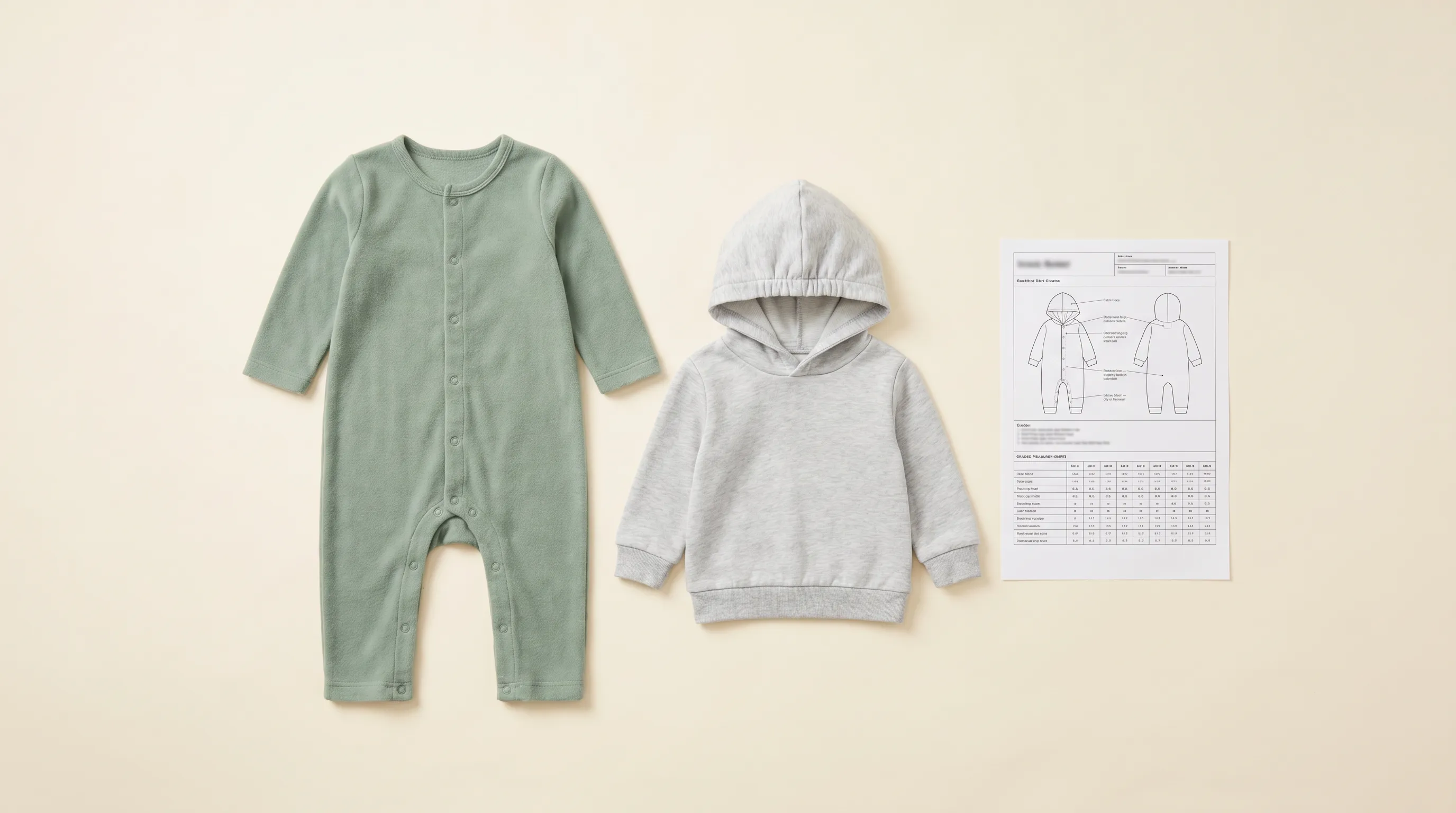
A kidswear tech pack is the manufacturing blueprint for a children's garment — a snap-front romper, a toddler tee, a hooded sweatshirt, a play dress. It carries the standard backbone (flat sketch, BOM, graded points of measure, construction notes, colorways), but it also carries a regulatory layer that adult apparel never touches — and in children's clothing that layer is not optional. It is federal law.
In the United States, every product designed or intended primarily for children 12 and under falls under the Consumer Product Safety Improvement Act (CPSIA). That means accessible-material lead capped at 100 ppm (90 ppm in surface paint or coating), restricted phthalates under 0.1%, a permanent tracking label identifying maker, batch, and date of production (16 CFR 1130), and a Children's Product Certificate backed by third-party lab testing. On top of CPSIA, the garment itself must satisfy drawstring rules (ASTM F1816), small-parts and snap security (16 CFR 1501), and flammability (16 CFR 1610). A pack that omits these fields doesn't just risk a bad sample — it risks a recall. That compliance layer is exactly the wedge a kidswear-aware generator handles, and the reason a generic apparel template is the wrong starting point.
Kidswear tech pack: what each section needs
Every section an adult pack has, plus a safety column the factory and the test lab both read first.
| Section | What kidswear demands |
|---|---|
| Drawstrings & cords | No drawstrings in the hood or neck area, sizes 2T–12 (ASTM F1816); waist/bottom cords ≤3 in outside the channel, no toggles or knots, bar-tacked. Spec elastic, snaps, or fixed bands instead. |
| Snaps, buttons & small parts | Snaps, buttons, appliqués, bows must pass a ≥15 lbf (≈70 N) pull test and not become small parts that fit the 16 CFR 1501 cylinder for under-3 wear. Call out attachment method and security testing. |
| Flammability | Class 1 normal flammability under 16 CFR 1610: plain-surface ≥3.5 s and raised-surface ≥7 s burn time on the 45° flame test. Note fabric class so the lab tests the right way. |
| CPSIA chemical limits | Lead ≤100 ppm in accessible substrate, ≤90 ppm in surface coating; phthalates <0.1% in plasticized parts (prints, snaps, trims). Flag every component that needs third-party testing. |
| Tracking label & care | Permanent tracking label per CPSIA §103 / 16 CFR 1130 (maker, batch/lot, date, location), plus fiber content and care label. Specify placement and that it survives wash. |
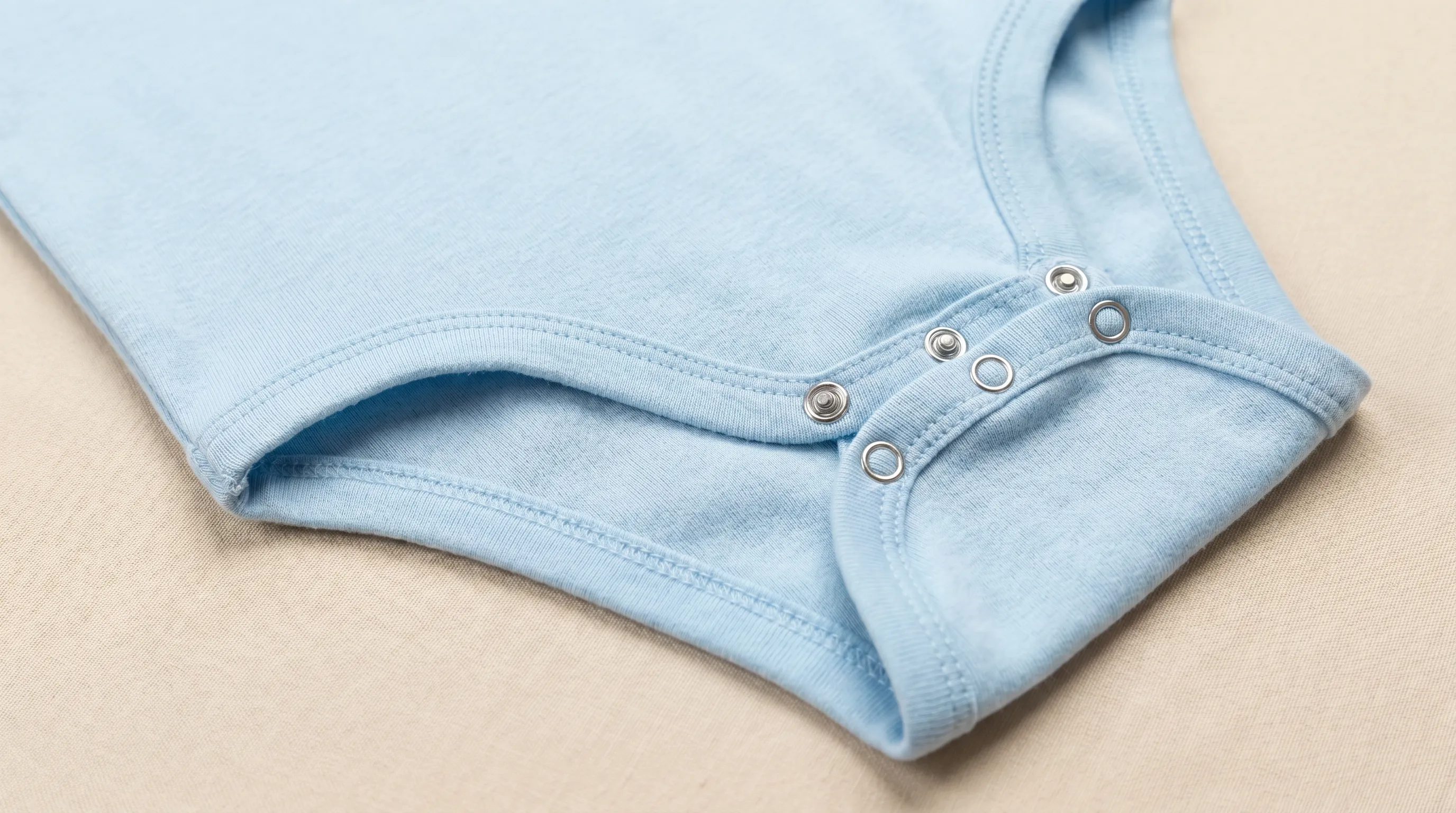
| Easy-on/off closures | Shoulder snaps, snap inseams for diaper access, elastic waists, flat seams, tag-free or printed labels — closures sized for small hands and quick changes, not adult zippers. |
| Soft trims & finishing | Covered or flat-felled seams to avoid skin abrasion, soft fold-over elastic, no scratchy backings; call out trim softness and seam class explicitly. |
| Measurements & grading | Age-graded POMs to ASTM D4910 (infants 0–24 mo), D5826 (children 2–6X/7), D6192 (girls 2–20); separate newborn, toddler (2T–4T), and kids (4–7, 7–16) blocks with growth allowance. |
| BOM | Shell fabric, soft trims, snaps/closures, elastic, prints (phthalate-checked), tracking + care labels, thread — each line flagged for the safety test it must pass. |
| Colorways | Pantone TCX per panel and trim; flag dye and print chemistry for CPSIA and check colorfastness for garments small children mouth. |
Drawstring rule per ASTM F1816; small parts per 16 CFR 1501; flammability per 16 CFR 1610; chemical limits and labeling per CPSIA / 16 CFR 1130; body measurements per ASTM D4910 / D5826 / D6192.
Worked example
One hood line, written to keep the garment legal
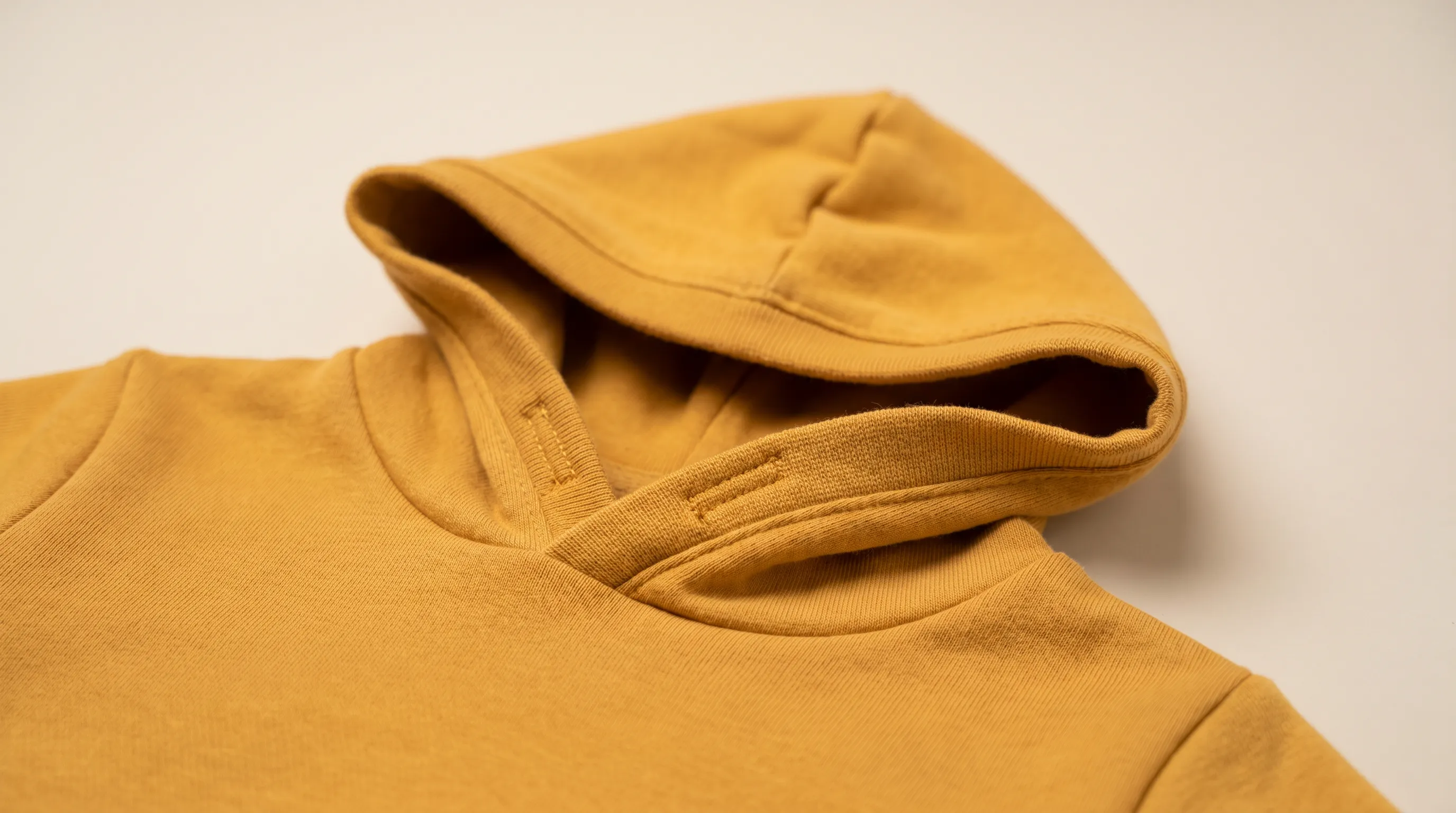
Weak spec: "hooded sweatshirt with drawstring, kids' sizes." That single instruction can make the whole style non-compliant and recallable. Factory-ready spec: "Hood, sizes 2T–7: NO neck or hood drawstring (ASTM F1816). Substitute 5/8 in covered fold-over elastic at hood opening; secure with bar-tack. Any waist cord on size 7+: continuous, bar-tacked, ≤3 in outside channel, no toggles or knots. Snaps: ring-spring, 15 lbf min pull (all four parts), lead-free per CPSIA. Shell: Class 1 flammability (16 CFR 1610). Tracking label at center-back neck." One callout, and the design that would have triggered a strangulation hazard and a CPSC recall ships safe. That is the level of detail the generator drafts and your review confirms.
Why kidswear packs differ from adult apparel
The construction techniques look familiar; the constraints around them do not. Closures are designed for safety and speed, not just fit. Adult zippers and fixed buttons give way to shoulder snaps, snap-crotch inseams for diaper changes, and elastic waists — and every one of those snaps, buttons, bows, and appliqués must survive a 15 lbf (≈70 N) pull test so it can't detach and become a choking hazard under the 16 CFR 1501 small-parts cylinder for children under three.
Drawstrings are essentially banned where it matters. ASTM F1816 prohibits hood and neck drawstrings entirely in sizes 2T–12 and limits waist/bottom cords to three inches outside the channel with no toggles or knots — because neck cords cause strangulation and waist cords catch on playground equipment and vehicle doors. So the pack specifies elastic, snaps, or fixed bands where an adult hoodie would call out a cord.
Chemistry and flammability are tested lines, not assumptions. Every fabric must hit Class 1 normal flammability under 16 CFR 1610 (≥3.5 s plain / ≥7 s raised burn time), and CPSIA caps lead at 100 ppm and phthalates at 0.1% across prints, snaps, and trims, with a Children's Product Certificate backed by an accredited lab. And sizing is age-graded, not S–M–L. Children's bodies change by months, so points of measure follow ASTM D4910 (infants 0–24 months), D5826 (2–6X), and D6192 (girls 2–20) with growth allowance and separate newborn, toddler, and kids grade blocks. A generic apparel template has none of these fields — which is exactly the gap a class-aware generator closes.
Generate a kidswear pack in 3 steps
From one photo to a safety-aware document a children's-wear factory can quote and a lab can test against.
- 1
Upload one photo
Flat-lay of your sample romper, toddler tee, or kids' hoodie, a mannequin shot, or a clean mockup. The AI detects the kidswear sub-class — bodysuit, romper, tee, hoodie, dress — and the closures and construction it implies. - 2
Review the safety-specific draft
In 3–5 minutes you get the flat sketch, BOM pre-populated with soft trims and closure components, age-graded POMs, and construction callouts. Spend 10–15 minutes confirming the compliance layer: the no-drawstring substitution, the 15 lbf snap-security note, the Class 1 flammability and CPSIA flags, the tracking-label placement, and your mill's exact fabric and grade blocks. - 3
Export and send
Print-ready PDF (Excel/CSV on Pro) to your factory and test lab. Total cost $3–6 — versus $150–$500 and 3–7 days for a freelance technical designer, per published rate surveys.
Where the tech pack stops and the lab begins
Be clear about what a tech pack does and does not do. The document specifies and references compliance — it names ASTM F1816 for cords, the 15 lbf snap-pull and 16 CFR 1501 small-parts rule, 16 CFR 1610 flammability, and the CPSIA lead, phthalate, tracking-label, and certificate requirements — so the factory builds to the right targets and nothing is left to assumption. That alone prevents the most common, most expensive kidswear mistakes.
But it does not replace third-party testing or legal sign-off. CPSIA requires a CPSC-accepted accredited lab to test the finished garment and the importer to issue the Children's Product Certificate. Adstronaut, and any AI tool, drafts the spec — it is not your compliance department. Treat the generated pack as a strong, standards-referenced first draft, then have a qualified lab and your sourcing partner verify the actual materials and finished product. For a deeper read on closing the gap between document and finished sample, see our guide on reducing sampling rounds.
Built for children's-wear founders
This is for the founder launching a baby or kids' line without an in-house technical designer or a compliance team: you've sourced a soft cotton knit, sewn a sample romper, and need a document a children's-wear factory will quote from — one that won't quietly skip a drawstring rule or a snap-security note that could trigger a recall. It fits baby and toddler brands scaling 10–30 SKU drops, production leads cutting first-sample revision rounds, and Shopify kids' stores graduating from blanks to cut-and-sew (where MOQ math and per-style fees suddenly matter).
Adstronaut writes the soft-knit composition, the no-drawstring substitutions, the snap- and small-parts-security callouts, the Class 1 flammability and CPSIA flags, the tracking-label placement, and the age-graded measurements — so your factory in Tiruppur, Vietnam, or Istanbul receives a kidswear-grade pack, in minutes, with the grade-rule logic applied to children's size blocks. When the samples come back, the AI Photoshoots side of the platform handles on-model and flat-lay imagery the same week — and if you also make stretch styles, the activewear pack guide covers the performance-knit specifics.
Frequently asked questions
What makes a kidswear tech pack different from an adult one?
It adds a federal safety-compliance layer on top of the standard sections. Children's garments (ages 12 and under) fall under CPSIA, so the pack must reference lead limits (≤100 ppm), phthalate limits (<0.1%), a tracking label, drawstring rules (ASTM F1816), snap and small-parts security (15 lbf pull, 16 CFR 1501), and Class 1 flammability (16 CFR 1610). Adult apparel packs carry none of these fields.
Are drawstrings allowed on children's clothing?
Not in the neck or hood for sizes 2T–12 — ASTM F1816 prohibits them entirely because of strangulation risk. Waist and bottom cords on sizes 2T–16 are limited to 3 inches outside the channel, must have no toggles or knots, and must be bar-tacked so they can't be pulled out. Tech packs usually substitute elastic, snaps, or fixed bands at the hood and neck.
What is the snap and button pull-test requirement for kidswear?
Snaps, buttons, bows, and appliqués should withstand a minimum pull force of about 15 lbf (≈70 N) without detaching, and all four snap components (cap, socket, stud, post) must hold. The goal is to keep small parts from coming loose and becoming a choking hazard for children under three, who are evaluated against the 16 CFR 1501 small-parts cylinder.
What does CPSIA require on a children's clothing tech pack?
CPSIA caps lead at 100 ppm in accessible substrate (90 ppm in surface coatings) and phthalates under 0.1% in plasticized components like prints and snaps. It also mandates a permanent tracking label (maker, batch/lot, date, location) under 16 CFR 1130, and a Children's Product Certificate backed by third-party testing at a CPSC-accepted lab. The pack flags every component that needs testing.
What flammability standard applies to kids' clothing?
General children's apparel must meet Class 1 normal flammability under 16 CFR 1610: plain-surface fabrics need a burn time of at least 3.5 seconds and raised-surface fabrics at least 7 seconds on the 45-degree flame test. Children's sleepwear in sizes 9 months–14 has a separate, stricter rule. The pack notes the fabric class so the lab tests it correctly.
How is kidswear sizing graded in a tech pack?
By age and body measurement, not S–M–L. Points of measure follow ASTM standards: D4910 for infants (0–24 months), D5826 for children sizes 2–6X/7, and D6192 for girls 2–20. Packs typically carry separate newborn, toddler (2T–4T), and kids (4–7, 7–16) grade blocks with growth allowance, because children's proportions change month to month.
What closures and trims are best for children's wear?
Easy-on/off, skin-safe ones: shoulder snaps and snap-crotch inseams for diaper access, elastic waists, flat-felled or covered seams to prevent abrasion, soft fold-over elastic, and tag-free or printed care labels. The pack calls out closure type, seam class, and trim softness explicitly — and confirms every snap and applied part passes the security pull test.
How much does a kidswear tech pack cost with Adstronaut?
$3–6 per pack (25 credits; plans from $29/month; first pack free as a watermarked preview). Freelance technical designers charge $150–$500 per style at 3–7 day turnarounds, so a 20-style kids' collection runs roughly $60–$120 in credits versus $3,000–$10,000 freelance. Note that lab testing and certification are separate, lab-charged costs.
Does the AI handle rompers, bodysuits, and toddler dresses?
Yes — the sub-class drives the sections. Bodysuit and romper packs add snap-crotch inseams, shoulder snaps, and lap-shoulder necklines; toddler dresses add soft elastic, covered seams, and no-cord closures; hoodies trigger the no-drawstring substitution. Each gets the appropriate closure, flammability, snap-security, and age-graded measurement treatment rather than a one-size template.
Does the tech pack replace lab testing or a compliance team?
No. It specifies and references the standards so the factory builds to the right targets, but CPSIA still requires a CPSC-accepted accredited lab to test the finished garment and the importer to issue the Children's Product Certificate. Treat the generated pack as a standards-referenced first draft, then have a qualified lab and your sourcing partner verify the real materials and finished product.
Generate your kidswear tech pack
Upload one photo of your romper, toddler tee, or kids' hoodie. Get the soft-knit spec, no-drawstring substitutions, snap-security callouts, flammability and CPSIA flags, tracking-label placement, and age-graded measurements in minutes. First pack free, then $3–6.
Try the AI Tech Pack GeneratorKeep going
Sources and further reading
- CPSC — Consumer Product Safety Improvement Act (CPSIA) — lead/phthalate limits, tracking labels, Children's Product Certificate for products for children 12 and under
- ASTM F1816 — drawstrings on children's upper outerwear — no neck/hood drawstrings sizes 2T–12; waist/bottom cords ≤3 in, no toggles, bar-tacked, sizes 2T–16
- 16 CFR Part 1610 — Flammability of Clothing Textiles — Class 1 normal flammability: plain ≥3.5 s, raised ≥7 s burn time on 45° flame test
- CPSC — small parts (16 CFR 1501) requirements chart — small-parts cylinder for children under 3; basis for snap and applied-part security
- ASTM D6192 — body measurements for girls — girls sizes 2 to 20; companion to D4910 infants and D5826 children for age-graded sizing
- Successful Fashion Designer — freelance technical-design rates — $150–$500 per style; 3–7 day turnaround benchmark