
What is AQL (Acceptable Quality Limit)?
Updated June 10, 2026
AQL — Acceptable Quality Limit — is the maximum percent of defective units a buyer will tolerate in a production lot before rejecting it. Defined by ISO 2859-1 and ANSI/ASQ Z1.4, it sets how many garments an inspector pulls from a shipment and how many defects pass. Apparel usually runs 0 critical / 2.5 major / 4.0 minor at General Inspection Level II.

What is AQL?
AQL stands for Acceptable Quality Limit (often written "Acceptable Quality Level") — the maximum percentage of defective units a buyer is willing to accept in a production lot. It is the worst tolerable process average that a sampling plan will still routinely pass. An AQL of 2.5 means a batch running at roughly 2.5% defective should usually be accepted; the further quality slips beyond that, the more likely the plan rejects the lot.
AQL is not a guess or a gut call. It is codified in two interchangeable standards — ISO 2859-1 internationally and ANSI/ASQ Z1.4 in the United States (the successor to the old MIL-STD-105E). Both define sampling by attributes: instead of inspecting every garment, an inspector pulls a statistically determined sample from the shipment, counts the defects, and compares the count against a fixed accept/reject number (QIMA, AQL guide; ASQ, Z1.4 & Z1.9).
The key nuance: AQL governs the lot, not the unit. Passing AQL never means "zero defects" — it means the sampled defect count stayed at or below the agreed threshold, so the lot is statistically likely to meet the quality the buyer signed off on. A shipment can ship with a handful of minor flaws and still pass, which is exactly why critical, major, and minor defects each carry their own AQL.
How AQL sampling works
An AQL inspection runs in three lookups, both standards using the same two-table structure (ISO 2859-1).
1. Lot size + inspection level → code letter. The first table maps your shipment quantity and an inspection level to a sample-size code letter (A through R). There are three general levels — I (less scrutiny, smaller sample), II (the default), and III (more scrutiny) — plus four special levels (S-1 to S-4) for slow or destructive tests. General Inspection Level II (GII) is the standard default for apparel and most consumer goods, balancing sample size against confidence (QualityInspection.org, inspection levels).
2. Code letter + AQL → sample size and accept/reject numbers. The second table converts the code letter and your chosen AQL into the sample size (n) and two numbers: the acceptance number (Ac) — the most defects allowed to still pass — and the rejection number (Re), one higher.
3. Inspect and decide. The inspector randomly pulls n units from across the lot, classifies each defect found, and applies a simple rule: if defects ≤ Ac, accept the lot; if defects ≥ Re, reject it. One count, one decision — no negotiation at the threshold.
Worked example
A 2,000-piece garment order, decided in counted steps
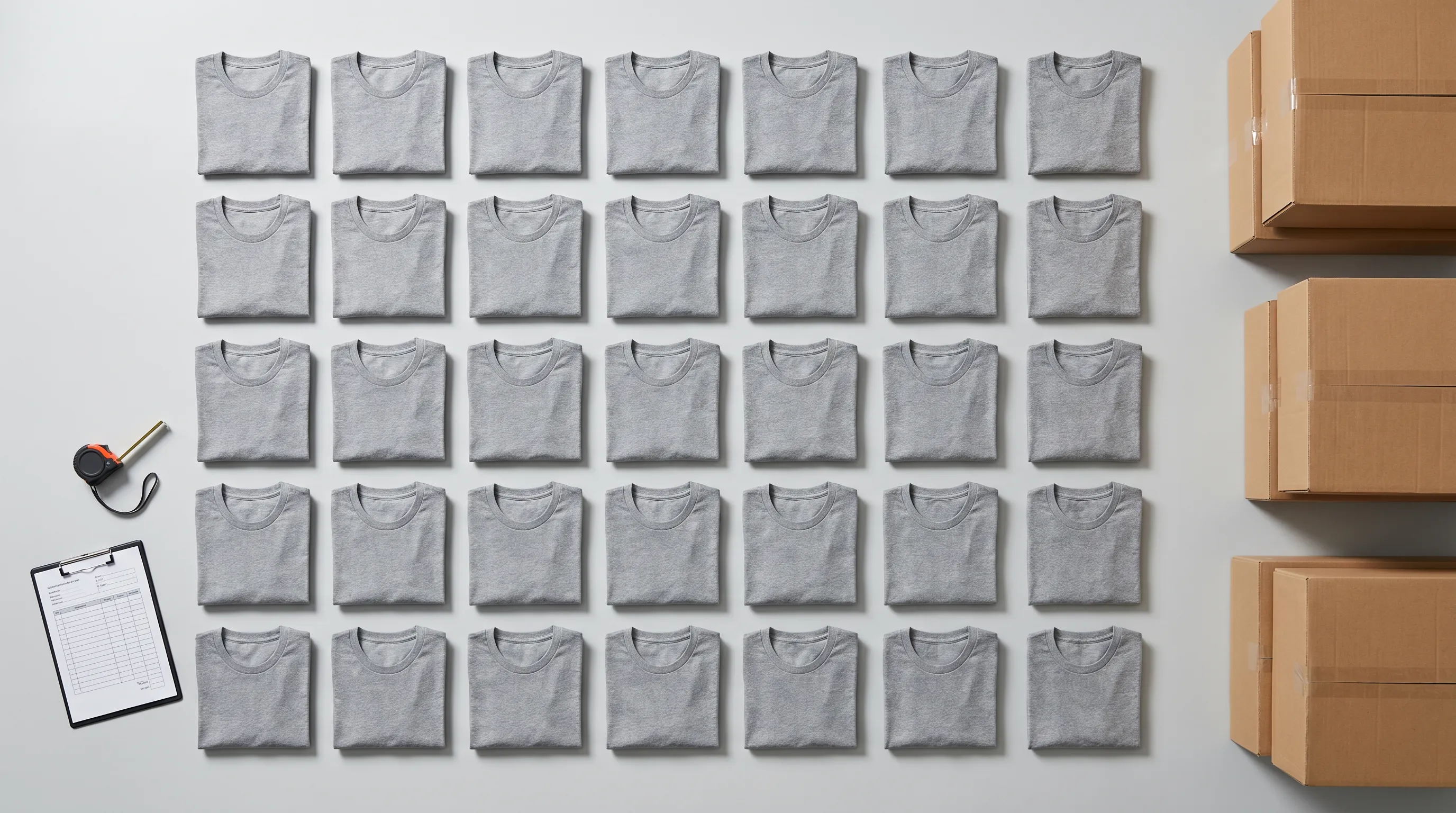
You produce 2,000 t-shirts and inspect at General Inspection Level II with the apparel-standard AQLs of 0 critical / 2.5 major / 4.0 minor. Step 1: a lot of 1,201–3,200 units at GII maps to code letter K. Step 2: code K gives a sample size of 125 pieces; at AQL 2.5 the major-defect plan is Ac 7 / Re 8, and at AQL 4.0 the minor-defect plan is Ac 10 / Re 11 (critical stays at Ac 0 — a single critical defect rejects). Step 3: the inspector pulls 125 shirts at random from across the cartons and finds 5 major defects (loose seams, broken stitches) and 8 minor defects (small spots, slightly off labels) — and 0 critical. Verdict: 5 ≤ 7 and 8 ≤ 10 and 0 ≤ 0, so the lot is accepted. Had majors hit 8, or a single critical appeared, the whole 2,000-piece lot would be rejected — sent back for sorting or rework before it ships (Tetra Inspection, AQL calculator).
AQL sampling reference (General Inspection Level II)
Lot size sets the code letter; the code letter sets the sample size; the AQL sets the accept/reject numbers. A selection of rows under normal, single-sampling inspection:
| Lot size | Code letter | Sample size (n) | AQL 2.5 — Ac / Re | AQL 4.0 — Ac / Re |
|---|---|---|---|---|
| 51 – 90 | E | 13 | 1 / 2 | 1 / 2 |
| 91 – 150 | F | 20 | 1 / 2 | 2 / 3 |
| 151 – 280 | G | 32 | 2 / 3 | 3 / 4 |
| 281 – 500 | H | 50 | 3 / 4 | 5 / 6 |
| 501 – 1,200 | J | 80 | 5 / 6 | 7 / 8 |
| 1,201 – 3,200 | K | 125 | 7 / 8 | 10 / 11 |
| 3,201 – 10,000 | L | 200 | 10 / 11 | 14 / 15 |
| 10,001 – 35,000 | M | 315 | 14 / 15 | 21 / 22 |
Single-sampling, normal inspection, General Inspection Level II, per ISO 2859-1 / ANSI/ASQ Z1.4. Ac = max defects to accept; Re = defects that reject (Ac + 1). Critical defects are typically run at AQL 0 (Ac 0). Values per QIMA and Tetra Inspection AQL tables.
Critical, major, and minor defects
AQL is applied per defect class, because not every flaw carries the same risk. Each class gets its own AQL number, and the lot must pass all of them at once.
Critical defects can cause harm or break a regulation — a broken needle left in a garment, a choking hazard, a missing flammability or fiber-content label. These are almost always run at AQL 0 (Ac 0): one critical defect in the sample rejects the entire lot. The standard's critical band sits at 0–0.65%.
Major defects make a garment unsaleable or likely to be returned without affecting safety — a hole, a broken zipper, a mismatched panel, seam puckering, the wrong shade. Apparel typically runs majors at AQL 2.5 (band 1.0–2.5%).
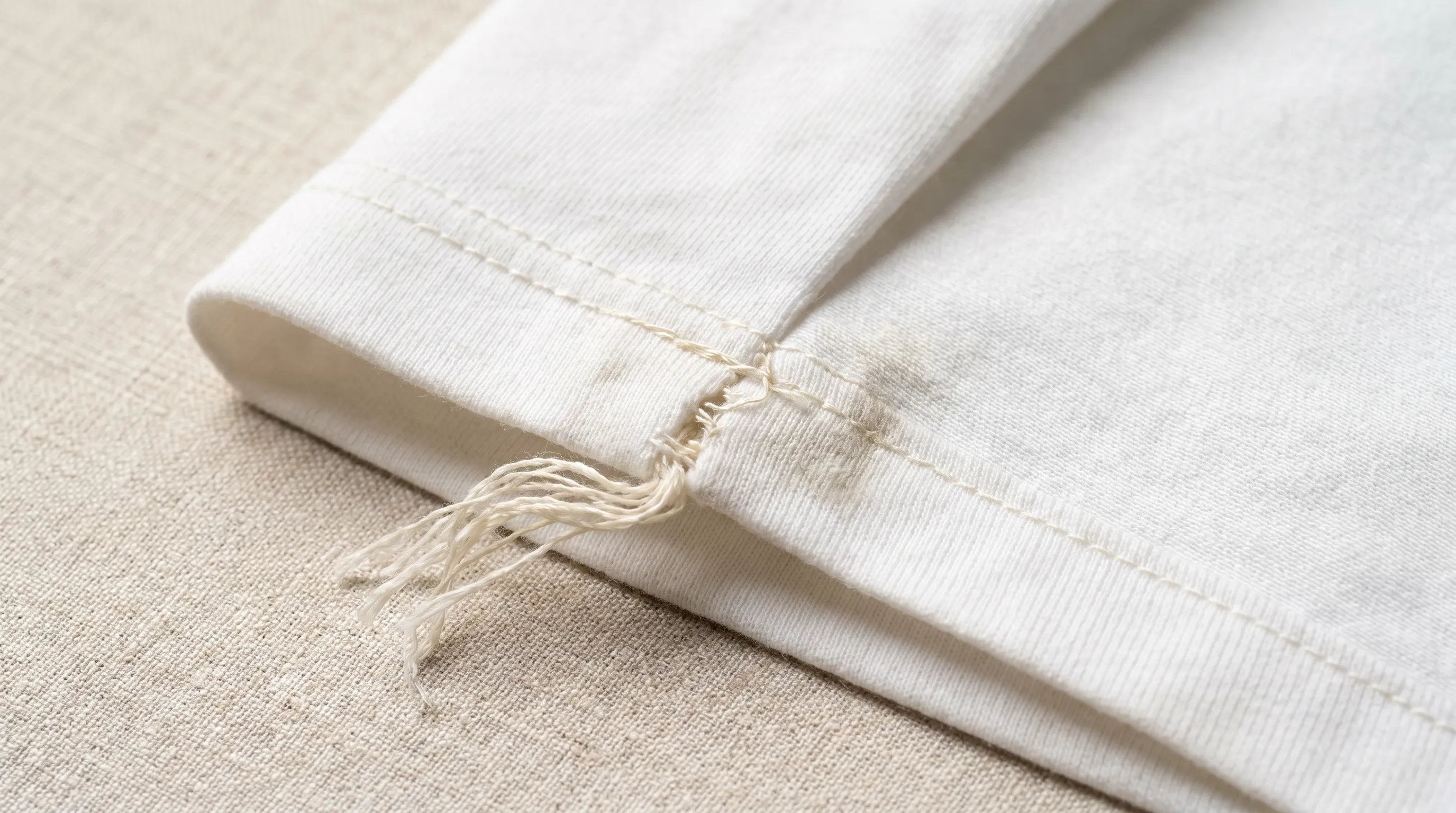
Minor defects are cosmetic and unlikely to trigger a return — a tiny loose thread, a faint mark, a slightly crooked label. These usually run at the most lenient level, AQL 4.0 (band 2.5–4.0%) (QC Advisor, AQL definition). The shorthand "0 / 2.5 / 4.0" on a purchase order or tech pack is exactly this trio — critical / major / minor — and it should be agreed with the factory before production starts, not argued at the inspection.
The AQL accept/reject decision, in one chart
Common AQL mistakes
Reading AQL as a quality guarantee. A passed AQL inspection does not mean a flawless lot — it means the sampled defect rate stayed within an agreed tolerance. Buyers chasing zero defects on cosmetic items at AQL 4.0 are misreading what the number promises.
Tightening the AQL to zero on everything. Demanding AQL 0 across major and minor defects forces 100% inspection economics onto a sampling plan and inflates rejection on harmless cosmetic flaws. Reserve AQL 0 for critical, and price the rest realistically — most apparel lives at 2.5 major / 4.0 minor.
Not agreeing the AQL up front. The defect levels, defect classification, and inspection level belong in the contract and the tech pack, settled with the factory before the line runs. Negotiating thresholds at the inspection — after the goods exist — is how disputes start. Clear, defect-classified specs are also what separate a quoteable order from a vague one when you communicate with the manufacturer.
Ignoring the inspection level. Defaulting to Level II is usually right, but a high-risk or new supplier may warrant Level III (larger sample), while a trusted line on a cheap item can drop to Level I. Choosing the level is part of setting the plan — it is not a fixed constant.
Confusing AQL with the found defect rate. AQL is the agreed threshold; the inspection reports the actual defect rate measured in the sample. The two are different numbers, and only the comparison between them — against Ac/Re — decides the lot.
Frequently asked questions
What does AQL stand for?
AQL stands for Acceptable Quality Limit (also called Acceptable Quality Level) — the maximum percentage of defective units a buyer will tolerate in a production lot before rejecting it. It is defined by the ISO 2859-1 and ANSI/ASQ Z1.4 sampling standards and expressed as a percentage, such as 2.5 for major defects.
What are the common AQL levels for clothing?
Apparel typically uses 0 critical / 2.5 major / 4.0 minor. Critical defects (safety or regulatory) are run at AQL 0, so a single one rejects the lot; major defects (function or saleability) at AQL 2.5; and minor defects (cosmetic) at the most lenient AQL 4.0. The three are checked together — the lot must pass every class.
What is the difference between critical, major, and minor defects?
Critical defects can cause harm or break a regulation (a needle left in a garment, a missing flammability label) — AQL 0, band 0–0.65%. Major defects make a garment unsaleable or returnable without being unsafe (a hole, broken zipper, wrong shade) — usually AQL 2.5, band 1.0–2.5%. Minor defects are cosmetic and unlikely to trigger a return (a loose thread, a small mark) — usually AQL 4.0, band 2.5–4.0%.
How is the AQL sample size determined?
By two ISO 2859-1 / ANSI Z1.4 tables. The first maps your lot size and inspection level to a code letter; the second maps that code letter and your AQL to a sample size and accept/reject numbers. For example, a lot of 1,201–3,200 units at General Inspection Level II gives code letter K and a sample size of 125 pieces. You never inspect the whole lot — only the calculated sample.
What is General Inspection Level II (GII)?
General Inspection Level II is the standard default inspection level in ISO 2859-1 and ANSI Z1.4, used for most apparel and consumer goods. It balances sample size against confidence. Level I uses a smaller sample (less scrutiny) and Level III a larger one (more scrutiny); special levels S-1 to S-4 are reserved for slow or destructive tests.
What are the accept and reject numbers in AQL?
The acceptance number (Ac) is the maximum number of defects allowed in the sample for the lot to pass; the rejection number (Re) is one higher and the point at which the lot fails. If defects found ≤ Ac, the lot is accepted; if defects ≥ Re, it is rejected. For example, sample size 125 at AQL 2.5 gives Ac 7 / Re 8 for major defects.
Does passing AQL mean zero defects?
No. Passing an AQL inspection means the number of defects in the sample stayed at or below the agreed acceptance number for each class — not that the lot is flawless. A shipment can ship with several minor or even a few major defects and still pass, which is why critical, major, and minor defects each carry their own AQL and critical is usually set to zero.
What is the difference between ISO 2859-1 and ANSI Z1.4?
They are the two dominant attribute-sampling standards and produce effectively the same plans. ISO 2859-1 is the international standard; ANSI/ASQ Z1.4 is the US version (the successor to MIL-STD-105E). Both use the same two-table structure — lot size and level to a code letter, then code letter and AQL to sample size and accept/reject numbers — so an AQL plan written to one reads the same under the other.
Who decides the AQL — the buyer or the factory?
The buyer sets it, but it should be agreed with the factory in writing — in the purchase order and tech pack — before production starts. The agreement covers the AQL per defect class, the defect classification itself, and the inspection level. Settling these up front is what keeps a third-party inspection objective rather than a negotiation after the goods already exist.
Where does AQL fit in the tech pack and production process?
AQL is the inspection threshold applied at the end of production, but it is defined upstream. The defects an inspector counts are measured against the points of measure, tolerances, and construction in the tech pack and spec sheet. A complete, defect-classified tech pack is what makes the AQL decision objective — the clearer the spec, the less room to argue about what counts as a defect.
Give your factory a spec worth inspecting against
AQL only works when the tech pack behind it is clear. Upload one garment photo and get a factory-ready pack — flat sketch, BOM, graded points of measure, and construction callouts — so every defect is measured against a real spec. First pack free, then $3–6.
Try the AI Tech Pack GeneratorRelated reading
Sources and further reading
- QIMA — Acceptable Quality Limit (AQL) guide & chart — AQL definition, ISO 2859-1 / ANSI Z1.4 basis, sampling tables, code K n=125, accept/reject numbers
- ISO 2859-1 — sampling by attributes indexed by AQL — two-table structure: lot size + level to code letter, code letter + AQL to sample size and Ac/Re
- ASQ — ANSI/ASQ Z1.4 & Z1.9 sampling standards — Z1.4 as US attribute-sampling standard, successor to MIL-STD-105E
- QualityInspection.org — AQL inspection levels in ISO 2859-1 — General Levels I/II/III and special S-1 to S-4; Level II as the default
- QC Advisor — Acceptable Quality Limit definition, charts & examples — critical 0–0.65%, major 1.0–2.5%, minor 2.5–4.0% defect bands and classification
- Tetra Inspection — AQL calculator — lot-to-code-to-sample lookups; code K sample 125; AQL 2.5 Ac7/Re8, AQL 4.0 Ac10/Re11