
How to make a factory-ready tech pack for cargo pants
Updated June 10, 2026
A cargo pants tech pack must specify a bottom-weight shell — typically cotton or poly/cotton twill or ripstop at 6–8 oz/yd² (≈200–280 GSM) — plus bellows cargo-pocket and flap construction, bartack reinforcement at stress points, waistband, belt loops, fly closure, drawcord or elasticated hems, and rise, inseam, thigh and leg-opening POMs graded per ASTM. Adstronaut AI drafts all of it — flat sketch, BOM, graded measurements, construction notes — from a single garment photo in minutes for $3–6 per pack.
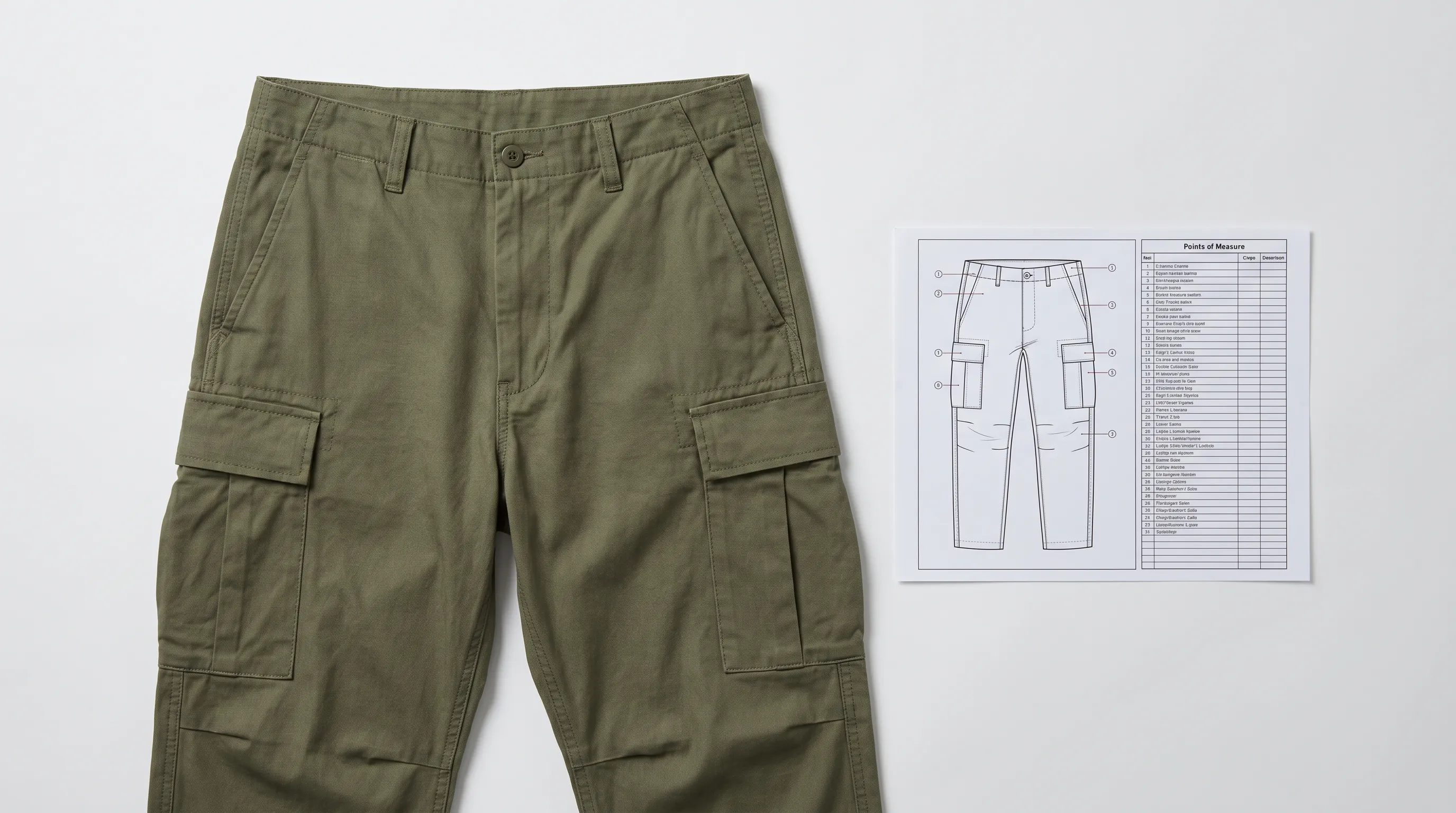
What goes in a cargo pants tech pack
A cargo pants tech pack is the manufacturing blueprint for a utility bottom — a trouser carrying multiple patch and bellows pockets, reinforced at every stress point. It keeps the standard backbone (flat sketch, BOM, graded points of measure, construction notes, colorways), but the document lives or dies on pocket construction and reinforcement detail that a plain-trouser template never carries.
The fabric line specifies a bottom-weight woven — most often a cotton or poly/cotton twill or ripstop at 6–8 oz/yd² (≈200–280 GSM), with tear strength (ASTM D1424) and grab tensile strength (ASTM D5034) called out because cargo pockets and knees take abuse a dress trouser never sees. The construction section then names every cargo pocket as a bellows pocket — a pleated, expandable pocket with a slanted flap — and pins bartack reinforcements at the flap corners, pocket mouths, belt loops and fly. Add waistband, belt loops, fly/closure, drawcord or elasticated hems, and a gusseted or articulated crotch and you have the full picture. Get any of these vague and the factory bartacks the wrong corner, sews a flat patch where you wanted a 3D bellows, or hems straight where you wanted a drawcord — and you pay for another sample round at $200–$1,500.
Cargo pants tech pack: what each section needs
| Section | What cargo pants demand |
|---|---|
| Fabric & composition | Bottom-weight woven: cotton or poly/cotton twill or ripstop, 6–8 oz/yd² (≈200–280 GSM); call out weave, tear strength (ASTM D1424) and grab tensile (ASTM D5034); lighter ripstop ~150–200 GSM for warm-climate styles |
| Cargo pockets | Bellows (3D) vs flat patch noted per pocket; pleat depth, flap shape, flap closure (button, snap, hook-and-loop), interior divider; placement and height called out on the flat sketch |
| Reinforcement | Bartacks at flap corners, pocket mouths, belt-loop ends, fly base and pocket bags; rivets or triple-needle felled seams at high-strain seams; stitch counts per bartack |
| Waistband & belt loops | Waistband type (curtained, faced, elasticated side-tab) and width; belt-loop count (5 jeans-style, 7 trouser-style), width to 1/16", and single vs double center-back loop |
| Fly & closure | Fly type (zip, button, shank/J-stitch), zipper gauge and length, button or shank-button count, fly-shield and J-stitch topstitch margin |
| Hem & cuff | Plain hem, drawcord-channel hem, or elasticated/snap-tab cuff; drawcord type, cord-stop and eyelet specs; finished hem depth |
| Seams & stitch class | Lockstitch (ISO 4915 class 301), felled/safety-stitch seams (ISO 516) and overlock (ISO 514) per seam; stitch types per ASTM D6193; SPI per seam type |
| Measurements & POMs | Waist relaxed, front and back rise, hip (7–8" below waist), thigh (1" below crotch), knee, leg opening, inseam, outseam; plus cargo-pocket placement dimensions |
| BOM | Shell twill/ripstop, pocketing, interfacing, zipper, shank buttons, rivets, bartack thread, belt-loop tape, drawcord, cord-stops, labels — 15–30+ line items |
| Colorways | Pantone TCX per panel and trim; flag piece-dye vs garment-dye/wash and any contrast topstitch thread color |
Stitch classes per ISO 4915/514/516 and ASTM D6193; fabric tests per ASTM D1424 (tear) and D5034 (grab tensile); pant POMs per successfulfashiondesigner.com and WavePLM pant-anatomy references.
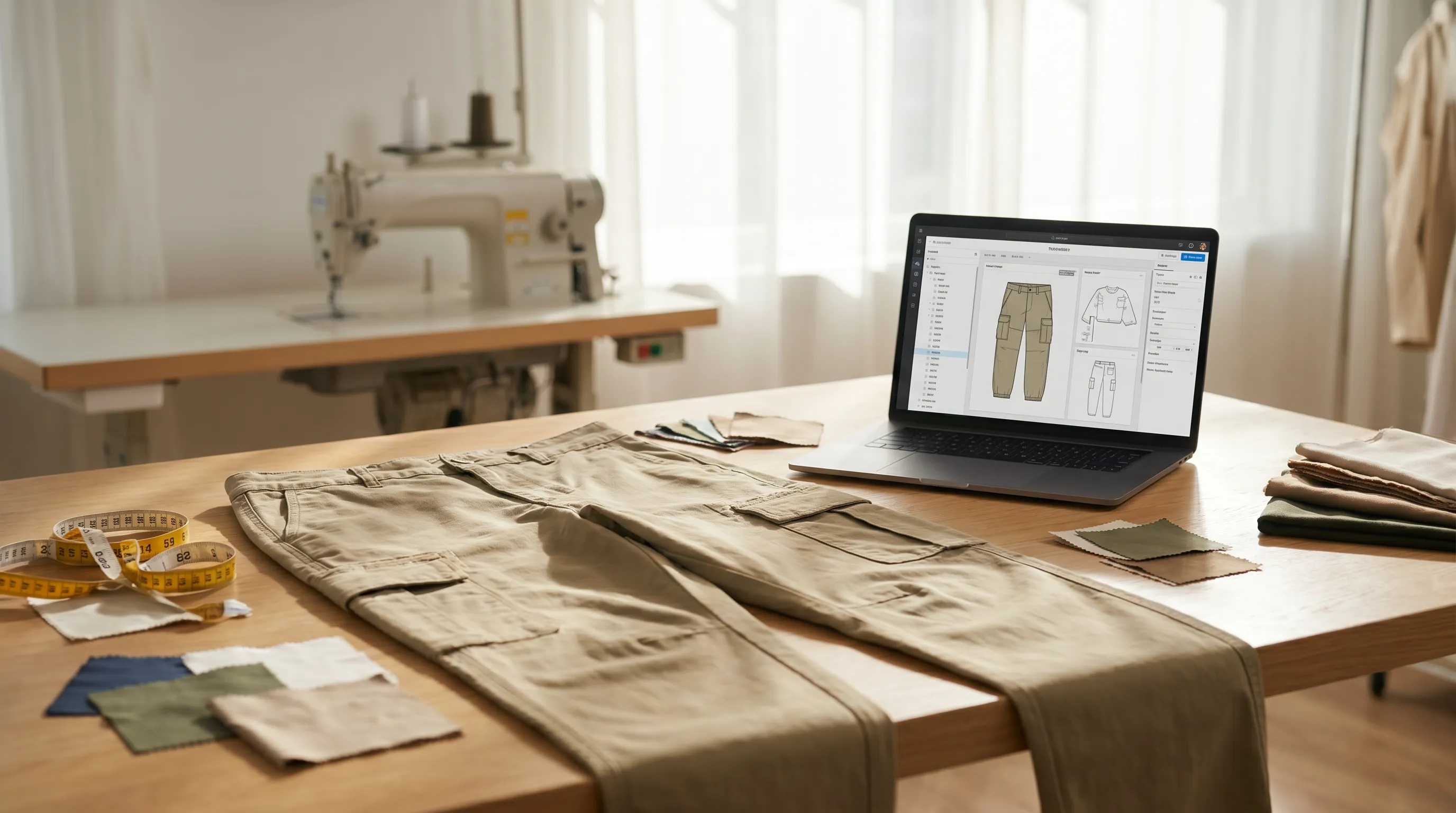
Worked example
One cargo-pocket callout, written correctly
Weak spec: "big pocket on the leg with a flap." Factory-ready spec: "Side cargo pocket, bellows type, 2" box pleat each side + 1" base pleat (≈3D expansion), placed 10" down outseam, centered on leg; slanted flap 7.5" × 2.5" closing with 1× 17L shank button; 42-stitch bartack at each flap corner and pocket-mouth corner; pocket bag and flap edge-topstitched at 1/16"; shell 7.5 oz cotton ripstop, Pantone 19-0510 TCX, contrast topstitch Pantone 16-1133 TCX." One callout, a dozen decisions the factory no longer guesses — and the difference between a first sample that holds and a $200–$1,500 discovery round. That's the level of specificity the generator drafts and your review confirms.
Why cargo packs differ from denim and plain trousers
Cargo pants share a leg block with denim jeans and chinos, but the document diverges hard at the pockets and reinforcement. The pockets are the product. A plain-trouser pack carries a slant or welt pocket as a one-line note; a cargo pack has to draw and dimension every bellows pocket — pleat depth, flap shape, closure type, placement off the outseam — because a 3D expandable pocket and a flat sewn-down patch are different sewing operations with different consumption and labor. Miss the pleat and the factory builds a flat patch.
Reinforcement is a named, counted spec, not a vibe. Cargo and utility wearers load the pockets, so every flap corner, pocket mouth, belt-loop end and the fly base needs a bartack with a stitch count, and high-strain seams may call for rivets or triple-needle felled construction. And the bottom-weight fabric earns test lines a dress trouser skips: tear strength (ASTM D1424) and grab tensile (ASTM D5034) on a 6–8 oz twill or ripstop tell the mill and factory what the cloth must survive. Finally the hem is a decision, not a default — plain, drawcord-channel, or elasticated snap-tab cuff each change the leg-opening POM and the BOM. A generic apparel template has none of these fields, which is exactly the gap a class-aware generator closes. The grade-rule logic still applies — rise, thigh, knee and leg-opening grades, plus belt-loop spacing — graded per the menswear or womenswear ASTM basis.
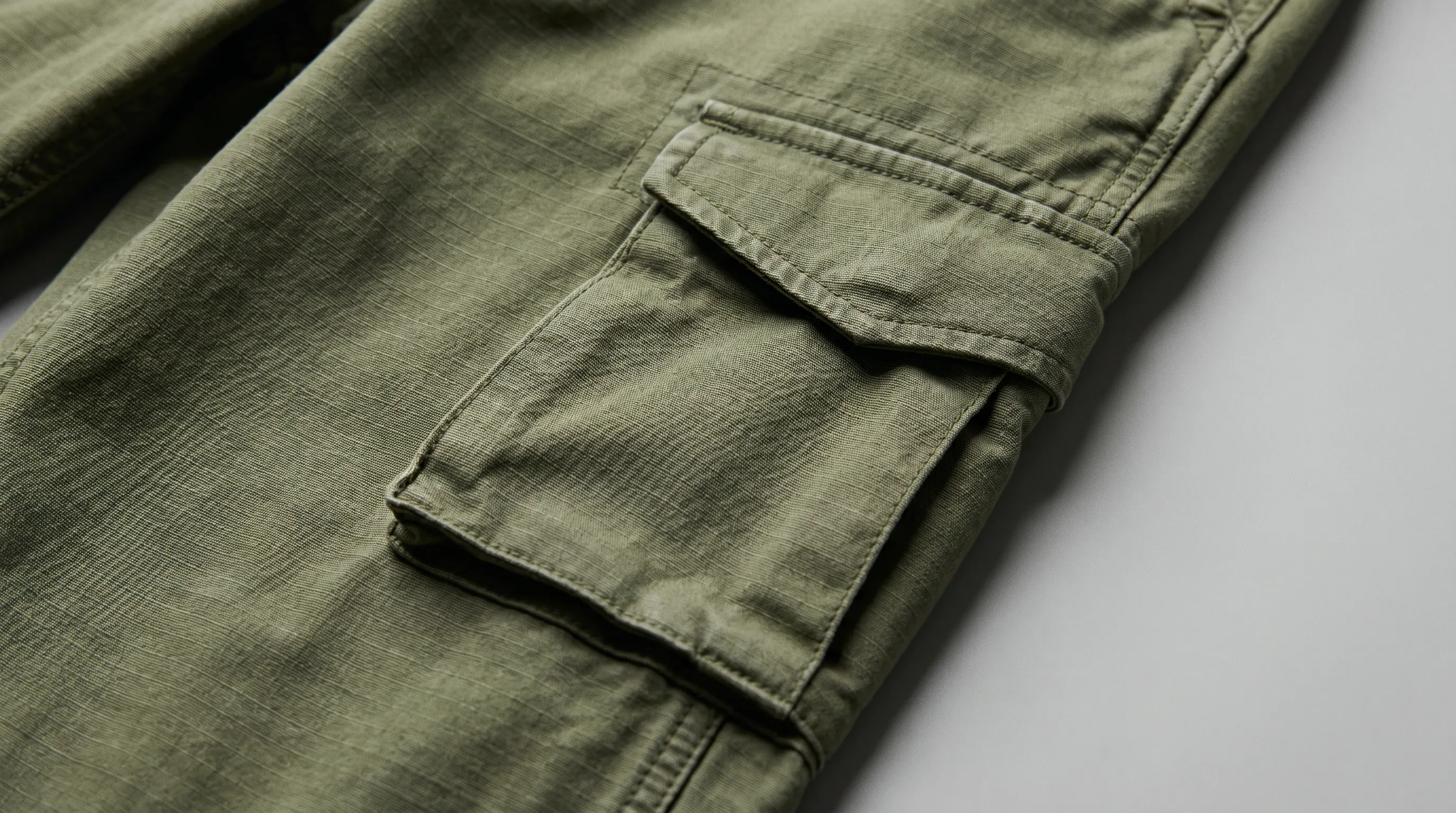
Generate a cargo pants pack in 3 steps
- 1
Upload one photo
Flat-lay of your sample cargo pants, a mannequin shot, or a clean mockup. The AI detects the bottoms sub-class — utility cargo, tactical, parachute/wide-leg, cargo shorts — and the pocket-and-reinforcement construction it implies. - 2
Review the cargo-specific draft
In 3–5 minutes you get the flat sketch, BOM pre-populated with shell, pocketing, zipper, rivet, bartack-thread and drawcord line items, graded rise/inseam/leg-opening POMs, and bellows-pocket, flap, bartack and hem callouts. Spend 10–15 minutes entering your mill's exact fabric weight and weave, pocket placements, bartack counts, and the measurements off your sample. - 3
Export and send
Print-ready PDF (Excel/CSV on Pro) to your factory. Total cost $3–6 — versus $150–$500 and 3–7 days for a freelance technical designer, per published rate surveys.
Built for utility, streetwear and workwear founders
This is for the founder launching a cargo, utility or workwear bottoms line without an in-house technical designer: you've sourced a bottom-weight twill or ripstop, sewn a sample, and need a document a factory will quote from — without $150–$500 per style in freelance fees or the 6–10 hour Illustrator grind on a pant with six-plus pockets to draw and dimension.
It fits streetwear brands building parachute and wide-leg cargo drops, workwear and tactical labels where bartack counts and tear strength are non-negotiable, and Shopify bottoms stores graduating from blanks to cut-and-sew (where MOQ math suddenly matters). Adstronaut writes the bottom-weight fabric composition, every bellows-pocket and flap callout, the bartack and rivet reinforcement spec, belt loops, fly, drawcord hems, and graded rise/inseam measurements — so your factory in Tiruppur, Vietnam, or Guangzhou receives a cargo-grade pack, in minutes. When the samples come back, the AI Photoshoots side of the platform handles the on-model imagery the same week.
Frequently asked questions
What fabric should a cargo pants tech pack specify?
Most cargo pants use a bottom-weight woven: cotton or poly/cotton twill or ripstop at roughly 6–8 oz/yd² (≈200–280 GSM). The pack states the exact weave (twill vs ripstop), weight in oz/yd² and GSM, fiber blend, and ideally tear strength (ASTM D1424) and grab tensile strength (ASTM D5034). Lightweight ripstop around 150–200 GSM suits warm-climate or tactical styles; heavier 10 oz+ twill suits workwear.
How do you spec a cargo pocket in a tech pack?
Name each pocket as a bellows (3D, pleated, expandable) or flat patch pocket, then dimension it: pleat depth, flap shape and size, closure type (shank button, snap, or hook-and-loop), any interior divider, and placement down the outseam. A bellows pocket has a springing pleat plus a slanted flap, so it is a different sewing operation — and consumption — than a flat patch, which is why the pack must distinguish them.
Where do bartacks go on cargo pants?
Bartacks reinforce the highest-stress points: each cargo-flap corner, the pocket mouths, the belt-loop ends, the base of the fly, and pocket-bag junctions. The tech pack calls out the location and the stitch count per bartack (commonly 28–42 stitches). High-strain seams may add rivets or triple-needle felled construction. Bartacks are why a loaded cargo pocket holds instead of tearing out.
What measurements does a cargo pants tech pack need?
Key POMs are waist (relaxed), front rise, back rise, hip taken 7–8" below the waist, thigh taken 1" below the crotch, knee, leg opening, inseam, and outseam. Cargo pants add pocket-placement dimensions — distance down the outseam and from the center — plus belt-loop spacing. Each point is graded across the size run per the relevant ASTM basis.
How are cargo pants graded across sizes?
Grade rules apply to each point of measure: waist, hip, thigh, knee and leg opening grow on the girth grades, while rise and inseam carry length grades, and belt-loop spacing and pocket placement scale too. Cargo-specific care is to keep pocket placement proportional across sizes so the flap doesn't crowd the knee on small sizes or float on large ones. The grade-rule logic is standard; the cargo nuance is the pockets and loops.
How are cargo pants different from a denim jeans tech pack?
They share a leg block, but a jeans pack centers on wash, rivets, five-pocket layout and indigo; a cargo pack centers on multiple bellows pockets, flap closures, bartack counts, drawcord or elasticated hems, and a bottom-weight twill or ripstop shell. Cargo construction is pocket-and-reinforcement heavy, where denim is wash-and-finish heavy. Our separate denim jeans guide covers the five-pocket and wash detail.
What stitch and seam types do cargo pants use?
Lockstitch (ISO 4915 class 301) for topstitch and closing seams, felled or safety-stitch seams (ISO 516) at the inseam and outseam for strength, and overlock (ISO 514) to finish raw edges. Stitch types are classified per ASTM D6193. The pack records the stitch class and SPI per seam, plus contrast topstitch thread color if used — common on streetwear cargos.
How do you spec the hem on cargo pants?
Decide the hem treatment explicitly: a plain folded hem, a drawcord-channel hem (with cord type, eyelets, and cord-stop), or an elasticated/snap-tab cuff. Each changes the leg-opening POM and the BOM, and a drawcord adds trim line items. Parachute and tactical cargos often use a drawcord or elastic cuff; classic utility cargos use a plain hem. The pack names which, with finished hem depth.
How long does generating a cargo pants pack take?
3–5 minutes for the draft — flat sketch, BOM, graded measurements, and pocket, flap, bartack and hem callouts — then 10–15 minutes of review to enter your mill's exact fabric weight, pocket placements, bartack counts, and sample measurements. Under 30 minutes end to end, versus 3–7 days for a freelance technical designer.
How much does a cargo pants tech pack cost?
$3–6 with Adstronaut (25 credits; plans from $29/month; first pack free as a watermarked preview). Freelance technical designers charge $150–$500 per style at 3–7 day turnarounds, so a 20-style collection runs $60–$120 in credits versus $3,000–$10,000 freelance — and cargo pants, with their pocket count, are among the slowest styles to draw by hand.
Generate your cargo pants tech pack
Upload one photo of your cargo pants. Get the bottom-weight fabric spec, every bellows-pocket and flap callout, bartack reinforcement, belt loops, fly, drawcord hems, and graded rise/inseam measurements in minutes. First pack free, then $3–6.
Try the AI Tech Pack GeneratorKeep going
Sources and further reading
- M. Müller & Sohn — sewing instruction for cargo pocket — bellows pocket = pleat + slanted flap + longitudinal strip; flap bartacked each side
- New Asia Garment — cargo pant pocket construction — bellows vs patch pockets, flap closures, reinforcement and durability detail
- Successful Fashion Designer — points of measure guide — pant POMs: waist, front/back rise, hip 7–8" below waist, thigh 1" below crotch, knee, leg opening, inseam, outseam
- WavePLM — pant anatomy guide — waistband, rise, fly, inseam/outseam, belt loops, hems and pocket components
- L&C Fashion — cargo pants fabric guide — cotton/poly twill and ripstop bottom-weights, ~200–280 GSM and 6–8 oz ranges
- Successful Fashion Designer — freelance rates — $150–$500 per style; 3–7 day turnaround