
How to make a factory-ready tech pack for outerwear
Updated June 10, 2026
An outerwear tech pack specifies a layered build — shell, lining, and insulation — that a single-layer garment never has. It calls out insulation type and amount (down fill power 600–800 with a fill weight in grams, or synthetic 40–200 GSM), quilting and baffle construction, seam-sealing tape (20–22mm, fully or critically taped), two-way separating zippers and storm flaps, and collar/hood specs, plus water-resistance test references. Adstronaut AI drafts all of it from one garment photo in minutes for $3–6 per pack.
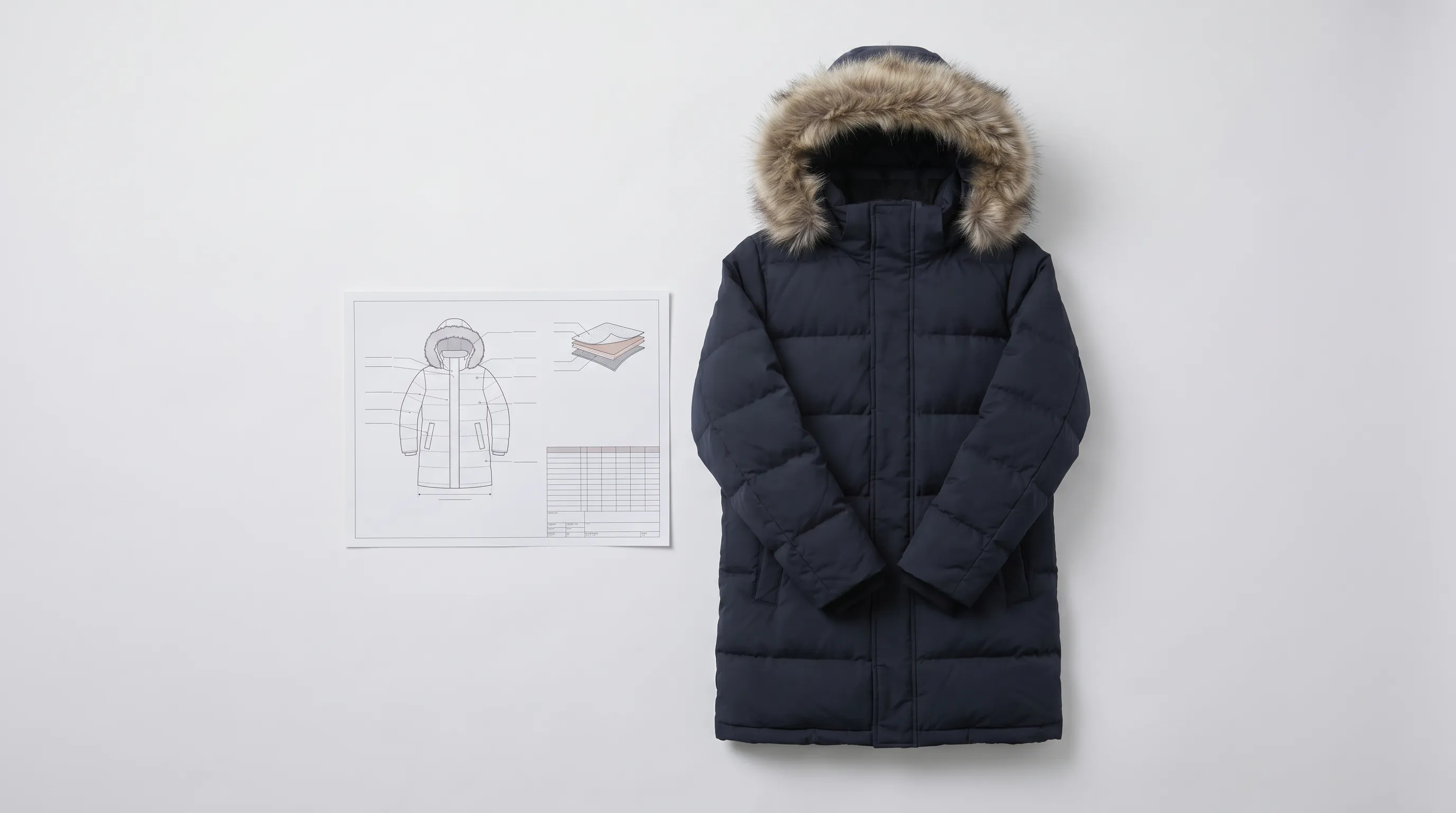
What goes in an outerwear tech pack
An outerwear tech pack is the manufacturing blueprint for an insulated, weather-resistant garment — a puffer, a parka, an insulated coat, a winter shell. It carries the standard backbone (flat sketch, BOM, graded points of measure, construction notes, colorways), but unlike a t-shirt or a jacket, outerwear is built in three layers — shell, insulation, and lining — and every section has to account for the stack.
The fabric line is really three lines: a shell (often a coated or laminated nylon/polyester with a water-resistance rating and a DWR finish), an insulation layer, and a lining. The insulation callout is the section a single-layer pack never has: for down it states fill power (typically 600–800) and fill weight in grams, with a downproof shell; for synthetic it states the insulation brand and gram weight (40–200 GSM). The construction section adds quilting pattern and baffle type, seam-sealing tape, heavy two-way separating zippers, storm flaps, and collar and hood callouts. Get any of these wrong and the factory loses loft, leaks at the seams, or sews a zipper that can't carry the load — and you pay for another sample round at $200–$1,500.
Outerwear tech pack: what each section needs
| Section | What outerwear demands |
|---|---|
| Shell fabric | Coated/laminated nylon or polyester with a water-resistance rating (10,000mm hydrostatic head for moderate rain, 20,000mm+ for heavy), DWR finish, and a downproof rating where down is used |
| Lining | Lining fabric and weight; cut slightly fuller than the shell (typically +0.25" to +0.5") so the layers don't bind through range of motion |
| Insulation — down | Fill power (commonly 600–800: 1oz of 800-fill lofts to 800 cubic inches) and fill weight in grams per panel; downproof shell to prevent feather migration |
| Insulation — synthetic | Insulation brand and gram weight in GSM (40g lighter/warmer-weather up to 200g for deep cold); even distribution and loft after wash noted |
| Quilting & baffles | Quilt pattern (horizontal channels 5–10cm, box, or diamond), stitch-through vs internal baffle/box-baffle construction to kill cold spots, stitch type (lockstitch/chainstitch) |
| Seam sealing | Fully taped vs critically taped (neck, shoulders, front zip only); tape width 20–22mm; application method, on waterproof styles |
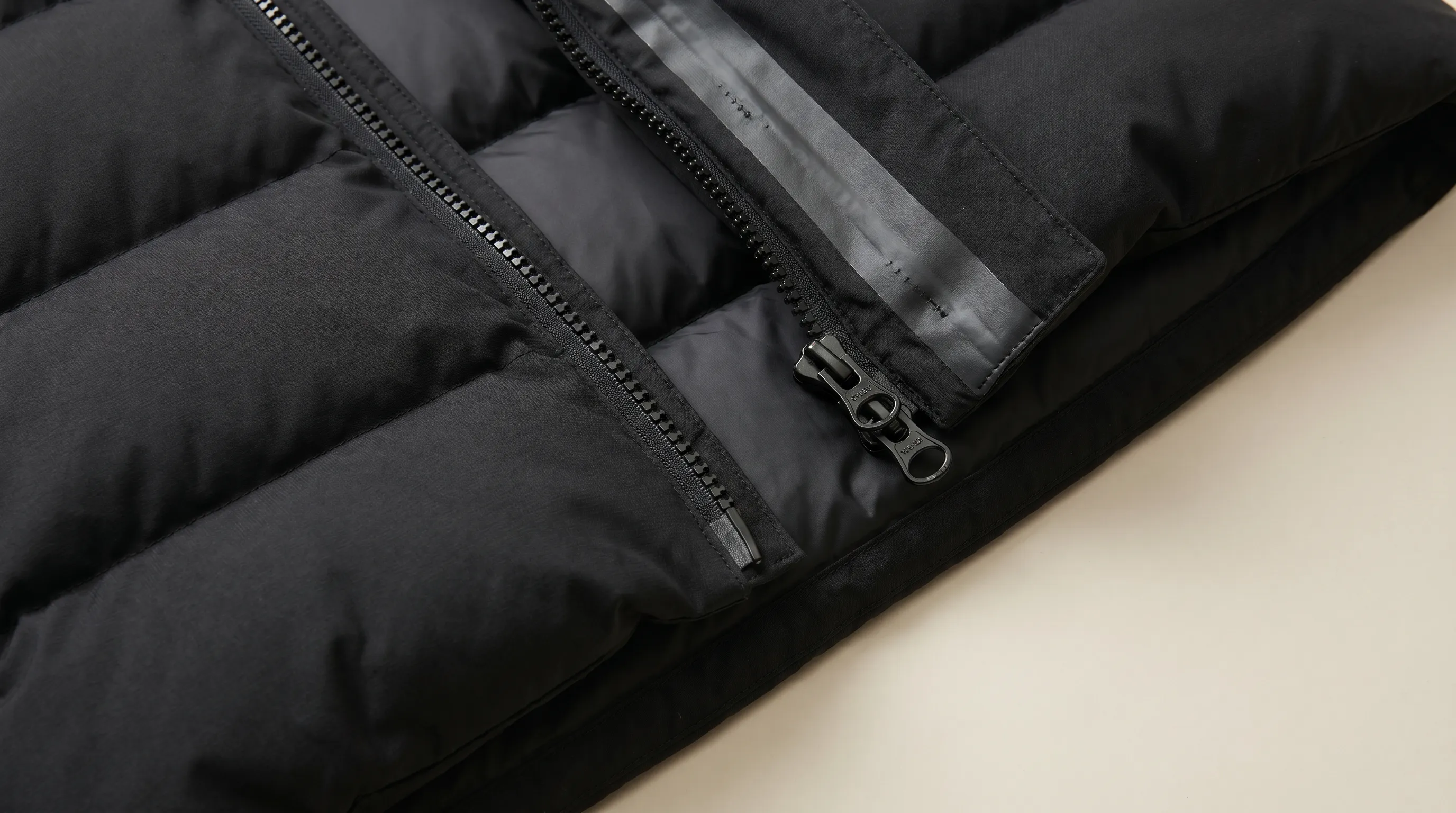
| Closures | Two-way separating zipper (coil vs molded Vislon, #5–#10), water-resistant/AquaGuard zips, storm flap (single/double), snaps, drawcords, zipper garage and chin guard |
| Collar & hood | Collar type (stand/funnel/fur trim), hood construction (fixed/detachable/stowable), brim wire, adjusters, and drawcord/cordlock callouts |
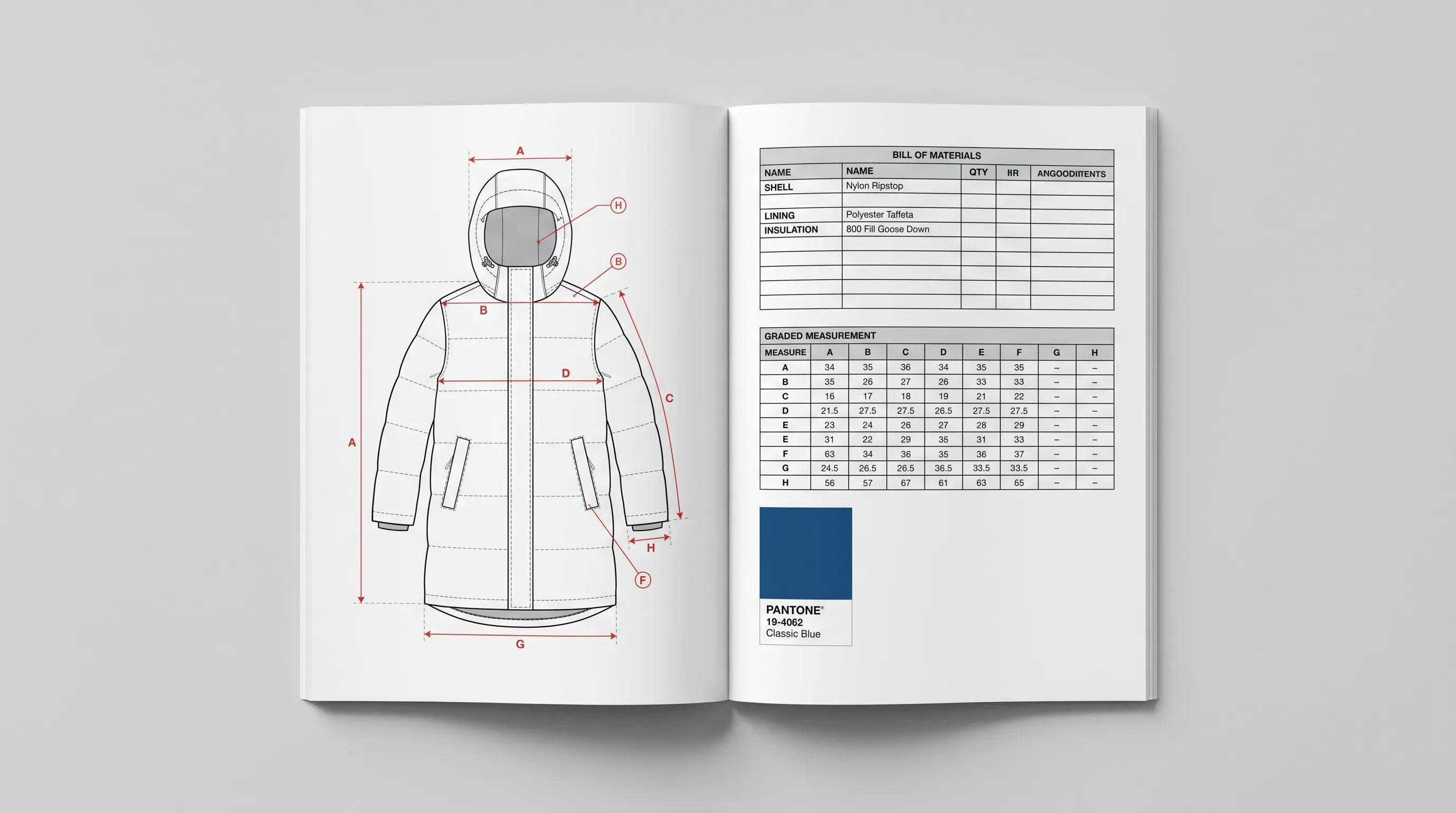
| Measurements & POMs | Chest, center-back length, sleeve length from CB, across-shoulder, sweep/hem, cuff, hood height/width — measured over the lofted, layered garment, not flat fabric |
| Testing | Water-resistance (AATCC 127 / ASTM D751 hydrostatic head), spray-rating DWR (AATCC 22), seam strength (ASTM D1683); reference what the garment must pass |
Water-resistance per AATCC 127 / ASTM D751; spray rating per AATCC 22; sewn-seam strength per ASTM D1683. Fill-power scale and tape widths per outerwear-manufacturing practice (evo, YKK).
Worked example
One insulation line, written correctly
Weak spec: "warm padded jacket." Factory-ready spec: "Body insulation: 700 fill-power RDS-certified white duck down, 120g fill weight in horizontal-channel baffles (8cm), box-baffle construction at chest and back to eliminate cold spots; shell 20D downproof recycled nylon, DWR, 10,000mm hydrostatic head (AATCC 127), spray rating ≥80 (AATCC 22)." One block, and the factory knows the loft, the weight, the baffle method, and exactly what the garment must pass — the difference between a first sample that fits and traps heat and a $200–$1,500 discovery round. That's the level of detail the generator drafts and your review confirms.
Fill power, in one chart
Why outerwear packs differ from single-layer apparel
A single-layer pack describes one fabric and the seams that join it. Outerwear describes a system. The same garment carries a shell, an insulation layer, and a lining, and the pack has to keep all three coordinated: the lining is cut a touch fuller than the shell so the layers glide, the insulation is held in place by a quilting or baffle structure, and the grade rule has to grow the loft, not just the flat dimensions.
Warmth is spec, not adjective. Down is specified by fill power and fill weight — 1oz of 800-fill down lofts to 800 cubic inches, so an 800-fill jacket is warmer per gram than a 600-fill one. Synthetic is specified by gram weight (a 100g insulation is warmer and thicker than 60g). Weatherproofing is a measured property: hydrostatic head in millimetres (AATCC 127 / ASTM D751), a DWR spray rating (AATCC 22), and a sealing strategy — fully taped seals every seam, critically taped seals only the neck, shoulders, and front zip. And the closures carry real load: outerwear uses heavy two-way separating zippers (molded Vislon for weight-bearing parkas, water-resistant coil where a clean front is wanted), storm flaps, chin guards, and zipper garages — hardware a t-shirt template has no field for. A generic apparel template has none of these layers — which is exactly the gap a class-aware generator closes.
Generate an outerwear pack in 3 steps
- 1
Upload one photo
Flat-lay of your sample parka or puffer, mannequin shot, or clean mockup. The AI detects the outerwear sub-class — down puffer, synthetic-fill coat, parka, insulated shell — and the layered construction it implies. - 2
Review the layered draft
In 3–5 minutes you get the flat sketch, a BOM pre-populated with shell, lining, insulation, tape, and zipper component lines, graded POMs over the lofted garment, and quilting, baffle, seam-sealing, and closure callouts. Spend 10–15 minutes entering your mill's exact fill power and weight, shell denier and hydrostatic rating, and the measurements off your sample. - 3
Export and send
Print-ready PDF (Excel/CSV on Pro) to your factory. Total cost $3–6 — versus $150–$500 and 3–7 days for a freelance technical designer, per published rate surveys.
Built for outerwear and cold-weather founders
This is for the founder launching a puffer, parka, or insulated-coat line without an in-house technical designer: you've sourced a shell, chosen an insulation, sewn a sample, and need a document a factory will quote from — without $150–$500 per style in freelance fees or the 6–10 hour Illustrator grind. It fits outdoor and technical brands specifying fill power and hydrostatic ratings, production leads cutting first-sample revision rounds on complex layered builds, and Shopify outerwear stores moving from blanks to true cut-and-sew (where MOQ math and GSM on the shell suddenly matter).
Adstronaut writes the three-layer fabric spec, the down or synthetic insulation callout, the quilting and baffle construction, the seam-sealing and closure details, and the measurements taken over the lofted garment — so your factory in Vietnam, China, or Bangladesh receives an outerwear-grade pack, in minutes. Need the standard backbone first? Start with what a tech pack is and how to create one. When the samples come back, the AI Photoshoots side of the platform handles the on-model imagery the same week.
Frequently asked questions
What does an outerwear tech pack include that a regular garment pack doesn't?
A layered build. Outerwear carries a shell, an insulation layer, and a lining, so the pack has separate spec lines for each, plus callouts a single-layer pack never has: insulation type and amount, quilting and baffle construction, seam-sealing tape, heavy two-way separating zippers, storm flaps, and collar/hood construction. Measurements are taken over the lofted, layered garment rather than flat fabric.
How do you specify insulation in a tech pack?
For down, state fill power (commonly 600–800) and fill weight in grams per panel — 1oz of 800-fill down lofts to 800 cubic inches, so it's warmer per gram than 600-fill. For synthetic, state the insulation brand and gram weight in GSM (roughly 40g for cool weather up to 200g for deep cold; 100g is warmer than 60g). Both also note the quilting or baffle structure that holds the insulation in place.
What is the difference between stitch-through and baffle construction?
Stitch-through (sewn-through) quilting sews the shell, insulation, and lining together along each quilt line — simple and light, but the stitch lines compress the insulation and create cold spots. Box-baffle construction sews internal fabric strips between shell and lining to build three-dimensional chambers, letting the down loft fully and eliminating cold spots. The pack specifies which method and the channel or box dimensions.
What does fully taped vs critically taped mean?
It's the seam-sealing strategy on a waterproof style. Fully taped means every seam in the garment is sealed with waterproof tape (typically 20–22mm wide). Critically taped seals only the most exposed seams — usually the neck, shoulders, and front zipper. Fully taped is more waterproof and more expensive; critically taped saves cost on garments that don't face sustained rain. The pack names which one and the tape width.
What zippers and closures does outerwear need in the pack?
Most coats and parkas use a two-way separating zipper so the hem can open for sitting and movement. The pack calls out the zipper type — molded Vislon for heavy weight-bearing fronts, water-resistant coil or AquaGuard for a clean, flap-free front — plus the gauge (often #5–#10), storm flap (single or double), chin guard, zipper garage, snaps, and any drawcords and cordlocks.
What water-resistance tests should the pack reference?
Hydrostatic head (AATCC 127 or ASTM D751) measures how much water pressure the shell holds before leaking, in millimetres — around 10,000mm handles moderate rain and 20,000mm+ handles heavy rain. The DWR finish is checked with the AATCC 22 spray test, where 100 means no wetting and below 70 means significant wetting. Seam strength is checked with ASTM D1683. Referencing the standards tells the factory and lab exactly what the garment must pass.
How are outerwear measurements different from a t-shirt's?
They're taken over the lofted, layered garment, not flat fabric, so the loft is captured in the dimension. Key outerwear POMs include chest, center-back length, sleeve length from center back, across-shoulder, sweep/hem, cuff opening, and hood height and width. The grade rule has to grow the layered, insulated body — grading it like a flat single layer leaves the size run fitting wrong.
How long does generating an outerwear pack take?
3–5 minutes for the draft — flat sketch, layered BOM, graded measurements, and quilting/closure callouts — then 10–15 minutes of review to enter your mill's exact fill power and weight, shell denier and hydrostatic rating, tape width, and sample measurements. Under 30 minutes end to end, versus 3–7 days for a freelance turnaround.
How much does an outerwear tech pack cost?
$3–6 with Adstronaut (25 credits; plans from $29/month; first pack free as a watermarked preview). Freelance technical designers charge $150–$500 per style at 3–7 day turnarounds, so a 20-style outerwear collection runs $60–$120 in credits versus $3,000–$10,000 freelance.
Does it handle parkas, puffers, and synthetic-fill coats too?
Yes — the sub-class drives the sections. Down puffers add fill power, fill weight, and baffle construction; synthetic-fill coats add insulation brand and GSM; parkas add longer body length, fur-trim or storm hoods, and multiple cargo pockets; rain shells emphasize hydrostatic rating, seam sealing, and waterproof zips. Each gets the appropriate layered, weatherproofing, and measurement treatment rather than a one-size template.
Generate your outerwear tech pack
Upload one photo of your puffer, parka, or insulated coat. Get the three-layer fabric spec, fill power and weight, baffle and quilting callouts, seam-sealing and closure details, and measurements over the lofted garment in minutes. First pack free, then $3–6.
Try the AI Tech Pack GeneratorKeep going
Sources and further reading
- evo — outerwear fabric, features & construction guide — shell water-resistance ratings, fill power 500–800, fully vs critically taped seams, 20–22mm tape
- REI — what is down fill power — fill power = cubic inches of loft per ounce; 600 mid-range vs 800 premium
- YKK Americas — water-resistant & waterproof zippers — two-way separating, Vislon vs coil, AquaGuard removing the need for storm flaps
- AATCC test methods (TM127, TM22) — TM127 hydrostatic pressure; TM22 spray rating 100 = no wetting, <70 = significant wetting
- ASTM D751 — coated fabrics hydrostatic resistance — hydrostatic head test method for waterproof outerwear shells
- Successful Fashion Designer — freelance rates — $150–$500 per style; 3–7 day turnaround