How to make a factory-ready tech pack for loungewear and sleepwear
Updated June 10, 2026
A loungewear tech pack specifies a soft knit (French terry 220–330 GSM, or modal/cotton jersey at 120–180 GSM for sleepwear), elastic and drawcord waistband construction, ribbed cuff and trim callouts, generous relaxed-fit tolerances, top-and-bottom set coordination, and US care-label and sleepwear-flammability references. Adstronaut AI drafts all of it — flat sketch, BOM, graded measurements, construction notes — from one garment photo in minutes for $3–6 per pack.
What goes in a loungewear tech pack
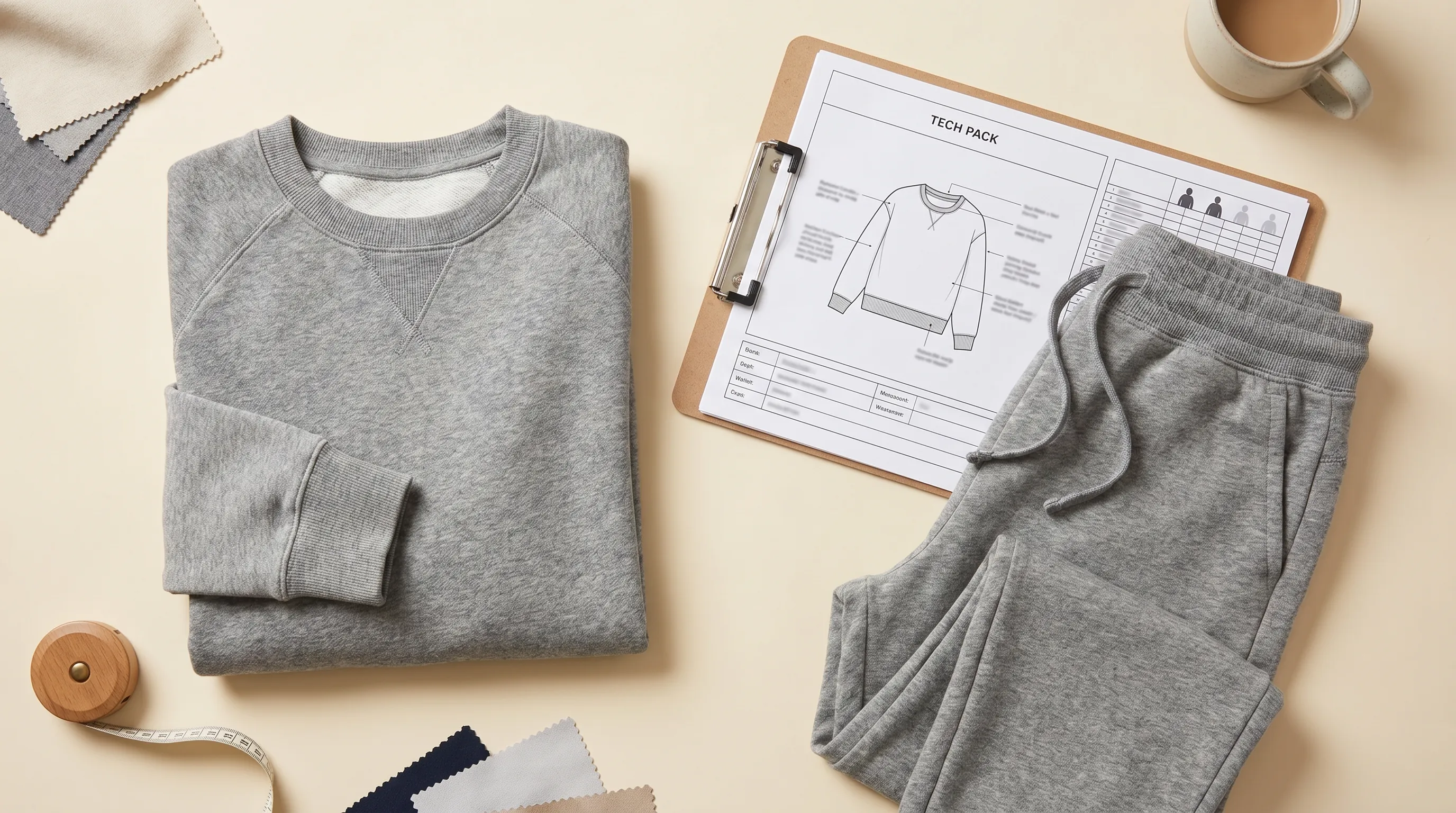
A loungewear tech pack is the manufacturing blueprint for a soft, relaxed-fit knit set — French terry sweatshirts and joggers, modal pajama tops and pants, jersey lounge dresses, robes, and shorts. It carries the standard backbone (flat sketch, BOM, graded points of measure, construction notes, colorways), but every section is tuned for soft hand-feel, drape, and a deliberately easy fit rather than performance or tailoring.
The fabric line specifies a soft knit — most commonly French terry at 220–330 GSM for sweatshirt-weight loungewear, or modal, cotton, or modal-cotton jersey at roughly 120–180 GSM for lightweight sleepwear, with hand-feel, drape, and shrinkage behavior noted. The construction section names the details that define comfort: elastic and drawcord waistbands, ribbed cuffs and trims, and coverstitched hems. Add relaxed-fit tolerances, top-and-bottom set coordination, and — for anything that reads as sleepwear — US care-label and flammability references. Get any of these wrong and the factory runs a too-firm elastic, a wrong-gauge rib, or a fit that reads tailored instead of cozy — and you pay for another sample round at $150–$1,500.
Loungewear tech pack: what each section needs
| Section | What loungewear demands |
|---|---|
| Fabric & composition | Soft knit: French terry 220–330 GSM (sweatshirts, joggers) or modal/cotton jersey 120–180 GSM (sleepwear); fiber split, hand-feel, drape, and shrinkage noted per fabric |
| Knit structure & finish | French terry loop-back face vs brushed/fleece back; single jersey vs interlock; enzyme-wash or peach-finish softening; modal or modal-cotton blend for drape |
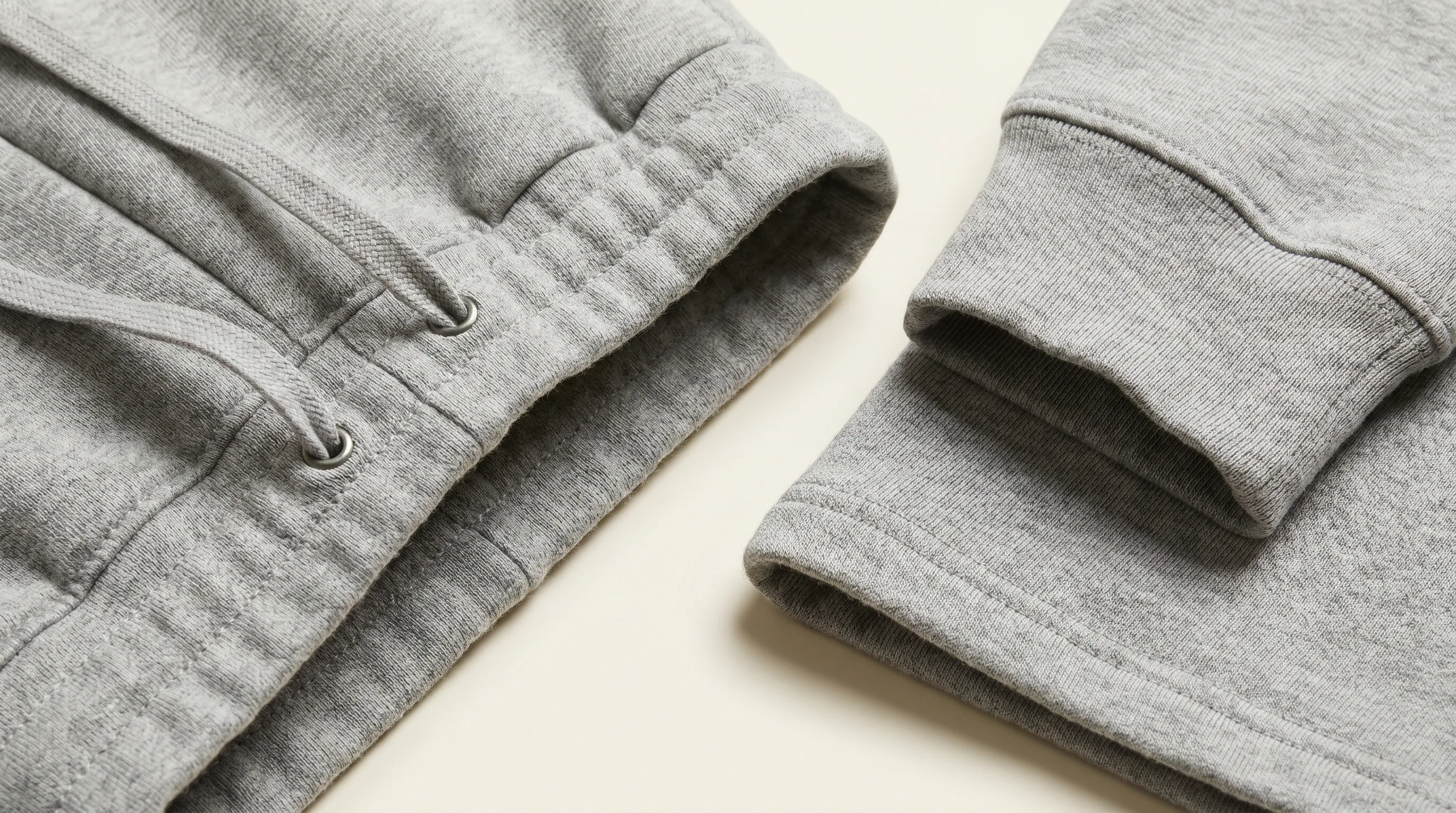
| Waistband & closure | Elastic type and width (encased vs exposed), drawcord with grommet or buttonhole exit, mock-fly, stretch-to-fit ratio for the relaxed waist opening |
| Ribbed trims | Rib gauge (e.g. 1x1 or 2x2), cuff, hem, neckband and waistband rib width, recovery and stretch ratio; self-fabric vs contrast rib callout |
| Seam & stitch | Overlock (ISO 514) to close knit seams; coverstitch (ISO 602/605) on hems, cuffs, and necklines at ~10–14 SPI; ballpoint needles and texturized thread for knits |
| Fit & tolerance | Relaxed/oversized block; wider grading tolerance than tailored woven (often ±1/2 in vs ±1/4 in on key POMs); drop-shoulder and easy-rise callouts |
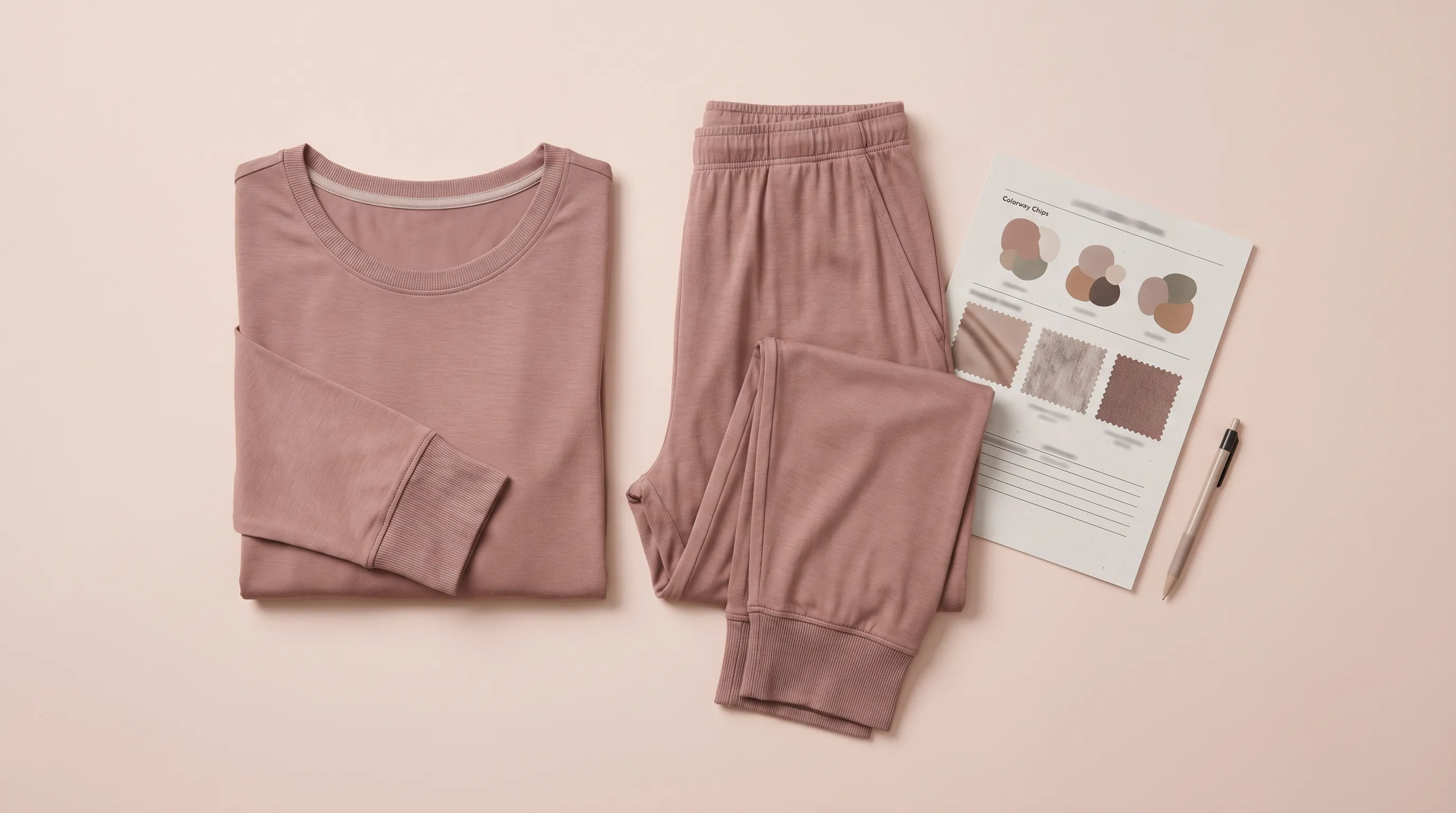
| Set coordination | Top + bottom matched: shared fabric lot, colorway, rib, and Pantone; consistent waistband and cuff treatment so the set reads as one |
| BOM | Shell knit, rib trim, elastic, drawcord, grommets/aglets, labels, care/content label, thread — typically 10–20 line items |
| Labeling & compliance | FTC care label (16 CFR 423) + fiber content; sleepwear adds CPSC flammability (16 CFR 1615/1616) for children's sizes 0–14 |
Stitch classes per ISO 514/602/605; care labeling per FTC 16 CFR 423; children's sleepwear flammability per CPSC 16 CFR 1615/1616.
Worked example
One jogger fabric line, written correctly
Weak spec: "soft grey sweatpants fabric." Factory-ready spec: "Body: 60% cotton / 40% modal French terry, loop-back face, 280 GSM, enzyme-washed for hand; max 5% shrinkage after 3 home washes; 2x2 self-fabric rib at cuff and waistband; 1.25 in encased elastic waistband with flat drawcord through metal grommets; Pantone 17-3905 TCX." One line, nine decisions the factory no longer guesses — and the difference between a first sample that feels right and a $150–$1,500 discovery round. That's the level of specificity the generator drafts and your review confirms.
Why loungewear packs differ from tailored or performance apparel
Loungewear lives between a structured woven and a high-performance knit, and the spec reflects that. Hand-feel is the headline: French terry runs 220–330 GSM for sweatshirt-weight pieces, while sleepwear modal and cotton jersey sit lighter at 120–180 GSM for drape and breathability — so the pack states GSM, knit structure (loop-back terry vs single jersey vs interlock), and any softening finish, because those choices, not stretch percentages, define the product.
Fit is intentionally easy: relaxed and oversized blocks use wider grading tolerances than a tailored garment — often around ±1/2 inch on key points of measure versus ±1/4 inch on a fitted woven — so the grade-rule logic is applied against a generous, drape-forward block. Sets must coordinate: a top and bottom sold together share one fabric lot, colorway, rib, and waistband treatment, and the pack ties both pieces to the same Pantone and trim BOM so they read as a single set. And sleepwear carries compliance fields a generic template ignores: every garment needs an FTC care label and fiber content (16 CFR 423), and US children's sleepwear in sizes 0–14 must reference CPSC flammability standards (16 CFR 1615/1616) — exactly the kind of class-aware field a one-size apparel template leaves blank. That gap is what a class-aware generator closes.
Generate a loungewear pack in 3 steps
- 1
Upload one photo
Flat-lay of your sample sweatshirt, joggers, or pajama set, a mannequin shot, or a clean mockup. The AI detects the loungewear sub-class — sweatshirt, jogger, lounge pant, robe, sleep set — and the soft-knit construction it implies. - 2
Review the comfort-specific draft
In 3–5 minutes you get the flat sketch, BOM pre-populated with soft-knit, rib-trim, elastic, and drawcord components, relaxed-fit graded POMs, and coverstitch and waistband callouts. Spend 10–15 minutes entering your mill's exact French terry or modal GSM, fiber split, elastic width, and the relaxed measurements off your sample. - 3
Export and send
Print-ready PDF (Excel/CSV on Pro) to your factory. Total cost $3–6 — versus $150–$500 and 3–7 days for a freelance technical designer, per published rate surveys.
Built for loungewear and sleepwear founders
This is for the founder launching a French terry lounge set, a modal pajama line, or a cozy robe collection without an in-house technical designer: you've sourced a soft knit, sewn a sample, and need a document a factory will quote from — without $150–$500 per style in freelance fees or the 6–10 hour Illustrator grind. It fits comfort and athleisure brands scaling 10–30 SKU drops, DTC sleepwear labels coordinating top-and-bottom sets across a size run, and Shopify stores graduating from blanks-and-print to cut-and-sew (where MOQ math and CMT pricing suddenly matter).
Adstronaut writes the soft-knit composition, rib-trim and elastic-drawcord waistband callouts, relaxed-fit tolerances, and set-coordination notes — so your factory in Tiruppur, Vietnam, or Portugal receives a loungewear-grade pack, in minutes. If your samples keep coming back wrong, the too-many-sampling-rounds workflow shows how the spec quality drops revision rounds; and when the set is approved, the AI Photoshoots side of the platform handles the on-model imagery the same week.
Frequently asked questions
What fabric and GSM should a loungewear tech pack specify?
For sweatshirt-weight loungewear, French terry typically runs 220–330 GSM (lighter tops around 180–240 GSM, joggers 260–320 GSM). For sleepwear and lightweight pajamas, modal, cotton, or modal-cotton jersey usually sits at 120–180 GSM for drape and breathability. The pack states the fiber split, exact GSM, knit structure (loop-back terry vs single jersey vs interlock), and any softening finish like enzyme or peach wash.
How is a loungewear tech pack different from an activewear one?
Loungewear prioritizes soft hand-feel, drape, and an easy relaxed fit rather than four-way stretch and compression. It leads with GSM and knit structure (French terry, modal jersey) instead of high elastane percentages, uses elastic and drawcord waistbands and ribbed trims, applies wider grading tolerances, and adds set-coordination and sleepwear care/flammability fields that a performance template never carries.
How should the pack spec a loungewear waistband?
Call out the elastic type and width (commonly 1–1.5 in, encased vs exposed), the construction (encased channel vs attached), and whether there's a drawcord with grommet, buttonhole, or eyelet exit. State the relaxed stretch-to-fit ratio of the waist opening so the factory cuts the channel and elastic length correctly rather than guessing the tension.
What ribbed trims need to be specified for loungewear?
Rib appears at cuffs, hems, necklines, and waistbands. The pack states the rib gauge (typically 1x1 or 2x2), the trim width, whether it's self-fabric or contrast, and the rib's stretch and recovery so cuffs and waistbands hold shape after washing. Matching the rib across a top-and-bottom set keeps the pieces reading as one coordinated product.
How do tolerances differ for relaxed-fit loungewear?
Relaxed and oversized loungewear typically uses wider points-of-measure tolerances than a tailored garment — often around ±1/2 inch on key measurements versus roughly ±1/4 inch on a fitted woven. The grade rule is applied against a generous, drape-forward block, and the pack notes drop-shoulder and easy-rise allowances so the fit reads cozy rather than ill-fitting.
How does the pack handle a matching top-and-bottom set?
Set coordination means both pieces share a fabric lot, colorway, rib, and waistband or cuff treatment, and the pack ties each piece to the same Pantone TCX and trim BOM. Documenting the shared fabric and trim prevents the common failure where a top and bottom return in slightly different shades or rib gauges and no longer read as one set.
Does loungewear need flammability or care-label compliance?
All US apparel needs an FTC care label and fiber content (16 CFR 423). Sleepwear is stricter: US children's sleepwear in sizes 0 through 14 must reference CPSC flammability standards — 16 CFR 1615 for sizes 0–6X and 16 CFR 1616 for sizes 7–14 — with tight-fitting and infant-garment exceptions. The pack should flag these as compliance line items so the factory and lab know what the garment must pass and label.
How long does generating a loungewear pack take?
3–5 minutes for the draft — flat sketch, BOM, relaxed-fit graded measurements, construction callouts — then 10–15 minutes of review to enter your mill's exact French terry or modal GSM and fiber split, elastic and drawcord widths, rib gauge, and sample measurements. Under 30 minutes end to end, versus 3–7 days for a freelance technical designer.
How much does a loungewear tech pack cost?
$3–6 with Adstronaut (25 credits; plans from $29/month; first pack free as a watermarked preview). Freelance technical designers charge $150–$500 per style at 3–7 day turnarounds, so a 20-style loungewear collection runs roughly $60–$120 in credits versus $3,000–$10,000 freelance.
Does it handle robes, sleep sets, and lounge dresses too?
Yes — the sub-class drives the sections. Robe packs add belt, tie, and shawl-collar construction; sleep-set packs coordinate the top and bottom with shared fabric, rib, and care/flammability fields; lounge dresses and shorts get the appropriate jersey GSM, hem, and elastic treatment. Each gets soft-knit, rib, and relaxed-fit handling rather than a one-size template.
Generate your loungewear tech pack
Upload one photo of your sweatshirt, joggers, pajama set, or robe. Get the soft-knit fabric spec, elastic and drawcord waistband callouts, ribbed-trim details, relaxed-fit measurements, and set-coordination notes in minutes. First pack free, then $3–6.
Try the AI Tech Pack GeneratorKeep going
Sources and further reading
- French Terry Fabric Guide — GSM by use — French terry 220–330 GSM; joggers 260–320, lighter tops 180–240
- Best Fabric for Sleepwear — modal and cotton jersey sleepwear weight; ~120–180 GSM sweet spot
- eCFR 16 CFR Part 1615 — children's sleepwear flammability (sizes 0–6X) — CPSC flammability standard; loungewear/sleepwear scope and exceptions
- CPSC — Children's Sleepwear FAQ — 16 CFR 1615 (0–6X) and 1616 (7–14); tight-fitting/infant exceptions
- eCFR 16 CFR Part 423 — FTC Care Labeling Rule — permanent care label and instructions required on textile apparel
- Successful Fashion Designer — freelance rates — $150–$500 per style; 3–7 day turnaround